South Carolina Passenger Rules for Minors
South Carolina’s passenger rules for minors depend on what they are riding, who is driving, and whether the machine is built to carry a passenger. A child’s age alone does not make a ride safe or legal. Here’s how to separate the rules for off-road ATVs from those for street-legal UTVs, and what to check before anyone climbs aboard.
The core passenger rule for off-road ATVs
An ATV is not automatically a two-person vehicle just because a child can fit on it. For an off-road ATV, South Carolina’s rule focuses on the machine’s design: a minor under 16 may not operate an ATV with a passenger unless the manufacturer designed that ATV to carry a passenger. The passenger must also be at least 6 years old.
That means a child cannot legally ride as a passenger on a single-rider ATV simply by sitting behind the operator or holding on. A longer seat, a backrest, or a cargo rack does not by itself establish that the ATV is designed for two people. Check the owner’s manual and the manufacturer’s passenger instructions for the specific model.
The age threshold concerns the operator as well as the passenger. A minor operating a properly designed two-up ATV still has to meet the rules that apply to young riders, including any applicable safety-course, supervision, helmet, and eye-protection requirements. Passenger permission does not cancel those separate obligations. See South Carolina Passenger Rules Under 16 and South Carolina Adult Accompaniment at 16 and Under for those related requirements.
| Situation | Practical rule to apply |
|---|---|
| A minor under 16 is driving an off-road ATV alone | Follow the rules for the rider’s age, training, supervision, and protective equipment. |
| A minor under 16 wants to carry a passenger | The ATV must be designed by its manufacturer to carry a passenger, and the passenger must be at least 6. |
| The ATV is designed for one rider | Do not carry a passenger, even for a short trip or at low speed. |
| A child younger than 6 is involved | Do not treat the passenger rule as permission to ride; confirm the specific law and machine instructions before planning a ride. |
| A child is riding in a street-legal UTV | Check the separate road-use rules, seating, restraint, and passenger-age requirements. |
The rule is about a vehicle designed for a passenger, not about the operator’s confidence or the passenger’s size. A small child may be especially vulnerable to being thrown off balance when an ATV turns, accelerates, or crosses a rut. If the machine has a designated passenger seat and manufacturer-approved handholds or footrests, use them as directed. Do not improvise a passenger position on the rear rack.
A passenger also changes how the ATV handles. Extra weight can affect braking, steering, stability, and the machine’s response on slopes. Follow the manufacturer’s passenger and load limits, and do not assume a two-person design makes every trail, speed, or maneuver appropriate for a child.
For more on the broader rules that apply to young operators, see South Carolina ATV Age Requirements and South Carolina Safety Certificate Requirements. Passenger permission is only one part of deciding whether a minor may ride.
Check the machine before deciding who can ride
The most useful first question is not “How old is the passenger?” It is “What does the manufacturer say this exact machine is designed to carry?” Many ATVs are single-rider machines. Some are designed for two people, with a separate passenger seat and equipment intended to help the passenger stay positioned.
Look in the owner’s manual, the vehicle’s labels, and the model information supplied by the manufacturer. If those materials identify the ATV as a single-rider machine, treat it as one. Do not rely on another owner’s setup, an accessory seller’s description, or the fact that a passenger has ridden there before.
Before a minor rides on a two-up ATV, check that:
- The manufacturer identifies the machine as designed to carry a passenger.
- There is a separate, appropriate passenger seating position.
- The passenger can reach and use the intended handholds and footrests.
- The passenger’s weight falls within the manufacturer’s limits.
- The operator and passenger can wear the required protective equipment.
- The operator can control the ATV with the passenger aboard.
- The route and riding conditions are suitable for the least experienced person.
If a passenger cannot sit securely, reach the intended footrests, or hold the appropriate grips, that is a practical reason not to ride together even if the ATV is designed for two. A child sliding around or leaning unpredictably can make the machine harder to control.
Do not use a cargo rack as a passenger seat
A cargo rack is for carrying cargo within the machine’s limits. It is not a passenger seat. A child perched on a rack may have no secure seating position, no suitable handholds, and no reliable way to keep their feet clear of moving or hot parts. A strap or added cushion does not turn cargo space into a manufacturer-approved passenger location.
The same caution applies to homemade seat extensions and modifications. An aftermarket part should not be assumed to make a single-rider ATV legal for passengers. Check what the manufacturer allows and whether the modification changes the machine’s passenger capacity or safe use.
Match the rider to the machine and conditions
A youth-sized ATV and a full-sized ATV can have very different controls, power, and weight. A child who can reach the controls on a parked machine may not be able to operate it safely on uneven ground. Adding a passenger can make it more demanding still.
Consider the whole ride, not just the departure. A short driveway loop differs from a wooded trail with turns, changing grades, mud, or other riders. If the operator is learning, is tired, or is unsure how the machine behaves with a passenger, ride separately or choose a different activity.
A helmet and eye protection remain important for young riders. The equipment needs to fit the person wearing it and be appropriate for the activity; a helmet that shifts, blocks vision, or does not stay fastened is not doing its job. If shopping on Amazon or another retailer, check the helmet’s certification, fit, and return options rather than choosing by appearance alone. See South Carolina Helmet Rules for Young Riders for the state-specific protective-equipment requirements.
A passenger’s age does not replace supervision or training rules
South Carolina has separate requirements for young ATV operators. A minor who is permitted to operate an ATV does not automatically qualify to carry a passenger. The passenger rule, operator age, safety training, supervision, and protective equipment should be treated as separate checks.
For example, meeting the passenger rule does not waive an applicable safety-certificate requirement. Nor does having an adult somewhere nearby necessarily meet an accompaniment rule that applies to the particular rider or riding situation. Check the rules that apply to the operator’s age and the land where the ride will take place. South Carolina Rules for a Child Passenger and South Carolina Rules for a 15-Year-Old Rider cover related questions.
The passenger also needs to understand their part in the ride. A child should be able to follow instructions to remain seated, keep feet on the footrests, use handholds, and avoid sudden movements. An operator should not expect a young passenger to know when to shift their weight or how to respond to a turn without being told.
Before setting off, explain in simple terms:
- Where the passenger should sit and what they should hold.
- That feet stay on the footrests and hands stay away from moving parts.
- That the passenger should not lean, stand, or change seats while the ATV is moving.
- How to signal that they want the operator to stop.
- That the passenger should speak up if they feel uncomfortable or cannot hold on.
If the passenger is too young to understand and follow those directions, postpone the ride. Legal minimums do not guarantee that a particular child is ready for a particular machine or route.
Public trails add another layer
A state passenger rule does not guarantee that every trail allows every type of ATV or every riding arrangement. A trail may have limits based on vehicle type, width, season, or local operating conditions. Forest access requirements and private riding-area rules can also add conditions for riders and vehicles.
Before hauling to a trail, confirm that the specific machine is allowed there and that the trail is open. Do not assume a child passenger is allowed just because the ATV itself fits through a trail gate. For public-land planning, South Carolina National Forest OHV Passes explains the separate pass issue, while South Carolina Trails That Allow Side-by-Sides helps distinguish routes for different machines.
On private property, the landowner’s permission and site rules still matter. A property owner can set stricter conditions than the general state minimum, including limits on passengers, ages, supervision, speed, or where machines may be ridden. A family’s own land does not make a single-rider machine safe to carry two people.
Street-legal UTVs use a different passenger framework
Do not apply the ATV rule automatically to a UTV intended for road use. A street-legal UTV is governed by a separate set of requirements, and its passenger rules are tied to the vehicle’s seating, restraints, and road-use eligibility. A machine being called a “side-by-side” by its owner or seller does not answer which legal category applies.
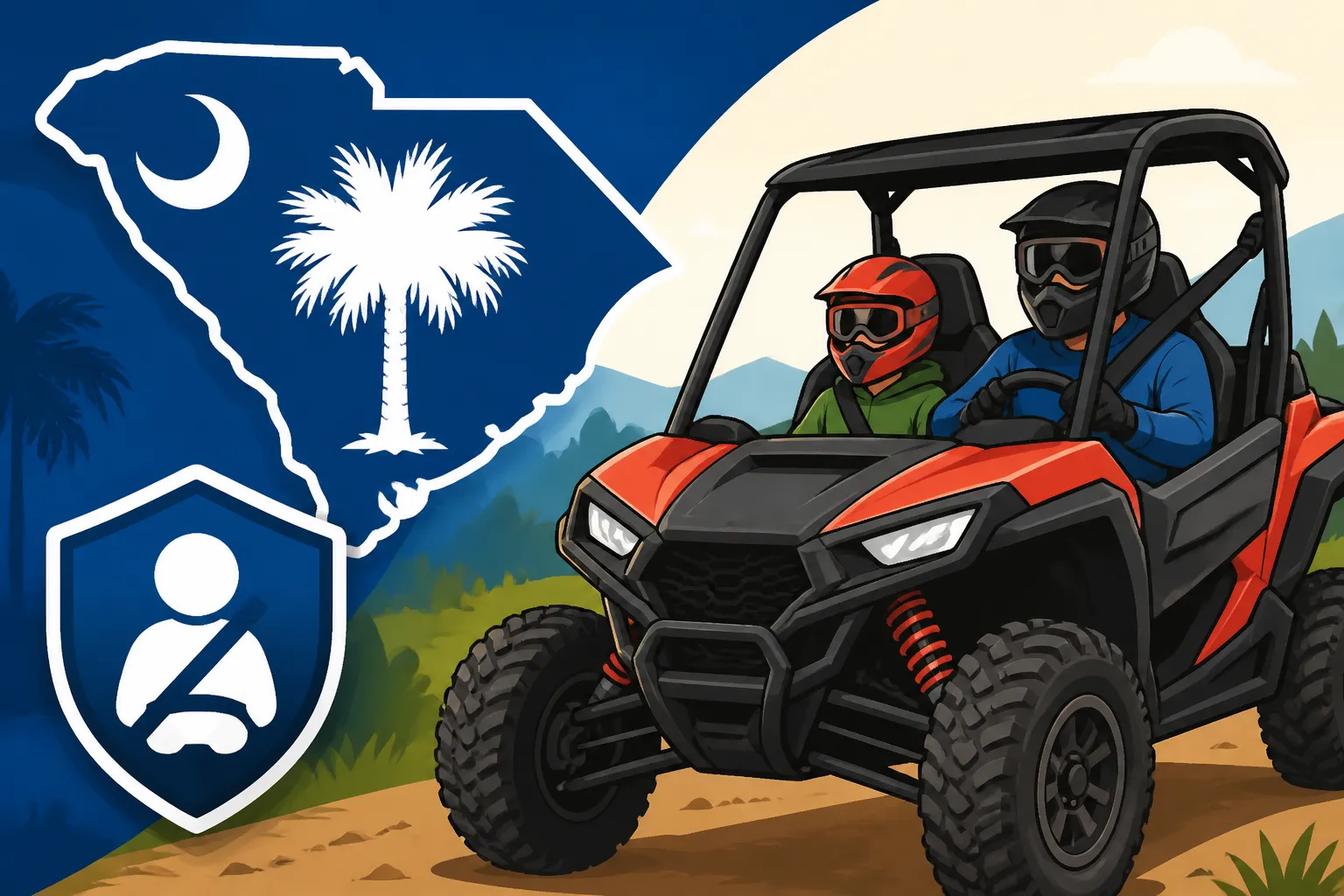
For a UTV being used on public roads under South Carolina’s street-UTV framework, check the passenger-age limit, required seating positions, seat-belt use, helmet requirements, and any rules for young drivers. The street-UTV passenger age restriction is separate from the off-road ATV rule; in particular, the street-UTV provisions address passengers eight and younger. Confirm how those requirements apply to the vehicle and the trip before carrying a child on a road.
A UTV’s extra seats do not mean every seat can be used by every passenger in every situation. Follow the manufacturer’s seating capacity, use the vehicle’s designated seats and restraints, and do not carry a passenger in the cargo bed. A child should be properly positioned and restrained as required by the vehicle and the applicable law.
Road-use status matters, too. A machine that is legal on a trail or private property is not automatically legal on a public road. Registration, insurance, equipment, driver eligibility, and roadway restrictions are separate from the passenger question. The rules for ATV trail use and street-legal UTV operation should not be blended. See South Carolina Street UTV Passenger Age Limits, South Carolina Street UTV Helmet Rules Under 21, and South Carolina Street UTV Rules From November 2026 for the road-use requirements.
If the machine is not properly eligible for public-road operation, carrying a child on a road does not become lawful because the UTV has seat belts or a roll cage. Verify the machine’s status and the route before leaving private land.
A practical pre-ride check for families
When a minor will ride as a passenger, use a short checklist rather than making the decision at the trailhead. It helps catch the common mistake of focusing on the child’s age while overlooking the ATV’s design or the rules for the operator.
- Identify the machine. Is it an off-road ATV, a UTV, or a street-legal UTV? Do not rely only on the seller’s label.
- Check the manufacturer’s passenger instructions. Confirm the model is designed to carry a passenger and use its intended seat.
- Check the ages involved. Apply the operator-age rules and the passenger-age rules separately.
- Confirm training and supervision. Check whether the young operator needs a safety certificate or adult accompaniment in the specific setting.
- Fit protective gear. Make sure the operator and passenger have appropriate, correctly fitting equipment.
- Inspect the riding area. Confirm trail access, vehicle restrictions, closures, and any park or landowner requirements.
- Choose a suitable route. Start with conditions the operator can manage safely with another person aboard.
- Agree on a stop signal. The passenger should be able to tell the operator to stop without waiting for a problem to become serious.
If any part of the answer is uncertain, do not solve it by carrying the child anyway and hoping the setup is acceptable. Check the machine manual, the applicable state requirements, and the riding area’s rules first. Keep the machine’s ownership and safety paperwork accessible as well; [South Carolina Proof of Ownership on the Trail] covers a separate document question that can arise during a ride.
The safest default is straightforward: no passenger on a single-rider ATV, no child on cargo space, and no road ride until the UTV and its passengers meet the separate street-use requirements. When a machine is designed for two, the operator is qualified, the passenger meets the age rules, and the route is suitable, a family can make a more informed decision.
Frequently Asked Questions
Can a minor under 16 carry a passenger on an ATV in South Carolina?
Only if the ATV is designed by its manufacturer to carry a passenger, and the passenger is at least 6 years old. Other rules for the minor operator, including training or supervision requirements, may also apply.
Can a child ride on the back of a single-seat ATV?
No. A cargo rack or added cushion does not make a single-rider ATV a passenger machine. Use only a passenger position the manufacturer designed for that model.
Are UTV passenger rules the same as ATV passenger rules?
No. Street-legal UTVs have a separate road-use framework that addresses passenger age, seating, and restraints. Check the requirements for the specific vehicle and whether it is being used off-road or on a public road.
Does an adult being present make any passenger arrangement legal?
No. Adult supervision does not turn a single-rider ATV into a two-person vehicle or replace the passenger-age rules. Check supervision requirements separately from machine design and passenger eligibility.
Disclaimer
This article is for general informational purposes only and does not constitute professional advice. Laws, prices and regulations vary by location and change over time. Consult a qualified professional for guidance on your specific situation.