South Carolina Rules for a Child Passenger
It can be incredibly confusing to figure out the exact rules for bringing your kids along on an ATV or UTV ride in South Carolina. You want to make sure your family is safe, but the laws can feel like a tangled mess of age limits, machine types, and where you're even allowed to ride. This guide is here to untangle all that for you, explaining the specific rules for child passengers on both off-road ATVs and street-legal UTVs, so you can enjoy your adventures without a worry.
Understanding South Carolina's Core ATV Passenger Rules for Minors
Let's start with the traditional ATV, often called a quad or four-wheeler. These machines are usually designed for a single rider, and South Carolina law is pretty clear on how that impacts carrying passengers, especially children. It's a huge point of confusion for many parents, and for good reason—safety is paramount, but deciphering the legal jargon can be a headache.
The Strict "No Passenger" Rule for Young Riders
When it comes to off-road ATVs, South Carolina's Chandler's Law is quite explicit: ATVs are generally intended for one operator only. The law really emphasizes operator safety, particularly for minors. If an ATV is rated for single rider use (which most are), then carrying any passenger, let alone a child, immediately puts you at odds with the spirit, and often the letter, of the law. This rule exists for a very good reason: safety. ATVs require precise weight distribution and rider input to handle turns, bumps, and obstacles. Adding a passenger, especially a child who might shift unexpectedly, drastically alters the machine's balance and makes it much harder to control, increasing the risk of rollovers or collisions. This is especially true if the operator themselves is a minor, as the law requires specific certifications and adult supervision for riders 15 and under.
Moreover, if you have a young rider (under 16) operating the ATV, [South Carolina Passenger Rules Under 16] make it very clear that they generally cannot carry any passengers. This is a critical point that many folks overlook. The law wants to ensure that young operators are fully focused on learning and controlling their machine, not trying to manage the added challenge of a passenger. It's about minimizing risk in an activity that already carries inherent dangers.
When a Minor CAN Have a Passenger (or Be One)
So, when can a child be a passenger? This is where the distinction between ATVs and side-by-sides (UTVs) becomes absolutely crucial, and it’s a major point of confusion for many. For traditional ATVs, the answer is almost always: don't do it. If the ATV is clearly marked for a single rider by the manufacturer, carrying a child passenger is both unsafe and likely a violation. The only arguable exceptions might be on private land where specific landowner rules apply and the machine is explicitly designed to carry a passenger, but even then, the general safety advice is against it. Most ATVs are simply not built for it.
However, the landscape changes significantly when we talk about UTVs, or side-by-sides. These machines are designed with multiple seats, seatbelts, and a roll-over protection structure (ROPS), making them much safer for carrying passengers, including children. While Chandler's Law primarily targets ATVs, the rules for UTVs, especially regarding passengers, are more aligned with their multi-passenger design. If you're riding a UTV, you're usually good to go with passengers as long as they fit properly, use seatbelts, and are within any age guidelines specific to the UTV itself or the riding area. This is a key distinction that needs to be understood.
Specific Age and Supervision Requirements for Riding in South Carolina
South Carolina has put a lot of thought into keeping young riders safe, and those rules indirectly but powerfully impact when and how a child can be a passenger. It's not just about what machine they're on, but also about the age and experience of the operator, and the presence of responsible adults.
Chandler's Law: What Every Parent Needs to Know
Chandler's Law (South Carolina Code Section 50-26-50), enacted after a tragic accident, sets out clear guidelines for ATV operation by minors. For example, riders [South Carolina Safety Certificate Requirements] for those aged 6 to 15. While these rules directly address the operator of an ATV, they have a ripple effect on passenger situations. An ATV operator under the age of 16 cannot carry a passenger. Period. This is a fundamental safety measure. If you have a child riding an ATV, their focus needs to be entirely on operating that machine safely, not on managing the added weight and movement of a passenger.
Furthermore, if the operator is under 16, they must be supervised by an adult, typically 18 years or older, who is either riding with them or is close enough to directly supervise. This adult supervision is another layer of protection, ensuring that even if a child passenger were somehow present (which, again, is generally prohibited on single-rider ATVs), there's an adult there to intervene or guide. The law's intent is to create a safer environment for young riders, and that includes discouraging unsafe passenger practices. The penalties for violating these rules, such as [South Carolina Fines of $50 to $200], are designed to encourage compliance and prevent serious accidents.
The Role of Machine Design: ATVs vs. Side-by-Sides for Passengers
This is really where the rubber meets the road when it comes to child passengers. Traditional ATVs are almost universally designed as single-rider machines. They have a saddle-style seat, handlebars, and foot pegs. Their stability and handling characteristics are based on the assumption of one operator shifting their weight to control the vehicle. Adding a passenger, especially on the back of the saddle, completely throws off this dynamic. It raises the center of gravity, makes steering harder, and significantly increases the chance of a rollover, particularly on uneven terrain or during turns. Many ATV manufacturers specifically warn against carrying passengers for these very reasons.
Side-by-sides, on the other hand, are engineered from the ground up to carry multiple occupants. They have bucket seats or bench seats, seatbelts, a steering wheel, and a roll cage. Their wider stance and more stable design make them much better suited for family outings. If you're looking to take your kids along for the ride, a side-by-side is almost always the safer and legally compliant choice. For UTV owners, the aftermarket is rich with ways to enhance safety and comfort for child passengers. Companies like SuperATV offer a range of accessories, from full windshields and roofs to more secure harnesses and even specialized seating options, all designed to make the UTV experience safer and more enjoyable for everyone on board, including the youngest adventurers. This distinction is critical because it dictates not only what is legal but, more importantly, what is genuinely safe for your children.
Navigating Street-Legal UTV Passenger Rules with Kids
The legal landscape for UTVs took a significant turn in South Carolina with the introduction of street-legal registration options. This means that some UTVs, if properly equipped and registered, can now be driven on certain public roads. This new classification brings a whole new set of rules, especially concerning passengers and minors.
Street-Legal UTVs and Passenger Age Limits
As of November 2026, [South Carolina Street-Legal UTV Registration Arrives], allowing certain UTVs to operate on public roads. When a UTV is legally street-plated, it falls under a different category of regulations, more akin to other motor vehicles, though with specific UTV nuances. For starters, the operator of a street-legal UTV must be at least 17 years old and possess a valid driver's license. This means that a younger, unlicensed operator cannot drive a street-legal UTV, let alone carry a passenger.
Regarding child passengers in a street-legal UTV, while there isn't a hard "minimum age" for being a passenger, the vehicle must have enough seating capacity, and every passenger must use a seatbelt. [South Carolina Street UTV Passenger Age Limits] specify that generally, children under eight years old are prohibited from being passengers in a street-legal UTV. This rule ensures that younger children who may not be able to properly use a seatbelt or withstand the forces of a sudden stop are not put at risk. Think of it as similar to car seat guidelines, where appropriate restraints are key. This is a significant difference from off-road ATV rules, highlighting the separate legal frameworks for these machines.
Helmets, Seatbelts, and Other Safety Gear for Young Passengers
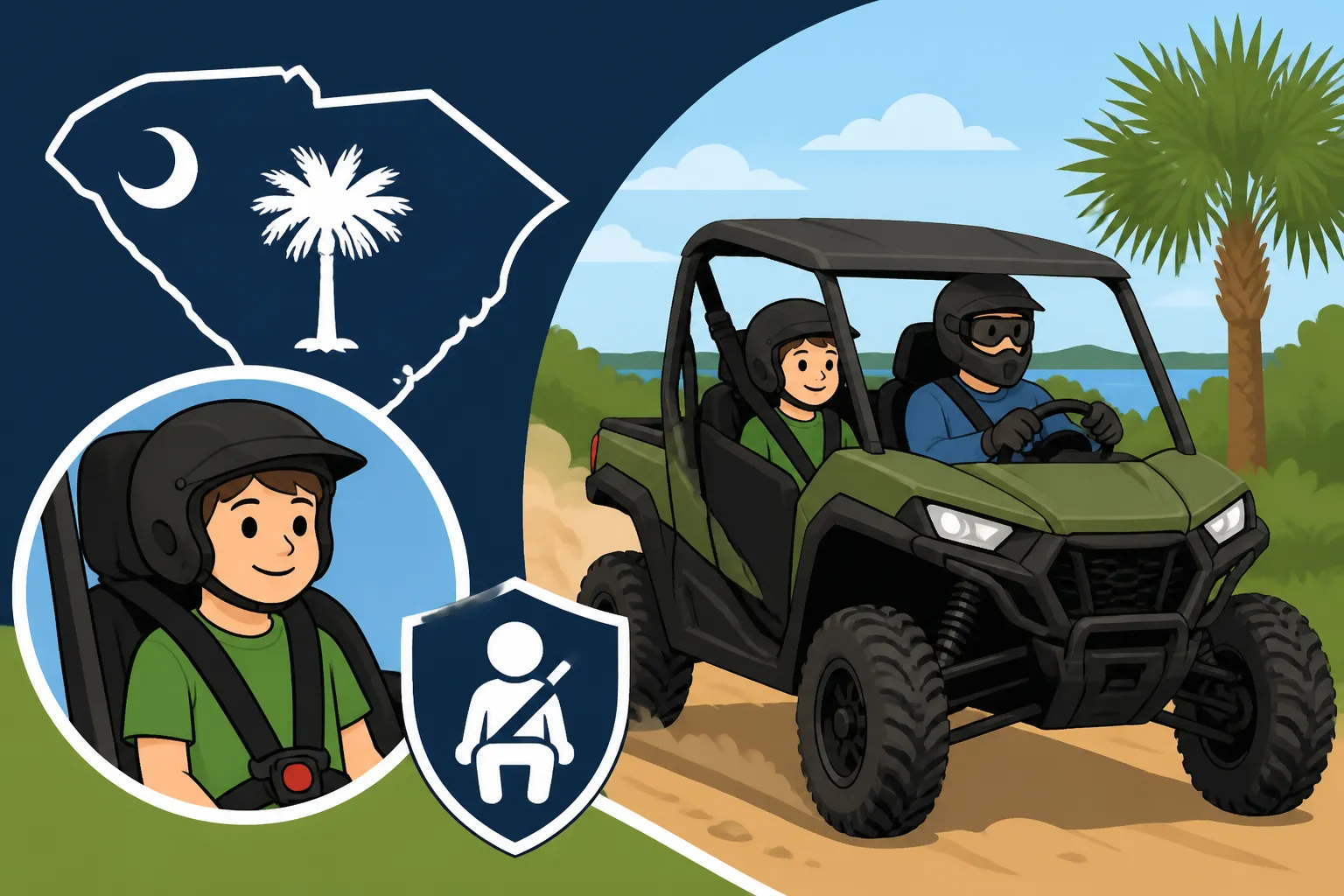
When operating a street-legal UTV on public roads in South Carolina, specific safety gear requirements come into play, which directly impact child passengers. One of the most important rules is that any occupant under the age of 21 must wear a DOT-approved helmet. This applies whether they are the driver or a passenger. So, if your 15-year-old is riding along as a passenger in your street-legal UTV, they absolutely need to have a helmet on. This rule is designed to provide critical head protection in the event of a crash or rollover, as UTVs, despite their roll cages, still present unique safety challenges compared to fully enclosed vehicles.
Beyond helmets, seatbelts are non-negotiable. Every passenger must be properly secured with the UTV's factory-installed seatbelt system. If the UTV seats more than two people, like a four-seater or six-seater, then all occupants, including children, must be buckled up in their designated seating positions. It’s also wise to consider supplemental safety features. While not legally required, products like a full harness system, often available from brands like SuperATV, can provide even greater security for young passengers, especially when navigating varied terrain or higher speeds. Ensuring your UTV is equipped with appropriate restraints and that all child passengers are using them correctly is paramount for their safety and compliance with the law.
Practical Advice and Common Misconceptions
It's easy to get caught up in the letter of the law, but sometimes the spirit of the law and practical safety measures are even more important. Understanding why these rules exist can help you make the best, safest decisions for your family.
Why the Rules Are There: Safety First
The primary reason for all these rules, especially those restricting child passengers on ATVs, boils down to one thing: safety. ATVs, by their very nature, are performance vehicles that require active control and balance from the operator. Adding a passenger, particularly a child, compromises this balance in several critical ways. It makes the machine top-heavy, significantly increases the braking distance, and makes it harder to steer and maneuver around obstacles. These factors contribute directly to the high risk of rollovers and collisions, which can lead to serious injuries. The statistics on ATV accidents involving multiple riders, especially children, are sobering.
South Carolina, through laws like Chandler's Law, is attempting to mitigate these risks by setting clear guidelines. It's not about preventing fun, but about ensuring that the fun is had responsibly and safely. Imagine trying to navigate a tight turn or climb a steep hill with an extra, shifting weight on your ATV – it's a recipe for disaster. While you might feel like you're in control, the machine's dynamics are fundamentally altered, making it much more unpredictable. Always remember that the manufacturer's recommendations and the state's laws are built on years of accident data and safety research.
When In Doubt, Choose a Multi-Passenger Machine
If your goal is to share the joy of off-road riding with your children, the absolute best and safest approach is to invest in a multi-passenger UTV, or side-by-side. These machines are purpose-built for carrying multiple occupants safely. They offer features like roll cages, seatbelts, and often more stable designs that make them much more forgiving and safer for family outings. Unlike ATVs, which require a high degree of physical input and balance, UTVs offer a more car-like experience, making it easier for an operator to focus on driving while passengers can enjoy the ride securely.
When considering a UTV for family use, think about what safety features are important to you. Many models come standard with seatbelts and a basic roll cage, but you can always enhance safety further. Aftermarket companies, like SuperATV, offer a vast array of accessories that can improve the passenger experience and overall safety. This could include adding a full set of doors for containment, upgrading to a stronger harness system for younger passengers, or installing a more robust roof for overhead protection. Choosing a UTV specifically designed for multiple passengers not only keeps you compliant with [South Carolina Street UTV Machine Specs] and other passenger rules but, more importantly, ensures that your children are as safe and comfortable as possible while enjoying the thrill of the trail or the open road.
It’s worth remembering that while private land often has fewer regulations than public roads or designated trails, the principles of safety remain the same. Even on your own property, an ATV is still an ATV, and a UTV is still a UTV. Prioritize the machine that offers the best safety features for carrying your precious cargo.
Here's a quick look at the distinctions in rules for child passengers:
| Feature/Machine Type | Off-Road ATV (Single Rider Design) | Street-Legal UTV (Multi-Passenger Design) |
|---|---|---|
| Child Passenger Legality | Generally Prohibited (unless ATV specifically designed for two, which is rare, and then only for operator 16+) | Generally Allowed (with proper seating & restraints) |
| Operator Age Requirement | If operator is under 16, they cannot carry a passenger. Operator 6-15 requires safety certificate & adult supervision. | Operator must be 17+ with a valid driver's license. |
| Helmet Requirement | Not specifically for passengers, but highly recommended for all riders (operators under 16 required). | Occupants under 21 MUST wear a DOT-approved helmet. |
| Seatbelts/Restraints | Not applicable (ATVs don't have seatbelts). | Every passenger MUST be secured with the UTV's seatbelt. Child under 8 generally prohibited. |
| Primary Safety Concern | Rollover risk due to altered center of gravity and unstable handling with a passenger. | Ensuring proper restraints and helmet use, especially at road speeds. |
| Relevant SC Law | Chandler's Law (SC Code Title 50 Chapter 26) | Act 164 (November 2026), [South Carolina Street UTV Rules From November 2026] |
| Best Practice | Never carry a child passenger on a single-rider ATV. | Always use proper seating, seatbelts, and helmets for children. Consider additional harnesses. |
Remember, these regulations are put in place to protect young riders, and understanding them is the first step toward safe and enjoyable adventures for your whole family in the Palmetto State. Always double-check the latest information from the South Carolina Department of Motor Vehicles for any updates or specific requirements for your machine type and intended use.
Disclaimer
This article is for general informational purposes only and does not constitute professional advice. Laws, prices and regulations vary by location and change over time. Consult a qualified professional for guidance on your specific situation.