South Carolina Hunting Club Riding Rules
A hunting club’s permission to ride an ATV or UTV in South Carolina is not the same as permission from every landowner, a public-land pass, or an exemption from state rules. If you belong to a club or are visiting one, the key is to confirm exactly where you may ride, which machines are allowed, and what paperwork and safety rules apply.
Club permission is not blanket permission
A hunting club may lease land, own land, or have permission to use property controlled by another owner. Those arrangements can set different limits on vehicle access. Being a member—or holding a hunting license—does not automatically give you permission to ride on every parcel associated with the club.
Start by asking the club contact who controls the land and what the agreement allows. Permission to hunt does not necessarily include permission to drive a quad across the property. The club may also have access to only certain roads, trails, parking areas, or stands. A locked gate, posted boundary, or road that continues onto another parcel should be treated as a stop until you confirm otherwise.
Written rules are especially useful when multiple landowners, leaseholders, or club officers are involved. Ask for a map or a clear description of approved routes, boundaries, and any no-ride zones. For more on documenting access, see Carrying Written Landowner Permission in South Carolina and South Carolina Landowner Permission Forms. If the club uses timber company land, its access agreement may restrict routes, vehicle types, seasons, or hours; What a Timber Company’s Access Policy Usually Says explains why those terms matter.
A club’s permission applies only to the land and uses it is authorized to approve. It does not grant access across a neighbor’s property, a public road, a wildlife management area, or a national forest trail. Nor does it override a landowner’s conditions. If an owner allows riding only on a designated road, for example, riding through the woods to reach a stand may still violate the agreement.
| Situation | What to confirm before riding |
|---|---|
| Club-owned property | Which trails, roads, and areas are open to members |
| Leased property | Whether the lease permits ATV or UTV use and who may ride |
| Timber company land | Approved routes, gates, closures, and seasonal limits |
| Shared access road | Who controls the road and whether vehicle use is allowed |
| Public land or a wildlife management area | Whether riding is specifically authorized there |
| A club event or group ride | Whether the organizer has permission for the full route and group |
When a club gives verbal permission, ask who gave it and whether that person is authorized to approve vehicle use. A quick confirmation can prevent a disagreement with a landowner, club officer, or enforcement officer later.
Hunting access does not automatically authorize riding
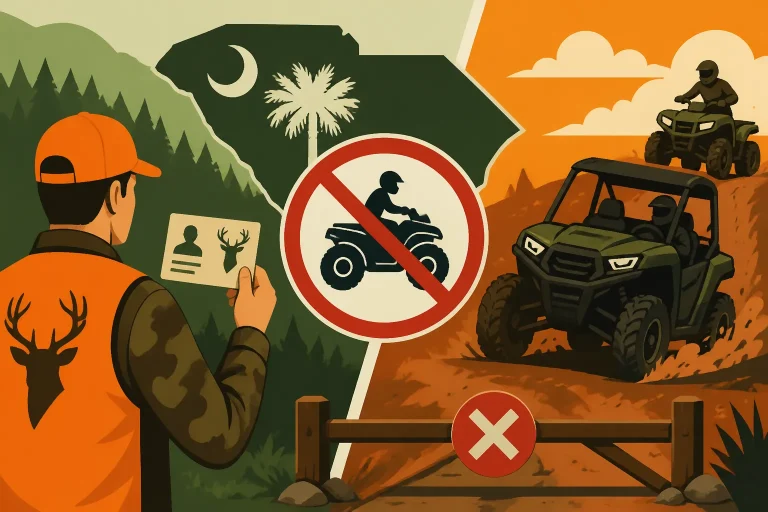
South Carolina has provisions concerning hunting and trapping in its ATV laws, but an exemption connected to hunting is not a general license to ride wherever a hunt takes place. Its application depends on the activity and circumstances. Do not assume that having a hunting license, carrying hunting equipment, or riding to a deer stand makes every route lawful. For a closer look at the limited legal context, see South Carolina Hunting and Trapping Exemptions.
A hunting club may set rules that are stricter than the state’s minimum requirements. It can limit riding to certain hours, close trails during a hunt, restrict machines to specific routes, or require permission before a member drives to a stand. Those limits can help protect hunters, land, and equipment, and they may be part of the club’s arrangement with the property owner.
Public land is a separate issue. A hunting license does not open vehicle trails on a wildlife management area. South Carolina wildlife management areas generally restrict ATV use unless the agency specifically authorizes it. Check the rules for the exact property and activity rather than relying on a club member’s assumption. See Every Wildlife Management Area Is Closed to Quads and A Hunting License Opens No Trails to Quads for more on this distinction.
National forest access also has its own conditions. A hunting club’s private-land permission does not substitute for any required forest pass or trail authorization, and a pass does not grant permission to ride on private land. Confirm the current trail status, machine restrictions, and pass requirements with the managing agency before hauling a machine. Forest routes can close for maintenance, weather, or other operational reasons.
If you are visiting from another state, do not treat an out-of-state tag, registration, or hunting-club membership as permission to ride in South Carolina. Permission and public-land access are separate from how the machine is titled or registered elsewhere. Your machine must also comply with the rules that apply to its use in South Carolina. South Carolina Rules for an Out-of-State Machine can help you separate visitor questions from land-access questions.
Agree on routes, machine use, and safety before the ride
Before riding, get the club’s rules in practical terms. “Stay on the roads” may sound clear until a road forks, crosses a boundary, or leads to a stand through a closed area. Ask for a current map and mark any routes that are off-limits. Clarify whether the rules differ during hunting seasons, after heavy rain, during timber work, or when other members are in the field.
The club should also explain which machines are permitted. A route suitable for a narrow ATV may not be suitable for a wide side-by-side. A gate or marked trail may have a width restriction, and a UTV may cause more ground damage than a small quad. Ask about passengers, trailers, winches, noise, speed, parking, and recovery plans. If a machine becomes stuck, do not assume you can cross a neighboring parcel to retrieve it.
State safety requirements still matter on private land. South Carolina has age-related rules and safety requirements for young ATV riders, and the details can depend on the rider and situation. Check South Carolina Safety Certificate Requirements and the applicable rules before bringing a minor. Club rules may require additional supervision, helmets, eye protection, or restrictions on passengers, even when a particular state rule does not require the same thing.
A practical pre-ride check can prevent common problems:
- Confirm that the landowner or authorized club contact permits ATV or UTV use.
- Identify the exact property and routes covered by that permission.
- Check for gates, closures, posted boundaries, and temporary work areas.
- Confirm whether the machine, passengers, and any trailer are allowed.
- Review the rules for young riders and required safety equipment.
- Carry the club’s map and permission details, and keep an emergency contact available.
- Make sure the machine is in safe condition and that its identifying information is recorded.
If you are buying supplies for a club ride, Amazon may be one place to compare items such as first-aid kits, eye protection, or trail tools. Match equipment to the rider and machine, and follow the club’s requirements rather than assuming a product listing proves that an item meets a particular standard.
Proof of ownership is a separate matter from permission to ride. A bill of sale, title, or other record may help establish who owns the machine, but it does not authorize access to land. South Carolina has optional titling for some off-road machines, so owners should understand what documents they have and keep useful records available. See [South Carolina Proof of Ownership on the Trail] for related paperwork considerations.
What to do when club rules and other rules overlap
The safest approach is to satisfy every applicable layer of permission and regulation. A club can authorize access only within the rights it holds; a landowner can set conditions for private property; public-land agencies control their own trails; and state law still governs vehicle operation where it applies.
If you cannot tell whether a route is private, public, or part of a managed area, do not ride it until you find out. Ask the club officer or property manager to identify the boundary and confirm access. For public land, contact the agency that manages the specific area. A trail pass, hunting license, or club membership should not be treated as a substitute for that confirmation.
Keep permission clear and current. A club’s lease or access arrangement can change, and a route that was open last season may be closed now. Confirm access again before a new season, event, or trip—especially when the land is shared with timber operations or other users. It also helps to share the route and land boundaries with every rider in your group, not just the person who arranged permission.
The simplest rule is to ride only where the responsible landholder or manager has clearly allowed you to ride, and to follow the most restrictive applicable condition. That protects access for the club and reduces the chance of trespass, property damage, or a conflict during a hunt.
Disclaimer
This article is for general informational purposes only and does not constitute professional advice. Laws, prices and regulations vary by location and change over time. Consult a qualified professional for guidance on your specific situation.