No Certificate Needed as an Adult
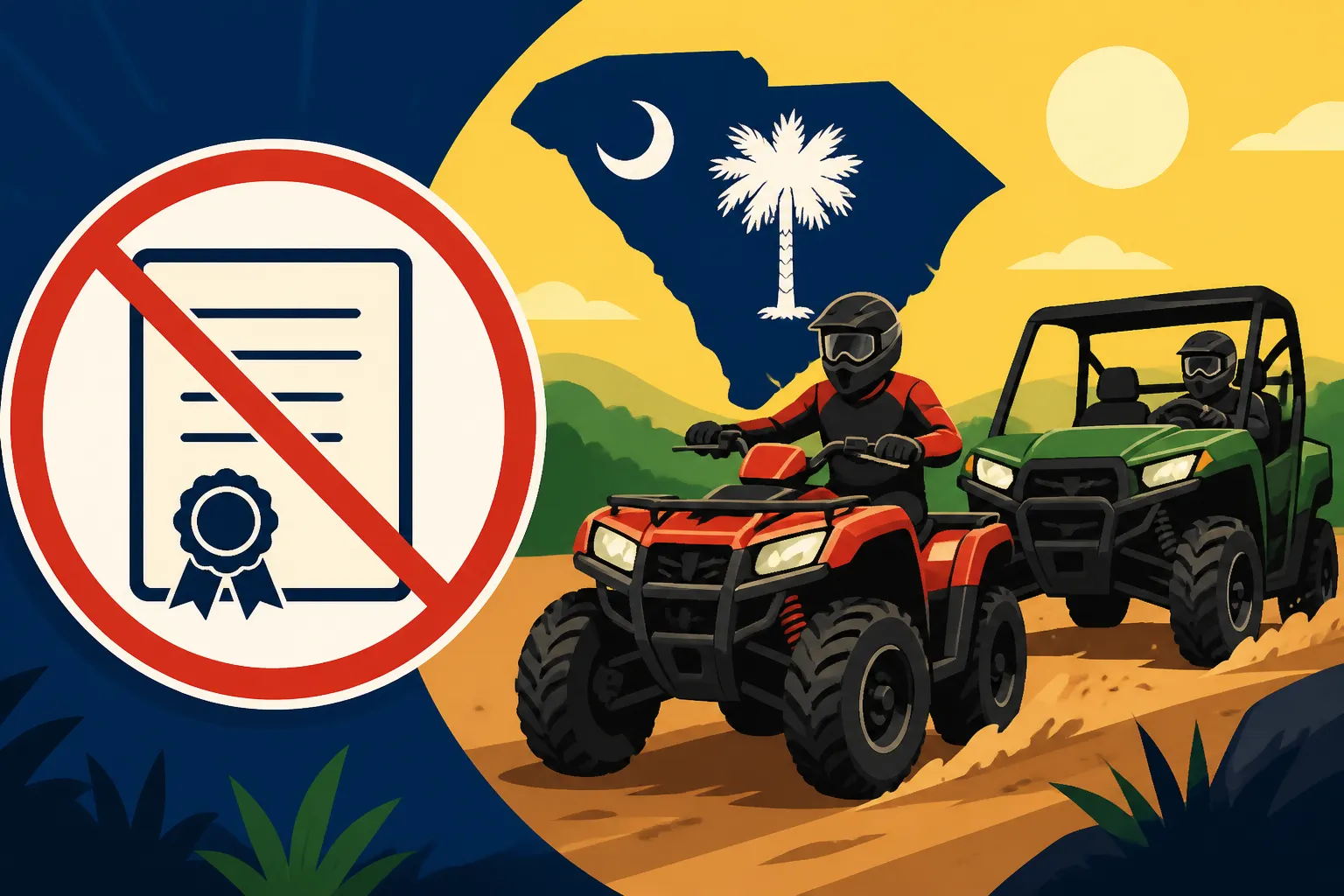
An adult riding an ATV in South Carolina generally does not need a safety certificate. The catch is that “no certificate” does not mean “no rules”: age, supervision, land access, trail permits and the difference between an ATV and a UTV can all affect what you may ride and where.
When South Carolina Requires an ATV Safety Certificate
South Carolina’s hands-on ATV safety-course requirement applies to young operators, not adults. According to the South Carolina Department of Motor Vehicles, operators age 15 and younger must successfully complete a hands-on ATV safety course approved by the All-Terrain Vehicle Safety Institute. The South Carolina Legislative Services Agency likewise says operators age 15 and younger must possess a safety certificate from an approved hands-on course.
That means an operator who is 16 or older does not need that certificate under the age-based course requirement. The exception is important for families: a 16-year-old may be old enough to avoid the course requirement but still subject to other restrictions. “No certificate required” and “free to ride without supervision” are not interchangeable.
The South Carolina Department of Public Health says children aged 16 and under must be accompanied by an adult when riding an ATV on public land. The South Carolina Legislative Services Agency also requires ATV operators age 16 and younger on public lands to be accompanied by an adult. On private property, minors between six and sixteen may operate ATVs under the direct visual supervision of a parent or legal guardian, according to the South Carolina Legislative Services Agency.
These distinctions matter because rules can vary with the rider’s age and the kind of land being used. A young rider might not need a certificate under one age cutoff, yet still need an adult present on public land. For a fuller breakdown of the age rules, see South Carolina ATV Age Requirements and South Carolina Safety Certificate Requirements.
A certificate requirement is also different from a trail pass or permit. Completing a safety course does not pay a riding-area fee or replace a permit required at a trail. And holding a trail pass does not satisfy the course requirement for a young rider who needs one.
| Question | General answer for an adult rider | What to check |
|---|---|---|
| Is an ATV safety certificate required? | No, not under the age-based course rule for operators age 16 or older. | Whether a private riding area has its own training or entry rules. |
| Does the rule also cover UTVs? | The cited hands-on course requirement is for ATV operators. | Whether the machine is an ATV or UTV, and whether it is being used on public roads. |
| Is a trail permit the same as a safety certificate? | No. A permit or pass addresses access and fees, not course completion. | The specific trail’s permit and vehicle rules. |
| Does an adult still need to follow safety rules? | Yes. A course exemption is not an exemption from operating rules. | Equipment, land access, traffic and trail requirements. |
What Adults Still Need to Check Before Riding
Not needing a certificate does not remove the basic legal and practical responsibilities of riding. South Carolina’s ATV rules still address equipment, operating conditions and the manufacturer’s age warning label.
According to the South Carolina Department of Motor Vehicles, an ATV must have an effective muffler system, a USDA Forest Service-approved spark arrester and a working brake system. The South Carolina Legislative Services Agency also lists those equipment requirements. An adult rider should check that the machine has the required equipment and that it is in working order, rather than assuming the rules apply only to children.
The manufacturer’s age restriction warning label is another separate issue. Removing the warning label attached to an ATV is against the law, according to the South Carolina Department of Motor Vehicles and the South Carolina Legislative Services Agency. A rider should not remove it simply because the rider is older than the age printed on the label.
Night riding has a specific lighting rule. According to the South Carolina Department of Motor Vehicles, an ATV operated more than 30 minutes after sunset or more than 30 minutes before sunrise must have its headlights on. That requirement applies independently of whether the rider has completed a safety course.
Other restrictions are especially relevant when a younger person is riding. The South Carolina Department of Public Health says children under 16 must wear a safety helmet and eye protection while operating an ATV. The South Carolina Legislative Services Agency specifies that operators age 15 and younger must wear a safety helmet meeting FMVSS #218 and eye protection. A rider who is exempt from the course rule should not assume that age-related equipment or supervision requirements disappear for other young operators in the group.
If you are buying protective equipment, choose gear that fits properly and is suitable for the riding conditions. Amazon may be one place to compare helmets and eye protection, but a product listing is not a substitute for checking whether gear meets a specific rule. For more on equipment and operating details, see South Carolina ATV Helmet Law and South Carolina Equipment Requirements for ATVs.
It also helps to confirm that the place you plan to ride allows your vehicle. Federal rules require off-highway vehicle operators to use only areas, roads and trails designated as open to OHVs, according to the Forest Service. A machine that is legal to own or operate on private land is not automatically allowed on every public trail.
For example, the Enoree OHV Trail offers 23 miles of trail, according to the Forest Service, but it has its own access and vehicle restrictions. Operators must have a permit in their possession while riding there, and daily and annual passes must be purchased through Recreation.gov, according to the Forest Service. The Forest Service says fee tubes are no longer available on-site for cash payment as of November 2026. Passes must be downloaded to a phone or printed before the ride and made available while riding.
The Forest Service also says UTVs over 50 inches, Jeeps and other 4×4 vehicles are prohibited on the Enoree OHV Trail. That is a useful reminder that a road-legal or otherwise properly equipped UTV is not necessarily allowed on an ATV trail. Check the rules for the exact riding area before loading the machine. South Carolina ATV Trails: Where to Ride and South Carolina Forest Passes in Your Budget can help with planning.
A Course Certificate Is Not a Trail Permit
The word “permit” can cause confusion because riders may hear it used for different things. An ATV safety certificate records completion of an approved course. A trail permit or pass gives access under the riding area’s rules. Neither document automatically replaces the other.
At Enoree, for instance, the Forest Service requires operators to have a permit in their possession while riding. It also says trail passes must be purchased through Recreation.gov and that riders should check the Call Before You Haul hotline for the trail’s current status. The hotline number is (803) 561-4025, according to the Forest Service. Those are access and trip-planning requirements; they do not turn an adult course certificate into a mandatory document.
Trail rules can also determine which vehicle is suitable. The Forest Service manages the Parsons Mountain OHV Trail exclusively for ATVs and dirt bikes and does not permit four-wheel-drive vehicles such as Jeeps and Hummers there. The Cedar Springs OHV Trail is likewise managed for ATVs and dirt bikes, according to the Forest Service. Before setting out, verify that your machine fits the trail’s vehicle limits, and confirm whether weather or maintenance has prompted a closure.
Keep the documents and equipment requirements separate in your planning:
- Course certificate: Required for ATV operators age 15 and younger under the cited South Carolina rule. An adult does not need it under that age-based requirement.
- Trail pass or permit: May be required to access a specific public riding area. Check the trail’s current instructions and keep the permit available while riding where required.
- Vehicle equipment: Muffler, spark arrester and brake requirements apply to ATVs under South Carolina rules, regardless of an adult rider’s course status.
- Access permission: Public-land trail designations and private-land permission determine where riding is allowed; a certificate does not grant access.
For help identifying which papers apply to a particular outing, see South Carolina Proof of Ownership on the Trail and South Carolina Permit Questions Riders Ask. If you are going to Enoree, How to Buy a South Carolina Forest Pass covers the pass question separately from the safety-course requirement.
UTV Road Rules Are a Different Question
A UTV is not the same thing as an ATV for every legal purpose. The ATV course requirement described above is about ATV operators. It should not be treated as a general road-use qualification for UTV drivers, and an ATV safety certificate does not make a UTV street legal.
Starting November 18, 2026, registered UTVs may be operated on certain South Carolina public roads, subject to restrictions, according to the South Carolina Department of Motor Vehicles. The agency says a qualifying UTV must be four-wheel drive, have an engine displacement of at least 450cc, reach a top speed greater than 55 mph, measure 80 inches or less in width and have a gross weight rating of 4,000 pounds or less. It must also have factory-approved Type 2 seat belts for every seat.
The road rules are separate from a safety-course certificate. According to the South Carolina Department of Motor Vehicles, a UTV driver on public roads must be at least 17 years old and hold a valid driver’s license. UTVs may be operated only on roads with a speed limit of 55 mph or less, and use is limited to a 10-mile radius of the address listed on the vehicle’s registration. Drivers and passengers under 21 must wear a helmet with a chin strap and a face shield or goggles while operating a UTV on public roads.
Those restrictions do not mean every UTV is allowed on every public road, nor do they change the rules for off-road trails. The Forest Service’s trail limits can exclude UTVs even when a machine meets the separate state requirements for road use. Check the vehicle’s classification, the intended route and the trail or road rules before riding. For the paperwork and registration side, see South Carolina Street UTV Requirements Explained and South Carolina Paperwork for a Street UTV.
The practical takeaway is straightforward: if you are an adult riding an ATV, South Carolina’s age-based hands-on course certificate requirement does not apply to you. You still need to follow the applicable equipment, access and operating rules. If you are riding with a minor, check that rider’s course, supervision and protective-gear requirements. And if your machine is a UTV, confirm the rules for the specific road or trail rather than relying on the ATV certificate rule.
Sources
- South Carolina Department of Motor Vehicles — Terrain Vehicles | SCDMV (checked November 3, 2026)
- Forest Service — Francis Marion and Sumter National Forests | Enoree OHV Trail | Forest Service (checked November 3, 2026)
- Forest Service — Francis Marion and Sumter National Forests | Parsons Mountain OHV Trail | Forest Service (checked November 3, 2026)
- South Carolina Department of Motor Vehicles — Terrain Vehicles | SCDMV (checked November 3, 2026)
- South Carolina Department of Public Health — ATV Safety | South Carolina Department of Public Health (checked November 3, 2026)
- South Carolina Legislative Services Agency — Code of Laws – Title 50 – Chapter 26- – FISH, GAME AND WATERCRAFT (checked November 3, 2026)
- South Carolina Department of Public Safety — UTV Law | SCDPS (checked November 3, 2026)
- Forest Service — Francis Marion and Sumter National Forests | Off-Highway Vehicles (OHV) | Forest Service (checked November 3, 2026)
- Forest Service — Francis Marion and Sumter National Forests | Check the Call Before You Haul hotline before riding our OHV trails | Forest Service (checked November 3, 2026)
- Francis Marion Sumter National Forest — Enoree%20OHV%20Trail%20rules_0.pdf (checked November 3, 2026)
- USDA Forest Service — Francis Marion and Sumter National Forests | Cedar Springs OHV Trail | Forest Service (checked November 3, 2026)
- Forest Service — Francis Marion and Sumter National Forests | Wambaw Cycle Trail (North Loop) | Forest Service (checked November 3, 2026)
- Forest Service — Francis Marion and Sumter National Forests | Wambaw Cycle Trail (South Loop) | Forest Service (checked November 3, 2026)
Disclaimer
This article is for general informational purposes only and does not constitute professional advice. Laws, prices and regulations vary by location and change over time. Consult a qualified professional for guidance on your specific situation.