South Carolina Supervision Rules for Minors
South Carolina’s rules for young ATV and UTV riders can be easy to misread: age limits, adult supervision, safety courses and road-use rules are separate requirements. Knowing which apply before a child rides helps families avoid unsafe situations and preventable violations. Here’s how to think through supervision, what changes between an off-road ride and a street-legal UTV, and what to check before heading out.
Start With the Type of Ride
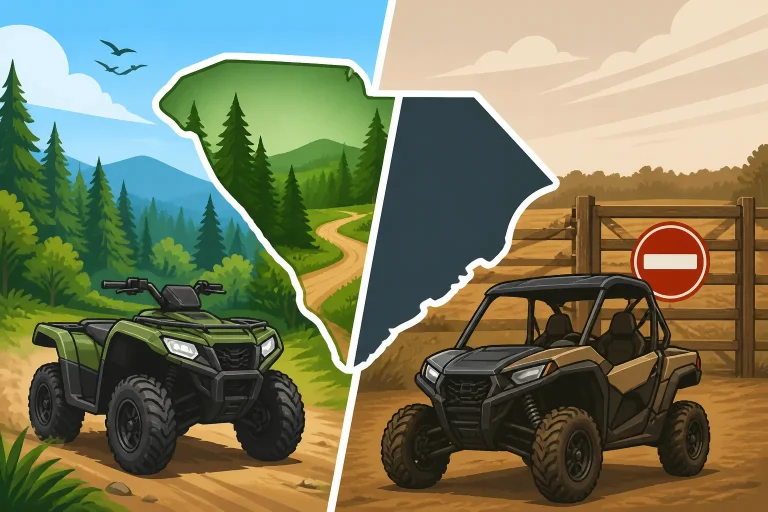
South Carolina does not have one supervision rule that covers every machine and every place. Before a minor rides, identify the vehicle and where it will be operated. An off-road ATV on private land is not the same case as an ATV on a trail, and neither is the same as a UTV driven on a public road.
For off-road ATVs, state age rules and adult-accompaniment requirements matter even when the ride is recreational. South Carolina’s ATV law, often called Chandler’s Law, sets age-related limits and includes requirements for young riders. A family’s permission is not a substitute for complying with the law. For a broader overview, see South Carolina ATV Age Requirements and Chandler’s Law and South Carolina ATV Rules.
A UTV brings a separate set of questions. If it is being used off road, check the applicable ATV and trail rules, the manufacturer’s age guidance and the riding area’s own policies. If it is being driven on a public road under the state’s street-UTV rules, driver age and license requirements apply. An adult riding along does not make a child eligible to drive a vehicle when the child does not meet the legal driving requirements. See South Carolina Street UTV Age of 17 and Do You Need a License for a UTV in South Carolina?.
| Situation | What to check first | Why supervision alone may not be enough |
|---|---|---|
| Minor operating an off-road ATV | Age, adult accompaniment, safety-course and protective-equipment rules | A supervising adult does not erase age or training requirements |
| Minor riding on private property | State rules, landowner permission and any relevant exemption | Private land is not automatically outside state law |
| Minor using a public OHV trail | Age and course requirements, trail rules, pass and equipment requirements | The land manager may impose additional conditions |
| Minor operating a street-legal UTV on a public road | Minimum driver age, license, vehicle eligibility and road rules | Having an adult passenger does not replace driver eligibility |
| Minor as a UTV passenger | Passenger-age restrictions, seating and restraint requirements | A passenger may be too young even if an adult is driving |
The table is a starting point, not a substitute for checking the rule that applies to the specific machine and location. The practical distinction is simple: an adult’s presence is one safeguard, while legal eligibility, training, equipment and land access are separate checks.
South Carolina’s ATV rules are not the same as the rules for golf carts or low-speed vehicles. Those vehicle categories have their own road-use conditions and should not be treated as interchangeable with a UTV. If the machine is intended for public roads, confirm what it is classified as before planning a route. A vehicle’s appearance or the fact that it has seat belts does not, by itself, determine its legal category.
Understand the Age and Adult-Accompaniment Rules
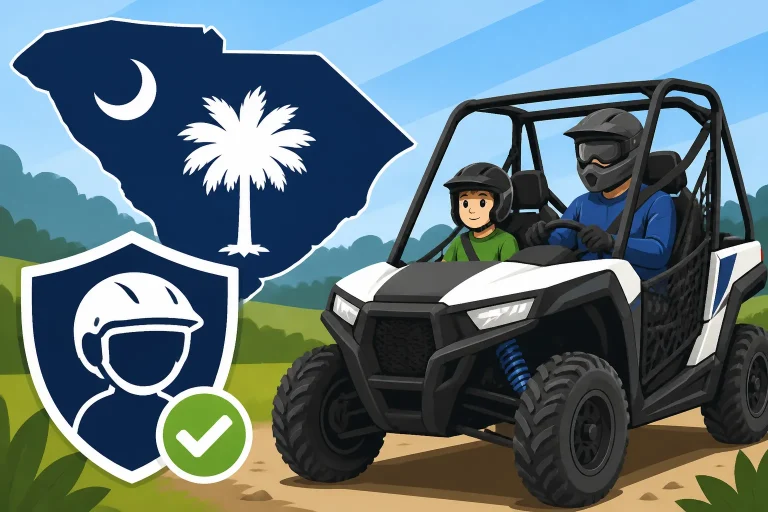
South Carolina’s ATV rules prohibit children under six from operating an ATV. For riders from six through fifteen, adult supervision and other requirements apply. Do not assume that a child is old enough simply because they can reach the controls, have ridden before or are using a small youth model. The law’s age limits are about the rider, not just the size of the machine.
For a rider in the six-to-fifteen range, plan for an adult to accompany the child as required. Read South Carolina Adult Accompaniment at 16 and Under together with Riders 6 to 15 Supervised on Private Land. Those topics help frame the core rule and the question families often ask next: whether the answer changes when the ride is on private ground.
Do not treat “supervision” as a distant adult who is somewhere on the property, reachable by phone, or waiting at the trailhead. A safe plan puts the responsible adult close enough to observe the child’s riding and intervene if needed. The adult should be able to see or promptly reach the child, understand the terrain and conditions, and stay attentive throughout the ride. Even where a legal rule does not spell out every practical detail of supervision, a child riding beyond an adult’s view is a poor safety plan.
There are important limits to what adult accompaniment accomplishes. It does not automatically:
- Make a child eligible to operate an ATV below the legal minimum age.
- Replace a required safety certificate or course.
- Allow a child to ride a machine that is too large or powerful for their ability.
- Override trail-operator, landowner or event rules.
- Make a child eligible to drive a street-legal UTV on a public road.
- Permit a passenger arrangement that the law or the machine’s manual does not allow.
Private property deserves particular care. Some ATV rules have exceptions tied to activities or types of land use, but families should not assume that a private driveway, backyard, farm or hunting property makes every age and supervision restriction disappear. An exemption may be limited to particular circumstances, and the person relying on it needs to know what it covers. The safest approach is to follow the age, training and supervision safeguards even when a family believes an exemption might apply.
Also distinguish a parent’s permission from the landowner’s permission. If the property belongs to someone else, get clear permission for the specific activity and confirm whether riders, passengers, vehicles or routes are restricted. On public forest land or a managed trail system, follow the land manager’s rules as well as statewide requirements. A responsible adult should check access conditions before unloading.
Where rules are unclear, ask a focused question rather than asking only whether “kids can ride.” Explain the child’s age, the machine type, whether the child will operate or ride as a passenger, and whether the location is private land, a managed trail or a public road. That makes it easier for an official or property manager to identify the relevant rule.
Treat Training and Equipment as Separate Requirements
A child may need both adult supervision and safety training. They are not interchangeable. Supervision provides immediate guidance during a ride; a course gives the rider structured instruction in controls, hazards and safe operating practices. Check South Carolina Safety Certificate Requirements and South Carolina Safety Courses for Riders 15 and Under before setting a child up to ride.
Do not assume any online video, informal lesson or general boating or driver course satisfies an ATV safety-certificate requirement. The accepted course and certificate process can be specific. The reference Only an ATV Safety Institute Course Counts is useful when checking what training qualifies, while South Carolina Course Locations can help families plan where to complete it. Confirm current course availability and certificate documentation before relying on a completion record.
Training is useful even if the child has operated a machine elsewhere. Controls, braking response, turning behavior and stability can vary by model. A rider who is comfortable on a small ATV may not be prepared for a heavier machine, a different transmission or a slippery trail. A course is a starting point, not proof that a child is ready for every model or terrain.
Protective equipment should be treated as part of the ride plan, not an afterthought. South Carolina has specific requirements for young ATV riders, including helmet and eye-protection rules. Check South Carolina ATV Helmet Law and South Carolina Eye Protection for Young Riders for the applicable details. Ensure the helmet fits properly and is appropriate for the activity; a loose helmet or one that obstructs vision can create its own hazard.
Before riding, an adult should check that the machine is suited to the child’s size, strength and experience. Important questions include:
- Can the child reach and operate the controls without stretching or losing a secure riding position?
- Can the child control the throttle and brakes, steer through a turn and stop the machine reliably?
- Is the ATV designed for the child’s age and size, with the required warning label still in place?
- Does the child know how to shut the machine off and what to do if it stalls or tips?
- Is the route appropriate for the child’s experience, with no unexpected steep slopes, deep water or traffic?
A child who cannot reliably stop the ATV or operate its controls is not ready to ride it independently, regardless of whether an adult is nearby. Start with a controlled, open area and close instruction before considering a trail. Avoid using speed or engine size as a shortcut for judging suitability; handling and rider fit matter just as much.
Adults should also inspect the machine before a young rider starts. Check brakes, tires, throttle return and other basic controls, and make sure the machine’s safety equipment is in working order. Do not let a child ride a machine with a known mechanical fault because the trip is short or the terrain looks easy. A breakdown or loss of control can become more serious when the rider is young and inexperienced.
The adult’s job is not simply to watch. Explain the route, riding boundaries and stop signals before the engine starts. Agree where the child must slow down or wait, and make sure the child understands not to follow another rider out of sight. If conditions change, such as rain, poor visibility or fatigue, end the ride or choose an easier route.
Off-Road UTVs and Public-Road UTVs Need Different Decisions
Families sometimes use “ATV” as a catch-all for every recreational machine. That can lead to mistakes. A quad, side-by-side and street-legal UTV can have different operating requirements. Identify the machine correctly by checking its paperwork, construction and intended use, then apply the rule for that category.
For an off-road side-by-side, an adult passenger or driver does not automatically resolve questions about a minor’s eligibility to operate it. Check the law, the manufacturer’s age guidance, the trail system’s vehicle rules and any park requirements. Some private riding areas set their own minimum ages or passenger policies that are more restrictive than a family expects. Read South Carolina Private Park Age Minimums and [South Carolina Private Park Helmet Rules] before arriving at a private park.
The UTV’s design also matters for safety. A side-by-side may have a steering wheel, seat belts and a rollover structure, but these features do not make it a passenger car or remove the need for age-appropriate operation. The driver must be able to control the vehicle and understand its size, stopping distance and rollover risks. Passengers need to use the seats and restraints as intended. Never carry more people than the machine is designed to hold.
Public-road use is a separate legal situation. South Carolina’s street-UTV framework has minimum driver qualifications and vehicle requirements. Check South Carolina Street UTV Rules From November 2026 and South Carolina Street UTV Requirements Explained for the road-use rules, and confirm current implementation details with the relevant state agency before relying on them. A supervising adult in the passenger seat cannot turn an underage child into an eligible street-UTV driver.
Keep these questions separate:
- Is this machine legally eligible to operate on the road?
- Is the proposed driver old enough and properly licensed?
- Does the machine meet the road equipment requirements?
- Does the route allow this type of vehicle?
- Are passengers allowed, and can each passenger ride safely in an approved seat?
A “yes” to the first question does not answer the remaining four. The same is true in reverse: an adult’s valid license and presence do not make an ineligible machine road legal or allow a minor to drive it.
Passenger rules deserve their own check. A child who is not old enough to drive may still be too young to ride as a passenger in a particular UTV or under the applicable road rules. Check South Carolina Street UTV Passenger Age Limits and South Carolina Rules for a Child Passenger. Use only manufacturer-designated seating positions, keep the number of occupants within the machine’s capacity and ensure each rider is properly restrained.
If a minor is riding as a passenger rather than operating the machine, do not assume that the driver’s age rule is the only rule that matters. Passenger age, seat-belt use, seating position, protective equipment and land-use rules can all affect whether the trip is allowed and safe. The child should be able to sit securely and follow instructions throughout the ride. If the restraint does not fit the passenger properly, do not take the trip.
Make a Supervision Plan Before the Engine Starts
A simple pre-ride plan makes supervision more effective. It also gives adults a clear reason to stop the ride when a child is tired, uncomfortable or out of their depth.
- Confirm the machine and location. Decide whether it is an ATV, off-road UTV or street-legal UTV, and whether the ride is on private property, a public trail or a public road.
- Check the child’s eligibility. Verify age limits, adult-accompaniment rules, required training and any passenger restrictions that apply to the situation.
- Read the machine’s manual. Confirm the age and size guidance, passenger capacity, restraint use and operating limits for that model.
- Choose an adult supervisor. Make sure the adult can remain attentive, keep the rider in view or close enough to respond, and is not distracted by another task or another group.
- Set boundaries. Point out the approved route and any areas the child must avoid. Agree on a signal to stop and a rule that the child does not ride out of sight.
- Inspect equipment and machine condition. Check helmet fit, eye protection, other required gear, brakes, tires and controls.
- Begin with a low-risk route. Use terrain that matches the child’s skill and the machine’s capabilities. Do not let a group’s pace dictate what a new rider attempts.
- Reassess during the ride. Stop if the child is tired, frightened, overheated or struggling to control the vehicle. Change plans when visibility, weather or trail conditions worsen.
The adult should be a capable rider or driver who can judge the terrain and respond calmly. If the supervising adult is operating a separate machine, they should not ride so far ahead that the child cannot keep up or so far behind that they cannot help. For a new rider, close accompaniment is better than simply assigning an adult to the group.
Avoid letting older children become the only supervisors for younger children. An older teen may be skilled and responsible, but a rule requiring adult accompaniment means a peer or sibling is not a substitute. Even when the law does not require an adult to be on the same machine, the responsible adult needs a practical way to monitor and assist the child.
Set a clear pace. Children may try to keep up with faster riders, especially in a group. Tell the group that the minor’s pace sets the pace, and choose routes where the child can stop safely without being pressured. A ride leader should know which adult is responsible for each young rider and should not assume someone else is watching.
Keep the adult’s attention on the child rather than on a phone, camera or another task. If the child is riding at a busy park, use a designated beginner area where possible and check posted policies at the gate. If the rules are stricter than the family’s plan, follow the park’s conditions or choose another location rather than arguing at the trailhead.
Finally, explain that stopping is a responsible choice. A child should be comfortable saying they are tired, nervous or unable to manage a hill. Adults should avoid turning a ride into a test of bravery. The best supervision is preventive: it keeps a child off terrain and machines they are not ready to handle.
Frequently Asked Questions
Can a child under six operate an ATV in South Carolina?
No. South Carolina’s age rule prohibits children under six from operating an ATV. Adult supervision does not make operation by a child below the minimum age permissible.
Does riding on private property remove the supervision requirement?
Do not assume so. Rules and limited exceptions can depend on the circumstances. Check the specific rule that applies to the land and activity, and use adult supervision and age-appropriate safeguards regardless.
Does completing a safety course replace adult supervision?
No. Training and supervision are separate safeguards. A course or certificate does not automatically remove an adult-accompaniment requirement, and an adult’s presence does not replace required training.
Can an adult ride along while a minor drives a street-legal UTV?
An adult passenger does not replace the street-UTV driver’s minimum-age and licensing requirements. Check the current road-use rules before allowing a minor to operate one on a public road.
Disclaimer
This article is for general informational purposes only and does not constitute professional advice. Laws, prices and regulations vary by location and change over time. Consult a qualified professional for guidance on your specific situation.