South Carolina Rules for a Young Passenger
A child riding behind an adult may look like a passenger question, but in South Carolina the answer depends first on the machine. ATV passenger rules are not the same as UTV road rules, and a child’s age, the seat design, and where you ride can all matter. Here’s how to sort out the key checks before a young passenger climbs aboard.
Identify the machine and where you will ride
“ATV” and “UTV” are often used interchangeably in conversation, but they can describe different vehicles with different rules. A typical ATV is a straddle-seat quad. A UTV is usually a side-by-side with a steering wheel, seat belts, and one or more bench or bucket seats. Do not assume a rule for one automatically applies to the other.
Also consider where the ride will take place. A vehicle used off-road on private land, a designated public trail, or a public road may be subject to different requirements. A riding park can set its own passenger and age rules too. Permission to ride in one place does not automatically authorize riding elsewhere.
| Situation | What to check before carrying a young passenger |
|---|---|
| Passenger on an ATV | Whether the manufacturer designed that model to carry a passenger, and whether it has a proper passenger seat and footrests |
| Young person operating an ATV | Age-related operating rules, supervision, and any applicable safety-course requirement |
| Passenger in an off-road UTV | Manufacturer capacity, seating position, seat belt fit, and landowner or park rules |
| UTV on a public road | Whether the vehicle and trip qualify under current street-UTV rules, including passenger-age and equipment requirements |
| Ride on public land | Trail access rules, required passes, and any restrictions specific to that trail |
For an ATV, the central passenger question is not simply whether the child is old enough to hold on. South Carolina’s ATV rules restrict carrying a passenger on a machine not designed for one. Many traditional quads have room for only one rider, even if a child appears small enough to sit behind the operator. Check the manufacturer’s specifications for the exact make, model, and year. A bolt-on seat or cargo accessory does not necessarily make a single-rider ATV a passenger vehicle.
For more on how these restrictions apply to children, see South Carolina Rules for a Child Passenger and South Carolina Passenger Rules Under 16. Those age-related rules should be considered alongside the machine’s seating design, not instead of it.
ATV passengers: seat design matters
South Carolina’s passenger rule is an important safety line: a passenger belongs only on an ATV designed by its manufacturer to carry one. If the owner’s manual identifies the ATV as a single-rider model, do not carry a child on the rear rack, fender, or an improvised seat. A passenger needs a proper seating position, a secure way to hold on, and foot support that keeps their feet away from the wheels and moving parts.
This rule can be easy to misread when a child seems light enough to ride without affecting the machine. Passenger capacity is not just a question of total weight. A second person can shift the ATV’s balance, change how it steers and stops, or fall off when the operator turns or crosses uneven ground. A child who cannot reliably reach the footrests or hold the designated handholds may be unsafe even on a two-person model.
Before a child rides as a passenger, check all of the following:
- The manufacturer identifies the ATV as suitable for two riders.
- There is a designated passenger seat, rather than a cargo rack or add-on perch.
- The passenger can sit securely and reach the footrests.
- The operator can control the ATV without the passenger shifting or interfering.
- The combined weight of the riders and gear stays within the manufacturer’s limits.
- Both riders have properly fitted protective equipment.
Do not treat a child’s age as proof that a ride is safe. A passenger may be allowed on a properly designed two-up ATV, yet still be too small to sit securely or follow instructions. If the child cannot keep both feet on the footrests, hold on without distracting the operator, and stay seated over bumps, choose another activity or a different vehicle.
A youth riding as a passenger is different from a youth operating the ATV. The passenger is not controlling the machine, but that does not remove the operator’s responsibility to follow passenger rules and ride within their ability. It also does not make an adult-supervision requirement disappear when the operator is a minor.
Age, supervision, and protective equipment
South Carolina has separate rules for young ATV operators. A child’s eligibility to operate a machine should not be confused with eligibility to ride as a passenger. Age restrictions, safety-course requirements, and adult accompaniment apply to the young operator, while the passenger-design rule concerns the ATV itself.
If a young person will operate an ATV, check the requirements that apply to that age and riding location before setting out. The state’s safety-certificate rules are especially relevant for younger operators; see South Carolina Safety Certificates at 15 and Under. Rules on adult accompaniment are also distinct from passenger rules, as explained in South Carolina Adult Accompaniment at 16 and Under. A parent or other adult should confirm the current requirements rather than assume that a child may ride alone because the land is private or familiar.
A passenger’s protective equipment matters, too. Use a helmet that fits securely and is appropriate for ATV riding, along with eye protection. A helmet that is loose, slides over the eyes, or leaves the chin strap unfastened is not a dependable safeguard. Gloves, long sleeves, long pants, and over-the-ankle footwear can help reduce scrapes and exposure, but they do not replace a helmet or make an unsuitable passenger seat safe.
Before starting the engine, explain a few basic passenger rules in language the child understands:
- Keep both feet on the footrests and hands on the passenger handholds.
- Sit still and follow the operator’s movements; do not lean suddenly in the opposite direction.
- Do not reach for branches, wave, or try to get on or off while the ATV is moving.
- Tell the operator immediately if anything feels loose, painful, or frightening.
- Wait for the ATV to stop completely before getting off.
The operator should start slowly in an open area and check that the passenger can stay seated comfortably. Avoid steep slopes, abrupt turns, deep mud, and rough terrain when carrying a child. A route that feels manageable alone can become much harder with another person changing the ATV’s balance.
For families using designated public trails, check whether the trail permits the vehicle and whether any pass or access condition applies to each rider. A pass is not a substitute for passenger authorization or safe seating. The rules for passes can differ from a vehicle’s registration or title requirements; South Carolina Season Passes Are Per Person explains one distinction to check when planning a public-land ride.
UTVs and public-road trips need a separate check
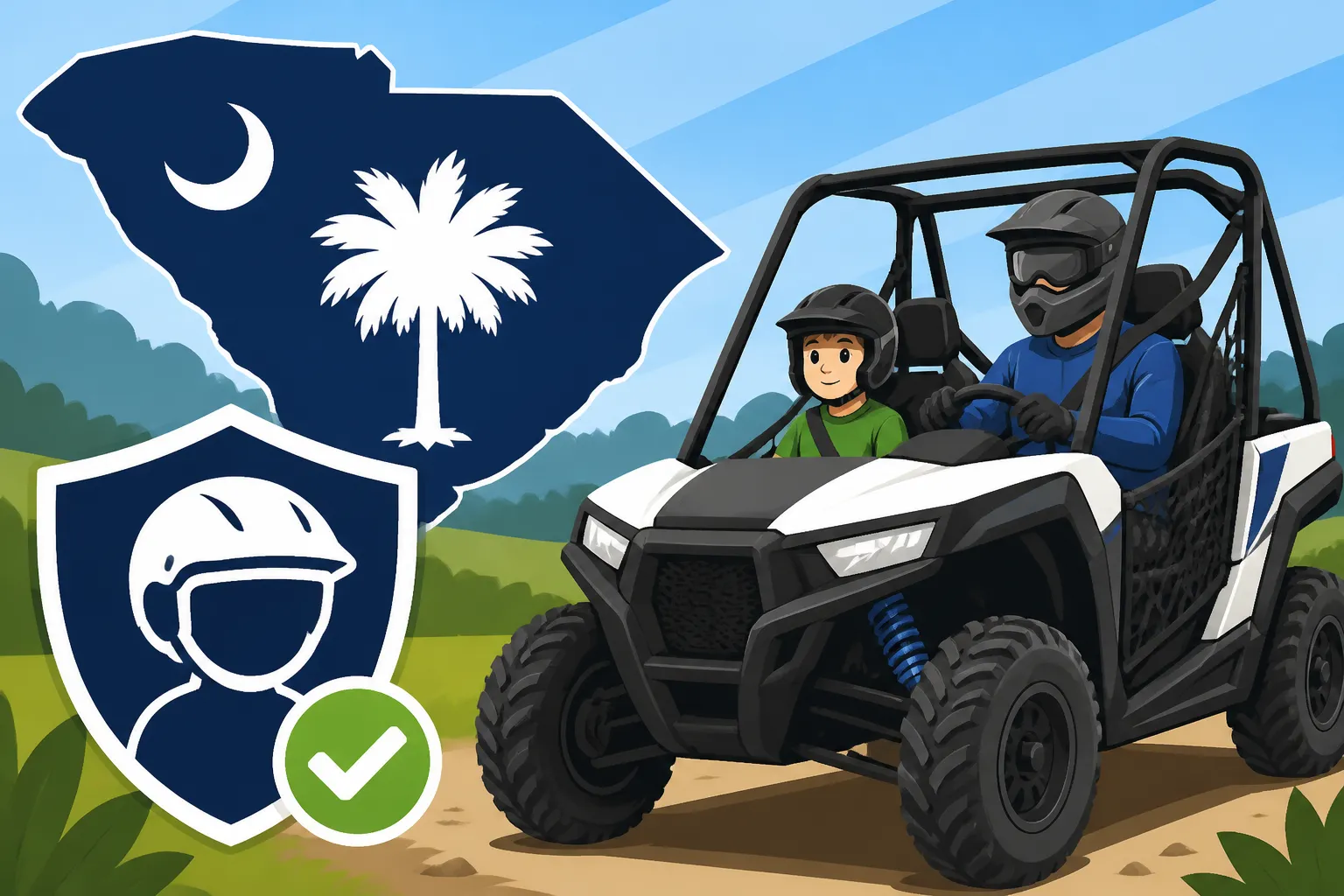
A UTV’s side-by-side seats and seat belts can make it more suitable for carrying passengers than a single-rider quad, but they do not mean every child can ride in every UTV. Follow the manufacturer’s stated seating capacity and age or size guidance. Use an actual passenger seat and the restraint system intended for that seat. Never put a child in a cargo bed, on a lap, or in a seat position without a suitable belt.
For an off-road UTV, check the landowner’s rules, the riding park’s requirements, and the vehicle manual. Parks may set a minimum passenger age or height, require helmets, or restrict passengers based on the vehicle’s seating configuration. Those rules can be more cautious than the minimum legal requirements. Call or check the venue’s current rules before hauling the vehicle and child to the entrance.
A UTV driven on a public road is a different situation from an off-road ride. South Carolina has a separate street-UTV framework, and its passenger-age, restraint, equipment, and operating rules should be checked before using public roads. Do not assume that a child who may ride in an off-road UTV is also allowed to ride in a street-driven one. The relevant requirements can depend on whether the vehicle and trip qualify under the current law. See South Carolina Street UTV Passenger Age Limits and South Carolina Street UTV Helmet Rules Under 21 for the road-use questions to verify.
Before any road trip, confirm that the vehicle is eligible for that use and that its passenger restraints and required equipment are in place. A child should use the belt provided for their seating position; an adult should not hold a child in place as a substitute for a restraint. If the belt cannot fit the child properly, do not take that child on the road in that seat. Check the current rules with the appropriate state office before relying on a registration or equipment interpretation.
Use this final check before a young passenger rides:
- Vehicle: Is it an ATV or UTV, and is that model designed for passengers?
- Seat: Does the child have a real passenger seat, foot support, and suitable restraints where required?
- Age: Are there age-specific rules for the passenger or the operator?
- Operator: If the operator is young, have you confirmed the applicable supervision and safety-course requirements?
- Location: Are you riding on private land, a public trail, at a park, or on a public road?
- Access: Does the land manager or park impose additional age, pass, or equipment rules?
- Fit and comfort: Can the child sit securely, follow instructions, and wear properly fitted protective equipment?
If any answer is uncertain, pause and confirm the rule before riding. The simplest safe decision is often not to carry a child on a one-rider ATV or to use a road-going UTV until its passenger and equipment requirements have been checked. A short delay is preferable to discovering at the trailhead—or during a ride—that the vehicle, passenger, or route does not meet the rules.
Disclaimer
This article is for general informational purposes only and does not constitute professional advice. Laws, prices and regulations vary by location and change over time. Consult a qualified professional for guidance on your specific situation.