South Carolina Safety Courses for Riders 15 and Under
A safety certificate is easy to mistake for a general riding permit, but it has a specific job: helping young ATV riders learn how to operate safely and meet South Carolina’s age-related rules. This guide explains who needs the course, which training counts, how the online and hands-on parts fit together, and what the certificate does not allow a rider to do.
Who needs a South Carolina ATV safety course
South Carolina’s youth ATV rules make safety training especially important for riders who are 15 or younger. In general, a rider under 16 needs to complete the qualifying ATV safety course and hold the required safety certificate. A child who turns 16 should not assume that every other rule disappears on their birthday: age restrictions, supervision rules, equipment requirements, and the rules for a particular riding area are separate questions.
The course is not just a formality to check off before a ride. It teaches young riders how to control an ATV, recognize hazards, and make better decisions before a small mistake becomes a serious injury. A young rider may know how to work the throttle and brakes but still need practice judging speed, choosing a safe line, or responding when the terrain changes.
For a broader view of age limits and related requirements, see South Carolina ATV Age Requirements. The training requirement is one piece of that picture, not a substitute for checking the rider’s age, the machine, the location, and any supervision rules that apply.
The certificate is for the rider, not the machine
A safety certificate belongs to the person who completed the course. It is not a registration sticker for an ATV, and it does not travel with the machine when it is sold or loaned to someone else. If two children take turns riding one ATV, each child who is subject to the course requirement should have completed the qualifying training.
This matters when families share machines. A parent may have finished a course years ago, and an older sibling may already have a certificate, but neither completion covers a younger rider. Before a family ride, check each child’s age and paperwork individually.
The course does not make every ride legal
Completing training does not give a rider permission to operate wherever they want. A certificate does not open a closed trail, replace a landowner’s permission, authorize riding on a public road, or satisfy a park’s separate entry conditions. South Carolina’s off-road rules and local access rules still apply.
For example, training does not make an ATV lawful to ride in a place where the land manager prohibits it. Wildlife management areas have their own vehicle restrictions; see South Carolina WMA Riding Is Prohibited. A private riding park may also set minimum ages, passenger limits, helmet requirements, or machine restrictions that are stricter than the state’s baseline rules.
The practical rule is simple: treat the certificate as proof of training, not as a universal riding permit.
Confirm how supervision applies to the ride
Safety training and adult supervision are related, but they are not interchangeable. Having an adult nearby does not necessarily replace a course certificate when the certificate is required. Likewise, completing the course does not necessarily remove supervision requirements.
South Carolina’s rules distinguish between a young rider operating on private land and operating in other settings, and the details can depend on age and circumstances. Review South Carolina Rules for a Supervising Adult and South Carolina Supervision Rules for Minors before relying on an assumption such as “the property is private” or “a parent is watching.”
A responsible adult should stay close enough to supervise effectively, not merely be somewhere on the property. That means being able to see or promptly reach the rider, understand the terrain and machine, and stop the ride if conditions become unsafe. Whether a particular arrangement meets a legal requirement is a separate question from whether it is good supervision.
Which course qualifies, and what training includes
For South Carolina’s youth ATV safety-certificate requirement, the reference list identifies an ATV Safety Institute course as the qualifying training. A generic online safety quiz, a dealer’s delivery demonstration, a school presentation, or a certificate from an unrelated recreational vehicle course should not be treated as equivalent without confirmation from the responsible authority.
That distinction can save a family from completing the wrong training. Before enrolling, check that the course is specifically the accepted ATV safety program and that its completion documentation is suitable for the South Carolina requirement. If a course provider describes a class as “ATV safety training” but does not clearly identify the recognized program, ask before paying or booking.
A course also has value beyond compliance. Good training gives a young rider a chance to learn and practice under instruction, rather than having their first serious lesson happen on a steep trail, in a muddy turn, or while trying to keep up with adults.
Online preparation comes before hands-on practice
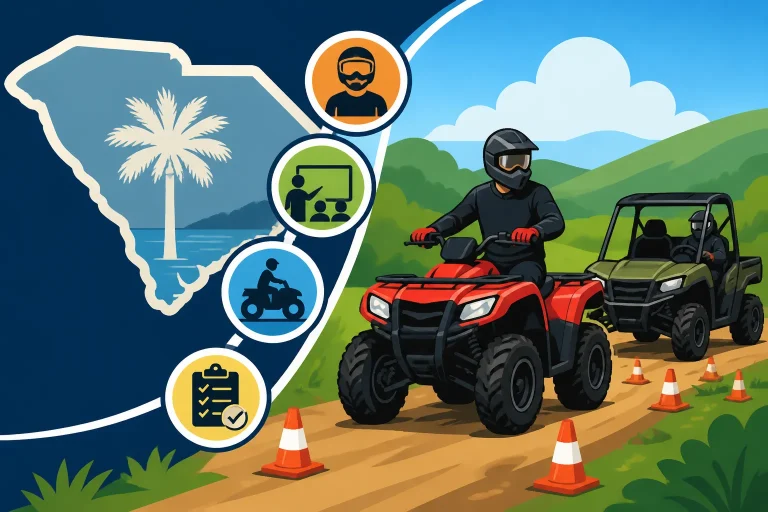
The course structure includes an online learning component before the practical riding session. The online part introduces core concepts and prepares the student for the in-person instruction. The sequence matters: complete the required online prerequisite first, then attend the hands-on portion as directed by the provider.
See South Carolina Online Course Prerequisite for more on that first stage. The online work is not a replacement for practical training. Reading about braking, posture, terrain, and turning is useful, but a young rider also needs to demonstrate control on an ATV with an instructor present.
Families should use the course provider’s instructions rather than guessing how much of the online work is required or whether a completion record has been received. If the online portion is incomplete, the student may not be ready to attend the practical session.
The hands-on session puts the lessons into practice
The in-person part is where students apply what they have learned. An instructor can observe how a rider starts, stops, turns, manages speed, and reacts to basic riding situations. This is especially useful for spotting habits that can be hard for a parent to notice, such as staring at the front tires instead of looking ahead or entering a turn too quickly.
The session is instruction, not a race or a chance to prove who is the boldest rider. A child who is nervous, physically too small for the machine, or not ready to follow directions should not be pushed through simply to obtain a certificate. The safer decision may be to wait, practice basic skills in an appropriate setting, or choose a machine that better fits the child.
Course details such as scheduling, age eligibility, equipment, and the format of the practical session can vary. Review the current provider instructions before making travel plans. For a fuller explanation of the practical component, see South Carolina Hands-On Course Length and What Happens at an ATV RiderCourse Session.
A course certificate is not a machine-size recommendation
Passing the course does not mean every ATV is an appropriate size for that child. A certificate shows that the rider completed the training; it does not guarantee that the child has the strength, reach, maturity, or experience to manage a particular machine in every condition.
Choose an ATV that the rider can control comfortably. They should be able to reach the controls, operate them without straining, and maintain a stable riding position. The machine should not be selected on the assumption that a child will “grow into it” while riding. More power and a heavier machine can make a loss of control harder to correct.
Also remember that an ATV is generally designed for one rider unless its manufacturer specifically designed it for more. Do not carry a passenger on a single-rider machine just because a child wants a parent or sibling along. The passenger rules for young riders are separate; see [South Carolina Rules for a Young Passenger].
How to complete the course without a last-minute scramble
Families often wait until a ride is planned to check whether a child has the right certificate. That can create avoidable stress: the online prerequisite may be unfinished, the next practical session may not fit the schedule, or the family may discover that the certificate they already have is for a different course.
A better approach is to treat training as part of preparing the rider, not as a final paperwork task. Use this sequence:
- Check the rider’s age and situation. Identify the rider’s age, the type of machine, where it will be ridden, and whether a certificate or supervision rule applies. Do not assume a rule for ATVs also covers UTVs.
- Confirm the accepted course. Verify that the program is the qualifying ATV safety course for South Carolina. Ask the provider directly if the course description or certificate language is unclear.
- Read the course instructions before registering. Check age eligibility, online requirements, practical-session arrangements, and what the student must bring.
- Complete the online prerequisite. Make sure the student finishes the required online work and retains any completion confirmation the provider issues.
- Attend the hands-on session. Arrive with the requested equipment and give the student enough time to get comfortable with the setting and instructions.
- Keep the certificate and a backup record. Store the original or official completion document safely, and keep a digital copy if the provider’s terms permit it.
- Check the riding location separately. Confirm access, pass, supervision, machine, and equipment rules for the trail or property where the child will ride.
This sequence helps distinguish course completion from ride planning. A family may have the right certificate and still need a trail pass, written permission, or other site-specific approval.
What to ask before enrolling
A short phone call or careful review of the provider’s course page can prevent a wasted trip. Ask:
- Is this the ATV Safety Institute course accepted for South Carolina’s youth certificate requirement?
- Does the student need to complete an online prerequisite first?
- What record or certificate will the student receive?
- What equipment or clothing must the student bring?
- Does the student need to bring an ATV, or is a training machine provided?
- What happens if weather, illness, or a scheduling problem prevents attendance?
- How can a family verify that the student’s completion record is available?
The provider’s answers should be clear. If they cannot confirm that their training meets the state requirement, do not rely on a vague assurance that the course is “recognized” or “good for ATV riding.” Ask the appropriate official source or select a provider that can explain the qualification.
Keep the paperwork easy to find
A certificate that is buried in an email account is hard to produce when someone asks for it. Save the completion record with the child’s important riding documents. A parent can keep a printed copy in a safe place and a digital copy on a phone, but should not assume that a screenshot or photo will satisfy every request.
The state-specific details about whether a record can be looked up, what information is needed, and how to handle a lost document should be confirmed through [South Carolina Safety Certificate Lookup]. If the student’s name is misspelled or other information is wrong, contact the course provider before the next ride rather than waiting until a check or incident.
What the certificate does and does not cover
Families sometimes use the word “permit” for several different things: a safety certificate, a forest pass, a park entry pass, a vehicle registration, or permission to use private land. Those documents serve different purposes. Getting one does not automatically satisfy the others.
| Document or approval | What it generally addresses | What it does not do |
|---|---|---|
| ATV safety certificate | Proof that the rider completed qualifying safety training | Does not grant access to a trail or authorize public-road riding |
| Landowner permission | Permission to use private property under the landowner’s conditions | Does not replace safety training or other legal requirements |
| Public-land or trail pass | Access or fee compliance for a specific riding area | Does not prove the rider completed a safety course |
| Private park pass | Entry under the park’s current rules | Does not override age, passenger, equipment, or machine restrictions |
| ATV title or ownership paperwork | Documents ownership or a title record where applicable | Does not function as a rider’s certificate or riding pass |
| Street-vehicle registration | Applies to a vehicle class and permitted road use where authorized | Does not turn an off-road ATV into a street-legal vehicle |
The table is a practical distinction, not a substitute for checking the current rules for a specific location or vehicle. Before riding in a national forest, for example, confirm both the current access requirements and the machine’s eligibility. South Carolina National Forest OHV Passes explains why a trail pass is separate from a rider’s training record.
A safety certificate is not a forest pass
A child can complete training and still need to meet the pass requirements for the riding area. Forest passes may be tied to an individual rider, a vehicle, a plate, or another condition depending on the pass type and current rules. Do not assume that one family member’s pass covers every rider, or that a safety certificate substitutes for a pass.
This is especially important when several family members share a machine or when a child rides with a parent who has already purchased a pass. Check the pass rules before leaving home. The certificate proves training; the pass addresses access or fee compliance.
It is not a golf cart permit or a street UTV credential
An ATV course is not a general vehicle license. It does not authorize an ATV to use public streets, and it does not replace any age, license, insurance, registration, or equipment requirement that applies to a street-legal vehicle class.
A UTV or side-by-side also differs from an ATV. They have different controls and handling characteristics, and road-use rules may be different. Completing an ATV course should not be treated as proof that a young rider meets the separate requirements for operating a UTV. Review South Carolina Street UTV Rules From November 2026 and South Carolina Street UTV Age of 17 for the distinct street-UTV questions, and confirm current effective dates and requirements before relying on them.
Likewise, golf carts and low-speed vehicles have their own rules. A child’s ATV certificate does not provide a golf cart permit or authorize road use. Keep each vehicle class and each document separate.
Training, riding rules, and good supervision
A course certificate helps establish that a young rider has received formal instruction. It does not mean the child is ready for every trail, nor does it transfer the adult’s responsibility to the child. Parents and supervising adults still need to make decisions about the rider, machine, weather, terrain, and the behavior of the group.
Match the ride to the student’s ability
Start with a low-pressure setting where the rider can practice without traffic, steep slopes, deep mud, or a crowd of faster machines. A child who has just completed a course should not be expected to ride at the pace of experienced adults. Choose terrain and distances that leave room to stop, rest, and turn back.
Watch for signs that the ride is becoming too difficult: repeated missed turns, poor throttle control, fatigue, a tense grip, trouble following directions, or a growing tendency to rush to catch up. Take a break before the child is exhausted. If the child cannot comfortably control the machine, end the ride rather than treating it as a confidence problem to push through.
A useful parent check is whether the young rider can explain the basic plan before starting: where the group is going, what to do if separated, how to signal a problem, and when to stop. If the child cannot follow the plan, simplify the ride.
Use appropriate protective equipment
A course does not supply a lifetime set of riding gear, and owning protective equipment does not replace the course. Use a properly fitting helmet that meets the applicable standard, eye protection, gloves, long sleeves, long pants, and sturdy over-the-ankle footwear suited to the conditions. Check that the gear fits the child now; a helmet that is too loose is not a safe bargain.
Families may shop locally, through a dealer, or on Amazon, but the important task is verifying fit, condition, and the relevant safety standard rather than choosing by appearance. If buying online, check the sizing guidance and return policy before ordering, and inspect the helmet when it arrives. Do not use a helmet that has taken a significant impact or has visible damage.
For children, fit changes quickly. Recheck the helmet and protective clothing as the rider grows. Make sure eye protection stays in place, gloves do not interfere with controls, and boots do not prevent the child from operating the foot controls.
Review the ATV’s condition before each ride
Young riders should be taught that a safe ride begins before the engine starts. An adult should inspect the ATV for obvious damage, check that the controls work, and confirm that tires and brakes are in usable condition. Make sure the machine is appropriate for the terrain and that any required equipment is functioning.
Teach the rider to stop and tell an adult about a new noise, loose control, leak, or change in how the machine handles. A child should never feel pressured to keep going because the group is waiting or because the problem seems small. Mechanical issues that seem minor in a driveway can become serious on a remote trail.
For equipment-specific details, use South Carolina Equipment Requirements for ATVs and South Carolina Lighting Requirements on a Machine. The exact requirements may depend on where and how the ATV is used, so do not treat a training certificate as an inspection sticker.
Make supervision active and predictable
Before the ride, agree on simple rules: no passing the adult, no leaving the group, no riding beyond the agreed area, and stop immediately when signaled. Keep the group small enough that the adult can actually monitor the young rider. A large group spread across a trail makes close supervision difficult.
An adult should also plan for separation. Choose a meeting point, make sure the child knows not to continue riding alone, and discuss what to do if the group is out of sight. In places with poor cell reception, do not rely on a phone as the only safety plan.
Passengers create another avoidable risk. Do not carry a child on a single-rider ATV or allow a young rider to carry someone else where the machine is not designed for a passenger. Passenger rules can depend on the rider’s age, license status, vehicle design, and setting. Review [South Carolina Passenger Rules for Minors] before a child rides with anyone.
Common questions from parents and young riders
Does an online course alone meet the requirement?
The course structure includes an online prerequisite followed by hands-on instruction. Do not assume that completing the online material by itself earns the required certificate. Follow the recognized course provider’s process through completion and obtain the proper documentation.
Can a school, dealer, or private instructor issue an equivalent certificate?
Not automatically. A lesson may be useful, but a general safety talk or informal demonstration is not necessarily the accepted course. Confirm that the program is the qualifying ATV Safety Institute training before registering. If a different provider says its certificate counts, verify that claim with an authoritative source before relying on it.
Does the certificate expire?
Do not guess. Check the certificate itself and the current instructions from the course provider or relevant state authority. Even if a certificate remains valid for a particular legal purpose, a rider may benefit from refresher training after a long break, a move to a different machine, or a change in riding conditions.
Does the certificate cover a sibling or friend?
No. Training is completed by an individual rider. A sibling’s certificate does not cover another child, even if they ride the same ATV or live in the same household. Each rider needs to meet the requirements that apply to them.
Does the course let a child ride alone?
Not by itself. The certificate addresses training; it does not erase age-based supervision requirements or make solo riding safe. Check the rules that apply to the child’s age and the location, then use active adult supervision even when the legal rules allow a particular arrangement.
Does a certificate let a child ride on a road?
No. An ATV safety certificate does not make an off-road ATV street-legal. Road use depends on the vehicle class and applicable road rules, not just the rider’s training. The safest approach is to treat any road crossing or road travel as a separate legal question and confirm the rules before riding.
What if the certificate is lost?
Contact the course provider and ask how to retrieve or replace the completion record. Keep any enrollment confirmation, student details, or other information the provider requests. Before the next ride, make sure the replacement documentation is available in a form the provider or relevant authority accepts.
Is the course useful if the child rides only on private land?
It can be. Private land does not eliminate the value of learning braking, turning, terrain awareness, and safe habits. The exact legal requirements and any exceptions can depend on the circumstances, so do not infer that private property automatically removes every rule. Check South Carolina Farm and Ranch Exemptions and the relevant rules for the land and activity.
Should the child take the course before buying an ATV?
That is often a sensible order. Training can help a family think more clearly about machine size, control, and the child’s readiness before spending money. It also gives the young rider a chance to learn that an ATV is not a toy or a passenger vehicle. If the child is not comfortable with the course or cannot follow instruction, pause before buying or riding.
What should we do if the course and a park’s rules differ?
Follow the requirements that apply to the specific activity and location. A park can set its own access conditions, and a public agency can have separate rules for its land. A state safety certificate does not force a park to admit a rider who does not meet its age, equipment, or machine conditions. Contact the park or land manager before traveling.
A practical checklist before the next ride
Before a young rider heads out, check the training record and the ride plan together. A quick review can catch problems that are easy to miss when everyone is focused on loading the trailer.
- Confirm the rider’s age and whether the certificate requirement applies.
- Verify that the completed course is the qualifying training and that the certificate is available.
- Check the rules for the specific riding area, including access, passes, and closures.
- Confirm that the ATV is suitable for the child and is designed for the number of riders.
- Inspect the machine and protective equipment.
- Review supervision, route, stop signals, and what to do if separated.
- Set a pace and distance the young rider can manage without pressure.
- Recheck the plan if weather, trail conditions, or the group changes.
Keep the lesson behind the certificate in view: safe riding depends on judgment and habits, not just paperwork. A young rider who knows when to slow down, ask for help, or stop is better prepared than one who treats the certificate as permission to take on a difficult ride.
Disclaimer
This article is for general informational purposes only and does not constitute professional advice. Laws, prices and regulations vary by location and change over time. Consult a qualified professional for guidance on your specific situation.