South Carolina Public Land Compared to Private
South Carolina riders often assume that “public land” means open riding, or that one trail pass covers every place they unload. Neither is a safe assumption. Access depends on the land manager, the specific route, and the site’s rules. Here’s how public-land permits compare with private-land permission and park admission, and what to check before you ride.
Public land does not mean open riding
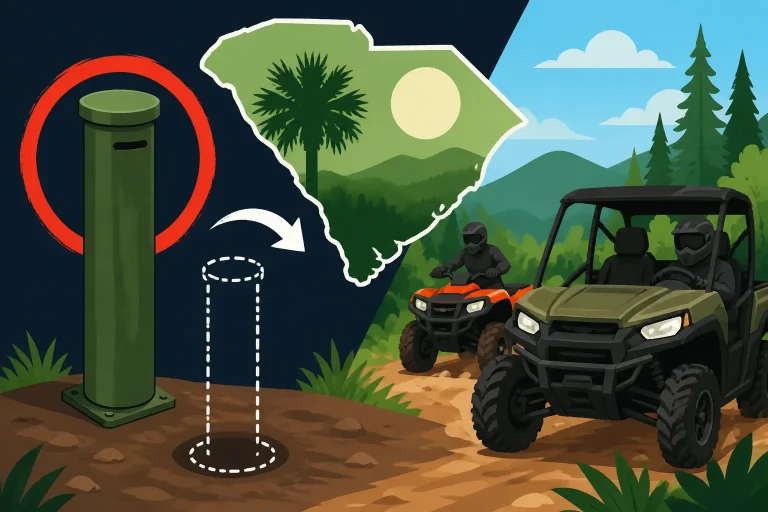
South Carolina public land includes places managed for different purposes, with different rules. A national forest trail, a wildlife management area, and a public road are not interchangeable riding areas. A land manager may allow motorized use on a designated trail while prohibiting it elsewhere on the same property.
The practical rule is to identify the exact place and route before loading your machine. A map showing forest boundaries does not show that every road, trail, or clearing is open to ATVs or UTVs. Signs, gates, seasonal closures, vehicle-width limits, and current land-manager notices can all affect access.
National forest trails
Designated OHV trails on national forest land are a common public-land option, but riders should confirm that the specific trail is open to their type of machine and that any required pass is in order. Trail access can depend on vehicle dimensions and the trail’s designation. A route that permits motorcycles or narrow ATVs may not be suitable or open to a full-size side-by-side.
The pass requirement is separate from the question of whether the trail is open. A pass does not make a closed trail legal to ride, and it does not authorize travel beyond the trail system. Check current trail information and pass requirements before the trip; weather, maintenance, and other conditions can change access. For a broader explanation of the pass system, see South Carolina National Forest OHV Passes and South Carolina Passes Cover All Four Trails.
Keep the pass and any required vehicle or rider information available in the manner the land manager specifies. If you are unsure whether your machine qualifies for a trail, check the trail’s current rules rather than relying on its name or on what another rider used there.
Wildlife management areas
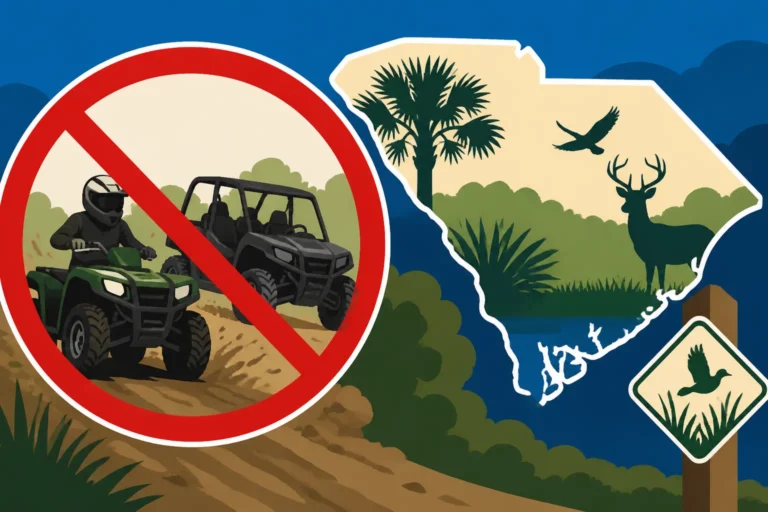
Wildlife management areas have their own access rules, and a hunting license does not automatically open them to ATV riding. South Carolina’s general wildlife management area rules prohibit ATV use, subject to the narrow exceptions that may apply under law or specific management conditions. Do not assume that a path, forest road, or hunting access point is available to recreational machines.
That distinction matters for riders who want to reach a hunting spot or retrieve game. Permission to hunt, a hunting license, or a public-land pass is not, by itself, permission to drive an ATV across a WMA. Check the specific area’s rules and any applicable exception before planning a route. See South Carolina WMA Riding Is Prohibited and South Carolina Hunting License and Land Access.
Public roads are a separate category
A road that crosses public land is not automatically an OHV trail. It may be a public road with separate vehicle and licensing requirements, a restricted management road, or a route closed to motorized recreation. Likewise, a trail pass is not a road registration or a license plate.
Treat these as separate questions:
- Is the land open to the public?
- Is motorized use allowed on this particular route?
- Is your type and width of machine permitted?
- Does the route require a pass, registration, or other documentation?
- Is the route currently open?
Answering only the first question is not enough. For road use, vehicle laws apply independently of access permission. For off-road routes, follow the land manager’s designation and posted restrictions.
Private land requires the owner’s permission
Private property can include a family farm, hunting lease, timber tract, or commercial riding park. The fact that land looks unused, has an unmarked track, or has been ridden before does not establish permission. Ask the owner or authorized land manager before entering, and be clear about where you may ride, when access is allowed, and whether passengers or guests are covered.
Written permission is especially useful when access is informal or when several riders will use the property. It can help prevent misunderstandings about boundaries, gates, dates, permitted machines, and activities. A landowner’s approval should identify the property or route clearly enough that riders can follow it without guessing. For practical considerations, see South Carolina Landowner Permission Forms and South Carolina Timber Land Access.
Private parks set their own entry rules
A commercial riding park is private land, even when it welcomes the public for paid riding. The park’s admission pass, waiver, vehicle rules, age requirements, and trail restrictions govern access there. A national forest pass does not pay for admission to a private park, and private-park admission does not satisfy a national forest pass requirement.
Park policies can differ substantially. One site may have trails suited to a particular machine type, while another may limit access by width, age, passenger arrangement, or riding area. The park may also set rules for helmets, alcohol, camping, pets, recovery, and quiet hours. Confirm the current rules directly before traveling, particularly if you have a youth rider or a wide side-by-side. See South Carolina Private Park Passes and Rules.
Farms and leases are not automatically riding areas
A farmer or hunting-club member may have permission to be on a property for work or a specific activity without having permission to ride recreationally across it. Permission given to one person does not necessarily extend to guests, family members, or a group. Ask who is authorized to approve riding, and do not treat a hunting lease or work arrangement as blanket ATV access.
When permission is granted, clarify where the machine can go. A farm lane may lead to a field, but that does not mean every field, creek crossing, or neighboring parcel is included. Keep gates as instructed, avoid crops and livestock, and stay off areas the owner has excluded.
| Access question | Public land | Private land |
|---|---|---|
| Who controls access? | The agency or land manager responsible for the property | The owner, leaseholder, or authorized park operator |
| Does public access mean ATV access? | No. Motorized riding may be limited to designated routes or prohibited | No. Entry and riding require permission or park admission |
| What may be required? | A trail pass, compliance with route and vehicle rules, and current open status | Owner permission or park admission, plus the site’s rules |
| Does a pass transfer to another place? | No. A pass applies only as defined by the issuing program | No. Admission applies to the private site and terms purchased |
| What should you check? | Trail designation, machine eligibility, closures, pass rules, and signs | Permission, boundaries, dates, allowed machines, and park policies |
Passes and permissions do not travel between properties
A frequent source of confusion is treating every form of access as a general ATV permit. It is not. A national forest OHV pass, a private park admission pass, landowner permission, a hunting license, and vehicle paperwork each serve different purposes. One does not replace the others.
For example, a rider who has paid for a private park visit still needs whatever pass or authorization applies to a national forest trail on a different day. Conversely, holding a forest pass does not grant entry to a private park or permission to cross private property to reach a trailhead.
The same principle applies to out-of-state riders. A registration, plate, or permit from another state does not automatically provide access to South Carolina public or private land. The land manager’s rules still apply, as do South Carolina’s relevant vehicle and safety requirements. Visitors should confirm both access and machine requirements before riding; South Carolina Visitors From North Carolina and South Carolina Visitors From Georgia address visitor questions.
Nor does proof that you own a machine establish permission to ride it on a particular property. Keep ownership documents available if relevant, but do not confuse them with an access pass. For that distinction, see South Carolina Proof of Ownership on the Trail.
A useful way to plan is to keep two checklists:
- Machine and rider compliance: Is the machine permitted on the route, and do the rider and vehicle meet the applicable requirements?
- Land access: Is the property open to riding, is this specific route allowed, and do you have the required pass or permission?
Both answers need to be yes. A pass cannot override a closure, and owner permission cannot override a safety or vehicle rule that applies to the ride.
A pre-ride check that prevents access problems
Before heading out, identify the land manager or property owner and confirm the exact riding area. Then verify whether your machine is allowed, what pass or permission is required, and whether the route is currently open. Avoid relying on old maps, social media posts, or another rider’s account when rules may have changed.
Use this short process:
- Pin down the destination. Get the trail or property name and the access point, not just the town or forest.
- Identify who manages it. Determine whether it is national forest, WMA, another public property, private land, or a commercial park.
- Check the route rules. Confirm that motorized use is allowed and that the machine’s type and dimensions fit the route.
- Verify the current pass or permission. Buy or obtain the right authorization for that location. For private land, confirm permission with someone authorized to grant it.
- Check for closures and restrictions. Look for current land-manager notices and on-site signs. A route that was open on a previous visit may not be open now.
- Keep access separate from road legality. If the ride includes public-road travel, check the vehicle rules for that road; an off-road pass does not authorize road use.
- Carry the required proof. Have the pass, permission details, or other documentation available as the land manager requires.
If a route is not clearly designated for your machine, ask before entering. If permission is verbal, repeat the boundaries and conditions back to the person granting it, and consider requesting written confirmation. If the answer is uncertain, choose a clearly authorized riding area instead.
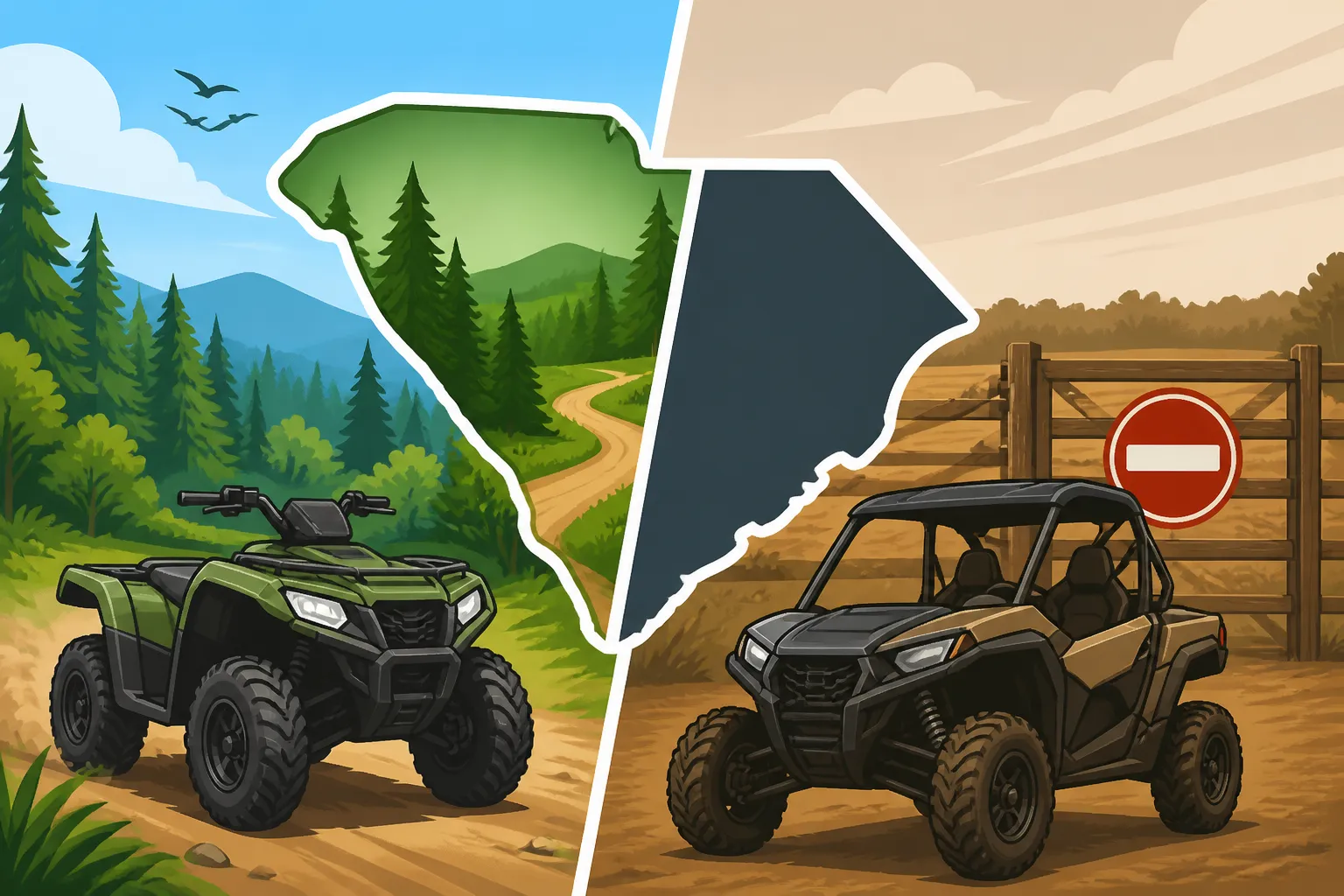
The simplest distinction is this: public-land access is controlled by the managing agency and its route rules; private-land access is controlled by the owner or operator. Neither category offers blanket permission to ride anywhere. Confirm the site, route, machine limits, and required authorization separately, and you are far less likely to arrive at a gate you cannot legally pass.
Disclaimer
This article is for general informational purposes only and does not constitute professional advice. Laws, prices and regulations vary by location and change over time. Consult a qualified professional for guidance on your specific situation.