Take the Online Course Before the Riding Course
South Carolina riders can’t always go straight from signing up to the hands-on ATV course. The online portion may need to come first, and completing it does not necessarily mean you have finished the training required for a safety certificate. Here’s how to plan the sequence, avoid a wasted trip, and check that the course fits the rider’s age and situation.
Why the online course comes first
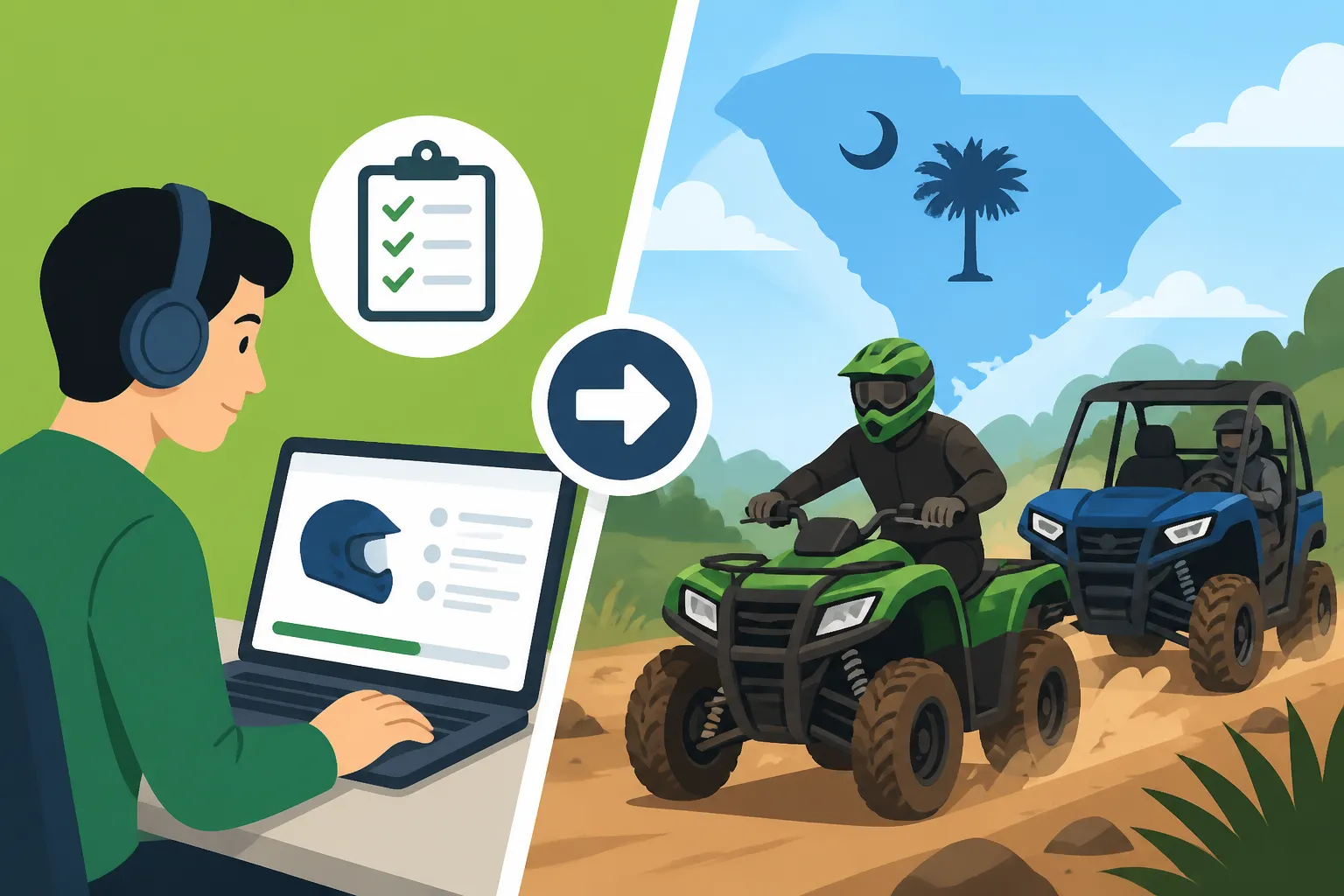
For some ATV safety training, the online course is a prerequisite to the in-person riding session. It introduces safety concepts before a student gets on a machine, so the instructor can spend the practical session on riding skills instead of starting with every basic topic.
That order matters if you are booking for a young rider or need a certificate to meet South Carolina’s rules. Do not assume that registering for the riding course gives you access to the online material automatically, or that finishing the online material alone completes the entire course. Check the provider’s instructions and identify each required part before you choose a date.
South Carolina’s requirements depend on the rider’s age and circumstances. Riders 15 and under have a safety-course requirement under state law, but the course needs to meet the applicable standard. The South Carolina Safety Certificate Requirements explain why it is important to confirm that the training counts before relying on it.
The online module and the hands-on course serve different purposes:
| Course stage | What it is for | What to confirm |
|---|---|---|
| Online course | Covers foundational safety information before the practical session | Whether it is required, how to access it, and how completion is recorded |
| Riding course | Gives the student practical instruction on an ATV | Which machine and protective equipment are needed, and where to report |
| Certificate or completion record | Shows that the required training was completed | Whether the provider issues it and how the rider should carry or retrieve it |
The sequence can be easy to misunderstand because “online course” and “riding course” may sound like two interchangeable options. They are not necessarily alternatives. If the provider describes the online work as a prerequisite, plan to complete it before the in-person session. The South Carolina Online Course Prerequisite covers that order, while The Two-Hour Online Course That Comes First explains the online component in more detail.
Also distinguish a training certificate from a permit or land-access pass. A safety course does not by itself authorize riding on private property, open a closed trail, or replace a pass required for a particular riding area. Likewise, buying a forest pass does not satisfy a rider-training requirement. For public-land access, review South Carolina National Forest OHV Passes separately.
How to complete the online portion without slowing down the riding session
Treat the online course as scheduled preparation, not as an optional form to open at the last minute. Before starting, read the provider’s enrollment and completion instructions. Providers may handle logins, progress records, and practical-course signups differently, so use the instructions for the specific course you booked.
1. Confirm the course is the right one
First, ask whether the course qualifies for the South Carolina requirement that applies to the rider. Do not rely only on a course title that includes “ATV safety.” A course may be useful for general knowledge without being the course required for a particular certificate.
For riders 15 and under, check that the program meets the applicable state standard and that it includes every required component. The South Carolina Safety Courses for Riders 15 and Under page can help clarify the age-specific context. If you are unsure whether a provider’s course qualifies, contact the provider or the appropriate state office before paying or reserving travel.
2. Enroll and save the login details
Use the same rider information you plan to use for the hands-on session. A mismatch in names, birth dates, or account details can make it harder to connect the online completion record to the practical course.
Save the confirmation email, login information, and any instructions for returning to unfinished work. If a parent or guardian is helping a minor, keep the account information accessible without completing the course on the student’s behalf. The student needs to engage with the material and show their own understanding.
3. Set aside uninterrupted time
The online course may take longer than expected if the rider pauses repeatedly, has trouble accessing the system, or needs to review material. Choose a time when the student can focus rather than trying to finish it in short bursts immediately before leaving for the in-person session.
A quiet place and a reliable internet connection help. Keep a notebook nearby for questions about protective gear, controls, trail behavior, or the rules that apply to the rider. The purpose is not merely to reach the final screen; it is to arrive at the riding session ready to apply what the online material covered.
4. Finish every required step and keep proof
At the end, follow the course’s instructions for recording or confirming completion. Some systems provide a completion page or record; others may send confirmation through an account or email. Save whatever the provider supplies and bring it if the course instructions ask for it.
Do not assume the hands-on instructor will be able to see an online record automatically. Before the session, ask whether you need to show a confirmation, provide a completion number, or bring another document. The South Carolina Safety Certificate Lookup may also be useful when you need to understand how certificate information is handled, but follow the provider’s instructions for the specific course you completed.
What to check before the in-person riding course
Once the online work is done, the next task is making sure the rider is prepared for the practical session. The in-person portion is not just a formality. It is where the student applies safety ideas to a real machine and receives instruction on operation.
The What Happens at an ATV RiderCourse Session page describes the practical side of the course. Before the session, use the provider’s checklist rather than guessing about equipment or arrival requirements.
Confirm the machine and equipment requirements
Ask whether the course provides an ATV or expects the student to bring one. If the student must bring a machine, confirm the allowed type and size, and ask whether it needs to be in safe operating condition before arrival. A machine that does not meet the provider’s requirements can prevent the student from participating.
Check the required protective equipment, too. Ask what the student must wear and whether the provider has any equipment available. Even if the online course discussed helmets and other protective gear, the in-person provider sets practical participation instructions. Bring the exact items requested rather than assuming that a general-purpose alternative will be accepted.
Confirm arrival time and parent or guardian rules
For a minor, ask whether a parent or guardian must attend, stay on site, sign a consent form, or provide other information. The expectations may differ by provider and course location. Confirm them before arranging transportation, especially if the adult plans to leave during the session.
Age also affects riding rules beyond the training course. A certificate does not cancel requirements for adult supervision or other restrictions that apply to young operators. Review South Carolina Rules for a Supervising Adult along with the course details so the family understands what applies after training.
Ask what happens if the rider is not ready
If the student has not completed the online prerequisite, arrives without the required gear, or brings a machine that does not meet the course criteria, the provider may not be able to place them in the practical session. Ask in advance how to reschedule and whether the online work remains valid for a later date.
This is especially important when the course location is far from home. A quick confirmation call or email can prevent a trip that ends before the student gets on the ATV. Keep the provider’s contact details and confirmation message with the course records.
For a younger student, consider whether the practical session is a good fit for their current ability and attention span. A course may satisfy a training requirement, but readiness still matters. The age-specific overview in South Carolina Safety Course for a 12-Year-Old can help families think through questions to raise with the provider.
Common mistakes and a simple pre-course checklist
Most avoidable course problems come from confusing the online prerequisite with the full course, assuming every ATV class qualifies, or overlooking the practical session’s requirements. A little checking before enrollment keeps those issues from turning into a missed class.
Common mistakes include:
- Stopping after the online module. If the provider requires a hands-on session, the online portion alone may not complete the course.
- Choosing a course based only on its name. Ask whether it meets the South Carolina requirement relevant to the rider.
- Assuming online completion transfers automatically. Confirm how the provider records completion and what the student must show at the riding session.
- Waiting until the night before. Leave enough time to resolve login, scheduling, and equipment questions.
- Guessing about machine or gear requirements. Get the provider’s specifications before loading a machine or buying equipment.
- Treating the certificate as permission to ride anywhere. Training, landowner permission, trail access, and any required passes are separate matters.
Use this checklist before the course date:
- Confirm the rider’s age and which training requirement applies.
- Verify that the chosen program qualifies for that requirement.
- Ask whether the online portion must be completed before the riding session.
- Enroll using the rider’s correct information and save the login details.
- Complete the online material early enough to handle technical problems.
- Save proof of completion and ask whether it must be presented in person.
- Confirm the machine, clothing, protective gear, and arrival-time requirements.
- Ask whether a parent or guardian must attend or remain on site.
- Keep the provider’s contact information and rescheduling instructions.
- Review the rider’s separate age, supervision, and land-access rules before the first ride.
If you are comparing providers, ask the same questions of each one. The [South Carolina Course Providers] page is a useful starting point, but confirm current availability and course details directly with the provider. Course dates, locations, enrollment steps, and equipment instructions can change.
A well-planned sequence is straightforward: verify that the course qualifies, complete the online prerequisite, preserve the completion record, and arrive prepared for the practical session. That approach gives the student the best chance to finish the training without a preventable delay—and helps the family understand what the certificate does and does not authorize.
Disclaimer
This article is for general informational purposes only and does not constitute professional advice. Laws, prices and regulations vary by location and change over time. Consult a qualified professional for guidance on your specific situation.