Retrieving a Deer on Carolina Private Ground
Retrieving a deer on private ground in South Carolina can be easier with an ATV or UTV, but private land does not make every ride automatically lawful. The key is having permission, staying within the rules for hunting-related use, and keeping the recovery route off public roads and closed public lands. Here’s how to plan a careful retrieval without turning a short trip into a legal or safety problem.
Start With Permission and the Right Land
Before taking a machine into the woods, confirm that you have permission to use it on the specific property. Permission to hunt does not always mean permission to drive an ATV or UTV, cross another person’s land, or use a particular road or trail. If you hunt through a club, lease, or family arrangement, check the rules with whoever controls vehicle access.
Be clear about the route, too. A property owner may allow you to retrieve a deer from one section but not drive through a planted field, cross a creek, or enter a neighboring parcel. If the deer is down near a boundary, do not assume that your hunting permission carries across the line. Ask the adjacent owner before crossing onto their land or moving the animal.
South Carolina’s ATV law includes hunting-related exemptions, but an exemption is not a general pass for any off-road ride. The details and limits matter. Read How Hunting and Trapping Escape Chandler’s Law and South Carolina Farm and Ranch Exemptions for context, and confirm the current requirements before relying on an exemption. A trip that is genuinely part of a hunt or deer retrieval may be treated differently from recreational riding, but that does not erase property boundaries, landowner rules, or other applicable laws.
This distinction is especially important if your route reaches a public road. Rules for operating on private ground do not automatically authorize riding on a public road, shoulder, or right-of-way. If you need to travel between properties or use a public road to reach a recovery site, stop and check the rules that apply to that route. Can You Ride an ATV on the Road in South Carolina? covers the separate road-use question.
Public wildlife lands are another important boundary. Do not assume that a hunting license or permission to hunt makes an ATV or UTV route available on a Wildlife Management Area. South Carolina WMAs generally restrict ATV use, with narrow exceptions that should not be guessed at. Check South Carolina WMA Riding Is Prohibited and The Hunting Exemption in South Carolina’s ATV Act before planning a recovery route that touches public land.
| Situation | What to check before moving the machine |
|---|---|
| Deer is on private land where you hunt | Confirm the landowner or lease allows machine access for recovery |
| Deer is near a property boundary | Get permission before crossing onto the adjoining parcel |
| Route uses a public road | Check road-use rules separately; private-land permission does not authorize road riding |
| Route enters a Wildlife Management Area | Verify current vehicle restrictions with the land manager before bringing an ATV or UTV |
| Recovery is part of a hunt | Confirm the relevant hunting-related exemption and any limits that apply |
| Another person will operate the machine | Make sure that person meets applicable age, supervision, and safety requirements |
When in doubt, get permission in a form you can keep, such as a text message or written note. A quick confirmation can prevent an avoidable disagreement later, especially when a lease has several hunters, a property has multiple owners, or the recovery route passes near neighboring land.
Plan the Recovery Before Driving In
A machine can save effort, but driving directly to a downed deer is not always the safest or least damaging option. Walk or inspect the route first when practical. Look for steep slopes, soft ground, hidden ditches, wire, stumps, streams, and areas where the machine could become stuck. Wet conditions can turn a route that was passable on the way in into a difficult recovery on the way out.
Choose the smallest suitable machine and the least damaging route. A compact ATV may fit between trees or along a narrow trail where a wider UTV cannot. A UTV may offer more room for a passenger and equipment, but its width and turning radius can make tight woods harder to navigate. Avoid cutting a new path just to save a few minutes. Ruts and torn ground can create problems for the owner and for anyone using the property afterward.
If the deer is a distance from a safe route, consider bringing it to the machine by hand or using a drag rather than driving the machine through sensitive ground. The practical choice depends on the terrain, the animal’s location, available help, and the property owner’s instructions. Never let pressure to recover an animal quickly override safe operation or permission.
A useful pre-trip routine is:
- Confirm the deer’s location as accurately as possible and identify the property boundary.
- Ask the landowner or lease contact which route and machine are permitted.
- Check whether the planned route crosses a public road, public land, a stream, or another parcel.
- Assess terrain, weather, daylight, and whether another person should accompany you.
- Bring recovery gear suited to the machine and the route.
- Tell someone where you are going and when you expect to return.
- Stop if conditions differ from what you expected or the route becomes unsafe.
Keep the machine on established, authorized paths where possible. Avoid riding through crops, soft streambanks, planted areas, and places where tires could cause erosion. A route that looks dry from the seat may still be too soft to support the machine without damage. If the owner has marked a trail or asked riders to avoid an area, follow that direction even if another way looks shorter.
For a creek or watercourse, do not treat a convenient shallow-looking spot as permission to ride through the water. South Carolina has specific rules concerning watercourse crossings, and the landowner’s permission alone may not answer whether a crossing is allowed. Review South Carolina Watercourse Crossing Rules before planning a route that involves a stream. If you cannot confirm that the crossing is lawful and safe, choose another route or move the deer without taking the machine through the water.
Bring equipment that fits the job rather than improvising with whatever is available. Useful items may include gloves, a suitable drag or sled, a first-aid kit, a flashlight, a phone, and straps rated for the load. A waterproof bag can keep small essentials dry; Amazon is one place people look for basic recovery and storage gear, but check product specifications and fit rather than choosing by appearance alone. Do not use a strap, winch, or hitch point unless it is appropriate for the load and the machine.
Move the Deer Safely and Without Overloading the Machine
Once you reach the deer, take a moment to check the situation before loading or towing anything. Make sure the firearm is handled safely and secured according to the circumstances. If other hunters are present, coordinate who is moving the machine, who is handling the animal, and where everyone should stand. Keep people clear of a taut strap and away from a moving vehicle.
Do not exceed the machine’s rated cargo or towing capacity. The capacity can be affected by passengers, tools, and other cargo already on board. A deer’s weight, combined with gear, may be enough to make an ATV unstable or put excessive strain on a rack, hitch, or winch. Consult the machine’s owner manual for its limits and proper attachment points.
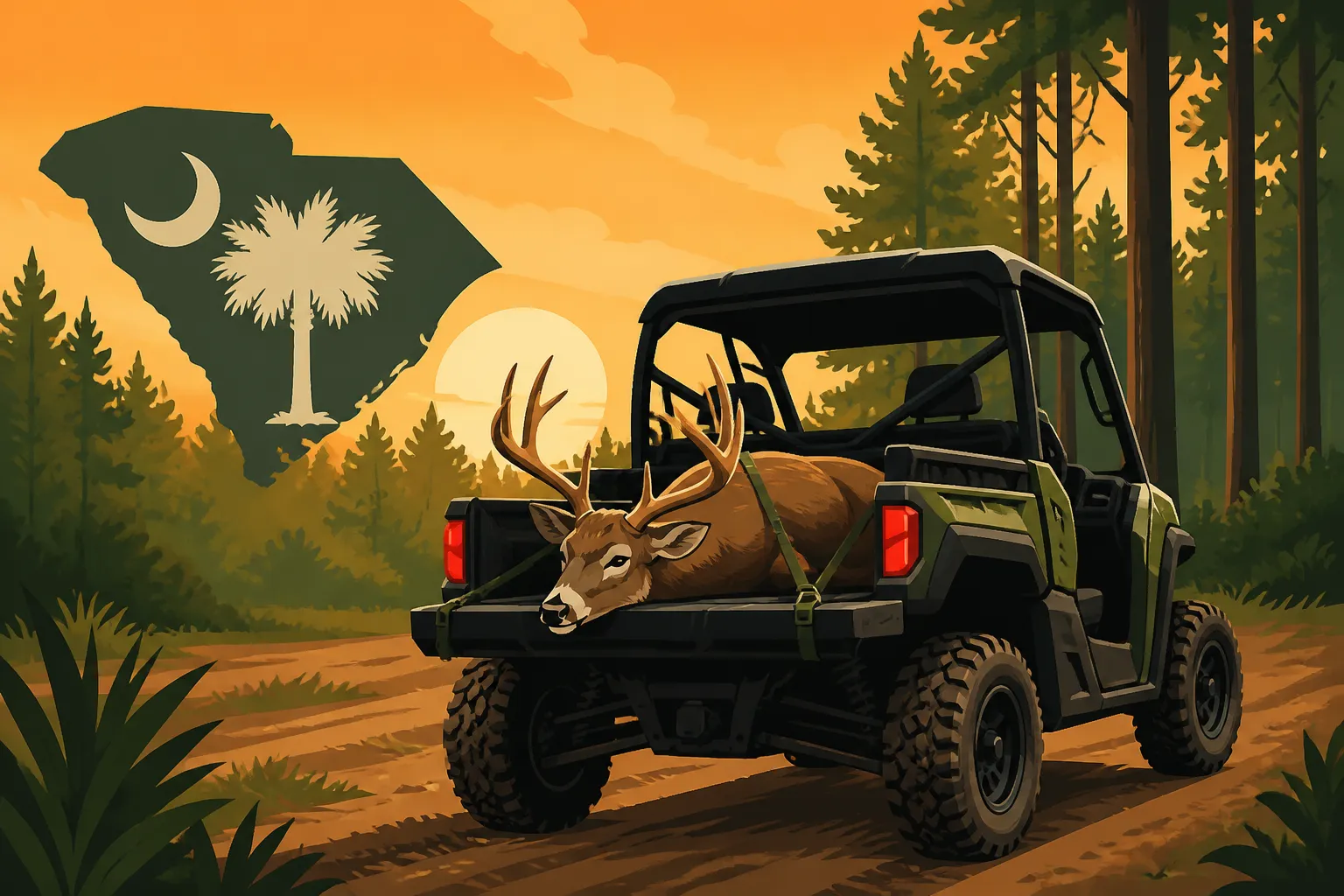
For a short carry, a properly secured load may work if the machine has suitable cargo capacity and the route is stable. Keep the load low and balanced, and make sure it cannot slide into the wheels, exhaust, controls, or the operator. Avoid placing a bulky load where it blocks the rider’s view or prevents normal steering. A passenger should not be used as extra cargo support.
For a longer or rougher route, a drag or purpose-built sled may be more practical, but it still needs to be attached correctly and used at a controlled pace. Keep the deer from snagging on brush or swinging into the machine. Do not tow a load so heavy that it changes how the ATV brakes, steers, or handles slopes. If the machine struggles, the load shifts, or the route becomes unstable, stop and reassess rather than adding throttle.
A winch can help in limited situations, but it is not a substitute for a safe route or suitable equipment. Use only the machine’s intended recovery points and keep bystanders away from the cable or strap. Never wrap a recovery line around a tree or machine component unless the equipment manufacturer says the attachment is suitable. Do not stand over or straddle a tensioned line. If the deer or ATV is stuck on a steep slope, it may be safer to get help than to attempt a forceful recovery.
Before moving, check that:
- The load is secured and within the machine’s limits.
- The operator can see the route and reach the controls freely.
- No one is standing in the path of the machine or a tensioned line.
- The route avoids steep side slopes, unstable banks, and unauthorized ground.
- The machine’s lights and brakes are working if visibility is changing.
Travel slowly and stop to check the load after rough sections. Keep enough space to brake and turn without the deer shifting. Avoid carrying a passenger unless the machine is designed for one and the passenger can ride safely without interfering with the load. If darkness is approaching, visibility, equipment, and applicable lighting rules become especially important. See South Carolina Rules for Riding After Dark and South Carolina Lighting Requirements on a Machine before relying on a late-day recovery plan.
After the retrieval, clean mud, blood, and debris from the machine in a way that does not carry them into a watercourse or damage the property. Pick up straps, packaging, and other waste. Let the landowner know the retrieval is complete, especially if the route or conditions differed from what you discussed.
Keep Hunting Rules and ATV Rules Separate
Recovering a deer is part of a hunting activity, but it still involves two sets of considerations: the rules for hunting and the rules for operating the machine. An ATV-related exemption does not replace hunting requirements, and hunting permission does not automatically make every vehicle use lawful.
Check the current South Carolina hunting rules for the season and species involved, including any requirements that apply to reporting, tagging, possession, or transportation. Requirements can depend on the circumstances, so do not rely on a general assumption that a deer recovered by ATV is treated differently from one moved by hand. The South Carolina Department of Natural Resources is the appropriate place to confirm current hunting rules.
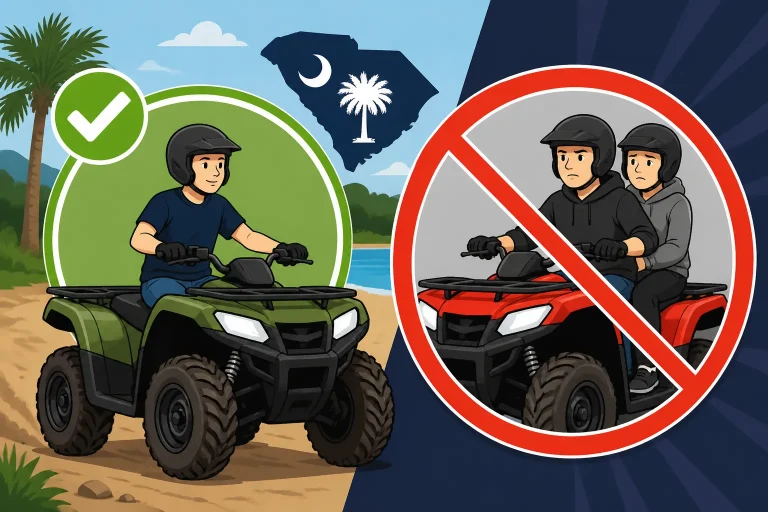
Also consider who is operating. Age, supervision, safety training, passenger restrictions, and helmet requirements may apply depending on the rider and the circumstances. A hunting-related purpose should not be treated as a reason to overlook those safety rules. South Carolina ATV Age Requirements, South Carolina Safety Certificate Requirements, and South Carolina ATV Helmet Law explain issues that may affect young riders and other operators.
Avoid carrying a firearm in a way that creates a handling risk while the machine is moving. Secure it safely, follow applicable hunting and firearm rules, and do not let a passenger or cargo interfere with the operator. If the recovery involves more than one machine, agree on a route and spacing so that riders are not crowded, dust does not block visibility, and no one feels pressured to travel faster than conditions allow.
A simple rule is to treat the recovery as a limited, practical trip tied to the hunt: use only the machine and route needed, stay within the landowner’s permission, and do not turn the retrieval into recreational riding. If the plan changes—for example, the animal is across a boundary or the route now involves a public road—pause and confirm that the new route is allowed.
For a landowner, clear rules can prevent confusion. Explain which machines are allowed, where riders may travel, whether guests may operate them, and which areas are off-limits. For hunters, ask before the season begins rather than waiting until a deer is down. If a hunting lease has written rules, keep them available and follow the stated vehicle restrictions.
The safest retrieval is often the one planned before the hunt: know the boundaries, identify a practical route, carry appropriate gear, and have a backup plan for bad weather or difficult terrain. When permission or the legal status of a route is uncertain, do not ride first and sort it out afterward. Carrying Written Landowner Permission in South Carolina and South Carolina Proof of Ownership on the Trail can help clarify what documentation may be useful to have with you.
Disclaimer
This article is for general informational purposes only and does not constitute professional advice. Laws, prices and regulations vary by location and change over time. Consult a qualified professional for guidance on your specific situation.