South Carolina WMA Riding Is Prohibited
South Carolina WMA Riding Is Prohibited
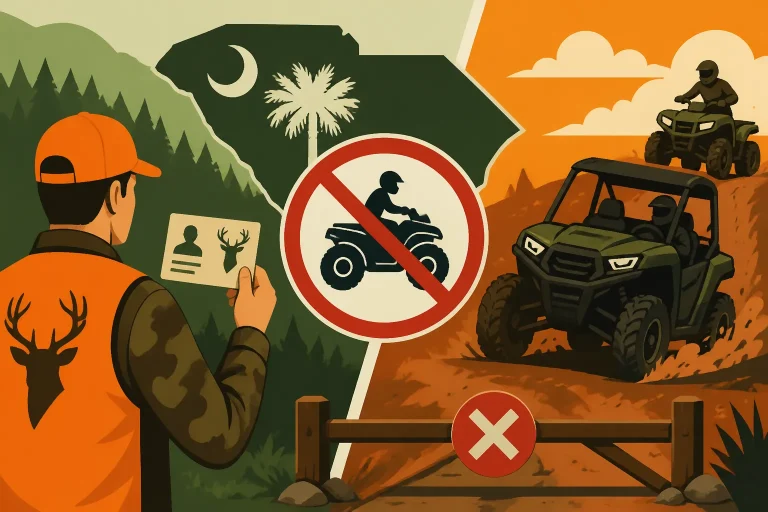
A hunting license, an ATV safety certificate, or an off-road pass does not automatically give you permission to ride through a South Carolina Wildlife Management Area. The key distinction is between having a legal, properly equipped machine and having authorization to use it on a particular piece of land. This guide explains the WMA restriction, common exceptions people misunderstand, and what to check before hauling your machine to a gate.
The Short Answer: Do Not Ride an ATV on a WMA Without Specific Authorization
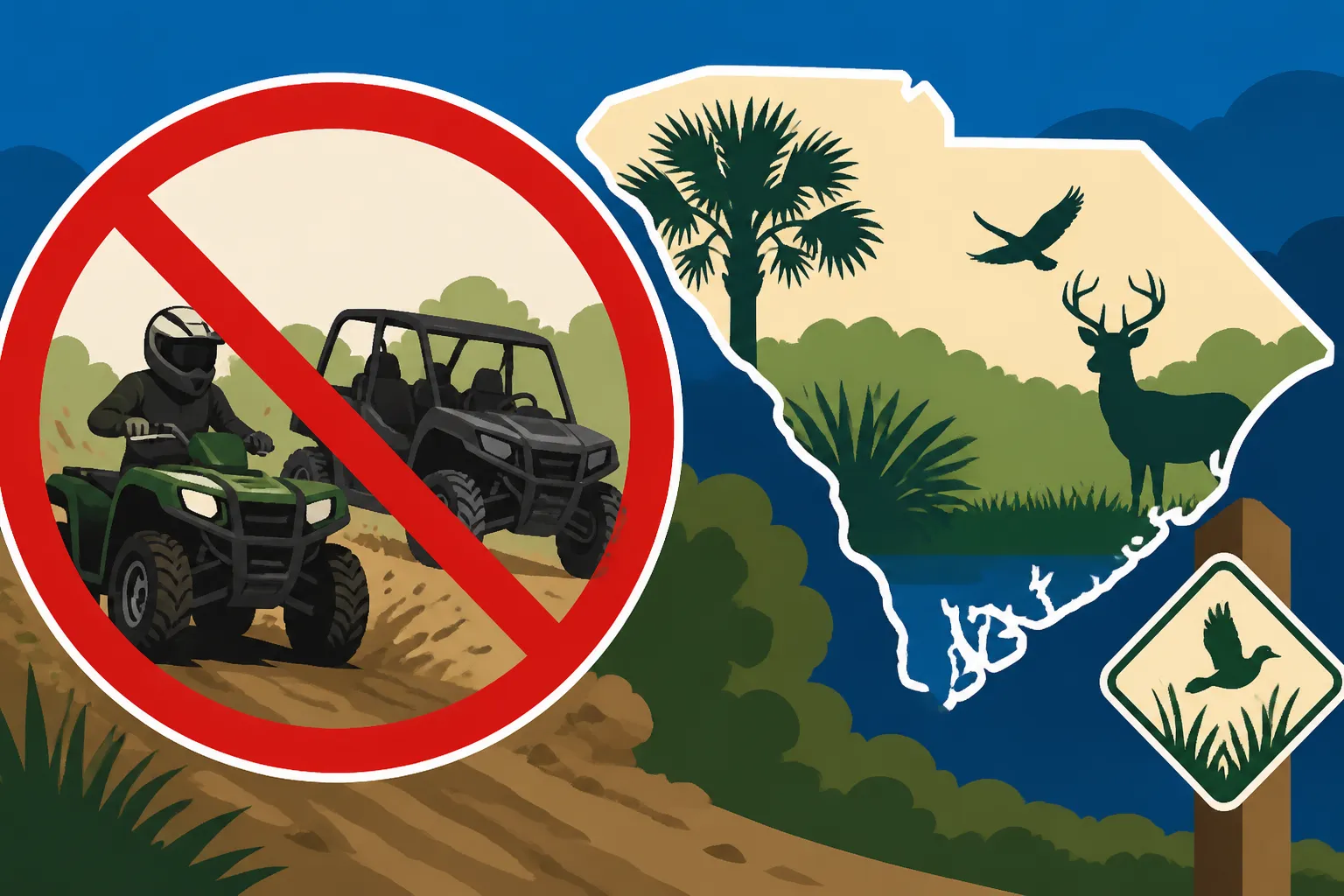
South Carolina riders should treat Wildlife Management Areas as closed to recreational ATV and UTV riding unless the land manager has clearly authorized motorized riding in a particular place and for a particular purpose. A WMA is not an off-road trail system just because it has dirt roads, gates, parking areas, or trails visible on a map.
That distinction matters because a route can look rideable without being open to motor vehicles. A forest road may be reserved for staff, landowners, hunters traveling under a limited access rule, or emergency use. A footpath, firebreak, or old logging road does not become an ATV trail merely because a machine can physically fit on it.
South Carolina’s off-road vehicle law and a WMA’s land-access rules answer different questions:
- State law sets rules for operating an ATV or other off-road machine, including rider requirements and equipment.
- Land rules determine whether you may bring and operate that machine on a specific property.
- A permit or pass may satisfy one particular requirement, but it does not necessarily provide access to every public or private property.
So, even if you have the right safety equipment and meet the rider rules, you can still be riding where motorized use is not allowed. For a broader look at the law governing riders, see South Carolina Code Title 50 Chapter 26. For the practical distinction between land types, South Carolina Public Land Compared to Private explains why permission on one property does not carry over to another.
| What you have or see | Does it automatically allow ATV riding on a WMA? | What to do |
|---|---|---|
| A South Carolina hunting license | No | Check the specific WMA’s current access rules |
| An ATV safety certificate | No | Treat it as a rider qualification, not land permission |
| A forest OHV pass | No | Use it only for the trail system and land covered by that pass |
| A county or public road nearby | No | Stay on the road only if it is open to your vehicle and you meet road-use rules |
| An open-looking dirt track | No | Confirm that motorized use is expressly allowed |
| A landowner’s permission on adjacent property | No | Ask separately about the WMA parcel |
| A posted trail or written authorization for a particular activity | Possibly | Read the conditions, boundaries, dates, and vehicle restrictions carefully |
The safest practical rule is simple: if the current official information does not clearly identify a road or trail as open to your type of machine, do not ride it. Do not rely on a route shown in an old map, a social media post, a neighbor’s recollection, or the fact that tire tracks are already there.
This conservative approach is not just about avoiding a citation. Riding in a closed area can damage habitat, disturb wildlife, create conflicts with hunters and hikers, or complicate land-management work. It can also put you in a difficult position if you need help and responders cannot easily reach the route.
What a WMA Is, and Why Its Rules Are Not the Same as Trail Rules
A Wildlife Management Area is land managed or made available for wildlife conservation and related outdoor uses. People often visit WMAs for hunting, wildlife observation, and other permitted recreation. The specific landowner, management arrangement, season, and access rules can differ from one area to another.
That variation can create a misleading impression. A WMA may be open to visitors for one activity while remaining closed to motorized recreation. It may have roads that are used by agency staff or opened for a limited purpose. It may allow certain kinds of vehicle access during a specific season, for a specific group, or under a special authorization. None of that means the area is an ATV park.
A public place is not automatically open to motor vehicles
“Public” can mean that certain members of the public may enter under stated conditions. It does not mean that every activity is allowed. A public walking trail, wildlife refuge, park, timber road, and OHV trail can all have different uses and restrictions.
Think of access as a set of separate permissions:
- You need permission to enter the property for the activity you intend to do.
- You need permission to use a motor vehicle there, if the activity involves one.
- You must follow any limits on route, time, machine type, speed, or purpose.
- You must meet any separate state rules for the machine and rider.
If a WMA is open for hunting, that does not make it open for recreational trail riding. If you may walk along a route, that does not mean you may drive an ATV on it. And if a road is open to ordinary road traffic, that does not necessarily mean an off-road machine is permitted on it.
This is why South Carolina WMA Regulations for Vehicles is a useful companion when you need to separate general WMA access from vehicle access. Check the current rule for the particular area and activity rather than assuming that one WMA’s arrangements apply statewide.
A WMA boundary can be hard to see on the ground
WMA boundaries do not always look like a fence or a clearly marked trailhead. Public land may adjoin private timberland, a county road, a hunting lease, or another managed property. Gates and signs may be placed only at certain entrances. A road may continue past a boundary even though the use rules change at the line.
Before unloading, identify the exact property and access point. Use an official current map or property information, and compare it with your location on the ground. If the boundary or route is unclear, stop and get clarification. A phone map can help with orientation, but a route line on a commercial app is not proof that motorized use is allowed.
A printed map can be useful where a signal is weak. If you keep map printouts or a waterproof map pouch with your riding kit, Amazon is one place people commonly look for basic supplies, but the important part is using an authoritative map that shows the current property boundary and restrictions. A consumer map should supplement—not replace—official access information.
Land management can change access
A road or area that was open previously may later be closed for wildlife management, timber work, erosion control, public safety, or another operational reason. A temporary closure may be posted at the entrance or announced through the land manager’s current information channels. Old signs, trip reports, and saved GPS tracks can quickly become outdated.
Make the access check part of the trip plan, not an afterthought. If you are also looking for legal riding destinations, South Carolina ATV Trails: Where to Ride can help direct your search toward established riding areas rather than a WMA that is not open to recreational ATV use.
Why a Hunting License Does Not Create ATV Trail Access
A common source of confusion is the idea that hunting permission and vehicle permission are interchangeable. They are not. A hunting license may allow you to participate in hunting where the activity is otherwise authorized, but it does not automatically give you permission to ride an ATV around the property.
The same applies to a permit, tag, or permission related to a hunting season. It may be relevant to the hunting activity, but you still need to follow the WMA’s rules for access, transportation, and vehicles. If the property’s vehicle rules do not allow your machine on a particular route, a hunting license does not turn that route into an ATV trail.
The issue is especially important during hunting seasons, when access rules may be more complicated than during other parts of the year. A gate could be open to a limited class of users while recreational motorized riding remains prohibited. Or a road may be open to ordinary vehicle travel under conditions that do not cover an ATV being used as a recreational ride. Read the precise rule instead of translating “access allowed” into “riding allowed.”
For more on how hunting-related language in the state’s ATV law is often misunderstood, see The Hunting Exemption in South Carolina’s ATV Act. The key point is that a legal exception for a defined activity does not automatically grant permission to use a particular property. Land access still matters.
Getting to a hunting location is not the same as riding for recreation
A hunter may have a reason to travel to a permitted location, but the route, vehicle, timing, and purpose remain subject to the applicable rules. Do not assume that because an ATV would make a trip easier, using it is permitted. Do not assume that a friend’s successful trip in a previous season establishes a continuing right to ride.
Ask the land manager or the person responsible for the property a specific question: “May I operate this type of ATV on this named road, on this date, for this stated purpose?” A general question such as “Can I use the WMA?” may produce an answer that does not address motorized access.
If a rule allows access only for a limited purpose, stay within that purpose. Do not use an authorized trip to a hunting spot as a reason to explore side roads, connect to another trail, or make a recreational loop. A narrow permission is not a general riding permit.
Retrieving game is not a blanket license to ride
Another commonly misunderstood situation is retrieving harvested game. A hunting-related provision or practical accommodation should not be treated as a general authorization to ride wherever you choose. The exact location, land status, conditions, and applicable rules matter. WMA property is not the same as private property where a landowner has agreed to a specific recovery method.
If you are planning to hunt, check the rules before the season and ask specifically how game retrieval works on that property. Do not wait until an animal has been taken to discover that the route you planned to use is restricted. If you hunt on private land, get the landowner’s permission for the machine and the route. If you are on a WMA, follow the current WMA rules and ask the managing authority about any limited recovery procedure.
The practical takeaway is that “I am hunting” and “I am allowed to ride an ATV here” are not equivalent statements. The activity, property, route, and authorization all need to line up.
Why a Forest OHV Pass Does Not Work as a WMA Permit
South Carolina riders may encounter pass systems for designated OHV routes in national forests or private riding areas. These passes are tied to the land and trail system covered by their rules. They are not statewide permissions to operate an ATV on any public land.
A forest pass may be necessary for using a designated forest OHV trail, but it does not authorize riding in a WMA. Likewise, a private park entry pass does not grant access to a neighboring public parcel, and a WMA hunting authorization does not serve as an OHV trail pass. Each system has its own boundaries and conditions.
For an explanation of the relevant pass system and where it applies, see South Carolina National Forest OHV Passes. It is also useful to understand South Carolina Passes Cover All Four Trails when planning a ride on covered forest routes. The important phrase is “covered trails”: a pass is not a general license to travel beyond those routes.
Keep the land authorization and the vehicle documents separate
For a trip, you may have several different documents or requirements to think about:
- A pass or permit for the riding area
- Proof of ownership or other machine paperwork
- Required rider safety documentation
- Insurance or registration documents where the vehicle type and use require them
- Written permission for private property, if applicable
- A current map showing the authorized route
Having one does not replace the others. A WMA does not become open because you can show an ATV title. A private landowner’s note does not override a closure imposed by the managing authority. And a forest pass does not grant permission to cross into an adjacent WMA.
If you are visiting from another state, do not assume that your home-state permit transfers. Reciprocity depends on the particular system and is not a substitute for property permission. South Carolina Has Nothing to Reciprocate offers related context about why out-of-state riders should confirm the actual South Carolina requirements rather than relying on a permit from home.
Do not use a road connection to turn separate areas into one ride
Some trailheads and public roads are near multiple kinds of land. A legal trail may end near a road or a WMA boundary. That proximity can make it tempting to continue along a road, cut across a property, or follow an unmarked track to create a longer route.
Do not assume that neighboring properties share the same motorized access rules. Check the status of every segment in your planned route. If the legal trail ends, your authorized ride may end there too. A map showing two destinations near each other does not prove there is a permitted ATV connector between them.
What to Check Before You Bring a Machine to a WMA
A few minutes of checking can prevent a wasted trip or an avoidable violation. Do the research before loading the machine, especially if you are planning around a hunt, a seasonal opening, or a route someone else recommended.
A practical pre-trip checklist
- Identify the exact WMA or property. Confirm the name and boundary rather than relying on a nearby town or trailhead name.
- Find the current official access information. Look for the latest rules, map, notices, and closures for that specific area.
- Check vehicle access separately from public access. Confirm whether the rule covers your type of machine, not just general entry or hunting.
- Verify the route. A property may have limited open roads, but that does not mean every dirt road or trail is open.
- Check dates and conditions. Seasonal access, hunting activity, weather, maintenance, or temporary closures may affect a route.
- Ask about unclear exceptions. If you are relying on a hunting-related purpose, game retrieval, disability access, or another special circumstance, ask the responsible authority before the trip.
- Keep evidence of permission. If access is granted in writing, carry the authorization and follow any conditions attached to it.
- Plan a legal alternative. If the WMA does not allow the ride, choose a designated trail system or private park with rules that fit your machine.
When you contact an office, be specific. State the property name, entrance, date, machine type, intended route, and purpose. Ask whether motorized use is allowed on that exact route and whether any additional pass, registration, insurance, or equipment requirement applies. If the answer is uncertain, get clarification before riding.
Use maps as planning tools, not permission slips
Maps are valuable for finding entrances, boundaries, nearby roads, and staging locations. They are not always current, and a map’s depiction of a path does not establish that an ATV may use it. A line may represent a foot trail, an administrative road, a former route, or a road on an adjacent property.
Save current official information for offline use when possible. A phone can lose service in wooded areas, and an online map may not load at a gate. A paper map or offline copy helps you avoid wandering across a boundary while trying to regain a signal. Amazon carries ordinary map cases and waterproof storage supplies, but the source and date of the map matter more than the accessory holding it.
If a route is ambiguous on the map, treat it as unavailable until you confirm otherwise. Do not use a GPS track from another rider as proof. The other rider may have been on a different parcel, may have had special authorization, or may simply have been riding where they should not have been.
Respect gates and signs even when no one is present
A locked gate, posted closure, or vehicle restriction should be treated as a clear stop. Do not drive around a gate, lift a barrier, or follow a track through the woods to get past it. Do not assume a gate is open to ATVs because a full-size vehicle has passed through, or because the gate is not locked at the moment.
A gate can also indicate that access is limited to specific users. If there is no sign explaining the restriction, that is not the same as permission. Check the official rules or contact the land manager. If you cannot confirm that your ride is allowed, unload somewhere else.
Carry what you need to avoid making poor decisions when plans change. A compact map, charged phone, basic first-aid kit, and reliable way to store paperwork can help. Amazon is one convenient source for general trail-planning supplies, but no piece of gear replaces permission to ride.
What to Do if You Find Yourself Near or Inside a Closed Area
Sometimes a rider discovers a boundary or closure only after turning onto a road. The right response is to stop, avoid continuing farther into the area, and leave by a route you know is permitted. Do not keep riding to “see where it goes,” and do not create a new route around a barrier.
If you realize you may have crossed onto a WMA or restricted road:
- Stop safely without blocking access for other users.
- Check your map and posted signs.
- Turn back on a route you are confident is lawful, if it is safe to do so.
- Do not cross into a different property to find an easier way out.
- If you cannot tell where you are or how to exit legally, contact the appropriate land manager or emergency services if there is a safety emergency.
- Be courteous and straightforward if an officer or land manager asks what happened.
Avoid arguing that the route looked public, that another rider used it, or that you bought a pass for a different trail system. Those details do not establish access. If you receive a citation or believe you were authorized, keep the paperwork and note the location, time, signs, and route while the details are fresh. For a general look at the process after a citation, see How to Dispute an ATV Citation in Court.
A map photo or GPS record may help you explain where you were, but it does not itself prove that the route was open. Keep any written permission, pass, or official direction that applied to your trip. If you had no clear authorization, the best choice is to leave and avoid repeating the route.
Make a safe exit without causing more damage
A closed road may be narrow, soft, or difficult to turn around on. Do not attempt a maneuver that risks rolling the machine or tearing up the ground. If you can safely backtrack, do so slowly and avoid widening the trail. If the machine is stuck or damaged, do not use a winch or another vehicle to cut a new path through vegetation. Ask for assistance through the proper contact or emergency channel.
If a gate is closed behind you, do not force it open or damage a fence. Look for posted contact information and follow the directions provided. If there is an immediate threat to life or safety, call emergency services rather than trying to solve the problem by crossing an unknown property.
The goal is to leave without increasing harm to the land, creating a confrontation, or making the situation harder for responders.
Where to Ride Instead
If your goal is recreational ATV or UTV riding, choose a place where motorized use is explicitly part of the activity. South Carolina has designated national forest OHV routes and private riding areas, each with its own rules. These are more suitable choices than trying to turn a WMA road into an informal trail.
Start by checking that the riding area accepts your machine. A trail system may have width limits, vehicle-type restrictions, seasonal closures, pass requirements, or sound and equipment rules. A route suitable for a dirt bike may not be open to a side-by-side, and a full-size rock-crawling park may not have trails appropriate for a small youth ATV.
Use South Carolina Trails That Allow Side-by-Sides if you are choosing a route for a UTV, and Best South Carolina ATV Trails for Beginners if you want a less demanding first ride. Before setting out, verify current closures and operating conditions through the land manager or riding-area operator. A previously open trail can close, and a route’s suitability can change after rain or maintenance.
Match the destination to your machine and group
Before you pay for a pass or load the trailer, check:
- Whether the area accepts ATVs, UTVs, dirt bikes, or the specific vehicle you own
- Width and other machine restrictions
- Rider age and supervision rules
- Helmet and safety-equipment requirements
- Pass, reservation, or check-in procedures
- Camping, parking, and trailer access
- Whether trails are temporarily closed
- Rules for passengers, pets, alcohol, and speed
A little preparation is particularly useful when a group has different machines. A trail that fits one rider’s ATV may be too narrow for a UTV, while a park that welcomes larger rigs may have a difficulty level unsuitable for a new rider. Confirm the fit for every machine in the group.
Carry the area’s current map and keep your route within the property’s designated system. If a trail ends, is marked closed, or becomes impassable, turn around rather than improvising a connection through adjacent land. That habit keeps your ride legal and makes it easier for land managers to maintain the trails people are actually permitted to use.
A clear way to remember the rule
When planning a ride, ask three separate questions:
- May I operate this machine under South Carolina law?
- May I enter this particular property for this activity?
- May I ride this machine on this exact route today?
A “yes” to the first question does not answer the other two. A hunting license, an ATV title, a safety certificate, a forest pass, or another state’s permit may matter for its own purpose, but none should be treated as a universal WMA riding authorization.
If the answer to the route question is not clear, do not ride there. Choose a designated trail system, confirm the rules with the land manager, and keep the WMA closed to recreational riding unless you have specific authorization.
Disclaimer
This article is for general informational purposes only and does not constitute professional advice. Laws, prices and regulations vary by location and change over time. Consult a qualified professional for guidance on your specific situation.