South Carolina Visitors From North Carolina
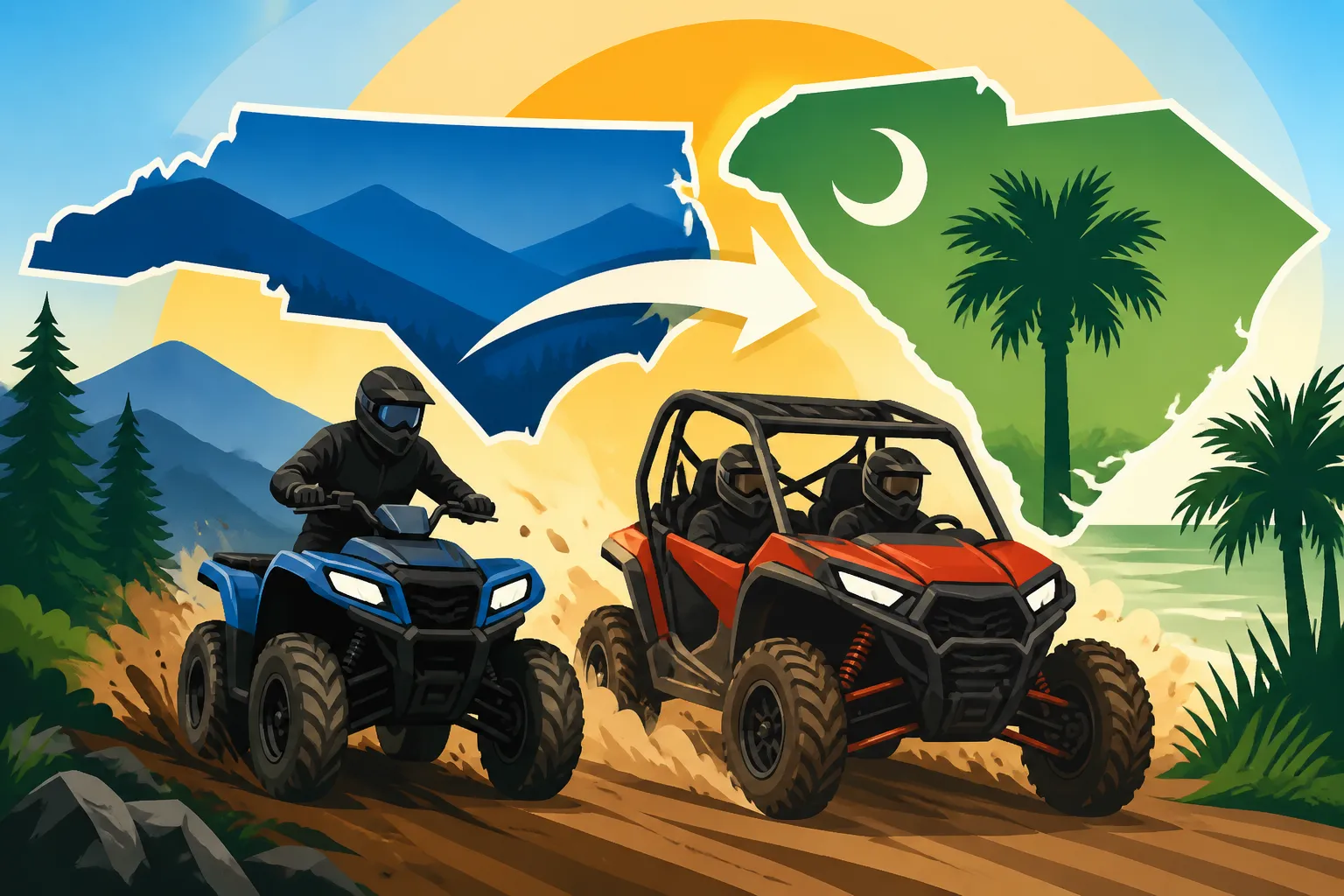
A North Carolina address does not automatically qualify you for free or reciprocal access to South Carolina ATV trails. The key is to identify who manages the place you plan to ride: a national forest, private park, or private property. Each has different access rules, and a pass or registration from North Carolina may not satisfy them. Here’s what to check before you load up.
Do North Carolina Passes Work on South Carolina Trails?
Usually, you should plan on meeting South Carolina’s access requirements separately. A North Carolina registration, trail pass, or resident permit is not a substitute for a South Carolina forest pass or a private riding park’s admission. There is no general cross-border pass that gives visitors access to every South Carolina riding area.
That distinction matters because “permit” can mean different things. One document may be proof that a machine is registered in its home state; another may be a fee pass for a specific riding area. Neither automatically proves that you are allowed to ride every trail in South Carolina.
For example, the motorized trails in South Carolina’s national forests use a forest-pass system. Visitors should check the current requirements for the specific trail and get the applicable pass before riding. The details are covered in South Carolina National Forest OHV Passes. Don’t assume that a North Carolina permit or plate replaces that pass.
South Carolina does not register off-road ATVs for ordinary trail use. That does not mean riders can use public trails without permission or a required pass. The state’s title rules, public-land access rules, and road-use rules address different things. If you want to understand the state’s off-road vehicle paperwork, see South Carolina Does Not Register Off-Road ATVs. If your plan includes riding on public roads, check the separate rules for that type of machine and route rather than treating an off-road trail pass as road authorization.
| Where you plan to ride | What a North Carolina visitor should check | Does a North Carolina pass automatically cover it? |
|---|---|---|
| South Carolina national forest trail | South Carolina forest-pass requirement, trail eligibility, and current closures | Do not assume so |
| Private riding park | That park’s admission, vehicle, age, equipment, and camping rules | No |
| Private land | The landowner’s permission and any conditions they set | No |
| Wildlife management area | Whether motorized riding is prohibited or specifically allowed | A pass does not override land-use rules |
| Public road | The machine’s legal status and the applicable road rules | A trail pass does not authorize road use |
A North Carolina registration may still be useful as evidence of the machine’s home-state status, but it does not give you permission to ride on a South Carolina property. Likewise, having a title or bill of sale does not replace an access pass. If you’re unsure what documents to carry, review [South Carolina Proof of Ownership on the Trail] and confirm whether the place you’re visiting has additional requirements.
Buying the Right Forest Pass Before You Travel
South Carolina’s national-forest OHV system covers designated trails, not every forest road or piece of public land. A pass is for use within the system’s rules; it is not blanket permission to ride wherever a machine can fit. Before travelling from North Carolina, identify the exact trail, confirm that your type of vehicle is allowed there, and check whether the trail is open.
South Carolina’s forest pass arrangements distinguish between day and season access. The pass type can affect who it covers and how it must be associated with a vehicle. Review South Carolina’s Day and Season Forest Passes before purchasing. In particular, don’t assume that a pass bought for one rider covers every person in a group, or that a pass associated with one vehicle can be transferred freely to another.
Forest passes are purchased online, according to the available pass process. Check the current official purchase instructions, including whether you need to print or display anything and which vehicle information is required. The purchase process is explained in South Carolina Passes Sold Only Online. Buying ahead is especially practical when your group is travelling a long distance: you can sort out an account, vehicle details, and required documents before reaching the trailhead.
Keep these points in mind:
- A pass and a vehicle registration are different. A North Carolina registration does not pay a South Carolina forest access fee.
- The pass may be tied to a person or vehicle. Confirm the terms before buying for a group.
- A pass does not guarantee an open trail. Weather, maintenance, resource protection, or other conditions can affect access.
- A pass is not permission for every machine. Trail width limits and vehicle restrictions still apply.
- A pass does not authorize riding outside designated routes. Stay on routes open to your vehicle type.
South Carolina’s forest trails do not all serve the same machines. Some routes are intended for narrower vehicles, and a full-size side-by-side may not be permitted on a trail that accommodates a smaller ATV. Check the width and vehicle restrictions for your chosen route instead of relying on a general trail map. South Carolina Passes Cover All Four Trails can help explain the pass system’s coverage, but it does not mean every vehicle can use every trail.
Conditions can also change after you make plans. Check South Carolina Trail Conditions Before You Haul close to departure, and look for notices from the land manager about closures, maintenance, or seasonal restrictions. If one location is closed, don’t simply ride around a barrier or continue onto an unmarked route. Choose another place that is open and permits your vehicle.
Avoiding pass mistakes in a group
For a group coming down from North Carolina, settle the pass question before anyone leaves home. Make a list of riders, machines, tow vehicles, and pass types. Then compare that list with the current rules. This is particularly important when riders are arriving in separate trucks or bringing more than one machine.
Season passes and day passes may follow different rules. A season pass may be associated with an individual rider, while a day pass may be connected to the tow vehicle’s plate. Those details make it risky to buy one pass and assume it covers everyone. Review South Carolina Passes Are Non-Transferable and confirm the terms for the pass you plan to use. If the machine is rented, ask the rental provider which paperwork or pass arrangements are included; see South Carolina Pass for a Rented Machine for the issue to check.
Keep a copy of the purchase confirmation and any required printed pass where you can reach it. If the instructions require a pass to be displayed in a tow vehicle, follow those instructions exactly. A screenshot or receipt may help you document a purchase, but don’t treat it as a substitute for the required display method.
Private Parks, Private Land, and Wildlife Areas
South Carolina has both public trails and privately operated riding areas. A forest pass is not a private-park admission ticket, and a private park’s pass does not grant access to national-forest trails. Each property sets its own entry requirements, so read the rules for the exact place you intend to ride.
Private parks may set conditions for:
- Rider and passenger ages
- Helmets and other protective equipment
- Vehicle types, dimensions, or sound levels
- Day-use admission and vehicle access
- Camping, pets, alcohol, and quiet hours
- Reservations, weather closures, or recovery assistance
If you have a North Carolina pass for a riding park, contact that park to ask whether it is valid at a South Carolina location. Do not infer that two parks share access just because they have similar names, operate under the same ownership, or participate in the same promotion. The terms may differ by property and can change.
Private land is different again. You need the landowner’s permission before riding there, and permission for one parcel or one visit does not necessarily extend to adjacent land. A gate left open, a visible trail, or a neighbor’s invitation is not a reliable substitute for permission from the person who controls the property.
Wildlife management areas also require care. A hunting license or a forest pass does not make an area open to ATV riding. South Carolina wildlife areas have their own vehicle rules, and riding may be prohibited. Check South Carolina WMA Riding Is Prohibited before taking a machine onto a wildlife management area. When rules are unclear, contact the managing agency rather than testing access on the ground.
For a broader look at places to ride, start with South Carolina ATV Trails: Where to Ride, then verify the entry rules for the location you choose. A trail list is a starting point, not proof that a route is open today or suitable for your machine.
Rules That Follow You Across the State Line
Once you ride in South Carolina, expect South Carolina’s rules to apply to your conduct there, even if your machine and home address are from North Carolina. A home-state registration does not exempt a visiting rider from South Carolina age, safety, equipment, or land-access requirements.
Before heading out, review the rules that apply to your machine and the people riding it. The state’s requirements can include age-related supervision and safety provisions, and different rules may apply to an ATV than to a street-legal UTV. For a visitor-focused overview, read South Carolina Rules for an Out-of-State Machine. If younger riders are in the group, check their requirements in advance rather than relying on the rules they follow at home.
Also separate trail use from public-road use. A machine that is permitted on a designated off-road trail is not automatically allowed on a public road. Road access depends on the vehicle category, equipment, route, and applicable state rules. A forest pass, private-park wristband, or North Carolina registration should not be treated as road-use authorization.
A practical pre-trip check looks like this:
- Choose the riding area. Identify the specific forest trail, private park, or property.
- Confirm the vehicle is allowed. Check machine type, width, and any other posted restrictions.
- Check the access requirement. Purchase the correct forest pass or follow the private property’s admission process.
- Review current conditions. Look for closures and notices shortly before leaving.
- Check the riders’ requirements. Pay special attention to rules for minors, passengers, and protective equipment.
- Bring the required paperwork. Carry pass proof and ownership or registration documents if requested by the land manager.
- Stay on permitted routes. Do not use a pass or local invitation as permission to ride beyond the authorized area.
The simplest way to avoid a wasted trip is to verify the pass with the land manager, not to assume North Carolina and South Carolina share one. Make the same check for a private park, and confirm trail conditions before hauling. That extra planning is far less frustrating than arriving at a closed trailhead or learning that the pass in your glove box applies somewhere else.
Disclaimer
This article is for general informational purposes only and does not constitute professional advice. Laws, prices and regulations vary by location and change over time. Consult a qualified professional for guidance on your specific situation.