South Carolina Passes Sold Only Online
South Carolina forest trail passes are easy to misunderstand: riders may expect to pay at a booth, leave cash in a fee tube, or buy one pass for every machine. In practice, the purchase process and pass rules depend on the pass type. Here’s how to buy the right pass online, display it correctly, and avoid arriving at a trailhead without proof of payment.
What “Sold Only Online” Means for South Carolina Forest Passes
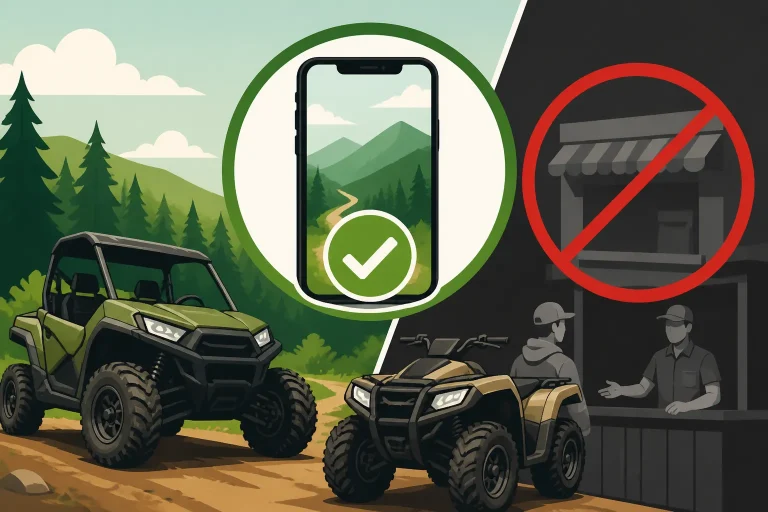
For the South Carolina National Forest OHV trails that require a fee pass, plan to purchase the pass online before you ride. The official purchase channel is Recreation.gov. Do not count on buying one from a ranger at the trailhead, paying cash at a self-service tube, or finding a pass at a nearby business. Trailhead cash tubes are no longer the way to pay for these passes.
That makes a little advance planning worthwhile. You need a working way to complete the online purchase, and you need to know whether you’re buying a day pass or a season pass. You should also check the current trail and pass instructions before you travel, since procedures and access conditions can change.
The online-only rule concerns the forest pass. It is not a universal permit for every place in South Carolina where people ride ATVs or UTVs. Private riding parks set their own admission requirements, while wildlife management areas have separate rules. A forest pass also does not register or title your machine. If you’re sorting out the difference between an access pass and vehicle paperwork, South Carolina National Forest OHV Passes is a helpful overview.
| Where you plan to ride | What to check before leaving home |
|---|---|
| A South Carolina National Forest OHV trail | Whether that trail requires a forest pass, which pass type you need, and how it must be displayed |
| A private riding park | The park’s own admission, vehicle, age, and safety rules |
| A wildlife management area | Current land-use rules; a hunting license or forest pass does not automatically make ATV riding permissible |
| Public roads | Whether the machine is eligible and properly authorized for that kind of road use |
The online-only process matters most when you’re hauling to a remote trailhead. Cell service may be weak or unavailable, and a last-minute attempt to purchase a pass from the parking area can turn into a frustrating delay. Buy and save your pass while you have reliable internet access. If the purchase system provides a receipt or pass document, keep a copy available offline and follow its display instructions.
Do not assume that a screenshot is enough, that a digital receipt is accepted in place of a displayed pass, or that a pass may be transferred between riders. Read the current instructions for the particular pass you buy. The key is to leave home with both proof of purchase and a clear understanding of how the pass is supposed to be shown.
Choosing Between a Day Pass and a Season Pass
The main choice is whether you need access for one outing or expect to ride more than once during the pass period. A day pass is geared toward a particular visit. A season pass is more suitable for someone planning repeated trips. The best option depends on your riding schedule, the pass’s terms, and whether everyone in your group needs an individual pass.
A common mistake is thinking of the pass as a sticker attached to a machine. The forest pass system has rules about who the pass belongs to and how it is connected to a visit or vehicle. In particular, season passes are per person and non-transferable. One rider’s season pass should not be treated as a group pass that covers every friend or family member riding along.
Day-pass instructions may tie the purchase to the tow vehicle’s plate. That can matter when you’re hauling more than one ATV or UTV, meeting another group at the trailhead, or switching vehicles after buying the pass. Review the requirements at checkout and make sure the information you enter matches the vehicle you will use. If the official directions call for the day pass to be displayed in the tow vehicle, follow that direction rather than placing it on an ATV.
| Pass detail | What to confirm |
|---|---|
| Day or season | Choose based on your plans and the pass’s current validity terms |
| Named rider | Check whose name the pass is issued to and whether it can be shared |
| Vehicle details | Confirm whether the day pass is associated with a tow vehicle or plate |
| Display method | Follow the current instructions for printing or showing the pass |
| Trail coverage | Verify that the pass applies to the trail you plan to ride |
| Purchase record | Save the receipt or pass information in case you need it at the trailhead |
If you ride with family or friends, decide who is riding and who is buying before anyone completes checkout. Each rider should understand whether they need their own pass. A passenger in the truck who is not riding may not need the same access credential as a person using the OHV trail, but don’t guess from the number of machines in your group. Use the official pass rules for the specific trail system.
For a longer season, compare the current season-pass terms with the number of days you realistically expect to ride. Don’t make the decision using an old receipt, a friend’s pass, or an outdated social-media post. Pass costs and conditions can change, so check Recreation.gov for the current details before purchasing. For help comparing the options, see South Carolina Day vs Season Pass Value and South Carolina Season Passes Are Per Person.
Also distinguish a forest pass from a private park admission pass. A private park may charge by rider, machine, or day and may have separate rules for camping, passengers, helmets, and recovery services. A forest pass does not serve as an admission ticket to a private park, and a private-park pass does not substitute for a forest pass. For a broader comparison, see South Carolina Private Park Passes and Rules.
How to Buy and Prepare Your Pass
The purchase itself is straightforward if you gather the details first. The practical work is confirming the trail, selecting the correct pass, and keeping the proof accessible once you are on the road.
-
Choose the riding area. Identify the specific National Forest OHV trail you plan to use. South Carolina has several forest trail systems, and access rules, trail status, and vehicle restrictions can differ. A pass does not override a closure or make a trail suitable for every machine.
-
Check the latest trail information. Confirm that the trail is open and review any current notices about maintenance, weather, or access. If you need help finding the appropriate system, start with South Carolina’s Four National Forest Trails and then check the individual trail information.
-
Review pass requirements. Confirm that the trail requires a pass, which pass types are available, and whether the terms match your outing. Pay attention to the rider, vehicle, and display instructions.
-
Purchase through the official online channel. Complete the transaction through Recreation.gov, not through an unofficial seller or a listing that merely looks like a trail permit. Check that you selected the correct pass and entered any required details accurately.
-
Save the confirmation. Keep the receipt or pass document on your phone and, if the official instructions call for a printed pass, print it before leaving. A confirmation email may be useful, but it is not automatically a substitute for the required pass display.
-
Prepare the vehicle display. If the directions require a pass in the tow vehicle, place it where it can be read as instructed. If the pass is assigned to a particular rider, make sure that rider has access to the required proof.
-
Recheck before departure. Look for updated notices, particularly after heavy rain or when a trail may be undergoing maintenance. A valid pass does not guarantee that every route will be open.
If you do not own a printer, plan for that before the morning of your ride. You might use a print service or ask someone you trust to print the document. Don’t assume you can solve the issue with a screenshot at the gate; verify the accepted display method in the official directions.
For a paper pass, a clear document sleeve can help protect it from rain, mud, and dashboard glare. You can find basic sleeves through retailers such as Amazon, but a third-party sleeve is only a holder, not an official pass. Keep it from blocking the driver’s view, and position the pass as directed. If you’re comparing accessories, Amazon may be one place to look for a simple waterproof document pouch, but the pass itself should still come from the official purchase channel.
Consider storing a second copy of the purchase confirmation on your phone or in your email for backup. That is not permission to disregard a print requirement; it is a practical way to retrieve the order details if the paper gets damaged. If you keep documents in a glove compartment, use a sleeve that stays closed and does not obscure the information an attendant or officer may need to see.
A second pass-related planning issue is the tow vehicle. When a day pass is tied to a plate, the vehicle you enter during purchase should be the vehicle you take to the trailhead. If plans change, don’t assume the pass automatically follows you to another truck. Read the provider’s change or cancellation instructions, if any, before purchasing. For more on the specific display rules, see South Carolina Pass Display Rules and Day Passes Checked Against Your Tow Vehicle Plate.
What Happens at the Trailhead
An online purchase does not end your responsibility. You still need to display or carry the pass as instructed, use an open trail, and follow the trail system’s rules for machine size and use. A pass is evidence of access payment; it is not a promise that the trail is open, a substitute for a safety requirement, or permission to ride anywhere in the forest.
Before leaving the parking area, check that the pass is visible in the required location. If the pass is associated with your tow vehicle, do not put it on the ATV and assume that solves the display requirement. If it belongs to a named rider, keep that rider’s proof available. The instructions for the current pass are what matter, even if another rider says they have always done it a different way.
Fee compliance checks can happen at trailheads. A ranger or other authorized staff member may check that the required pass is present and corresponds to the rider or vehicle covered by the purchase. Be ready to show the proof in the way the pass instructions specify. Carrying a driver’s license and being able to retrieve your order information can make a check smoother, but neither replaces the pass itself.
If your group arrives in separate tow vehicles, do not assume a single day pass covers both vehicles simply because everyone is riding together. Likewise, a season pass belonging to one person should not be passed around so each person can use it on a different trip. These are common sources of confusion because riders naturally think in terms of machines, trailers, or groups, while the pass terms may be tied to an individual or a specific vehicle.
The pass also does not eliminate the need to check local trail restrictions. Some routes have width limits or prohibit full-size vehicles. A trail that accepts a pass may still be unsuitable for a wide side-by-side. Review the specific machine rules before hauling, especially if your group includes different vehicle types. South Carolina’s 50-Inch Trail Width Limit and South Carolina Trails That Allow Side-by-Sides can help you identify questions to resolve before you go.
Weather is another reason to check close to departure. South Carolina forest roads and trails can become muddy or close after rain, and conditions may change after you have purchased a pass. If a trail closes, do not ride around a barrier or treat the pass as an exception. Use the latest closure notice and have a backup plan. South Carolina Wet Weather Trail Closures and South Carolina Trail Conditions Before You Haul cover the practical checks that can prevent an unnecessary drive.
Keep the pass and confirmation tidy after the ride as well. If you later need to confirm which pass you bought or whether it was associated with a particular plate, an accessible email or saved document can help. For a day pass, take care not to mix up the vehicle information if you buy another one for a later outing. For a season pass, remember that it belongs to the person named or otherwise covered under its terms, not to whoever happens to have the paper.
Common Mistakes and How to Avoid Them
Arriving without buying a pass. The old idea of stopping at a trailhead and paying cash can leave you stuck. Purchase online before travel, and save the proof while you still have service.
Buying from an unofficial source. A marketplace listing or a person offering to transfer a pass may not provide valid access. Use the official purchase channel and follow the provider’s instructions. Amazon can be useful for practical accessories such as a protective sleeve, but it is not the source for the official forest pass.
Assuming one pass covers a whole group. Pass terms may be individual or linked to a vehicle. Count riders and vehicles carefully, then verify what the selected pass actually covers. For more detail on the individual rule, see Season Passes Are Per Person and Non-Transferable.
Using a pass for the wrong trail or land manager. Forest trails, private parks, and wildlife management areas are different places with different access rules. An online forest pass does not grant access to a private riding park, and a private park ticket does not authorize riding on a closed public trail. The rules for wildlife management areas are particularly important: South Carolina WMA Regulations for Vehicles explains why a hunting license does not automatically open those areas to ATVs.
Entering incorrect vehicle information. If the day-pass process asks for a tow vehicle plate, double-check it before submitting. A typo or a last-minute switch of trucks can create confusion during a compliance check.
Treating a receipt as the pass. A receipt proves a transaction occurred, but the required display may be different. Read the instructions and print the pass if that is what they require. Store the receipt as backup, not as a replacement unless the official terms say it is accepted.
Assuming purchase means access is guaranteed. A pass does not open a closed trail, cancel machine restrictions, or authorize riding off the designated route. Check trail status and comply with posted restrictions each visit.
Leaving without a backup plan. If the selected trail is closed or your machine does not meet its limits, a pass will not make it usable. Check nearby options before loading the trailer. The guide to South Carolina Trail Closures After Rain can help you plan around changing conditions.
A low-cost, low-effort item such as a clear document sleeve can also prevent a paper pass from getting soaked or buried under other gear. If you shop for one on Amazon, choose a size that keeps the pass legible and can be positioned safely in the tow vehicle. Don’t laminate or alter an official document unless its instructions allow that; the important thing is to protect it without making it hard to inspect.
The simplest routine is to buy through the official channel, save the confirmation, print and display the pass if required, and check the trail status before each trip. That routine covers most avoidable problems without relying on cell service at the trailhead or hoping someone nearby can sell you a pass.
Disclaimer
This article is for general informational purposes only and does not constitute professional advice. Laws, prices and regulations vary by location and change over time. Consult a qualified professional for guidance on your specific situation.