South Carolina’s 50-Inch Trail Width Limit
A 50-inch restriction can turn a carefully planned South Carolina ride into a frustrating trip back to the truck if your machine is too wide for the trail. The key is knowing what the limit applies to, how to measure your ATV or UTV, and how to check the rules for a specific riding area before you haul.
What South Carolina’s 50-inch trail limit means
The limit is about the machine, not the path
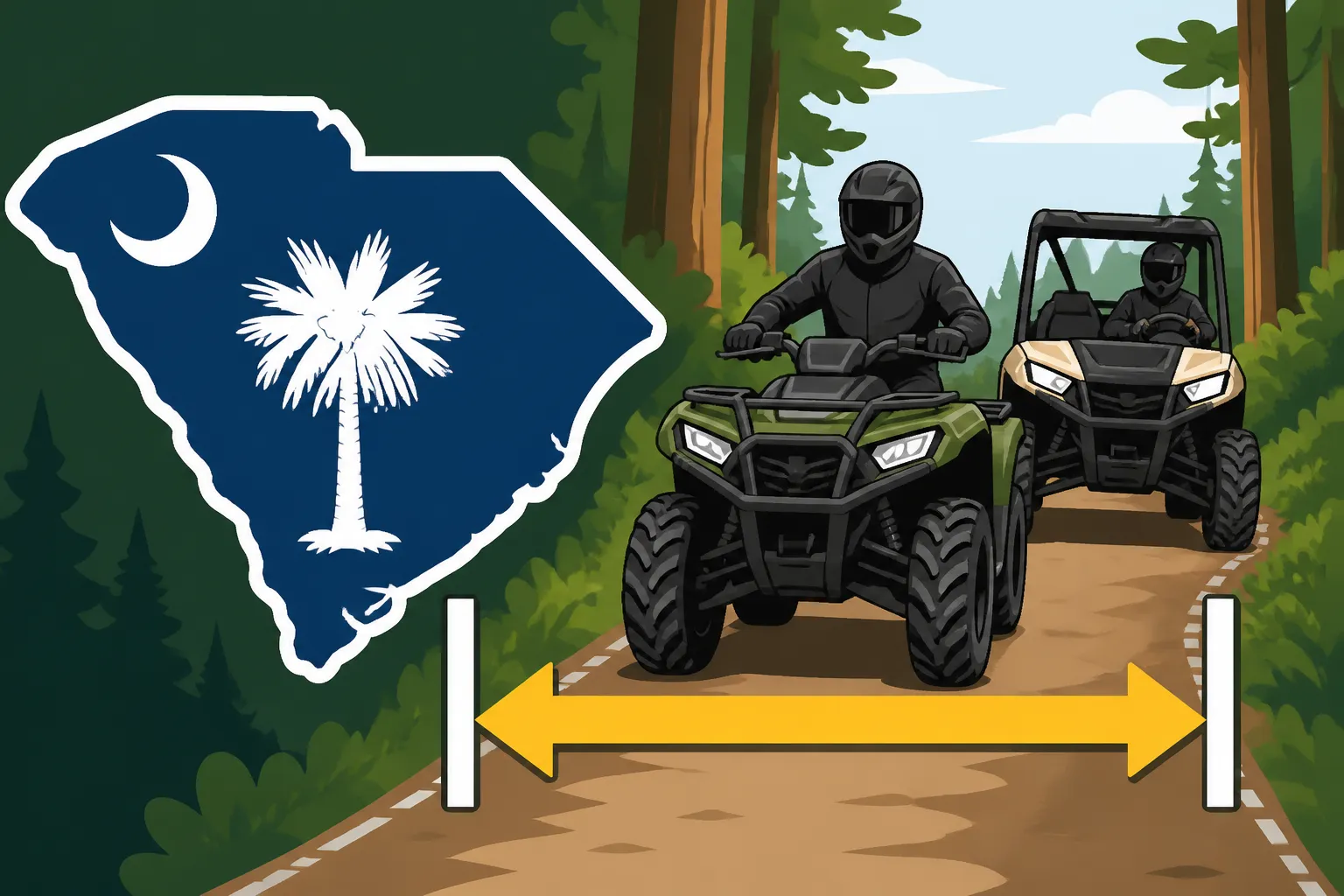
A 50-inch limit generally refers to the maximum width of the vehicle allowed on a designated trail. It does not mean every section of trail is exactly 50 inches wide, and it does not guarantee that a machine measuring just under the limit will have an easy ride. The route may still narrow between trees, pass through ruts, or include tight turns.
Treat a posted limit as an access rule, not as a suggestion about how much room you might need. A wider machine can be prohibited even if you believe it could squeeze through a particular spot. Likewise, an open entrance does not automatically mean every vehicle is allowed; check the riding area’s posted information and current map.
Measure the machine you will actually bring
Manufacturers’ specifications are a useful starting point, but the machine’s real width may differ from its published dimensions. Wider tires, wheel spacers, aftermarket fenders, suspension changes, mirrors, or other accessories can affect the overall measurement. If you have modified your ATV or UTV, do not rely only on the original brochure.
Measure across the widest point from side to side, usually at the tires or bodywork that extends farthest outward. Keep the machine on level ground, point the wheels straight ahead, and use a tape measure rather than estimating by sight. If you are close to the limit, measure again and leave room for uncertainty. A machine that is nominally at the limit may not be accepted if its actual width exceeds the posted rule.
Where width limits matter
Designated trails in public riding areas
A 50-inch restriction matters most where a riding area designates a trail for narrower machines. South Carolina has several national forest OHV riding areas, but their trail types, permitted vehicles, and conditions are not interchangeable. Start with the specific area’s rules rather than assuming that a machine allowed at one forest trail will be allowed at another. [South Carolina's Four National Forest Trails]
The distinction is especially important for side-by-sides. Some trails are intended for narrower ATVs or motorcycles and exclude full-size vehicles, while other riding areas may have routes that accommodate wider machines. A trail map or an app such as onX Offroad can help you orient yourself and compare route information, but use it alongside the managing agency’s current rules. For a broader comparison, see [South Carolina Trails That Ban Full-Size Vehicles] and [South Carolina Trails That Allow Side-by-Sides].
A trail limit is not a general road rule
A posted trail-width restriction does not, by itself, tell you whether a machine may use a public road, private road, or another kind of riding area. Those settings can have different access rules, equipment requirements, and legal conditions. A route that appears on a map may cross land with separate restrictions or may not be open to the public at all.
Private parks set their own admission and riding rules, so do not assume that a machine accepted on a public trail will meet a private park’s requirements—or the reverse. Check the park’s vehicle rules before setting out, particularly if your UTV has a wider stance or aftermarket equipment. [South Carolina Private Park Passes and Rules] explains why it pays to check a riding area’s own requirements rather than treating “off-road” as one universal category.
| Riding situation | What to check | Why it matters |
|---|---|---|
| Designated narrow trail | Posted vehicle-width or vehicle-type limit | A machine may be excluded even if it fits through the entrance |
| National forest riding area | Current area rules, map, closures, and permitted trail types | Rules can differ between riding areas and trail sections |
| Private park | Park-specific vehicle and access rules | The park determines which machines can enter and where they can ride |
| Public or private road | Applicable road-access rules and landowner permission | A trail-width rule does not establish road access |
How to check a trail before you haul
Start with the riding area’s own information
First identify the exact trail system you plan to visit. Then check the managing agency’s current map and rules for vehicle-width limits, permitted vehicle types, seasonal restrictions, closures, and any pass or access requirements. A broad search result or an old screenshot may describe a route that has since changed or become unavailable.
If you use a mapping app such as onX Offroad, treat it as a planning aid, not the final authority on access. App information can help you understand where routes are and how trails connect, but verify important restrictions with the agency or park responsible for the land. Before leaving, save or download the relevant map information if possible; cell reception can be unreliable at trailheads and in wooded areas. [South Carolina ATV Trail Map Downloads] offers another starting point for organizing a route.
Compare the posted rule with your machine’s real width
Once you find the stated limit, compare it with the machine as equipped for the ride. Measure the outside-to-outside width at the widest point and include any installed accessories that extend the machine. If you are unsure whether a particular part counts, ask the riding area before traveling rather than hoping staff will interpret the rule in your favor at the gate.
It also helps to write down the measurement and keep the manufacturer’s specifications handy. That gives you a consistent reference when asking a park or agency about eligibility. If your machine is very close to the limit, explain exactly how you measured it and describe any modifications. Do not remove safety-related equipment or make an unsafe change simply to get below a posted width.
Choosing a route and preparing your machine
Match the route to the vehicle
Choose a riding area based on the machine you own, not only on the trail photos or the distance from home. A narrow ATV may have access to trails that a broad side-by-side cannot use, while a larger machine may be better suited to an area with routes specifically open to wider vehicles. Check more than the width: trail difficulty, surface, vehicle type, and current conditions all affect whether a route is a sensible fit.
If you are riding with friends who own different machines, plan for the vehicle with the most restrictions. A route that works for a narrow ATV may split the group if the UTV cannot legally enter. Look for a suitable alternate route or choose a riding area that accommodates everyone. Resources such as [South Carolina Trail Difficulty Ratings] can help you think beyond width when deciding whether a trail suits your group’s experience and equipment.
Prepare for tight conditions without forcing a passage
Even on an approved trail, narrow sections can demand patience. Watch for exposed roots, branches, erosion, and turns where the usable space is less than it looks from a distance. Travel at a pace that lets you stop safely, and avoid driving over vegetation or widening a trail to get around an obstacle. If a route becomes impassable or appears unsuitable for your machine, turn around when it is safe to do so.
Good trail etiquette matters when passing other riders or meeting someone coming the opposite way. Give each other time and space, follow posted signs, and do not block the route while making adjustments. [South Carolina Trail Etiquette Locals Expect] is useful background for sharing narrow routes responsibly. If rain has changed the trail surface or created new hazards, check for updates before continuing; [South Carolina Trail Closures After Rain] covers why conditions can affect access even when a route was open during an earlier visit.
Common mistakes with the 50-inch limit
Assuming the gate tells the whole story
A wide entrance does not prove that a wide machine is permitted. Gates may be designed for access control, livestock or boundary management, or other purposes, and they may not reflect every vehicle restriction farther along the route. The reverse is also true: a narrow-looking entrance is not a reliable measuring device for the official limit.
The clearest answer comes from the trail’s posted rules and the agency or park that manages it. If the information is unclear, ask before you make the drive. The explanation in [Why a 50-Inch Gate Turns Machines Away] can help put the restriction in context: gates and trail design can be part of managing which vehicle types use a route, rather than a challenge to squeeze through.
Measuring the stock machine instead of the modified one
A common source of trouble is checking the width in a catalog and forgetting about changes made after purchase. Wheel spacers, larger tires, suspension work, and added body panels can push a machine beyond its original dimensions. Even accessories that seem small may become the widest point, so check the whole vehicle rather than measuring only the frame or seat.
Measure again after any modification that could change the machine’s width. If you borrow or rent a machine, confirm the dimensions of that exact model and configuration rather than assuming it matches one you have used before. A few minutes with a tape measure at home is much easier than discovering a mismatch after the trailer is unloaded.
Assuming “50-inch trail” means a guaranteed fit
The phrase describes a limit, not a promise that every compliant machine will have a comfortable or trouble-free ride. Trail surfaces change, and a narrow route may include sharp bends, uneven ground, or obstacles that require more room to navigate safely. A machine under the limit can still be a poor match for a particular trail or for the rider’s experience.
Think of width as one item on a pre-ride checklist. Confirm the vehicle type, permitted routes, trail difficulty, conditions, and access requirements. If your machine fits the stated limit but the route looks unsuitable, choose another trail rather than forcing the issue. That protects the machine, the trail, and everyone else using the area.
Disclaimer
This article is for general informational purposes only and does not constitute professional advice. Laws, prices and regulations vary by location and change over time. Consult a qualified professional for guidance on your specific situation.