A Hunting License Opens No Trails to Quads
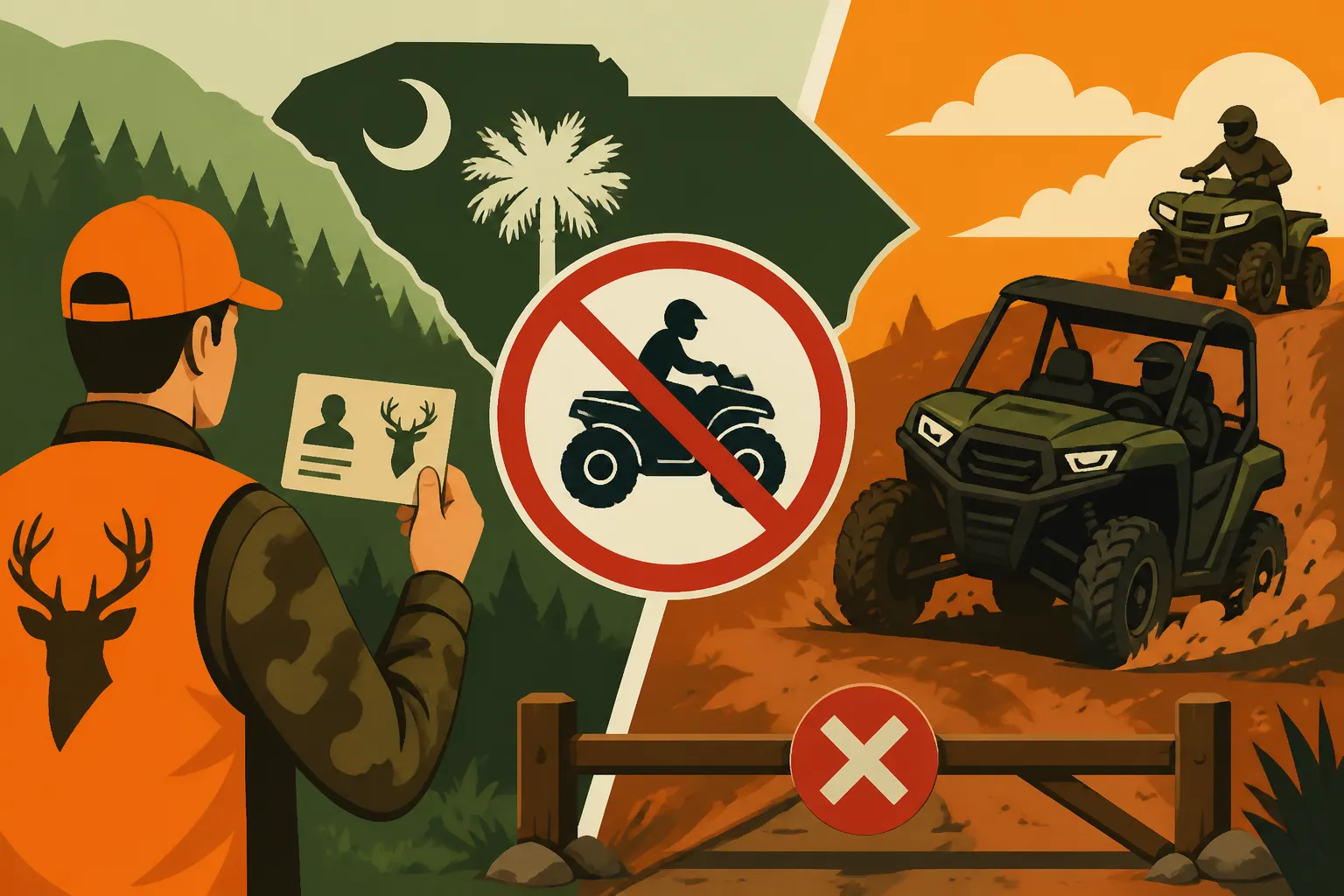
A South Carolina hunting license can authorize you to hunt, but it does not automatically authorize you to ride an ATV or UTV to a stand, along a trail, or across public land. The key is to separate hunting permission from vehicle access. Here’s how to check the land rules, understand the hunting-related exemption, and avoid assuming a legal hunt means a legal ride.
A hunting license and ATV access are separate permissions
A hunting license and permission to operate a machine answer different questions. A license concerns whether you may hunt under the applicable wildlife rules. Vehicle access depends on who manages the land, which routes are open to motorized use, and what that manager allows.
That distinction matters because a quad can be legally owned and suitable for hunting while still being prohibited on the route you want to ride. A license does not turn a closed road into an open one, authorize travel off a designated route, or replace an ATV pass where one is required.
South Carolina’s ATV law includes a hunting- and trapping-related exemption. That exemption is not a general trail permit or an all-purpose exemption from land-access rules. It does not, by itself, give a rider permission to enter property, cross a closed area, or operate a vehicle wherever hunting is allowed. For a closer look at the distinction, see The Hunting Exemption in South Carolina’s ATV Act.
Think of a hunting trip as requiring several separate checks:
- Hunting authorization: Are you allowed to hunt this species, in this season, in this area, and by this method?
- Land access: Are you allowed to enter and use this particular property?
- Motorized access: Is your ATV or UTV allowed on the road, trail, or area you plan to use?
- Vehicle requirements: Do registration, pass, equipment, youth-rider, or other rules apply to your machine and riders?
A “yes” to the first question does not answer the other three. The rules may come from different agencies or landowners, so it’s worth checking each one rather than treating a hunting license as a catch-all authorization. For general land-access questions, see South Carolina Hunting License and Land Access.
The hunting exemption does not create a route
An exemption in a state ATV statute addresses the statute’s own requirements. It should not be read as permission to ride wherever hunting is lawful. A wildlife area, forest, or private property can have separate rules restricting vehicles, closing roads, or limiting access to specific routes.
The practical approach is to look for an explicit rule allowing the ride you intend to make. If the property rules do not clearly allow ATVs or UTVs on the route, do not infer permission from the fact that you hold a hunting license or plan to hunt. South Carolina WMA Vehicle Rules explains why the land manager’s vehicle rules need to be checked separately.
What changes by land type
The same hunting trip can involve very different vehicle rules depending on whether the ground is a Wildlife Management Area, national forest, or private property. Use the table as a starting point, not as a substitute for the current rules for the specific property.
| Land type | What a hunting license establishes | What to check before riding |
|---|---|---|
| South Carolina Wildlife Management Area | Hunting eligibility subject to wildlife and area rules | Whether the area allows the machine, which roads or routes are open, and whether access is restricted by season, gate, or area-specific rule |
| National forest | Hunting may be allowed under applicable regulations | Whether the route is designated for motorized use, whether the vehicle fits the route restrictions, and whether a forest pass or other requirement applies |
| Private land | Hunting may be allowed if you have the necessary permission | Whether the owner has also allowed ATV or UTV use, and where you may travel |
| Timber or other managed land | Hunting access may be available under the property’s program or agreement | The manager’s current vehicle policy, permitted roads, closures, and any limits on travel to a stand or retrieval area |
Wildlife Management Areas
Do not assume that a South Carolina Wildlife Management Area is open to ATVs just because hunting is allowed there. Public hunting access and motorized recreation are different uses. In general, treat ATV access as prohibited unless the rules for that specific area clearly authorize it.
Look for the WMA’s current instructions about roads, gates, parking, mobility access, and vehicle restrictions. An open gate is not necessarily an invitation to ride through it, and a route that looks drivable is not necessarily open to public motorized use. Conditions and permitted access may also differ by area or season. See South Carolina WMA Riding Is Prohibited and South Carolina WMA Vehicle Rules when checking this distinction.
If the rules are unclear, ask the land manager before bringing the machine onto the property. Describe the intended route and purpose: for example, driving to a hunting location, crossing the area to reach another property, or recovering game. A general answer about hunting access may not answer whether an ATV is permitted.
National forests
A hunting license does not replace the rules for motorized travel in a national forest. ATVs and UTVs generally need to stay on routes designated for the vehicle type; riding cross-country or using a closed road is not made lawful by hunting nearby. Trail designations, vehicle-width limits, seasonal closures, and pass requirements can all affect whether a route is usable.
If you plan to hunt near a designated OHV route, confirm that the route is open and appropriate for your machine. Also check whether your trip involves leaving the route to reach a stand. Permission to ride on a trail does not automatically mean you can continue through the woods once you reach the trail’s edge.
Forest passes cover authorized motorized recreation under their terms, not every road or hunting destination in the forest. See South Carolina National Forest OHV Passes for the pass question, and check the route rules separately. A pass is not permission to ride on a route that is closed or not designated for your vehicle.
Private land and timber roads
On private land, permission to hunt does not automatically include permission to drive an ATV or UTV. Ask the owner or land manager specifically about vehicle access. Clarify whether you may use a machine, which roads you can use, whether you can leave those roads, and whether game retrieval is included.
This matters on timber land and hunting leases, where access can depend on gates, road conditions, active operations, or a landowner’s current policy. A verbal statement such as “you can hunt here” may not settle whether you can ride to a stand. Written permission that identifies vehicle access and boundaries can prevent misunderstandings. South Carolina Landowner Permission Forms is useful when you need to document access.
A road on private property is not automatically open to the public, even if it appears on a map or connects to another road. Do not bypass a locked gate or assume that a route is available because it has tire tracks. For more on this issue, see South Carolina Rules for Riding a Timber Road.
How to verify the route before your hunt
A little planning can prevent a frustrating trip, a citation, or damage to a property. Check the route itself—not just the hunting location—and keep the vehicle plan within the permissions you have.
- Identify the land manager. Find out whether the property is a WMA, national forest, private parcel, or a mix of land types. A route may cross boundaries, and permission from one manager does not carry over to another.
- Read the current rules for that property. Look for vehicle restrictions, designated routes, closures, seasonal limits, and any permit or pass requirements. Do not rely on an old map, a past trip, or another hunter’s description as proof that access remains open.
- Ask about the exact trip. If a rule is unclear, contact the responsible office or landowner. Explain where you want to enter, the route you want to use, the type of machine, and whether you plan to ride to a stand or retrieve game.
- Confirm the route is open to your machine. A route that allows some vehicles may not allow every ATV or UTV. Width limits, surface conditions, or route designations can matter.
- Check the riders and machine separately. Age, supervision, equipment, and other riding rules may apply even when a route is open. For a broader overview, see South Carolina Rules for an Out-of-State Machine if you are bringing a machine from elsewhere, or the relevant state rules for your riders and vehicle.
- Carry useful documentation. Keep your hunting documents and any required trail pass or written landowner permission available. Proof that you may hunt does not prove that you may ride, but having the relevant documents can help clarify what you were authorized to do.
If your plan involves a forest OHV route, check route status before hauling the machine. A trail can close or become unsuitable, and permission to hunt elsewhere in the forest does not override that closure. If the hunt requires riding beyond the designated route, ask whether that specific access is allowed rather than treating the pass as blanket permission.
For documentation on the machine itself, see South Carolina Proof of Ownership on the Trail. Ownership paperwork can be useful, but it is not a substitute for land-access permission or a route pass.
Common hunting-trip scenarios
Riding to a deer stand
A hunting license does not automatically authorize you to ride an ATV to a stand. First confirm that motorized travel is permitted on the land and that the route to the stand is open to your machine. If only a particular road is authorized, stay on it unless the manager has separately approved travel off-road.
On a WMA, do not presume that you may ride simply because you have a valid hunting license or the stand is close to a public road. Check the specific WMA’s rules and access arrangements. The answer to Can You Ride to a Deer Stand in South Carolina? depends on the property and the route, not just the purpose of the trip.
Hauling a harvested animal
The fact that you have harvested an animal does not automatically create new vehicle access. Before the hunt, ask whether game retrieval by ATV or UTV is allowed and whether any limits apply to the route or area. If retrieval is permitted, follow the land manager’s instructions and do not extend the permission to unrelated riding.
A plan to use a machine only after a successful hunt should still be confirmed in advance. Waiting until an animal is down can put you under pressure to cross a closed area or leave an authorized route. For details on the retrieval question, see Hauling a Deer Out by Quad in South Carolina.
Hunting from private property beside public land
Permission to hunt on one parcel does not authorize riding across neighboring public land to reach it—or vice versa. If a planned route crosses a boundary, confirm permission and vehicle rules for every section. A trail, field edge, or gate does not tell you who controls the land or whether motorized access is allowed.
When the property line or route is uncertain, stop and verify rather than crossing on the assumption that the hunting permission covers the whole trip.
A simple rule to remember
Use your hunting license to answer, “May I hunt here?” Use the land manager’s rules and the owner’s permission to answer, “May I ride here?” Those are separate questions, and both need a clear answer before you unload the quad.
If the route is not explicitly open to your machine, choose another legal way to reach the hunting area or leave the ATV at an authorized parking location. A hunting license opens hunting opportunities under the applicable rules; it does not open trails to quads.
Disclaimer
This article is for general informational purposes only and does not constitute professional advice. Laws, prices and regulations vary by location and change over time. Consult a qualified professional for guidance on your specific situation.