South Carolina Pass for a Rented Machine
Renting an ATV or side-by-side in South Carolina does not automatically include permission to ride every trail. The pass requirement depends on where you ride, and a rental company’s paperwork may not cover your forest access. Here’s how to check what you need, what to ask the rental provider, and how to avoid arriving at a trailhead with the wrong pass.
Does a Rental ATV Need a South Carolina Forest Pass?
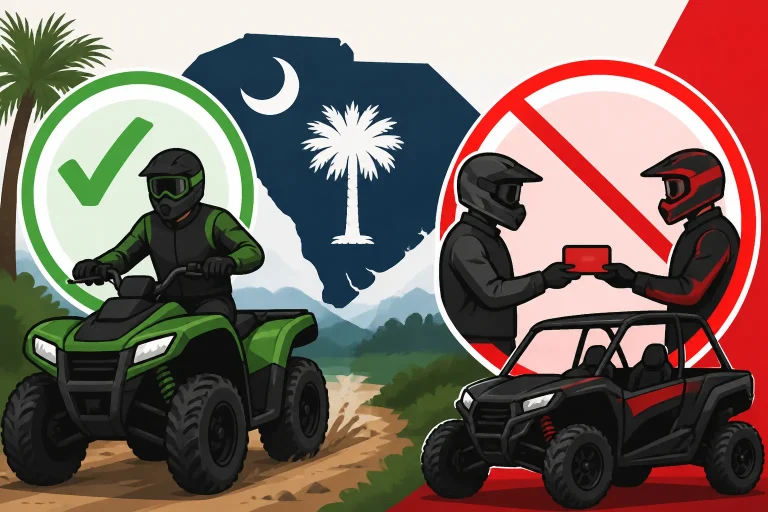
A rental machine is not exempt from a pass requirement simply because it belongs to a rental company. If you plan to ride on a South Carolina national forest OHV trail that requires a pass, confirm that the pass covers your ride before heading out. The rental agreement and the public-land pass serve different purposes: one lets you use the machine under the company’s terms; the other covers access under the trail system’s rules.
This distinction matters because a rental provider may include access to its own private riding area, but that does not necessarily include a pass for a national forest trail. Likewise, a forest pass does not give you permission to ride a private park’s trails or override the rental company’s restrictions. Check the specific location you plan to visit and ask the rental provider what, if anything, is included.
South Carolina’s national forest OHV trails have pass requirements that can differ from the rules at private parks. If you are considering a public trail, check the current pass instructions before you buy or travel. The state’s forest passes are sold online, and you can review the process in South Carolina Passes Sold Only Online. For an overview of the public trail systems, see South Carolina’s Four National Forest Trails.
A rental machine can also have limits that affect which trail you may use. The pass is not a substitute for checking vehicle width, trail access, operating hours, closures, or other restrictions. For example, a side-by-side may not be allowed on a trail intended for narrower machines. Confirm that the machine you rented is permitted on your chosen route; South Carolina Trails That Allow Side-by-Sides can help you identify the relevant access issue.
Before booking, ask the rental company whether it operates on public forest trails, private property, or both. If the company offers a guided ride, ask whether the guide handles the required pass or whether each customer must arrange one. Get the answer for the exact trail and date, rather than relying on a general statement that the rental “includes trail access.”
Who Should Buy the Pass for a Rental?
Do not assume that a pass belonging to the rental company automatically covers you. South Carolina forest pass products may have different conditions, including rules about who the pass is assigned to and what identifying information is used. The instructions for the specific pass are the authority. Read them before purchasing, and ask the forest office or rental company if you cannot tell whether a pass can be used with a rented machine.
The practical question is: whose name or vehicle information must be associated with the pass? Some pass arrangements are linked to an individual, while day-use instructions may involve vehicle details. A rented ATV or UTV can complicate that process because the rider may not own the machine or the tow vehicle. Follow the instructions for the pass type instead of entering information that does not match the requirements. South Carolina Passes Are Non-Transferable explains why a pass should not be treated as a general ticket that can be freely shared.
Use this checklist before buying:
- Identify the trail system. Confirm whether it is a national forest trail, a private riding park, or another type of property.
- Ask the rental company what is included. Request a clear answer about the exact trail, date, machine, and pass.
- Read the pass instructions. Check whether the pass is tied to a rider, a vehicle, or other identifying details.
- Confirm how a rental fits the rules. If the pass instructions refer to a vehicle you do not own, ask the pass provider what information a renter should use.
- Keep the proof required for the ride. Follow the display or carry instructions for that pass, and keep your rental agreement available as proof that you are authorized to use the machine.
Do not buy a pass based on a guess about how the rental company’s plate, trailer, or machine identification should be entered. If the pass is associated with a particular rider or vehicle, the wrong information could make it difficult to show that you have complied. When you contact the rental company, ask whether it has a written policy or specific directions for customers using public forest trails.
If you are choosing between a day pass and a season pass, compare the requirements for each rather than assuming one is more convenient for renters. A season product may have personal-use conditions, while a day product may ask for vehicle information. South Carolina Day vs Season Pass Value can help you weigh the options, but confirm the current terms for your planned ride before purchasing.
What to Confirm With the Rental Company
A few specific questions can prevent confusion at the counter or trailhead. Get answers before you pay a deposit, especially if the rental company advertises access to multiple riding areas.
Ask:
- Is the rental intended for use on a national forest OHV trail, or only on the company’s property?
- Does the rental price include the required forest pass, or must the rider buy one separately?
- If the pass is not included, which pass should a customer purchase?
- Does the pass need to be associated with the rider, rental machine, or tow vehicle?
- Does the company provide the information a customer needs to complete the pass purchase?
- Are there particular trails that the rented machine cannot use?
- Are there closures, reservation requirements, or operating limits for the planned date?
- What proof should the customer carry or display during the ride?
Ask for the trail name, not just a general description such as “forest riding.” Different routes can have different machine limits and access conditions. A rental company may also provide directions to an approved staging area; do not assume that the nearest trailhead or forest road is an authorized place to unload or ride.
For a guided trip, confirm whether the pass requirement applies to each rider, the group, or the vehicle under the current rules. The guide’s pass or business authorization should not be assumed to cover customers unless the operator confirms that it does. If the company says it handles the pass, ask what proof you should have with you and whether that arrangement applies to the specific public trail you will use.
Keep the rental agreement accessible while riding. It can help show that you have the company’s permission to use the machine, particularly if its registration or ownership documents are in the company’s name. It does not replace a required forest pass, and it does not guarantee access to a trail. For more on carrying documentation, see [South Carolina Proof of Ownership on the Trail].
If you are bringing a rental machine to a trail yourself, also verify transport and staging details. The rental agreement may limit where the machine can be taken, and the pass instructions may ask for information about the tow vehicle. Check the trail’s current conditions before loading up; South Carolina Trail Conditions Before You Haul covers why a last-minute check can matter.
Avoiding Pass Problems on Ride Day
The safest approach is to settle the pass question before the rental begins. Pass sales and trail conditions can be subject to changes, so check the official pass instructions and the trail manager’s current notices close to your ride. Do not rely solely on an old screenshot, a social media post, or a friend’s pass if the terms say it is assigned to a specific person or vehicle.
A simple preparation plan is:
- Save or print the pass confirmation in the format the pass provider requires.
- Make sure the name or vehicle information on the pass matches the applicable instructions.
- Carry your rental agreement and any other documentation the rental company requires.
- Check that the rental machine is allowed on the specific trail you intend to ride.
- Confirm the trail is open and that your planned staging area is permitted.
- Keep the rental provider’s contact information available in case the pass instructions do not match what you were told.
If you discover at the trailhead that the pass is missing or linked to the wrong information, do not assume you can ride while sorting it out. Follow the posted instructions and contact the appropriate provider or land manager. A rental company may be able to clarify its own policy, but only the pass issuer or trail manager can confirm what satisfies the public-land requirement.
Private parks are a separate case. They set their own admission, vehicle, age, and operating rules, and a national forest pass generally should not be treated as admission to a private property. Ask the park directly whether the rental company has arranged access and whether the machine meets the park’s requirements. If your rental includes a private park visit, confirm whether you need to pay or register separately as a rider.
In short, a rented machine can be used only when both sides of the arrangement are in order: you have the rental company’s permission to operate it, and you meet the access rules for the trail or park. Verify the pass’s current terms, the trail’s machine restrictions, and who is responsible for arranging the pass. That small amount of planning is easier than trying to resolve an unclear pass at the trailhead.
Disclaimer
This article is for general informational purposes only and does not constitute professional advice. Laws, prices and regulations vary by location and change over time. Consult a qualified professional for guidance on your specific situation.