South Carolina WMA Vehicle Rules
South Carolina’s wildlife management areas can look like convenient places to ride, especially when a trail crosses land open to hunters or other visitors. But public access does not automatically allow ATV or UTV use. The key is to distinguish an authorized vehicle route from a place where off-road riding is prohibited, and to confirm the rules for the specific area before unloading.
The basic rule for motorized vehicles on a WMA
A South Carolina wildlife management area is not automatically an ATV trail system. In general, riders should not take an ATV, side-by-side, or other off-road machine onto a WMA for recreational riding unless the area’s rules specifically authorize that use. A road or open gate is not, by itself, permission to ride.
That distinction matters because WMAs may include public access roads, parking areas, hunting access points, and land managed under different arrangements. A route that is open to ordinary road traffic does not necessarily permit an ATV to leave the road or use a woods trail. Likewise, a track that appears rideable on a map may be a closed management road, a footpath, or a route intended for authorized personnel.
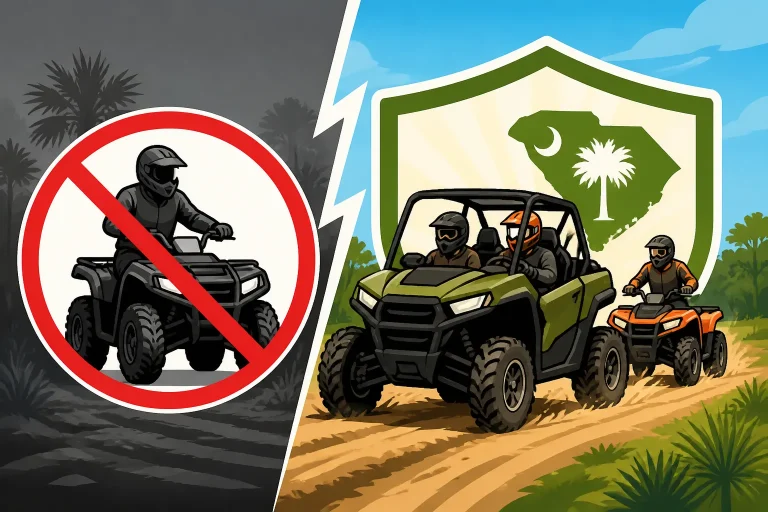
The practical takeaway behind South Carolina WMA Riding Is Prohibited is simple: treat a WMA as closed to recreational ATV and UTV riding unless the current site-specific rules clearly say otherwise. Don’t assume that a hunting license, WMA access privilege, or nearby trailhead makes riding lawful.
| Situation | What to assume | What to check |
|---|---|---|
| Recreational ATV or UTV riding off-road | Not allowed unless specifically authorized | Current rules for that WMA |
| Driving on a road through or beside a WMA | Only if the road is open to that vehicle and that use | Signs, gates, and official access information |
| Parking and unloading | Use an authorized parking or staging area | Whether trailers and unloaded machines are allowed |
| Traveling to a hunting location | A hunting purpose does not automatically permit ATV travel | WMA-specific hunting and vehicle rules |
| Management, emergency, or accessibility use | May require separate authorization | The responsible agency or land manager |
The term “vehicle” can cover more than an ATV. A UTV or side-by-side is still a motor vehicle for access purposes, even if it is used for hunting or utility work. A dirt bike may also be covered by rules restricting motorized travel. Don’t rely on a machine’s size, registration status, or intended use to decide whether it may enter.
The South Carolina WMA Regulations for Vehicles are especially relevant when you are unsure whether a route is designated for motorized access. Read the rules for the particular area rather than assuming one WMA’s access arrangement applies statewide. Signs at entrances and road closures matter, too. If a gate is locked or a route is marked closed, don’t go around it or unload the machine beyond it.
A hunting license or permit does not create ATV access
Having permission to hunt, fish, or visit a WMA does not automatically give you permission to ride there. These are separate questions: whether you may enter the area for a particular activity, and whether you may use a motor vehicle on a particular route. Permission for the first does not answer the second.
A hunting license may be required for hunting, and separate access requirements may apply to a WMA. Neither should be treated as an off-road vehicle permit. The distinction also applies when a machine would make it easier to carry gear, reach a stand, or retrieve game. Before taking an ATV into the area, confirm that the vehicle use itself is permitted.
This is why A Hunting License Opens No Trails to Quads is a useful rule of thumb. A legal hunting activity does not turn a closed road into an open riding route. Likewise, exceptions in ATV laws for certain hunting or land-use activities do not override a landowner’s or land manager’s access rules. The ATV statute and the WMA’s land-use rules address different things.
If you’re planning a hunt, confirm the access plan before the trip:
- Identify the exact WMA and the access point you intend to use.
- Check the current area-specific information for vehicle restrictions, road closures, and parking.
- Ask whether an ATV or UTV may be driven on the route you have in mind, not merely whether hunters may enter the area.
- Confirm whether a trailer can be parked at the access point and whether unloading is allowed.
- If the rules are unclear, contact the responsible land manager before bringing the machine.
If you’re hunting on private property instead, the landowner’s permission is still essential. A general discussion of the distinction is available in [South Carolina Hunting License and Land Access]. For hunting or trapping-related exceptions in ATV law, see South Carolina Hunting and Trapping Exemptions—but don’t treat those exceptions as a substitute for WMA permission.
What if the machine is being used for access or a disability?
Don’t assume that a mobility need, a work purpose, or a special hunting arrangement automatically authorizes motorized access. Some areas may have specific accommodations or require advance approval, while other routes may remain closed. Contact the relevant agency or land manager and describe the machine, route, purpose, and dates. If approval is granted, ask what documentation or route restrictions apply and keep the authorization available during the visit.
The same approach applies to volunteers, contractors, researchers, and people helping with area management. An assignment or invitation may allow access that ordinary visitors don’t have, but the details should come from the organization responsible for the work. A verbal assumption from someone who is not authorized to approve vehicle access is not a safe basis for riding.
WMA roads are not the same as public ATV trails
A common source of confusion is the difference between a road that can be driven and a trail that can be ridden. A WMA may have a road used by staff, hunters, or other permitted traffic, but that does not make every spur, woods track, or open stretch available for recreational ATV use. Road access may also be limited by gates, seasonal conditions, hunting activity, or posted instructions.
When you arrive, follow signs and use only the access route that the area identifies as open to your vehicle and purpose. Do not use a machine to bypass a closed road, cross an unmarked field, or reach a trailhead by cutting through WMA land. Keep your machine off areas where motorized use is restricted, including sensitive habitat and roads closed to public travel.
Be especially careful about maps and apps. A route shown as a road on a phone map may be private, closed, or unsuitable for public motor vehicle access. GPS lines can also lead riders onto a management road or a footpath. Map data helps with navigation, but it does not establish legal access.
A WMA also isn’t interchangeable with a national forest trail system. Some South Carolina national forest routes are designated for OHV use under separate rules, and those routes may have their own pass requirements, vehicle limits, and closures. A forest pass does not grant permission to ride on a WMA, even if the properties meet or overlap in the broader landscape. See South Carolina National Forest OHV Passes for the separate public-land system.
Private parks are different again: they set their own admission and riding rules, and a WMA permission or forest pass does not cover them. If you need a legal place to ride, look for an area that explicitly accepts your type of machine and verify that it is open on your planned date. The distinction between public land and private riding areas is explained in South Carolina Public Land Compared to Private.
How to avoid an access problem before you unload
The easiest way to avoid a citation, a trespass dispute, or a wasted trip is to settle the access question before the trailer leaves home. Start with the exact WMA name, not just a nearby town or trail system. Then check the current information for that area and confirm whether motorized access is allowed for your specific activity and route.
Use this quick checklist:
- Confirm the land designation. Make sure the destination is a WMA, national forest OHV trail, private park, or another type of property. Nearby parcels can have different rules.
- Check the current rules. Look for instructions from the agency or land manager responsible for the specific WMA. Rules can differ by location and may change.
- Separate access from riding. Permission to hunt, fish, hike, or enter does not necessarily permit an ATV or UTV.
- Verify the route. Ask whether the road or trail is open to your machine, not just whether the area is open to visitors.
- Check signs and closures on arrival. A general map or older information may not reflect a closure at the entrance.
- Use approved parking and staging areas. Don’t unload on a shoulder, block a gate, or leave a trailer where it interferes with access.
- Keep relevant paperwork with you. If you have written authorization or a specific permit, bring it. Ownership documents may help identify a machine, but they do not grant land access; see [South Carolina Proof of Ownership on the Trail].
- Have a different destination ready. If the route is closed or the rules are unclear, use a confirmed riding area rather than testing the boundary.
A good question to ask the land manager is precise: “May I ride this ATV or UTV on this named route for this purpose on this date?” Asking only whether “ATVs are allowed at the WMA” may produce an answer that misses the difference between road travel, hunting access, special authorization, and recreational riding.
If no one can confirm that the route is open to your use, don’t ride it. Choose a designated OHV trail or a private riding area that expressly allows your machine. That may mean changing plans, but it avoids treating a WMA as a general-purpose trail network when it isn’t one.
Disclaimer
This article is for general informational purposes only and does not constitute professional advice. Laws, prices and regulations vary by location and change over time. Consult a qualified professional for guidance on your specific situation.