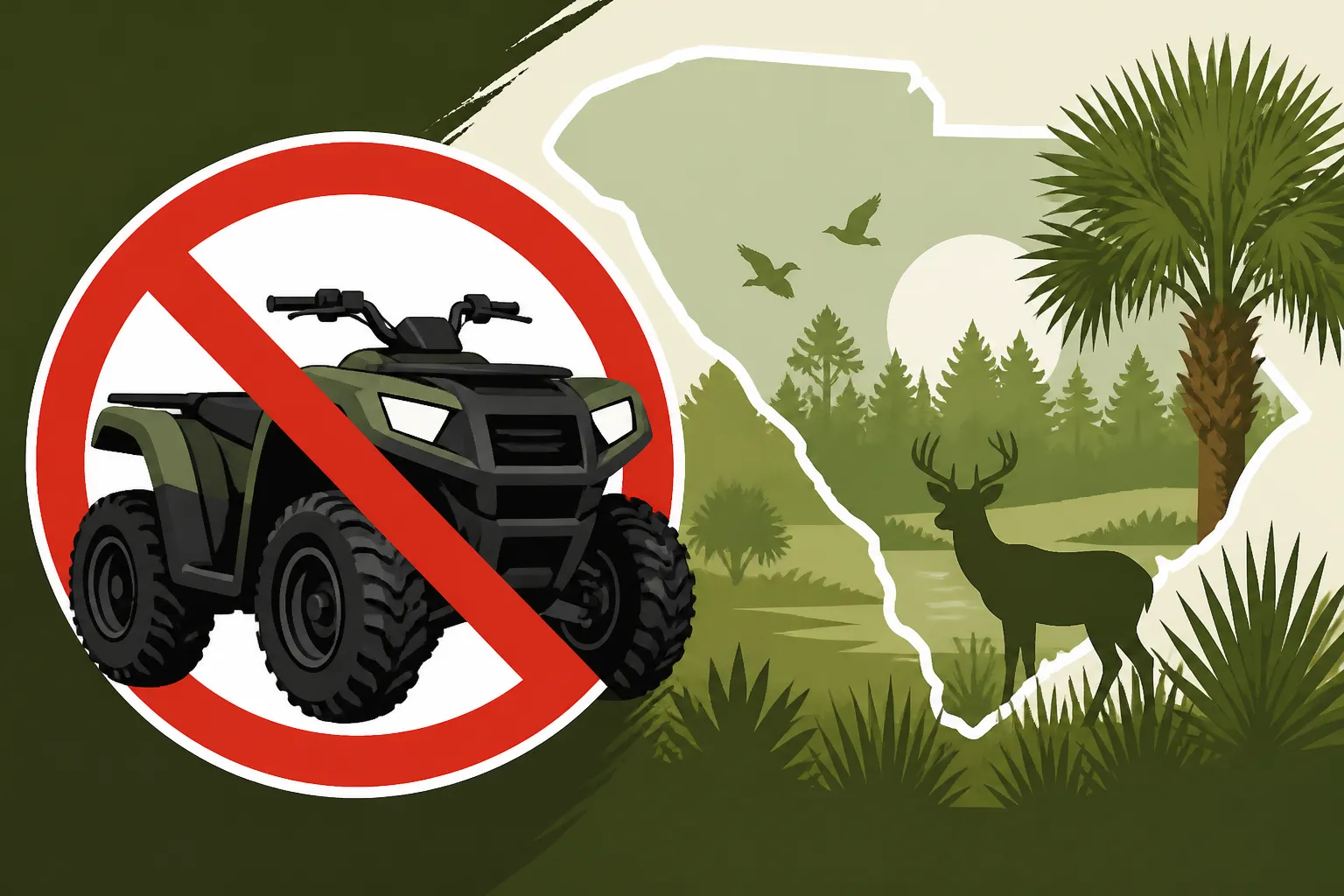
Every Wildlife Management Area Is Closed to Quads
South Carolina riders can easily mistake a hunting permit, public-land access or a nearby trailhead for permission to ride a quad. They are not the same thing. Wildlife Management Areas are not open for general ATV or UTV riding, and having a hunting license does not create that access. Here’s how to tell what is—and is not—allowed before you unload.
Why a hunting license does not open a WMA to quad riding
South Carolina Wildlife Management Areas, commonly called WMAs, are managed for wildlife and outdoor recreation under area-specific rules. A hunting license or other authorization to hunt may allow you to use a WMA for an approved activity, but it is not a motor-vehicle permit. In general, recreational quad and ATV riding is prohibited on WMAs.
That distinction matters because two different questions are involved:
- Are you allowed to enter the area for your activity?
- Are you allowed to operate that particular vehicle there?
Permission for hunting, fishing or another activity does not automatically answer the vehicle question. A license is not permission to ride wherever you can reach on a map, and a trail visible on the ground is not necessarily open to motorized recreation.
A quad may also be called an ATV, four-wheeler or off-road vehicle. A side-by-side is a UTV. The machine’s size or intended use does not create an exception: do not assume a UTV is allowed just because a rule or sign refers to ATVs. Check the vehicle rules for the specific WMA and the specific route.
| What you have or see | What it does not establish |
|---|---|
| A South Carolina hunting license | Permission to ride a quad on a WMA |
| A WMA permit or other activity authorization | Permission to use an ATV as transportation |
| A marked route or old track | That the route is open to off-road vehicles |
| A forest pass for an authorized trail system | Permission to ride off that system or onto a WMA route |
| A machine used for hunting | A general exemption from WMA vehicle rules |
The practical rule is simple: unless the managing authority has specifically authorized ATV or UTV use on a particular route, leave the machine off the WMA. The broader explanation in South Carolina WMA Riding Is Prohibited and the details in South Carolina WMA Vehicle Rules can help clarify why access rules apply even when a rider’s purpose is lawful.
The hunting exemption is not an ATV access pass
South Carolina’s ATV law includes exemptions connected with hunting and trapping. That language can be easy to misread. An exemption under an ATV statute does not, by itself, grant permission to operate a machine on land where motorized access is prohibited.
In other words, a rider may have an activity or use that falls under an exception in one law and still have to follow the land manager’s rules. The landowner or managing agency controls access to its property. A hunting exemption does not convert a WMA into a riding area, open a closed road or authorize travel across land to reach a hunting location.
This is particularly important when someone plans to ride to a deer stand, retrieve game or carry gear. Those tasks may be related to a lawful hunt, but that does not mean a quad can be driven through a WMA. Before taking a machine onto any property, get clear, location-specific authorization for both the activity and the vehicle. For more on the distinction, see The Hunting Exemption in South Carolina’s ATV Act and A Hunting License Opens No Trails to Quads.
Do not rely on a verbal assumption such as “hunters use that road” or “the gate is open.” A road may be open to ordinary traffic while remaining closed to off-road vehicles. A gate may be open for agency work, landowner access or a specific season. Even where vehicles are allowed for some purposes, access can be limited by route, date, vehicle type or written authorization.
If you believe you qualify for a special access arrangement—for example, because of a disability or a specific agency-approved use—ask the managing agency before entering. Confirm the approved route and conditions, and keep any written authorization with you. Do not treat a possible exception as a general permission that applies to every WMA.
WMA access is different from a forest trail pass or private park permit
South Carolina has several kinds of outdoor riding access, and their rules do not transfer from one property to another. A pass for an authorized National Forest OHV trail system, a day pass at a private park and permission to hunt on a WMA are separate things. Buying one does not authorize riding on the others.
For example, National Forest land may contain designated OHV trails where motorized riding is allowed when the trail is open and the rider has met the applicable requirements. That does not mean every road or piece of forest land is open to quads. Stay on the designated route and follow its posted rules. South Carolina National Forest OHV Passes explains the separate pass system, while South Carolina Public Land Compared to Private helps distinguish public-land rules from private-park access.
Private riding areas work differently again. A park may allow ATVs or UTVs under its own admission, vehicle, age and safety rules. A permit or pass from that park applies only to the property and activity it covers; it is not a statewide riding license.
| Place or access type | What to confirm before riding |
|---|---|
| Wildlife Management Area | Whether motorized use is specifically authorized on the route; do not assume recreational quad riding is allowed |
| National Forest OHV trail | Trail designation, current closure status, pass requirements and vehicle restrictions |
| Private riding park | Park admission, vehicle eligibility, operating rules and any age or safety requirements |
| Private land | Permission from the landowner and any limits on routes, dates or vehicle use |
The word “public” can cause confusion. Public access for hunting or wildlife recreation does not necessarily include motorized recreation. Likewise, a road shown on a map may cross land with different ownership or management rules. Confirm the property boundary and the rules that apply to the exact route, rather than relying on the name of a nearby forest or recreation area.
If a route crosses private property, permission needs to come from the landowner or the party authorized to grant access. A hunting club’s permission, a neighbor’s approval or a pass for an adjacent trail system may not cover the property in question. South Carolina Landowner Permission Forms is a useful next step when you need to understand how to document private-land access.
How to check a route before you unload
A little verification before a ride can prevent a trespass problem, a citation or a wasted trip. Use this process whenever your planned route touches a WMA, public forest land or property with unclear boundaries.
- Identify the exact property. Use an official map or contact the managing agency to determine whether the trailhead and route are inside a WMA, National Forest, private riding park or privately owned land. Nearby names and road signs may not tell the whole story.
- Check the rules for that specific area. Look for current vehicle restrictions, seasonal closures, designated routes and any special-use authorization. General hunting access information is not enough to confirm ATV access.
- Ask directly about your machine and purpose. If the rule is unclear, contact the agency or landowner and ask whether your ATV or UTV may use the exact route. Mention whether you intend to ride for recreation, access a hunting location or perform another task.
- Confirm any exception in writing. If permission is granted, keep the authorization and follow its conditions. Confirm where you may travel and whether dates, vehicle types or operating hours are limited.
- Have a legal riding alternative. If the WMA route is closed to quads, choose a designated trail or a private park that accepts your machine. Check closures and access requirements before towing there.
Keep proof of ownership and any required passes or authorizations available for the place where you are riding. Those papers do not override a closure, but they can help answer routine questions about your machine and your access. South Carolina Proof of Ownership on the Trail covers the ownership side of that preparation. For riding-area options, start with South Carolina ATV Trails: Where to Ride and then verify each location’s current rules directly.
If you arrive and the rules remain unclear, do not use the quad while you try to sort it out. Park outside the restricted area and contact the manager. Avoid bypassing a locked gate, riding around a closure sign or following tracks left by other vehicles. Someone else’s tire marks are not evidence of permission.
Disclaimer
This article is for general informational purposes only and does not constitute professional advice. Laws, prices and regulations vary by location and change over time. Consult a qualified professional for guidance on your specific situation.