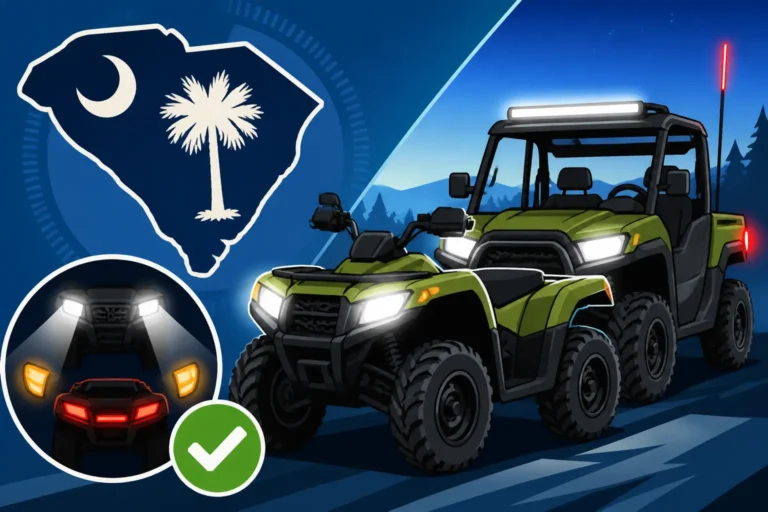
What Separates a Low-Speed Vehicle From a Cart
It's easy to look at a compact, open-air vehicle zipping down a side street in a Lowcountry beach town or a quiet upstate neighborhood and wonder, "Is that a golf cart or something else entirely?" The visual similarities can be striking, leading to a lot of confusion for folks just trying to understand what's legal to drive where in South Carolina. This guide is going to clear up that mystery, breaking down the specific legal definitions and operational differences that separate a low-speed vehicle from a standard golf cart in our beautiful state.
Defining a Golf Cart in South Carolina
In South Carolina, a golf cart isn't just any small, electric or gas-powered buggy you might see on the links. Our state has very specific legal parameters for what qualifies as a golf cart for public road use. This definition is crucial because it dictates where, when, and by whom these vehicles can be operated, and what kind of paperwork you need to have on hand. It's not nearly as free-for-all as some might assume!
Operational Characteristics of a South Carolina Golf Cart
When we talk about a golf cart in South Carolina, we're talking about a vehicle primarily designed for use on a golf course. That's its original intent, and that purpose still heavily influences its legal standing. The law specifically states that a golf cart is a "motor vehicle that is designed and manufactured for operation on a golf course for sporting or recreational purposes." This isn't just about how it looks, but how it's legally defined by its design and intended use.
Crucially, these vehicles are speed-limited. A true golf cart, under South Carolina law, must not be capable of exceeding 20 miles per hour. If your machine can fly past that limit on flat ground, it's immediately venturing out of the golf cart category and into a different class of vehicle, which means a whole different set of rules. This speed restriction is a primary safety measure, reflecting the typical environment where golf carts are expected to operate, which is generally not high-traffic public roads. The slower speed helps ensure they can safely share lower-speed routes without impeding traffic too much or posing a greater collision risk.
Permit and Road Restrictions for Golf Carts
To legally operate a golf cart on public roads in South Carolina, you absolutely need a valid permit issued by the Department of Motor Vehicles. This isn't just a suggestion; it's a hard requirement. Many folks move here from states where golf carts might be unregulated on side streets, and they quickly learn our rules are different. Getting caught without the proper [South Carolina Golf Cart Permit Fees] or decal can lead to fines, so it's best to get this squared away before you even think about leaving your driveway. The good news is that obtaining a permit for a golf cart is a relatively straightforward process compared to registering a full-fledged vehicle.
Once you have that permit, you're not free to roam anywhere. South Carolina places strict geographic and temporal limitations on golf cart use. You can only operate a permitted golf cart during daylight hours – from a half-hour after sunrise to a half-hour before sunset. Nighttime operation is a definite no-go. Furthermore, you're typically restricted to roads with a posted speed limit of 35 miles per hour or less, and generally within a four-mile radius of your home or the entrance to the community where you're staying. Some municipalities might have their own ordinances that slightly alter this radius, but the general principle of local, low-speed travel remains. This radius rule is a big one; don't accidentally exceed it thinking you're still within bounds. For more details on the practical side, check out [South Carolina Golf Cart Permit Steps]. You'll also need to keep an eye on when your permit decal needs to be replaced, as [South Carolina Golf Cart Decals Every Five Years] are part of the ongoing compliance.
Understanding Low-Speed Vehicles (LSVs) in South Carolina
Now, let's talk about Low-Speed Vehicles, or LSVs. While they might look like souped-up golf carts to the casual observer, legally and functionally, they are a completely different animal in South Carolina. Think of them less as a golf course accessory and more as a compact, street-legal car. The distinction is absolutely vital because the rules governing their ownership and operation are far more stringent, mirroring those for regular passenger cars rather than golf carts.
Federal and State Requirements for LSVs
Unlike golf carts, Low-Speed Vehicles are specifically manufactured to meet federal safety standards for motor vehicles. This is a critical difference. It means an LSV isn't just a golf cart that happens to go a bit faster; it's designed from the ground up to be safe for road use. These federal standards mandate certain safety equipment, which includes things like headlamps, tail lamps, stop lamps, turn signal lamps, reflex reflectors, a rearview mirror (or mirrors on both sides), a parking brake, a VIN (Vehicle Identification Number), and seatbelts for all designated seating positions. Without these features, a vehicle cannot be classified as an LSV.
Because they meet these more robust safety standards, LSVs can operate at slightly higher speeds than golf carts, generally between 20 and 25 miles per hour. This speed range makes them suitable for local errands, community travel, and navigating slower secondary roads without holding up traffic quite as much as a golf cart might. This speed, combined with the safety features, gives them a much broader range of legal operation. If you're looking at aftermarket accessories from a brand like SuperATV, make sure any modifications you make still adhere to federal LSV standards if you intend for your vehicle to remain street legal. Adding things like robust lighting, mirrors, or proper turn signals are often part of getting a machine compliant, but it needs to be done right.
Titling, Registration, and Road Use for LSVs
Here's where the rubber meets the road, so to speak, in terms of distinguishing an LSV from a golf cart. In South Carolina, a Low-Speed Vehicle must be titled and registered with the DMV, just like a regular car or truck. This means you'll go through the same processes, present proof of ownership, and receive a proper vehicle title and license plate. This is a significant step up from the simple permit required for a golf cart. If you're wondering about the cost implications, the fees for [South Carolina Low-Speed Vehicle Plates] are comparable to other vehicle registrations.
Once registered and plated, an LSV can be driven on any public road where the posted speed limit is 35 miles per hour or less. Crucially, unlike golf carts, LSVs are not restricted to daylight hours. They can be operated at night because they possess the full suite of required lighting equipment. They also don't have the same restrictive radius rules that golf carts do. This opens up a lot more possibilities for their use, making them a practical choice for folks who need a local commuter vehicle that can handle a bit more mileage and time on the road. Remember, even with these expanded privileges, they are still limited to those 35 mph or less roads; don't try to take them on a major highway! When it comes to proving ownership for an LSV, the process is very much like a car, requiring formal documentation. You can read up on topics like [South Carolina Proof of Ownership Without a Title] for situations where traditional paperwork might be missing.
Key Differences and Operational Impact
The differences between a low-speed vehicle and a golf cart might seem subtle at first glance, especially if you're only looking at the general shape of the vehicle. However, the legal and practical ramifications of these distinctions are anything but subtle. Understanding these differences is absolutely paramount for anyone considering purchasing or operating either type of vehicle in South Carolina. Misinterpreting the rules can lead to significant headaches, from fines to insurance issues, or even being cited for illegal operation.
A Comparative Look at Key Features
To really cement the distinctions, let's lay out the key differences side-by-side. It’s not just about speed; it’s a whole package of design, safety, and legal classification.
| Feature | Golf Cart (South Carolina) | Low-Speed Vehicle (LSV) (South Carolina) |
|---|---|---|
| Primary Design | For golf courses, recreational use | For public roads, local transportation |
| Top Speed | Cannot exceed 20 mph | 20-25 mph |
| Safety Features | Minimal (basic lighting, no seatbelts required) | Federal motor vehicle safety standards (FMVSS) compliant: head/tail lights, brake lights, turn signals, mirrors, windshield, seatbelts, VIN |
| Legal Status | Requires DMV permit, decal | Requires DMV title & registration (like a car), license plate |
| Road Use | Daylight hours only; roads 35 mph or less; 4-mile radius from home/community (local ordinances may vary) | Day or night; roads 35 mph or less; no radius restriction |
| Insurance | Not legally required for operation on most roads (though highly recommended) | Mandatory liability insurance (like a car) |
| VIN | Often does not have a federally compliant VIN | Requires a federally compliant VIN |
This table clearly illustrates why you can't just slap a license plate on a golf cart and call it an LSV. The underlying construction and safety equipment are fundamental. If you're outfitting your machine with components from a company like SuperATV, make sure you understand whether those parts help meet LSV safety standards or if they're simply recreational upgrades for a golf cart.
Operational Consequences and What It Means for You
The operational consequences of these differences are profound. If you have a golf cart and drive it at night, or beyond your permitted radius, or on a road with a 45 mph speed limit, you are breaking the law. A local law enforcement officer can issue a citation, and your vehicle could even be impounded. The penalties, including fines, can add up quickly, not to mention the inconvenience. Similarly, trying to pass off an unregistered, untitled golf cart as an LSV will get you into trouble.
For LSV owners, the greater freedom comes with greater responsibility. You must carry proper [South Carolina Insurance Proof at Registration] and adhere to all traffic laws just as you would in a car. While you have more flexibility in terms of time of day and distance from home, you're still bound by the 35 mph road limit. The DMV treats an LSV much more like a regular car, meaning a full [South Carolina Title Application at the DMV] is needed. If you ever sell an LSV, you'll transfer the title just like you would for any other motor vehicle. The requirements for LSV operation also extend to who can drive them: [South Carolina Street UTV License Requirements] clarify that you'll need a valid driver's license, just like a car.
Why the Distinction Matters for South Carolina Riders
Understanding the precise legal distinction between a low-speed vehicle and a golf cart in South Carolina isn't just about avoiding a ticket; it's about making informed decisions for your safety, your finances, and your peace of mind. Our state's beautiful coastal towns, charming historic districts, and scenic backroads are tempting places to cruise in a smaller, open-air machine, but knowing which machine is right for which purpose is key to truly enjoying the lifestyle without legal worries.
Making the Right Choice for Your Needs
When you're shopping for a new leisure vehicle, or even considering modifying an existing one, this distinction should be at the forefront of your mind. If your primary use will be limited to quick trips around a golf course community, a standard golf cart with a permit might be perfectly adequate and more budget-friendly upfront. It’s simple, designed for that purpose, and the lower speed limit keeps things relaxed.
However, if you envision using your vehicle for slightly longer distances, on a wider variety of secondary roads, or for essential errands that might extend into the evening, an LSV is almost certainly the better and safer choice. While the initial investment might be higher due to the federal safety requirements and the need for full registration and insurance, the expanded utility and legality often make it worthwhile. You'll have the assurance that your vehicle meets real safety standards and is recognized as a legitimate road-going machine. Some folks even customize their golf carts with parts from companies like SuperATV to get closer to LSV-like features, but you must be careful not to cross the line without fully meeting all federal LSV requirements. It's not enough for it to look compliant; it must be compliant.
Avoiding Common Misconceptions and Legal Pitfalls
One of the biggest pitfalls many residents and visitors fall into is the "it's just a golf cart" mentality. This casual attitude can lead to serious legal problems. For instance, attempting to operate a golf cart outside its permitted hours or radius, or trying to register a golf cart as an LSV without it truly meeting federal safety standards, are common mistakes. Conversely, some LSV owners might inadvertently restrict themselves to golf cart rules, not realizing they have greater flexibility.
Always verify the exact classification of your vehicle and ensure you have the correct documentation for its intended use. If you've purchased a used machine, especially from a private seller, clarify its history and ensure it was properly titled or permitted in the past. If you're uncertain, a quick call to your local DMV office can provide clarity. [South Carolina Title Questions the DMV Hears] can give you an idea of the types of questions that might come up. Ultimately, respecting the specific laws for each type of vehicle ensures not only your legal standing but also contributes to safer roads for everyone in the Palmetto State.
Disclaimer
This article is for general informational purposes only and does not constitute professional advice. Laws, prices and regulations vary by location and change over time. Consult a qualified professional for guidance on your specific situation.