South Carolina Rules for Riding Near a School
It's incredibly frustrating when you want to enjoy your ATV or UTV but aren't quite sure where the lines are drawn, especially when it comes to sensitive areas like school zones. You're trying to be a responsible rider, but the rules around riding off-road vehicles on public roads, and what that means for areas with children, can feel like a tangled mess. This guide aims to untangle those specific rules in South Carolina, helping you understand where you can and cannot ride your machine, particularly when you're near a school.
Understanding South Carolina's General Road Rules for Off-Road Machines
Before we can dive into the specifics of riding near schools, it's really important to grasp the broader context of where ATVs, UTVs, and even golf carts are permitted on South Carolina's public roads. This isn't just about avoiding a ticket; it's about public safety and understanding the intent behind these regulations.
ATVs and Public Roads: A Clear "No"
Let's be blunt: generally speaking, ATVs (All-Terrain Vehicles) are designed and intended for off-road use only. South Carolina law is quite clear on this: [Can You Ride an ATV on the Road in South Carolina?] The vast majority of ATVs are not street-legal and should not be operated on public roads, highways, or shoulders. This includes the roads that lead directly to or past a school.
There are very limited exceptions, like crossing a road at a 90-degree angle to get to another trail, or possibly for agricultural purposes on certain private property roads. But even these exceptions come with strict conditions and are certainly not an open invitation to ride recreationally on a paved street. The frustration here is understandable, especially if you live in a rural area where "the road less traveled" might seem like a natural extension of your riding area. However, the law distinguishes these machines from standard vehicles for very specific reasons, primarily safety, due to their design, lack of traditional safety features, and operator training.
Street-Legal UTVs: A New Chapter in South Carolina
For a long time, UTVs (Utility Terrain Vehicles), or side-by-sides, were in a similar boat to ATVs when it came to public roads. But things have changed! South Carolina has, through recent legislation, created a pathway for UTVs to become street-legal. This is a big deal for enthusiasts and a common point of confusion. [South Carolina Street-Legal UTV Registration Arrives] opened up new possibilities for UTV owners.
To qualify as a street-legal UTV, your machine must meet a host of specific requirements, including things like headlights, taillights, brake lights, turn signals, a horn, a windshield, mirrors, and seatbelts. It also requires registration with the DMV and proof of insurance. Without meeting all of these [South Carolina Street UTV Requirements Explained], your UTV is still considered an off-road machine and cannot legally be on public roads. This is where you might find yourself looking for reliable aftermarket parts to meet these standards; companies like SuperATV offer many accessories designed to help make your UTV street-compliant, from full windshields to signal kits. Once registered and properly equipped, these street-legal UTVs generally follow the same rules as other motor vehicles on roads with speed limits of 55 mph or less. However, this general permission can have specific caveats, especially when it comes to school zones.
Golf Carts and Low-Speed Vehicles: Different Rules, Similar Areas
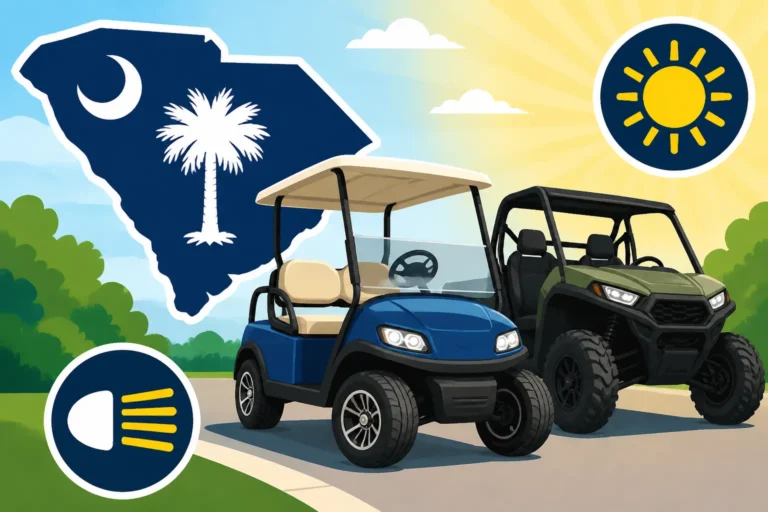
Golf carts are a staple in many South Carolina communities, especially coastal towns and master-planned neighborhoods. They have their own distinct set of rules for road use, which are separate from ATVs and UTVs. Generally, [South Carolina Golf Cart Road Rules] permit golf carts to be operated on secondary roads or streets during daylight hours, within a certain radius (often 4 miles) of your home or the entrance to a community, and only on roads with a speed limit of 35 mph or less. They also require a permit, which is different from a full vehicle registration.
Then there are Low-Speed Vehicles (LSVs). These are distinct from golf carts, despite looking similar. [A Low-Speed Vehicle Is Not a South Carolina UTV], and they have stricter manufacturing standards (like seatbelts and specific lighting) and are usually capable of higher speeds (up to 25 mph). LSVs are treated more like regular cars for registration and insurance purposes and can operate on roads up to 35 mph. Understanding these distinctions is crucial because a golf cart or LSV might be legally operating on a street near a school where an ATV or non-street-legal UTV absolutely cannot.
Specific Rules and Considerations for Riding Near Schools
Now that we've laid the groundwork for what's generally allowed on South Carolina roads, let's focus on the heart of the matter: riding any of these machines near a school. This is where heightened caution and strict adherence to the law become paramount, not just for your safety, but for the safety of children.
ATVs in School Zones: Strictly Prohibited
For ATVs, the answer is straightforward and unwavering: do not ride an ATV on public roads, and therefore, do not ride an ATV near a school on a public road. Period. Since ATVs are generally not allowed on public roads in South Carolina, operating one on a street, especially one that leads to a school, would be a violation of the law.
Even if a school is located in a rural area, and the roads around it feel more like dirt paths than paved streets, if those are public roads, the prohibition still stands. The potential for an accident involving an ATV and a child is simply too high, given the ATV's design and the unpredictable nature of school zones with children walking, biking, and waiting for buses. It's a risk no responsible rider should take.
Street-Legal UTVs in School Zones: Proceed with Extreme Caution
For street-legal UTVs, the situation is a bit more nuanced, but the emphasis remains on extreme caution. If your UTV meets all the [South Carolina Street UTV Requirements Explained] and is legally registered and insured to be on public roads, it generally has the same rights and responsibilities as any other motor vehicle. This means it could theoretically be driven on a public road near a school, provided that road's speed limit is within the UTV's allowed operating speed (typically 55 mph or less).
However, "could" does not mean "should" or "without extra vigilance." School zones are areas of high pedestrian traffic, especially during arrival and dismissal times. Drivers of any vehicle, including street-legal UTVs, must be acutely aware of their surroundings, adhere to reduced speed limits (which are often clearly marked in school zones), and be prepared for sudden stops or children darting into the road. If you've accessorized your UTV with items like a rearview camera or enhanced mirrors, perhaps from SuperATV, you'll have an even better view of the bustling activity around schools, which is a huge plus. The spirit of the law, and common sense, dictates that you exercise the highest degree of care when operating any vehicle in these areas.
Golf Carts and LSVs in School Zones: Follow Local Ordinances and State Law
Golf carts and LSVs are frequently used in residential areas where schools are often located. If a school falls within the allowed radius and on a road with the appropriate speed limit (35 mph or less for golf carts; 25 mph or less for LSVs), then riding a legally permitted golf cart or LSV near a school is generally allowed.
However, local municipalities can impose additional restrictions. It's vital to check with your specific city or county ordinances to see if they have any further limitations on golf cart or LSV operation in or around school zones. For example, some areas might prohibit golf carts on certain roads or during specific hours near schools, even if they meet the general state requirements. Always slow down, obey all traffic laws, and be extra mindful of children. Many golf cart drivers also install additional safety features, such as enhanced lighting or mirrors, to boost visibility—something that's never a bad idea when children are present.
Table: Summary of Machine Legality Near South Carolina Schools (Public Roads)
Here's a quick overview of how different types of off-road and low-speed vehicles typically interact with public roads near schools in South Carolina:
| Machine Type | General Road Legality (SC) | Legality Near Schools (Public Roads) | Key Considerations |
|---|---|---|---|
| ATV (All-Terrain Vehicle) | Generally NOT street legal. Limited exceptions for crossing. | Strictly PROHIBITED. | High risk, illegal operation. Focus on off-road trails like Enoree OHV Trail in South Carolina. |
| UTV (Street-Legal) | Permitted if fully compliant (Act 164), registered, insured. | Permitted with EXTREME CAUTION, like any other street-legal vehicle. | Must adhere to all traffic laws, school zone speed limits. Heightened awareness for children. |
| Golf Cart | Permitted under specific conditions (daylight, radius, speed). | Permitted if within legal radius, speed limits, and local ordinances. | Check local rules. Daylight only. Be mindful of child pedestrians. |
| Low-Speed Vehicle (LSV) | Permitted if fully compliant, registered, insured. | Permitted with CAUTION, like any other street-legal vehicle. | Treat as a small car. Adhere to all traffic laws and school zone rules. |
Penalties and Enforcement Near Schools
Ignoring these rules, especially in a school zone, isn't just a minor infraction; it can carry significant consequences. Law enforcement officers are particularly vigilant around schools to ensure the safety of children, and they won't hesitate to enforce vehicle laws in these areas.
Fines and Citations for Illegal Operation
If you're caught operating an ATV or a non-street-legal UTV on a public road near a school, you're looking at fines. These aren't just slaps on the wrist. Depending on the specific violation and whether it's a first or repeat offense, fines can range anywhere from $50 to $200. [South Carolina Penalties Under Chandler's Law] often apply to illegal ATV operation. Beyond the immediate financial hit, there could be other consequences, like your machine being impounded, leading to additional towing and storage fees. This can quickly turn an enjoyable ride into a very expensive headache.
For street-legal UTVs, golf carts, or LSVs, operating them carelessly or illegally in a school zone (e.g., speeding, ignoring crossing guards, violating local ordinances) will result in tickets similar to those issued for conventional vehicles. These can range from minor traffic infractions to more serious offenses if reckless endangerment is involved.
Impoundment and Property Tax Implications
In some cases, especially with illegal ATV operation, law enforcement has the authority to impound the vehicle. Getting your machine back can be a convoluted process involving fines, proving ownership, and paying impound fees. It's a massive inconvenience and a financial drain that no one wants to experience.
While South Carolina has a [South Carolina Property Tax Exemption Since 2011] for ATVs, which is fantastic for owners, illegal operation in sensitive areas can still lead to other unforeseen costs and legal troubles that far outweigh the benefit of not paying property tax. The core message here is: follow the rules. It's simpler, safer, and cheaper in the long run.
Best Practices and Safety Tips Around School Zones
Beyond just following the letter of the law, there's a strong ethical component to riding any vehicle near a school. Children are often unpredictable, easily distracted, and not always aware of traffic. Prioritizing their safety should always be your number one concern.
Slow Down and Be Hyper-Vigilant
This is the golden rule for any vehicle in a school zone. Even if your street-legal UTV or golf cart is allowed on the road, reduce your speed significantly. School zones often have posted reduced speed limits, sometimes with flashing lights indicating active times. Always obey these.
Look for children who might run into the street, cyclists, and school buses. Be prepared to stop suddenly. Avoid distractions like cell phones or loud music. Your full attention needs to be on your surroundings. If your UTV has a performance exhaust or is otherwise louder than a typical car, be extra considerate of noise levels, especially during school hours. Think about how you would want someone driving near your own children.
Plan Your Route to Avoid School Zones When Possible
If you're out for a recreational ride on your street-legal UTV or golf cart, consider adjusting your route to bypass school zones entirely, especially during peak drop-off and pick-up times. These times are notoriously chaotic, with heavy traffic, distracted parents, and excited children. Opting for a different route, even if it adds a few extra minutes, can significantly reduce risk and stress for everyone involved.
For ATVs, since they shouldn't be on public roads, this point reinforces the need to transport your machine to designated riding areas. Don't try to "just ride it down the road" to get to a field nearby if that road passes a school. Use a trailer and keep your ATV off public asphalt.
Educational Emphasis: Lead by Example
As riders, we have a responsibility to set a good example. If you're riding a street-legal UTV, make sure it's fully compliant and that you operate it safely and courteously. If you have younger riders with you, teach them the importance of safety around pedestrians and especially children.
Understanding [Chandler's Law and South Carolina ATV Rules], for instance, gives you insight into the state's emphasis on youth safety in off-road environments. This same mindset should extend to public roads near schools. Ensuring your machine, perhaps equipped with safety accessories from SuperATV, is in top condition and that you are an alert, responsible operator will not only keep you safe but also contribute to a positive image for all ATV and UTV enthusiasts in South Carolina.
Disclaimer
This article is for general informational purposes only and does not constitute professional advice. Laws, prices and regulations vary by location and change over time. Consult a qualified professional for guidance on your specific situation.