Why South Carolina’s ATV Law Is Called Chandler’s Law
Ask a group of South Carolina riders why the state’s ATV safety statute is called Chandler’s Law and you will get a shrug, a half-remembered story and at least one wrong answer about helmets. That matters, because the name is attached to real rules about age, training and gear that deputies enforce. This guide explains where the name comes from and what the law actually requires.
Where the Name Chandler’s Law Comes From
Most laws in South Carolina carry a dry bill number and a code section that nobody outside the State House ever says out loud. A handful get a name, and when a statute is named after a person, it is almost always because a family turned a loss or a near miss into a campaign. The ATV safety law is one of those. It is known across the Palmetto State as Chandler’s Law, and the name has stuck far better than any official citation.
A Statute Named After a Boy
The law takes its name from a South Carolina boy named Chandler whose ATV accident became the rallying point for a push to put basic safety rules on youth riding. Before the law, South Carolina had very little that specifically governed who could ride a quad, at what age, with what training or in what gear. Kids rode machines far too large for them on family land, on dirt roads and on power line cuts, and the state simply did not have a framework that addressed it.
His story gave lawmakers and safety advocates a face and a reason. That is the pattern behind most named safety statutes: a single, specific accident makes an abstract risk feel personal. If you want the fuller background on how the story became legislation, A South Carolina Statute Named After a Boy goes deeper into the campaign itself.
What is worth holding onto is this. The law was built around children and teenagers. Almost every core requirement, from the minimum age to the safety course to the helmet rule, targets young riders. Adults riding on their own land are touched far less, which surprises people who assume the law is a general ATV rulebook.
From Bill to Code in 2011
The law took effect in July 2011 and lives in the South Carolina Code of Laws, Title 50, Chapter 26. Title 50 is the section of the code that deals with fish, game and watercraft, which tells you something about how the state thought of ATVs at the time: as outdoor recreation and hunting equipment rather than road vehicles.
For riders, the chapter number matters mainly when you want to read the text for yourself or when a citation lists a section. South Carolina Code Title 50 Chapter 26 walks through the layout and the section numbers you are most likely to see on a citation. The short version is that from mid-2011 onward, the age, training and gear rules described below have been the law of the land.
It is also worth noting how this differs from the paperwork side. Titling, the optional South Carolina title and the newer street UTV registration all sit elsewhere in the code and are handled by the Department of Motor Vehicles. Chandler’s Law is about how and by whom a machine is ridden, not about who owns it on paper.
Why People Still Use the Name
Riders, dealers and deputies all say Chandler’s Law rather than Title 50, Chapter 26, and there are good reasons for that. The name is memorable, it signals that the rules are about safety, and it reminds people that there was a real child behind them. Dealers often use it when they explain why they will not sell a full-size quad to a parent shopping for an eight-year-old.
The name also creates a little confusion. Some riders assume Chandler’s Law covers everything to do with ATVs in South Carolina, including road use, insurance and registration. It does not. Those topics are handled by other statutes, and some of them changed substantially in 2026. Keeping that separation clear will save you from a lot of bad advice in parking lots and online groups.
What Chandler’s Law Actually Requires
The heart of the law is a short list of rules for young riders, plus a few equipment and conduct provisions that apply more broadly. None of it is complicated, but the age thresholds are specific, and getting them slightly wrong is the most common mistake parents make.
Age Limits and the Under 6 Ban
The clearest rule is the bottom line on age: children under 6 may not operate an ATV at all. This is a flat prohibition, not a guideline, and it applies regardless of the size of the machine. A five-year-old on a tiny youth quad in the backyard is outside the law. The details are covered in South Carolina Bans Riders Under 6.
Above that, the law ties young riders to machines that fit them. Every ATV sold in the United States carries a manufacturer’s age warning label that states the minimum recommended rider age for that machine, based on engine size and design. Chandler’s Law makes that label part of the rules. A child should be on a machine whose label allows their age, and removing that label is unlawful, as Removing the Age Warning Label Is Unlawful explains.
For parents, this is the practical point. You cannot put an eleven-year-old on an adult-sized sport quad and claim it is fine because a grown-up is watching. Machine size and rider age are linked under the law.
The Safety Certificate for Riders 15 and Under
Riders aged 15 and under must complete an approved ATV safety course and carry proof of it. This is one of the parts of Chandler’s Law that deputies and wildlife officers actually check, because it is easy to verify on the spot. A young rider who cannot show the certificate is in violation even if they are otherwise riding perfectly safely.
Only the ATV Safety Institute course counts for this purpose, which is a detail people often miss when they sign up for a general off-road class or a local club clinic. Only an ATV Safety Institute Course Counts sets out why, and The Safety Certificate Riders 15 and Under Need covers how to get the card and keep it handy.
Many families treat the course as a formality, then discover it is genuinely useful. Hands-on instruction covers starting, stopping, turning, riding on hills and handling obstacles, and kids who take it seriously often ride more smoothly than adults who never did.
Helmets, Eye Protection and Supervision
Riders under 16 must wear a helmet that meets the federal safety standard for motorcycle helmets. A bicycle helmet or a cheap novelty lid does not qualify. Look for the certification label inside the shell. Helmets Under 16 Must Meet the Federal Standard explains how to check, and riders who buy gear from aftermarket suppliers like SuperATV should confirm the helmet’s certification on the product listing rather than assuming.
Eye protection is required alongside the helmet for young riders. That can be a face shield on the helmet or separate goggles. On dusty South Carolina dirt roads and sandy coastal trails, goggles are a comfort item as much as a legal one.
Young riders also face limits on carrying passengers and on riding without adult supervision. The law expects an adult to be present with younger children, and a minor without a driver’s license should not be carrying a passenger. Many youth machines are built for one rider only, so a passenger is both a legal and a mechanical problem.
| Requirement | Who It Applies To | What It Means in Practice |
|---|---|---|
| No operation | Children under 6 | May not ride an ATV at all |
| Age-appropriate machine | Young riders | Follow the manufacturer’s age warning label |
| Safety certificate | Riders 15 and under | ATV Safety Institute course, carry proof |
| Helmet | Riders under 16 | Must meet the federal motorcycle helmet standard |
| Eye protection | Young riders | Face shield or goggles with the helmet |
| Age warning label | All machines | Removing it is unlawful |
The Rules That Reach Every Rider
Although the law is aimed at children, several provisions apply to anyone who operates an ATV in South Carolina. These are the rules adult riders most often discover only after a conversation with an officer.
Lights, Brakes and Spark Arresters
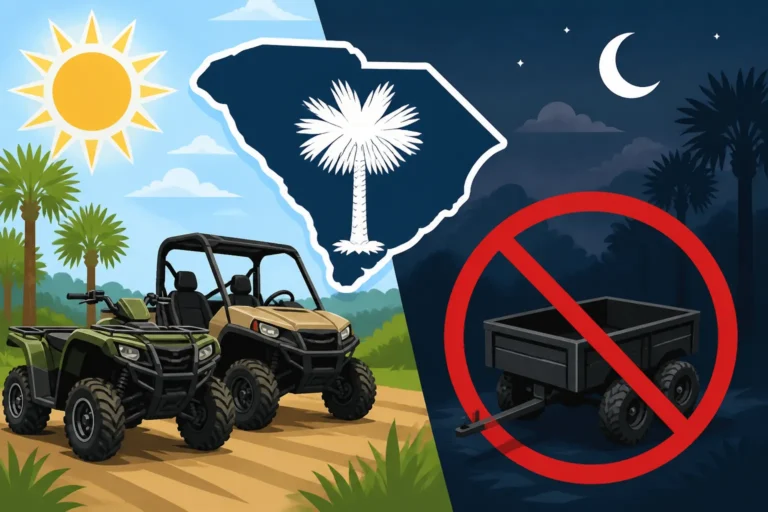
A machine ridden after sunset needs working lights. Many riders run without them because they only ride in daylight, then get caught out when an afternoon trail ride stretches into dusk. When the Law Says to Turn Lights On explains the timing. Aftermarket light bars and replacement headlights from brands like SuperATV are a common fix for older machines whose factory lights have failed, but the key point is that some working light is needed once the sun goes down.
Brakes must be in working order. That sounds obvious until you consider how many old farm quads have a rear brake that has not done anything in years. Spark arresters are also expected on machines used in areas where fire is a concern, and the South Carolina Forestry Commission takes woodland fires seriously in dry spells. These equipment provisions are covered together in South Carolina Equipment Requirements for ATVs.
Creeks, Beaches and Private Land
Chandler’s Law also addresses where you ride. Crossing a creek or stream is allowed only at an established ford, not by charging down a bank and churning through the bed. The rule protects stream banks, fish habitat and water quality, and wildlife officers treat it seriously.
Riding on a beach is not a free-for-all either. You need permission from whoever controls that stretch of sand, and many South Carolina beaches, from the Grand Strand to the Lowcountry islands, simply do not allow it. Owners of private land, on the other hand, keep the right to decide who rides on their property, and trespass rules still apply to riders who wander off a friend’s land onto the neighbor’s.
Exemptions for Farm and Hunting Use
The law recognizes that ATVs are working tools on many South Carolina farms and hunting properties. Certain farm, ranch, hunting and trapping uses are treated differently from recreational riding. A farmer checking fence lines or a hunter hauling a deer out of a stand is not in the same position as a teenager tearing around a sand pit on a Saturday.
The exemptions have limits, and they do not mean anything goes. A child who is too young to ride is still too young on a farm, and the details of each exemption matter. Before you rely on one, read South Carolina Farm and Ranch Exemptions and the companion articles on hunting and private property so you understand exactly where the lines fall.
Penalties and Enforcement
A law with no consequences is a suggestion. Chandler’s Law has real penalties, though they are modest compared with road traffic offenses. Knowing how enforcement works helps you avoid an unpleasant afternoon.
What a Violation Costs
Violations of Chandler’s Law are typically punished with fines in the range of $50 to $200, as South Carolina Fines of $50 to $200 explains. Court costs and assessments can push the total you actually pay higher than the base fine, which surprises many first-time offenders.
For parents, there is an extra dimension. When a child breaks the law, the responsibility often falls on the parent or guardian who allowed the riding. A citation for letting an underage child ride without a certificate or helmet lands on the adult, not the kid.
Who Enforces It
Officers from the South Carolina Department of Natural Resources, county sheriff’s deputies and local police all have authority to enforce the law. DNR officers are the ones you are most likely to meet on rural land, near rivers or around hunting areas. Deputies often get involved when a neighbor complains about noise or a quad is spotted on a public road.
Enforcement is usually driven by visible problems: a small child on a big machine, a teenager without a helmet, a rider churning through a creek or a quad on a county road. Riders who follow the basic rules rarely draw attention.
What to Carry When You Ride
The simplest way to make an encounter with an officer short and friendly is to carry the right things. For a young rider, that means the safety certificate card, ideally in a zip bag in a jacket pocket or a small box on the rack where it will not get soaked on the first creek ford. Parents often take a photo of the card as a backup, but the physical card is what the law has in mind.
Adults should carry identification and, if they are on someone else’s land, a clear idea of whose permission they have. A quick text from the landowner saying you are welcome on the property can settle a trespass question in seconds. If you are riding a newly titled machine, a copy of the title or the bill of sale is useful when a deputy asks whether the quad is yours, especially in rural counties where machine theft is a real problem.
Finally, look at the machine before you leave the yard. Check that the lights work if there is any chance of riding at dusk, that the brakes bite, and that the age warning label is still in place on a youth machine. Two minutes in the driveway is cheaper than a citation and far cheaper than a crash.
| Situation | Likely Enforcing Agency | Common Issue |
|---|---|---|
| Rural land near rivers or wildlife areas | SC Department of Natural Resources | Creek crossings, young riders |
| Neighbor noise or nuisance complaint | County sheriff | Riding on someone else’s land |
| Machine seen on a public road | Sheriff or local police | Road use without a street UTV plate |
| Organized trail or riding area | Area staff, DNR or law enforcement | Helmets, certificates, lights |
How Chandler’s Law Fits With the 2026 Changes
South Carolina’s off-road rules did not stand still after 2011. The biggest recent change came in 2026, when a new act created a path for side-by-sides to become street legal. That has caused a lot of confusion about whether Chandler’s Law still applies, so it is worth spelling out how the pieces fit.
Chandler’s Law Still Covers Off-Road Riding
Nothing in the 2026 street UTV law repeals Chandler’s Law. The age limits, safety certificate, helmet rule and equipment provisions all continue to apply to ATV riding in South Carolina. The new law adds a separate set of rules for side-by-sides that will be registered and plated for limited road use.
So a 14-year-old riding a youth quad on the family farm still needs the safety certificate and a proper helmet, regardless of what is happening with street UTVs. The two laws sit side by side, each covering its own territory.
The Street UTV Rules Are Separate
Act 164, signed in May 2026, created a registration path for qualifying side-by-sides, with registrations opening on November 18, 2026. Registered street UTVs will carry a rear plate, renew every two years, and are limited to secondary roads within 10 miles of the owner’s registered address. Drivers must be at least 17 and properly licensed, and riders under 21 face their own helmet rule on the road.
Those requirements are not part of Chandler’s Law, and they do not apply to an ordinary trail quad. If you are thinking about converting a side-by-side for road use, start with South Carolina Street UTV Rules From November 2026, which covers the machine specs, insurance and paperwork involved. Owners kitting out a machine for the road often look to suppliers such as SuperATV for mirrors, horns, lighting and other equipment, but check the final list of required items against the state’s own guidance before you buy.
Practical Takeaways for Riders and Parents
If you remember nothing else, remember these points.
- Chandler’s Law is South Carolina’s ATV safety law, named after a boy whose accident drove the campaign for it.
- It took effect in July 2011 and sits in Title 50, Chapter 26 of the state code.
- Children under 6 may not ride an ATV at all.
- Riders 15 and under need an ATV Safety Institute certificate and must carry proof.
- Riders under 16 need a helmet meeting the federal standard, plus eye protection.
- Every rider needs working brakes, lights after sunset and respect for creek, beach and property rules.
- The 2026 street UTV law adds new rules for plated side-by-sides but does not replace Chandler’s Law.
Treat the name as a reminder of why the rules exist. A safety course, a properly sized machine and a good helmet cost far less than the alternative, and every South Carolina family that rides can take the law’s lesson to heart without ever meeting a DNR officer on the trail.
Disclaimer
This article is for general informational purposes only and does not constitute professional advice. Laws, prices and regulations vary by location and change over time. Consult a qualified professional for guidance on your specific situation.