Which Body Approves an ATV Safety Course
If you’re trying to work out whether an ATV safety course will satisfy South Carolina’s rules, the key question is who approved the course—not just who teaches it. The approving body named in the state requirement is the ATV Safety Institute. Here’s how that approval connects to the age rules, the safety certificate, and riding on public land.
The ATV Safety Institute Is the Named Approving Body
South Carolina requires young ATV operators to complete a hands-on safety course approved by the ATV Safety Institute, commonly abbreviated as ASI. The state’s requirement identifies ASI as the body whose approval matters. A course that is simply advertised as an ATV class, safety session, or online lesson is not automatically a qualifying course.
The distinction is important: the course provider may teach the class, but the course must meet the approval requirement. Before registering, ask the provider directly whether the specific hands-on course is approved by the ATV Safety Institute. If the provider cannot confirm that, don’t assume the course will count.
South Carolina agencies describe the rule and the certificate requirement, while the ATV Safety Institute is the organization named in the requirement for approving the course. That means a class offered by a local organization is not necessarily disqualified—but you should confirm that its course has the required ASI approval. The provider’s reputation or the fact that it teaches safe riding is not, by itself, proof of approval.
For the state rule and how the certificate fits into it, see South Carolina Safety Certificate Requirements. For a closer look at the training requirement for young riders, South Carolina Safety Courses for Riders 15 and Under and Only an ATV Safety Institute Course Counts may also help.
| Question | Practical answer |
|---|---|
| Who approves the qualifying course? | The ATV Safety Institute |
| What kind of course does the rule call for? | A hands-on ATV safety course |
| Does any ATV class automatically qualify? | No. Confirm that the specific course is ASI-approved |
| What does the young operator need? | A safety certificate from an approved hands-on course |
| Is a trail pass the same as the safety certificate? | No. They serve different purposes |
The shortest reliable check is to ask: “Is this specific hands-on course approved by the ATV Safety Institute, and will it provide the safety certificate required for South Carolina riders?” That question keeps the focus on both the course and the proof a rider may need.
Which Riders Need the Course and Certificate
South Carolina’s age rules set out who needs training and who must have an adult present. According to the South Carolina Department of Motor Vehicles, operators age 15 and younger must successfully complete a hands-on ATV safety course approved by the ATV Safety Institute. According to the South Carolina Legislative Services Agency, operators age 15 and younger must possess a safety certificate from an approved hands-on course.
The South Carolina Department of Public Health describes the age group as children under 16 and likewise says they must complete a hands-on ATV rider safety course approved by the ATV Safety Institute before operating an ATV. In practical terms, the course requirement applies to riders who have not yet reached 16.
The minimum operating age is separate from the training rule. According to the South Carolina Department of Public Health, the minimum age to operate an ATV in South Carolina is 6. The South Carolina Department of Motor Vehicles says parents or guardians cannot allow anyone younger than 6 to drive an ATV. A child being old enough to operate one does not mean the child is exempt from the course requirement.
Keep the rules distinct:
- Minimum operating age: According to the South Carolina Department of Public Health, a rider must be at least 6 years old to operate an ATV.
- Course and certificate: According to the South Carolina Department of Motor Vehicles and the South Carolina Legislative Services Agency, operators age 15 and younger need an approved hands-on course and safety certificate.
- Adult accompaniment on public land: According to the South Carolina Legislative Services Agency, ATV operators age 16 and younger must be accompanied by an adult on public lands.
- Helmet and eye protection: According to the South Carolina Legislative Services Agency, operators age 15 and younger must wear a safety helmet meeting FMVSS #218 and eye protection.
These requirements can apply together. For example, completing an approved course does not remove the adult-accompaniment rule for a young rider on public land. Likewise, having an adult nearby does not replace the hands-on course requirement for an operator who falls within the age group covered by the rule.
The course is also not the only age-related responsibility. According to the South Carolina Department of Public Health, operators may not ride an ATV in violation of the manufacturer’s Age Restriction Warning Label. The South Carolina Legislative Services Agency says removing that label is illegal. A course certificate does not override the manufacturer’s age warning for a particular machine.
If you need a clear breakdown of adult supervision, see South Carolina Rules for a Supervising Adult. For the broader set of age and riding rules, South Carolina ATV Age Requirements explains how the requirements fit together.
How to Confirm a Course Will Count
Course listings can use similar language while describing different types of instruction. Before enrolling, make sure you have confirmed the right details—not just that the class covers safe riding.
Ask about the specific course
Ask the provider whether the hands-on course you plan to take is approved by the ATV Safety Institute. If the provider offers more than one class, verify the exact course rather than relying on a general statement about the organization’s training.
A clear answer should identify the course as ASI-approved and explain whether successful completion results in the safety certificate required for South Carolina operators in the covered age group. If the provider is uncertain, ask how to verify approval before paying or attending.
Confirm that it is hands-on
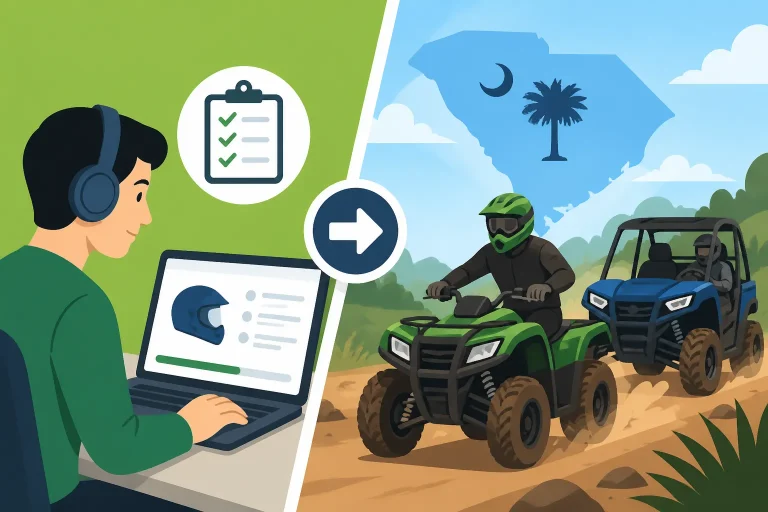
South Carolina’s requirement calls for a hands-on course. A video, reading assignment, online quiz, or informal discussion may help a rider prepare, but don’t assume that it replaces the required practical course. If an online component is offered, ask whether it is only part of a larger hands-on course or whether the provider is presenting it as the complete qualification.
Find out what proof you receive
Ask what documentation is issued after successful completion and how the rider can access it later. According to the South Carolina Legislative Services Agency, operators age 15 and younger must possess a safety certificate from an approved hands-on course. The certificate is therefore more than a keepsake: it is proof that the rider completed the required training.
Keep the certificate somewhere it can be found when needed, and make sure the family knows which rider it belongs to. If you are unsure whether a record is available or what documentation counts, check with the course provider and consult the state’s current guidance. You can also review South Carolina Safety Certificate Lookup for information about checking a certificate.
Check the rider’s age and the machine’s warning label
Confirm the rule for the specific rider, not just the age of an older sibling or another participant. The requirement is tied to the operator’s age. Also check the ATV’s manufacturer warning label: South Carolina’s rules prohibit riding in violation of that label, and removing it is unlawful according to the South Carolina Legislative Services Agency.
Parents and guardians should treat training, supervision, protective equipment, and the machine’s warning label as separate checks. Completing one does not cancel the others.
Training Is Separate From Trail Permits and Riding Rules
A safety certificate and a trail permit solve different problems. The certificate documents that a young rider completed the required course. A land manager’s permit authorizes access to a particular trail system under that land manager’s rules. Don’t assume that buying a pass replaces a state-required course, or that a training certificate gives permission to ride wherever you choose.
For example, the Forest Service says operators must have a permit in their possession while riding on its trails, and that OHVs may be used only on areas, roads, and trails designated as open to OHVs. Those access requirements are separate from South Carolina’s age-based course rule. A rider may need to satisfy both the applicable state requirements and the trail manager’s access rules.
The same separation applies to adult supervision. According to the South Carolina Legislative Services Agency, ATV operators age 16 and younger must be accompanied by an adult on public lands. An approved course does not make a young operator exempt from that requirement.
Before a ride, check the rules for the specific location, the machine, and the rider. South Carolina ATVs are intended primarily for off-road travel and are no more than 50 inches wide, according to the South Carolina Department of Motor Vehicles. The Forest Service also says side-by-sides and other vehicles over 50 inches are prohibited on certain OHV trails. A machine that is allowed on one property or trail may not be permitted on another.
For a South Carolina OHV trail, check the land manager’s current status and access information before hauling the machine. The Forest Service says the Enoree OHV Trail offers 23 miles of trail and that riders should check the Call Before You Haul hotline for current status. Trail access, passes, and closures can change independently of whether a rider has completed training.
A useful pre-ride check is to confirm:
- The rider’s age and whether a course certificate is required.
- Whether the hands-on course is approved by the ATV Safety Institute.
- Whether the rider has the certificate issued after course completion.
- Whether adult accompaniment and protective-equipment rules apply.
- Whether the trail is open to that type of machine.
- Whether the trail manager requires a separate permit.
The main takeaway is straightforward: for the South Carolina youth ATV course requirement, look for approval by the ATV Safety Institute and a hands-on course that provides the required safety certificate. A class title, a provider’s general experience, or a trail pass is not a substitute for confirming that specific approval.
Sources
- South Carolina Department of Motor Vehicles — Terrain Vehicles | SCDMV (checked November 3, 2026)
- Forest Service — Francis Marion and Sumter National Forests | Enoree OHV Trail | Forest Service (checked November 3, 2026)
- South Carolina Department of Motor Vehicles — Terrain Vehicles | SCDMV (checked November 3, 2026)
- South Carolina Department of Public Health — ATV Safety | South Carolina Department of Public Health (checked November 3, 2026)
- South Carolina Legislative Services Agency — Code of Laws – Title 50 – Chapter 26- – FISH, GAME AND WATERCRAFT (checked November 3, 2026)
- Forest Service — Francis Marion and Sumter National Forests | Off-Highway Vehicles (OHV) | Forest Service (checked November 3, 2026)
- Forest Service — Francis Marion and Sumter National Forests | Wambaw Cycle Trail (North Loop) | Forest Service (checked November 3, 2026)
- Forest Service — Francis Marion and Sumter National Forests | Wambaw Cycle Trail (South Loop) | Forest Service (checked November 3, 2026)
Disclaimer
This article is for general informational purposes only and does not constitute professional advice. Laws, prices and regulations vary by location and change over time. Consult a qualified professional for guidance on your specific situation.