A South Carolina Pass That Follows the Rider
A forest OHV pass in South Carolina can be tied to the rider rather than shared among machines or people. That distinction matters when you ride with family, borrow a quad, or switch vehicles. Here’s how person-based passes work, where to verify the rules, and why a trail pass is not the same as permission to ride on public roads.
What it means for a pass to follow the rider
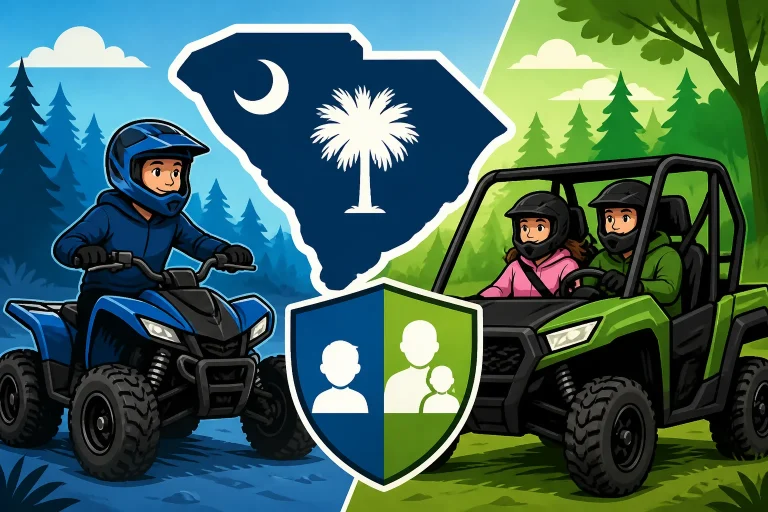
A person-based pass is issued to an individual, not to a specific ATV. That means the named rider can use an eligible machine on a covered trail, but another person generally cannot use that pass just because they are riding together or using the same vehicle. The Forest Service says seasonal passes for the Wambaw Cycle Trail are issued to specific individuals, and only the named individuals may use them. The distinction is also reflected in South Carolina Season Passes Are Per Person and South Carolina Passes Are Non-Transferable.
This setup is easy to confuse with vehicle registration. A trail pass covers a person’s use of a particular recreation area under its rules. It does not, by itself, register a vehicle for public-road use or make an otherwise prohibited machine eligible for a trail. Think of the pass as permission associated with the rider, while registration and equipment rules apply to the vehicle.
For Enoree OHV Trail, the Forest Service says daily and annual passes must be purchased through Recreation.gov. The Forest Service states that the day pass fee is $5 for each operator and the yearly pass fee is $50 for each operator, as of November 2026. The same agency says operators must have a permit in their possession while riding. Those terms make the practical point clear: plan on a pass for each person who will operate, not one pass to circulate among the riders in a group.
A person-based pass can be useful when you own more than one machine, use a rented machine, or ride with friends who bring different vehicles. But it does not mean you can use any machine anywhere. The trail may restrict vehicle type or width, and a pass purchased for one trail system may not automatically apply to another. Before paying, check the specific trail page and confirm that the pass covers the place and dates you intend to ride. For a closer look at buying and displaying a pass, see How to Buy a South Carolina Forest Pass and South Carolina Pass Display Rules.
| Question | What a person-based OHV pass means |
|---|---|
| Who is the pass for? | The named rider or operator |
| Can another rider borrow it? | Not when the pass is assigned to a specific person |
| Does it register the ATV for roads? | No; trail access and road registration are separate |
| Does it guarantee a machine can use a trail? | No; vehicle restrictions still apply |
| What should you check before riding? | The trail’s pass, vehicle, season, and closure rules |
Choosing between a day pass and a seasonal pass
The right pass depends on how often you expect to ride and which trails you plan to visit. For an occasional outing, a day pass may be simpler. For repeated visits, a yearly or seasonal option may make more sense, but only if it covers the trail you use and is issued in a way that works for your riding group.
For Enoree, the Forest Service says the day and annual passes are purchased through Recreation.gov, and the fee applies to each operator. If several people in your party will take turns operating, do not assume one purchase covers them all. Check each rider’s pass requirement before you leave. South Carolina Day vs Season Pass Value can help with the basic comparison, but the trail’s current instructions are the final word.
Other trails can have different purchase procedures. The Forest Service says seasonal permits for Cedar Springs and Parsons Mountain can be purchased from the District office, while annual passes for all Francis Marion and Sumter National Forest OHV trails are available on Recreation.gov. The fact that passes are person-based does not mean every pass is sold in the same place or has identical coverage. Confirm the specific trail’s instructions rather than relying on a receipt or pass from another riding area.
A pass that follows the rider is especially helpful if you ride more than one eligible machine. For example, a rider might bring a personal ATV one weekend and use a rented machine another time. The person-based pass may still be associated with that rider, but the rental or alternate vehicle must meet the trail’s requirements, and the trail’s terms must allow that use. Check South Carolina Pass for a Rented Machine and South Carolina Pass for a Second Machine before assuming that a change of vehicle has no effect.
One important distinction: a pass issued to a person is not necessarily transferable just because the named holder is absent. The Forest Service says Wambaw seasonal passes are issued to specific individuals and only those individuals may use them. If a family member or friend operates instead, they should have a pass in their own name if one is required. Avoid treating a printed pass, phone image, or account receipt as a group credential unless the trail’s official instructions expressly say it covers multiple operators.
Pass rules can also include how you carry proof. The Forest Service says Enoree passes must be downloaded to a phone or printed ahead of time and available while riding. The Forest Service also says fee tubes are no longer available for cash payment at the site, as of November 2026. That means buying or saving proof before heading to the trail is part of trip planning, not something to leave until arrival. Confirm the current purchase and display instructions for the trail you are visiting.
Match the pass to the trail and machine
A valid pass does not override trail-specific restrictions. Enoree offers 23 miles of trail, but the Forest Service prohibits side-by-sides over 50 inches, Jeeps, and other 4×4 vehicles there. The Forest Service says the trail has one-way sections marked with orange blazes and two-way sections marked with white blazes. Always ride the marked route and check the rules for the specific area; a machine that is legal on one public road or permitted at a private park may still be barred from a narrow OHV trail.
The same basic limitation applies at Parsons Mountain and Cedar Springs. The Forest Service says those trails are managed exclusively for ATVs and dirt bikes, and four-wheel-drive vehicles such as Jeeps and Hummers are not permitted at Parsons Mountain. The Forest Service says Cedar Springs and Parsons Mountain are open year-round subject to weather conditions and the wet weather policy. A pass does not guarantee that a trail is open on the day you arrive, so check the status before hauling your machine.
For Enoree, the Forest Service says the official season runs from the last Friday in March to the first Monday after January. The Forest Service also describes the seasonal closure as beginning on the first Monday in January and ending on the last Thursday in March. Because seasonal schedules and closures affect whether a pass can be used, verify the trail’s current status before setting out. The Forest Service’s Call Before You Haul hotline is (803) 561-4025, and the agency says it is updated when trail open or closed status changes. You can also call the Enoree Ranger District at (803) 276-4810 during its stated office hours, Monday through Friday, 8:30 a.m. to 4:30 p.m.
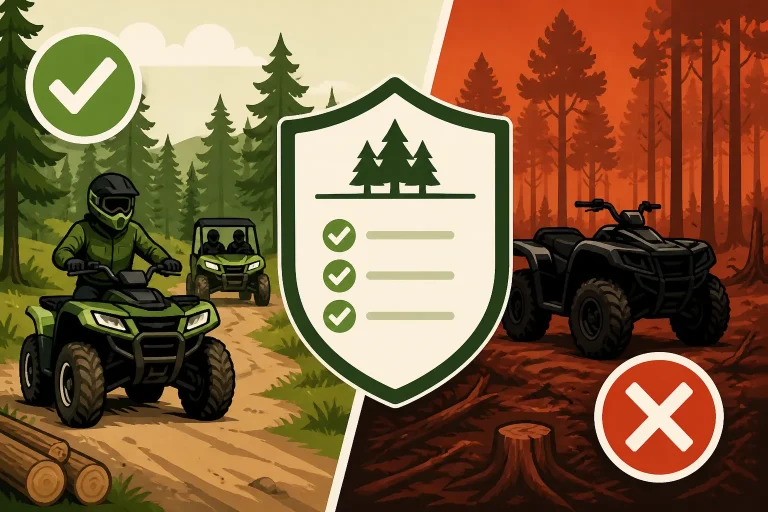
The pass itself is only one piece of trail readiness. Operators must have the required permit with them while riding, wear protective equipment, and stay on designated routes. The Forest Service also says riders must remove litter, may not ride under the influence of alcohol or drugs, and must not damage land, wildlife, or vegetation. If a trail crosses a road, riders should yield to road traffic. Review South Carolina Pass for a Second Machine and South Carolina Trails That Ban Full-Size Vehicles when planning a trip involving a different machine or a mixed group.
Forest trail rules can be stricter than a rider expects from general ATV rules. The Forest Service says children under 16 must wear helmets at Enoree, and it recommends helmets for riders at Parsons Mountain and Cedar Springs. The Forest Service also advises riders to wear blaze orange throughout hunting season and to avoid the first two weeks of rifle deer season. Verify the current trail-specific safety requirements and seasonal notices, especially when children or new riders are in the group.
Some trails have extra features for smaller machines and younger riders. The Forest Service says Enoree has a beginner loop for children riding dirt bikes smaller than 110 cc or ATVs smaller than 90 cc. This does not replace South Carolina’s applicable ATV safety rules. The South Carolina Department of Motor Vehicles says children 15 or younger need to complete a hands-on ATV safety course approved by the All-Terrain Vehicle Safety Institute. The same agency says an ATV’s manufacturer warning label about age restrictions must not be removed. Check both the trail guidance and the state requirements before taking a young rider.
A forest pass is not a street UTV registration
A Forest Service OHV pass applies to riding on the designated trail system under that system’s rules. It does not give an off-road ATV or UTV permission to use public roads. Likewise, a public-road registration does not automatically provide access to a forest trail that excludes the machine by type or width.
South Carolina’s street-UTV rules are a separate system. According to the South Carolina Department of Motor Vehicles, registered UTVs may be operated on certain public roads starting November 18, 2026, subject to restrictions. The South Carolina Department of Motor Vehicles says a qualifying UTV must be four-wheel drive, have an engine displacement of at least 450 cc, reach a top speed greater than 55 mph, measure 80 inches or less in width, and have a gross weight rating of 4,000 pounds or less. It must also have factory-approved Type 2 seat belts for every seat.
Those road requirements do not make a UTV eligible for a narrow OHV trail. The Forest Service prohibits side-by-sides over 50 inches at Enoree, even though a street-legal UTV may be as wide as 80 inches under the South Carolina Department of Motor Vehicles’ qualification rules. The two rules address different places and purposes: one sets a vehicle limit for a trail, while the other describes eligibility for public-road use.
The road rules have their own operator and equipment requirements as well. According to the South Carolina Department of Public Safety, a UTV driver must be at least 17 years old and have a valid Class D driver’s license. The agency says drivers and passengers under 21 must wear a helmet with a chin strap and a face shield or goggles on public roads, and passengers must be at least 8 years old. UTVs may operate only on secondary highways or streets with posted speed limits of 55 mph or less, and they must remain within 10 miles of the address listed on the registration certificate or an entrance to a gated community. They may not be operated on interstates.
The South Carolina Department of Public Safety also says public-road UTV use requires liability insurance, title and registration, the registration certificate and proof of insurance in the driver’s possession, and an official rear license plate. According to the South Carolina Department of Motor Vehicles, the biennial UTV registration fee is $10, as of November 2026. Owners who do not intend to operate their UTVs on public roads are not required to register or buy liability insurance under the road-use requirements described by the South Carolina Department of Public Safety. For the DMV process, see South Carolina Street UTV Registration Steps.
In short, check three separate questions before a ride: whether the named rider has the right pass, whether the machine is allowed on that particular trail, and whether the route is open. If your plan includes public roads, confirm registration, insurance, driver eligibility, and road restrictions separately. A pass that follows you can make trail planning more flexible, but it does not travel with every person in your group, authorize every machine, or replace the rules for the place you are riding.
Sources
- South Carolina Department of Motor Vehicles — Terrain Vehicles | SCDMV (checked November 3, 2026)
- Forest Service — Francis Marion and Sumter National Forests | Enoree OHV Trail | Forest Service (checked November 3, 2026)
- Forest Service — Francis Marion and Sumter National Forests | Parsons Mountain OHV Trail | Forest Service (checked November 3, 2026)
- South Carolina Department of Motor Vehicles — Terrain Vehicles | SCDMV (checked November 3, 2026)
- South Carolina Department of Public Health — ATV Safety | South Carolina Department of Public Health (checked November 3, 2026)
- South Carolina Department of Public Safety — UTV Law | SCDPS (checked November 3, 2026)
- Forest Service — Francis Marion and Sumter National Forests | Off-Highway Vehicles (OHV) | Forest Service (checked November 3, 2026)
- Forest Service — Francis Marion and Sumter National Forests | Check the Call Before You Haul hotline before riding our OHV trails | Forest Service (checked November 3, 2026)
- Francis Marion Sumter National Forest — Enoree%20OHV%20Trail%20rules_0.pdf (checked November 3, 2026)
- USDA Forest Service — Francis Marion and Sumter National Forests | Cedar Springs OHV Trail | Forest Service (checked November 3, 2026)
- Forest Service — Francis Marion and Sumter National Forests | Wambaw Cycle Trail (North Loop) | Forest Service (checked November 3, 2026)
- Forest Service — Francis Marion and Sumter National Forests | Wambaw Cycle Trail (South Loop) | Forest Service (checked November 3, 2026)
Disclaimer
This article is for general informational purposes only and does not constitute professional advice. Laws, prices and regulations vary by location and change over time. Consult a qualified professional for guidance on your specific situation.