South Carolina Trails That Ban Full-Size Vehicles
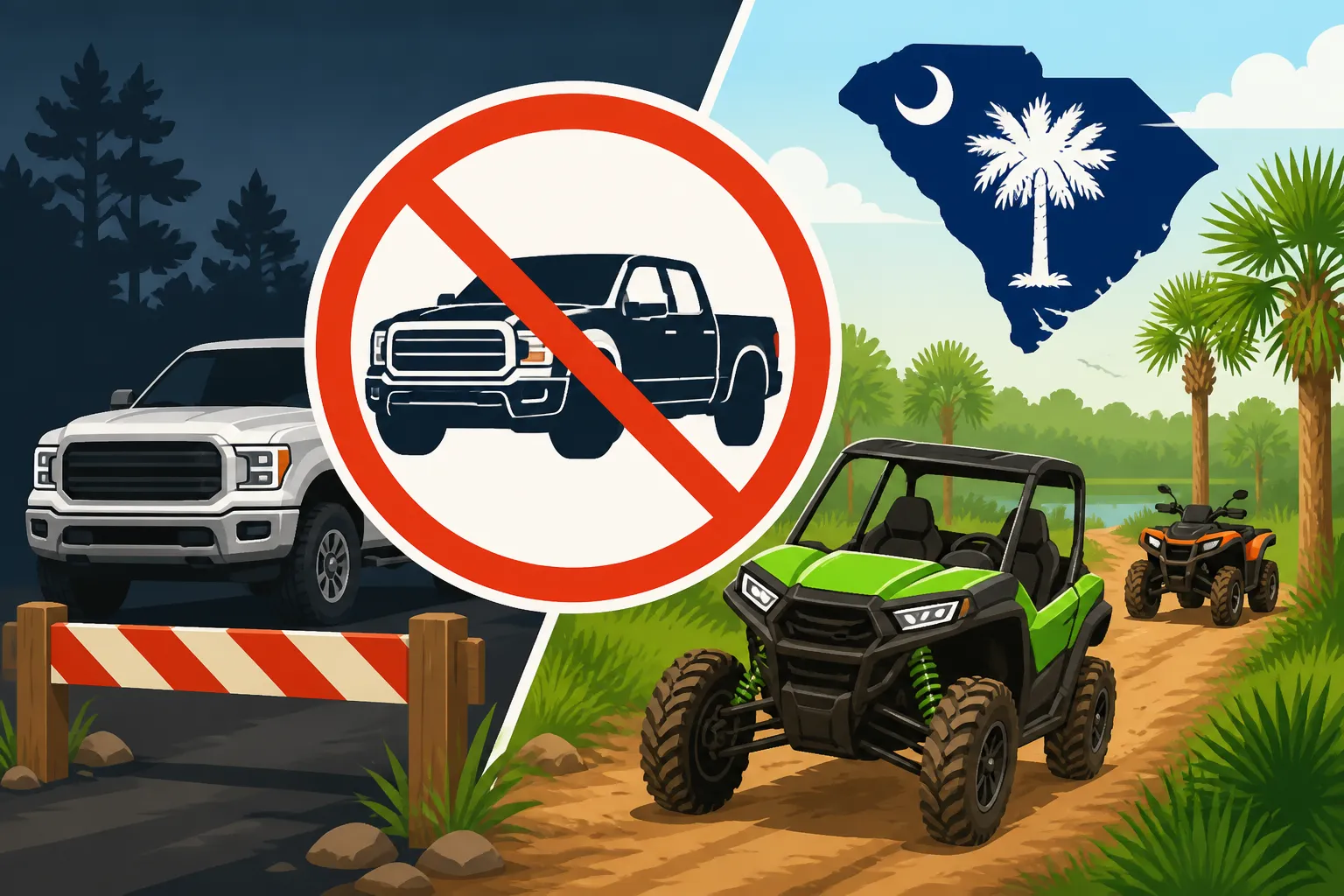
A wide side-by-side can look trail-ready and still be turned away at a narrow gate. In South Carolina, some off-highway routes are built for motorcycles or machines within a set width, not full-size UTVs, Jeeps, or trucks. This guide explains what those restrictions mean, how to check a route before hauling, and how to avoid arriving at a trailhead with the wrong machine.
What “No Full-Size Vehicles” Means on a South Carolina Trail
Full-size is a practical description, not one universal vehicle class
On a trail map or sign, “full-size” usually describes vehicles that are too wide, heavy, or bulky for a narrow off-highway route. That can include Jeeps, trucks, and many side-by-sides. It is not always a precise legal category, so do not assume your machine is permitted just because the sign does not name its make or model.
A vehicle that fits on a public road may still be prohibited on a trail designed for smaller off-road machines. These routes can have narrow entrances, tight turns between trees, soft shoulders, and terrain where a wide vehicle cannot safely pass another rider. Restrictions are about the route’s design and permitted use, not simply whether a machine can physically squeeze through.
For a rider planning a trip, the key is to identify the rule that applies: a maximum vehicle width, an allowed vehicle type, or a complete vehicle restriction. A sign that says motorcycles only is different from one allowing ATVs up to a stated width. Look for wording on official maps and at the trail entrance, and don’t treat “OHV trail” as meaning every off-highway vehicle is welcome.
Width limits are one common reason larger machines are excluded
A 50-inch limit is an important restriction to watch for on South Carolina OHV routes. It generally means the vehicle must be no wider than the stated maximum; it does not mean a wider machine can proceed if the rider believes the trail itself looks broad enough. Gates and trail signs may make the limit clear before the route narrows. See [South Carolina's 50-Inch Trail Width Limit] and [Why a 50-Inch Gate Turns Machines Away] for more on how those limits affect machine choice.
Measure the machine at its widest point as it will be ridden, including any installed accessories that extend beyond the body. A stock specification may not reflect added wheel spacers, oversized tires, fender extensions, or other modifications. If the limit is close, check the manufacturer’s stated width and measure your actual setup rather than guessing from a photo.
Do not confuse a width limit with a recommendation. A machine slightly over the limit is still over the limit, even if it seems capable of navigating a particular stretch. A narrow route can pinch unexpectedly, and a gate or barrier may be narrower than the open trail beyond it. If you are unsure, ask the managing agency before you load the trailer.
A trail’s designation matters as much as the machine’s size
Some routes are intended for a specific kind of riding, such as motorcycles, and are not open to ATVs or side-by-sides. Other routes may permit certain ATVs but exclude wider vehicles. A trail can also have separate rules for motorized use, bicycles, hikers, or horses. Check the permitted-use details for the exact route, not just the general name of the riding area.
This distinction is especially useful when comparing South Carolina’s national forest routes. The state’s forest riding options are not all interchangeable, and a route described as an OHV trail may still have vehicle-specific limits. [South Carolina's Four National Forest Trails] is a useful starting point for understanding that trail systems differ; then confirm the current rules for the particular route you plan to ride.
If your machine is a side-by-side, don’t rely on a broad statement that a riding area “allows UTVs.” The area may allow them only on designated roads or routes, while narrow trails remain off-limits. A route-by-route check is more reliable than assuming the entire property has one vehicle rule. For a broader comparison, see [South Carolina Trails That Allow Side-by-Sides].
South Carolina Routes Where Full-Size Machines Need Extra Checking
Enoree and Cedar Springs have rules worth checking before you go
Enoree OHV Trail is one of the South Carolina riding areas where machine fit and route designation matter. Riders should check the access rules for the trail they intend to use, including vehicle-width requirements and any seasonal or operational notices. Don’t assume a large UTV can follow every route simply because smaller off-highway machines use the trail system. [Enoree OHV Trail in South Carolina] provides a trail-specific place to continue your planning.
Cedar Springs is another route to research carefully. Confirm which vehicle types are allowed on the specific trail and whether a width restriction applies. Even when two trails are in the same broader forest area, their permitted vehicles and conditions may differ. A machine that is acceptable on a wider route may not be suitable or legal on a narrower one.
Before setting out, check the route information provided by the managing agency and read the signs when you arrive. If a posted restriction conflicts with an app, an old forum post, or a map you saved months ago, follow the official signage and agency guidance. A quick call or route check can prevent a long drive to a trail entrance that your machine cannot use.
Wambaw Cycle Trail is not a general invitation for every OHV
Wambaw Cycle Trail is a route to investigate as a motorcycle-focused riding option, not a place to assume a UTV or full-size vehicle can enter. A trail’s name and riding reputation do not replace its permitted-use rules. Check whether your vehicle type is explicitly allowed before planning around it. [South Carolina's Wambaw Cycle Trail] can help you focus on the details specific to this route.
This matters because some riders use “off-road trail” as a catch-all phrase. In reality, a designated cycle trail may have a different user group and different infrastructure from a route designed for ATVs. A UTV driver who arrives with a full-size machine may discover that the trail is unsuitable even if the surrounding forest has other roads or motorized access areas.
For a group with mixed machines, make the plan around the least-permitted vehicle, not the most capable one. If one person brings a motorcycle and another brings a wide side-by-side, the group may not be able to ride the same route together. Agree on a route that allows every machine in the group, or plan separate outings rather than trying to improvise at the trailhead.
Forest roads and OHV trails are not the same thing
A road inside a forest may be open to some vehicles while a nearby purpose-built OHV trail is restricted to narrower machines. The reverse can also happen: a road may be closed to public motor vehicles even when a nearby designated trail is open to a particular type of off-highway vehicle. Location alone does not tell you what is allowed.
This difference can be confusing when a trailhead is reached by a public road or when a route crosses a forest road. Permission to drive to the staging area does not automatically grant permission to take a full-size vehicle onto a narrow trail. Follow signs at junctions and respect gates, barriers, and posted closures.
A route map is most useful when it shows both the trail and the connecting roads, but the map should not be your only source of rules. Use it to understand where you are going, then verify vehicle access with official information. A planning app such as onX Offroad can help riders review route layouts and avoid confusing a nearby road with the actual trail; posted restrictions and land-manager rules still take priority.
How to Confirm Whether Your Machine Is Allowed
Check the vehicle dimensions and the rule together
Start with the machine’s exact width, then compare it with the trail’s posted limit. Manufacturer specifications are helpful, but an altered machine may be wider than the listed stock dimensions. Measure across the widest point, including accessories that affect the vehicle’s overall width. If the route specifies a limit and your machine exceeds it, choose another route.
Also check the type of vehicle the trail permits. A route may be limited to motorcycles, or it may allow ATVs while excluding side-by-sides. Width alone does not settle the question: a machine could meet a size limit but still fall outside the permitted vehicle category. Conversely, a particular route may allow a wider vehicle on an access road while prohibiting it on its narrower trail segment.
Keep the details together before you leave: vehicle type, measured width, planned route, and any access conditions. This is especially helpful when a trip involves several riders or multiple machines. You can compare each machine against the same rule rather than relying on one rider’s memory of a sign from a previous visit.
Use maps for navigation, not as a substitute for permission
A mapping tool can help you understand the trail network, locate a trailhead, and prepare a route before the trip. onX Offroad may be useful for reviewing the layout and keeping your route organized, particularly when the group is unfamiliar with the area. Still, a line on a map does not necessarily confirm that a specific vehicle is permitted or that a route is open.
Cross-check digital maps against information from the land manager. Conditions, access rules, and closures can change, and older screenshots or saved routes may not reflect a current restriction. If a map appears to show a trail continuing past a gate, that does not mean the gate is open to your machine.
A sensible routine is to use a map for orientation, official trail information for access rules, and on-site signs for final confirmation. If those sources disagree, pause and check with the managing agency instead of treating the most permissive interpretation as correct. [South Carolina Trail Conditions Before You Haul] offers another useful planning topic to review before loading up.
Ask specific questions when the wording is unclear
If an agency page uses broad wording such as “OHV access,” ask whether the exact route allows your vehicle type and width. A specific question is more likely to get a useful answer than asking whether “UTVs are allowed” across an entire forest. Mention the trail name, machine type, measured width, and any accessories that could affect fit.
Ask about the whole planned route, not only the entrance. A vehicle might be allowed on a road leading to a staging area but excluded from a nearby trail. If you are planning a loop or using connectors, check each segment and junction so you do not accidentally continue onto a route with a different restriction.
Write down the answer or save the relevant official information for the group. This is not about arguing with a ranger at a gate; it is about making sure everyone understands the same plan. If you cannot get a clear answer, select a route with an explicit vehicle allowance rather than gambling on a vague description.
Planning a Ride When Your Vehicle Is Too Wide
Choose routes based on the machine you actually own
A full-size side-by-side or Jeep owner may need to focus on routes and riding areas that explicitly accommodate that vehicle class. Don’t treat a narrow-trail exclusion as a challenge to overcome with careful driving. A machine that cannot fit through a gate or safely navigate the trail is not a good match for that route, regardless of the driver’s experience.
When evaluating alternatives, look for clear vehicle-specific guidance. Ask whether the machine can use the main route, connectors, staging areas, and any access road needed to reach the trail. The best option is not simply a place that allows UTVs somewhere on the property; it is a place where your particular machine can use the route you intend to ride. The link [South Carolina Trails That Allow Side-by-Sides] can help guide that comparison.
For riders who own both a narrow ATV and a wider UTV, keep separate plans for each machine. A route suitable for one does not automatically suit the other. Label saved maps or notes with the machine they apply to, so a group member does not accidentally bring the wrong vehicle based on a plan made for a smaller quad.
Don’t bypass a gate or ride around a restriction
A gate, bollard, or narrow entry is often there to enforce a vehicle limit and protect a route. Do not drive around it, widen an opening, or use the trail shoulder to get past the barrier. Those actions can damage land, create a safety hazard, and put access at risk for other riders.
Even where a vehicle could physically pass through a barrier, that does not make entry lawful or appropriate. A restriction may protect a narrow trail surface, prevent resource damage, or keep larger vehicles away from users who cannot safely share the route. Respecting the limit helps preserve access for the vehicles the trail was designed to serve.
If you reach a restriction unexpectedly, stop in a safe location and turn around only where it is permitted and safe to do so. Avoid blocking the entrance or forcing other riders into an unsafe maneuver. If the sign is unclear or appears inconsistent with official information, contact the managing agency rather than making your own exception.
Build a backup plan for closures and mismatched access
A good outing plan includes a second option. A route may be closed, muddy, under maintenance, or unsuitable for one vehicle in your group. Check conditions before hauling, and identify another legal riding area that accepts the machine you are bringing. [South Carolina Trail Difficulty Ratings] can help you think beyond vehicle width and consider whether the route suits the group’s experience too.
For a mixed group, agree on the vehicle restrictions before anyone leaves home. Share the route name, staging location, machine limits, and backup plan with every driver. This can prevent the frustrating situation where one trailer arrives with a machine that cannot ride the planned trail and the group has no alternative.
onX Offroad can be one part of that preparation by helping the group keep a route and nearby options organized. Save the official trail information separately, and make sure at least one person has access to it even if cell service is weak. Good preparation is especially valuable when the trailhead is far from town and turning around means losing much of the day.
Trailhead Checklist for Full-Size Vehicle Owners
Confirm the route, access point, and parking arrangement
Before loading, confirm the exact route name and entrance. A large recreation area may contain roads, trails, and staging locations with different rules. Be certain that the entrance you plan to use connects to a route that permits your machine, rather than simply to a nearby forest road or a smaller-vehicle trailhead.
Check trailer access and parking separately from trail access. A trail may be unsuitable for a full-size UTV but still have a staging area reachable by truck and trailer, or the access road itself may have limits. Don’t assume that a comfortable parking lot means the vehicle can continue onto every route beyond it.
Make sure your group knows where to meet and what to do if someone gets separated. A paper or offline map is helpful in areas with unreliable service, but remember that navigation does not override access restrictions. [South Carolina Trail Etiquette Locals Expect] is also worth reviewing if you are new to the area or riding with a larger group.
Inspect signs and equipment before riding
At the trailhead, read the posted notices before unloading or entering the route. Check for vehicle-width limits, vehicle-type restrictions, closures, pass requirements, and other instructions. Rules may be posted at the entrance or at a junction farther along the route, so keep watching for signs as you ride.
Make sure the machine is in a suitable condition for the permitted route. Tires, steering, brakes, and safety equipment matter even when the machine is the right width. A narrow trail can leave less room to recover from a mechanical issue or move aside for another rider, so a basic inspection before departure can prevent a difficult situation.
If the trail is too narrow or the signage excludes your machine, turn back and choose your backup plan. Do not try to squeeze through a tight gate or continue until the route becomes impassable. The safest and most responsible answer is to ride where your machine is explicitly allowed.
Disclaimer
This article is for general informational purposes only and does not constitute professional advice. Laws, prices and regulations vary by location and change over time. Consult a qualified professional for guidance on your specific situation.