South Carolina Spark Arrester Checks
A spark arrester is easy to overlook when your ATV or UTV starts and runs normally. But a missing, damaged or incorrect exhaust component can create a safety problem and keep you from riding on land where an arrester is required. Here’s how South Carolina riders can check their machine, understand where rules apply and avoid a last-minute problem at the trailhead.
Where spark arrester rules apply in South Carolina
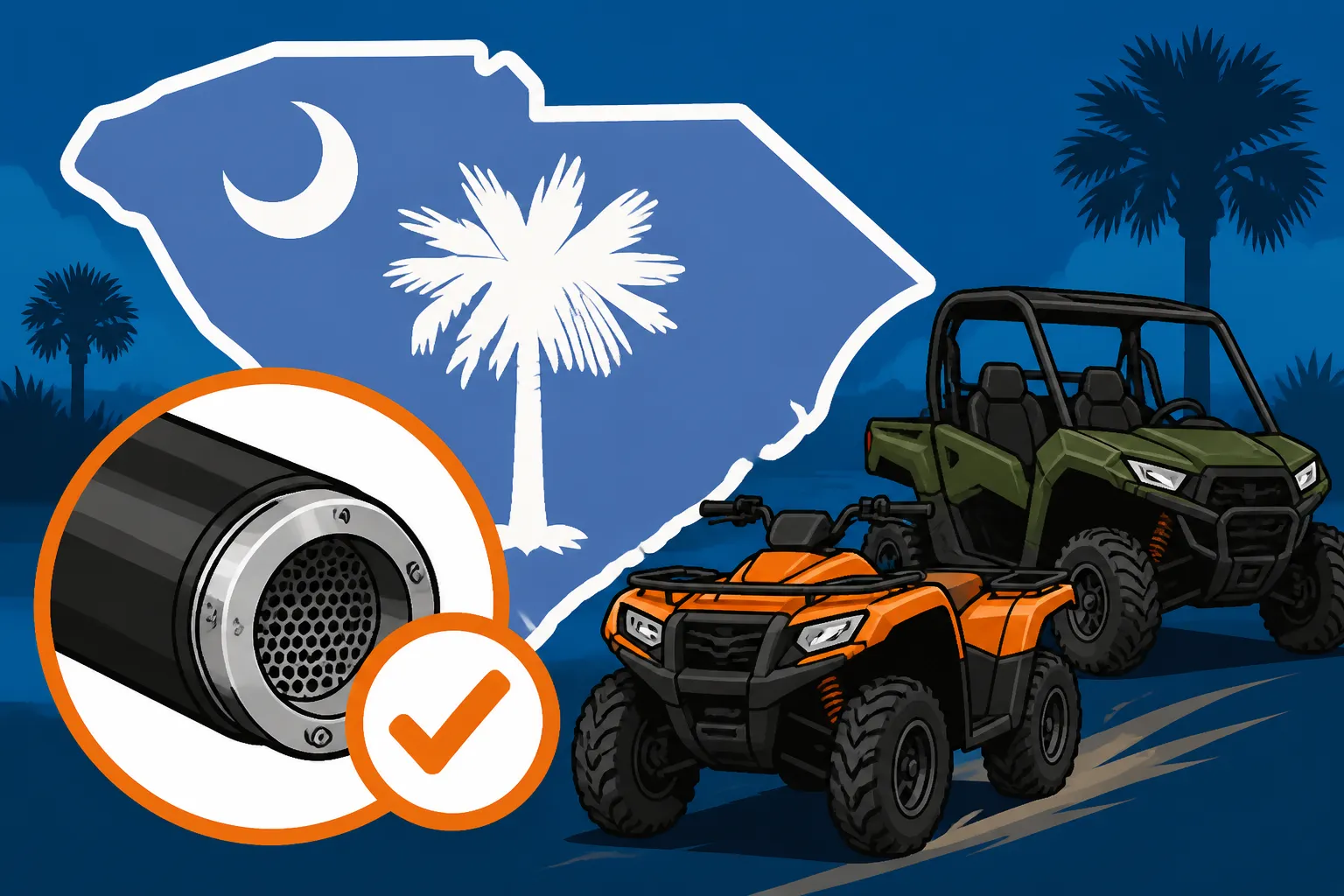
A spark arrester helps stop hot particles from escaping an engine’s exhaust. That matters around dry leaves, pine needles and other easily ignited material. It is not the same as a muffler: a muffler reduces noise, while a spark arrester is designed to limit sparks leaving the exhaust. One component may perform both functions, but a quiet exhaust is not proof that it has an approved arrester.
Requirements depend on who manages the land where you ride. On U.S. Forest Service land, motorized equipment generally must have a spark arrester that meets applicable Forest Service requirements. That makes the issue especially relevant on public OHV trails in the Sumter and Francis Marion national forests. Before planning a trip, check the current rules for the specific area and trail. South Carolina’s Four National Forest Trails gives a useful overview of the forest trail systems.
That federal requirement is not the same as a single rule for every trail, road or piece of private property in South Carolina. A private riding park may set its own equipment conditions, and rules can differ between a forest trail and a road leading to it. Don’t assume that because a machine is legal to own or works on private land, it meets the requirements everywhere you plan to ride.
South Carolina’s general ATV rules and a land manager’s operating requirements also serve different purposes. A machine may meet the rules that apply to riders but still fail a forest or park’s equipment check. For a broader look at where the state’s equipment rules fit, see South Carolina Equipment Checks by Officers. For the forest-specific background, South Carolina Spark Arrester Requirements is also relevant.
| Riding location | What to check before riding |
|---|---|
| U.S. Forest Service OHV trail | Confirm the machine has a compliant, working spark arrester and check current forest and trail rules |
| Private riding park | Read the park’s current equipment rules; requirements may differ from public land |
| Private property | Get the landowner’s permission and ask whether any equipment conditions apply |
| Public road or route to a trail | Check the rules for that road separately; an OHV trail’s equipment rules do not make a road open to ATVs or UTVs |
A pass does not replace an equipment check. A valid forest pass may cover access or fees, but it does not certify the machine’s exhaust system. Check South Carolina National Forest OHV Passes for pass details, and confirm trail access and equipment requirements separately.
What to inspect on an ATV or UTV
Start with the exhaust system, not just the sound of the engine. The arrester may be inside the muffler or exhaust outlet, so it is not always visible from the outside. Your owner’s manual or the machine manufacturer can help identify the original setup and explain how to inspect it safely.
Make the inspection when the machine is cool and switched off. Hot exhaust parts can burn you, and reaching into an exhaust outlet or removing components while the machine is hot is unsafe. If access requires disassembly, use the service procedure for your model or have a qualified mechanic do the work.
Look for these warning signs:
- Missing parts: The exhaust tip, end cap or insert may have been removed, leaving the system incomplete.
- Loose or damaged components: A cracked housing, loose fastener or damaged insert can mean the arrester is no longer secure or working as intended.
- Heavy blockage: Carbon buildup, mud or debris may obstruct the screen or outlet. Don’t ride with a blocked exhaust.
- Unverified modifications: A replacement muffler, exhaust tip or performance part may not include a compliant spark arrester, even if it fits the machine.
- A changed or missing screen: If the design uses a screen, check that it is present and undamaged according to the manufacturer’s instructions.
Appearance alone cannot confirm compliance. A screen or insert that looks plausible may not be the correct part or may not meet the standard required where you are riding. Look for manufacturer documentation or a marking where available, and confirm that the part is approved for your machine and intended use. If the paperwork is unclear, contact the manufacturer, dealer or land manager before traveling.
A stock exhaust system is often the simplest starting point, but “stock” does not mean “never inspect it.” Parts can be removed during maintenance, damaged by an impact or altered by a previous owner. If you bought a used machine, ask whether the exhaust has been changed and inspect it before heading to a public trail.
For a replacement, use a part that is specifically identified for your make and model and meets the applicable requirement. An online marketplace such as Amazon may list exhaust parts, but a listing’s fitment claim or product description is not, by itself, proof that the part is compliant. Check the manufacturer’s specifications, keep product documentation and ask the trail manager if you still have doubts.
How to prepare for a spark arrester check
A quick inspection before loading the machine can prevent a wasted trip. It also gives you time to address a missing part rather than trying to solve the problem at the entrance.
- Identify the land manager. Find out whether the trail is on national forest land, at a private park or somewhere else. Don’t rely on a trail name alone; access roads and nearby riding areas can be managed differently.
- Read the current rules. Check the official information for the riding area, including any alerts, closures and equipment requirements. Rules can change, and a trail that was open on a previous trip may have new restrictions. South Carolina Trail Conditions Before You Haul can help you build this check into trip planning.
- Inspect the exhaust while it is cool. Check that the muffler, end cap and arrester components are present, secure and free of obvious damage or blockage.
- Verify aftermarket parts. If the exhaust has been modified, confirm that the specific configuration meets the applicable requirement. Keep the part’s documentation accessible.
- Fix problems before departure. Replace missing or damaged components with a suitable part, or have a mechanic inspect the system. Don’t improvise a repair or remove an insert to improve exhaust flow.
- Recheck after hard use. A collision, rollover, deep mud or recent exhaust work can loosen or damage components. Inspect again before the next ride.
During a check, an officer or land manager may look at the exhaust and ask about the machine’s equipment. A visible component may help show that the system is complete, but it may not settle questions about whether a modified part is approved. Be ready to explain what has been installed and show documentation if you have it.
If you are unsure what an official is asking you to correct, ask politely which component or requirement is at issue. Don’t argue at the trailhead or attempt to remove a part in the parking area. If the machine cannot meet the site’s requirement, the practical choice is to leave it off the trail until the problem is resolved.
Common mistakes and what to do if your machine fails
The most common mistake is treating a spark arrester as just another name for a muffler. Replacing a muffler with a louder or performance-focused unit may change the exhaust configuration, and it does not automatically preserve the original arrester. Likewise, a machine that sounds quiet may still lack the required component.
Other problems arise when riders:
- Assume one rule applies at every South Carolina riding area.
- Buy a used ATV or UTV without checking whether its exhaust was modified.
- Rely on a seller’s assurance instead of verifying the installed part.
- Confuse a forest pass with approval of the machine’s equipment.
- Wait until arrival at the trailhead to read the rules.
- Keep riding after a part becomes loose or damaged.
If a check reveals a problem, don’t ride that machine on the affected trail until it is corrected. Contact the land manager if you need clarification about the requirement, and contact a dealer or mechanic if the right replacement part is uncertain. If the area is closed or the machine is not compliant, check whether another lawful riding option is available rather than assuming a nearby road is an acceptable substitute.
A spark arrester check is only one part of preparing a machine. Bring any paperwork the riding area requires, and confirm the rules for the trail itself. [South Carolina Proof of Ownership on the Trail] covers a separate paperwork question that riders may want to settle before setting out.
Disclaimer
This article is for general informational purposes only and does not constitute professional advice. Laws, prices and regulations vary by location and change over time. Consult a qualified professional for guidance on your specific situation.