10 Miles Unless a Town Says Otherwise
Many South Carolina riders scratch their heads trying to understand exactly where and when they can legally operate their UTVs on public roads. The "10-mile radius rule" often comes up, but it's frequently misunderstood, leading to confusion, potential fines, and even unsafe situations. This comprehensive guide will untangle the complexities of South Carolina's 10-mile radius rule, clarify its application, and explain how recent legislative changes for street-legal UTVs impact your riding plans.
Understanding the South Carolina 10-Mile Radius Rule
When it comes to riding your UTV on public roads in South Carolina, the "10-mile radius rule" has been a significant point of discussion and, frankly, a source of major confusion for years. It's not a blanket permission slip for all off-road vehicles, and understanding its nuances is crucial for any rider who wants to avoid an unpleasant encounter with law enforcement. Before recent changes, this rule was essentially the only way a UTV could legally touch pavement, and even then, it came with very specific strings attached. It stemmed from a time when UTVs were almost exclusively thought of as off-road utility machines, not street-capable vehicles.
The Core Intent Behind the 10-Mile Radius
At its heart, the 10-mile radius rule was designed to provide a limited, specific exemption for UTV owners to use their machines on public roads for practical purposes, not for joyriding or commuting. Think about farmers needing to cross a state road to get to another field, or homeowners needing to run a short distance to a neighbor's house or local store for supplies, especially in rural areas where slow-moving farm equipment is a common sight. It was about convenience and utility, acknowledging that for some residents, a UTV might be the most practical vehicle for very short trips close to home. The legislature wasn't aiming to open up all roads to all UTVs, but rather to solve specific, everyday logistical challenges faced by property owners, easing their burdens without fully embracing UTVs as road vehicles.
Who the 10-Mile Radius Applies To
Historically, this rule primarily applied to UTVs that were not otherwise classified as street-legal vehicles. This meant a typical side-by-side, which might be decked out with accessories from SuperATV for trail riding, but didn't have all the safety equipment mandated for on-road use, could only venture onto public roads under this specific exemption. It did not, and still does not, apply to ATVs (quads) in the same way; [Can You Ride an ATV on the Road in South Carolina?] generally, the answer for ATVs remains a firm no, with very few exceptions for agricultural use or crossing purposes. The rule was specifically written with the multi-passenger, utility-focused side-by-side in mind, allowing them a very restricted allowance on public roads, acknowledging their larger size and different operational needs compared to smaller ATVs.
When and Where the Rule Applies and Doesn't
The key to understanding the 10-mile radius isn't just knowing it exists, but truly grasping its limitations. Many riders assume it gives them free rein within that distance, but that's a dangerous misconception. The rule comes with geographical and functional restrictions, and ignoring them can lead to tickets and impoundment. It’s a nuanced part of [South Carolina Code Title 50 Chapter 26], which outlines many of the state's off-road vehicle laws.
Navigating County Roads and State Highways
Under the original interpretation of the 10-mile radius rule, UTVs could generally operate on secondary roads and highways within 10 miles of the owner's residence. However, there were significant limitations: you couldn't travel on roads with a posted speed limit of 55 mph or more, and interstates were strictly off-limits. This was designed to keep slower-moving vehicles off high-speed thoroughfares where they could pose a danger. Imagine trying to drive your UTV, even one equipped with street-style tires and a full windshield from SuperATV, on a busy four-lane highway with cars zipping by at 65 mph. It's a recipe for disaster. The intent was always to keep these machines on less-trafficked routes where their lower speeds and different handling characteristics wouldn't create undue hazards for other motorists.
The Impact of Local Ordinances and Municipalities
Here's where the "unless a town says otherwise" part of the rule really comes into play and adds a layer of complexity. While the state law created the 10-mile radius, individual municipalities and counties have the authority to enact their own ordinances that can further restrict or even prohibit UTV use on their public roads. This means that even if you're within 10 miles of your home, a city or town might have a specific ordinance that prohibits UTVs entirely within its corporate limits, or restricts them to certain hours or designated streets. For instance, a small beach town might allow golf carts on certain roads but ban UTVs due to noise or traffic concerns, even if you are within the state's 10-mile window. It's absolutely crucial to check with local law enforcement or municipal offices before riding in any specific area, especially if you're venturing beyond your immediate rural property. Ignoring local rules is a common mistake that can easily land you a fine.
How to Measure the 10 Miles
The 10-mile radius is measured from the owner's registered address. It's not a radius from where you happen to be parked, or from your favorite hunting camp if it's not your primary residence. This means that if your home is in rural Colleton County, and you're visiting a friend with your UTV in Dorchester County, the 10-mile radius rule measured from your home doesn't apply there at all. You'd be subject to the rules of Dorchester County and potentially any local ordinances. Furthermore, the measurement is typically "as the crow flies" or a reasonable driving distance from your property boundary, not necessarily a strict GPS circle. It's about practical proximity to your home base. If you're consistently pushing the boundaries, you might find yourself in a gray area that an officer could interpret as outside the spirit, if not the letter, of the law. Always err on the side of caution and understand the exact starting point for this crucial distance.
New Legislation and Street-Legal UTVs
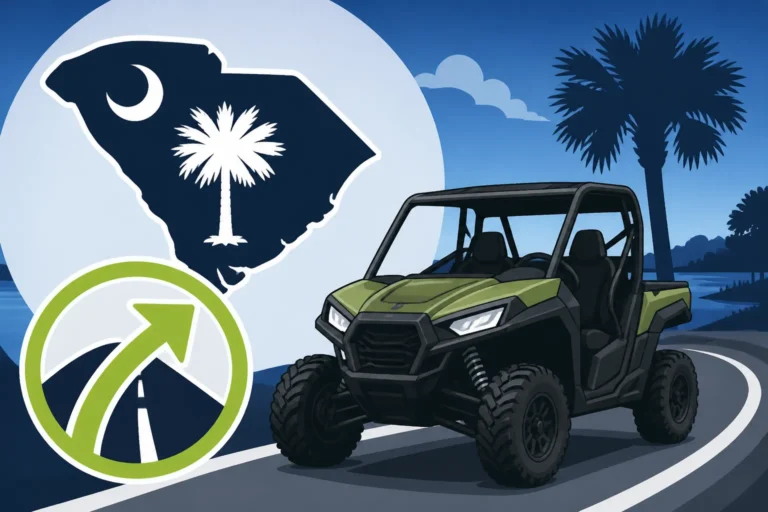
The landscape for UTVs on South Carolina roads changed significantly with the passage of Act 164. This new legislation introduced a dedicated path for UTVs to become truly street-legal, moving beyond the limited scope of the 10-mile radius rule. This is a game-changer for many riders who want more freedom and flexibility to enjoy their machines beyond private property or designated off-road parks. [South Carolina Street-Legal UTV Registration Arrives] is a topic that has been eagerly anticipated by many.
South Carolina's Act 164 and Its Ramifications
[South Carolina Act 164 and Street UTVs] fundamentally altered how UTVs are classified and permitted on public roads. Prior to this act, a UTV was almost universally considered an off-road vehicle, with very limited exceptions. Act 164, which became effective in November 2026, established a new class of "street-legal UTVs" that can be titled and registered with the DMV. This means that once a UTV meets specific equipment requirements (like turn signals, brake lights, seat belts, and proper tires—features that many performance UTVs from brands like SuperATV might already incorporate, or can be added with aftermarket kits), and is registered, it can be operated on public roads much like a traditional car, with some limitations. This legislation directly addresses the frustration many riders felt with the old, restrictive 10-mile rule, which often felt inadequate for their needs and led to confusion and inconsistent enforcement.
What South Carolina Street-Legal UTV Registration Means
For UTV owners, the ability to obtain [South Carolina Street UTV Registration Steps] means a significant expansion of where and how they can ride. A properly registered street-legal UTV is no longer confined to the 10-mile radius of the owner's home or subject to the same strict local ordinances that typically govern off-road vehicles. Instead, these machines can be driven on any public road where the posted speed limit is 55 mph or less. Interstates, expressways, and certain controlled-access highways remain off-limits, much like golf carts or low-speed vehicles. However, the ability to travel freely on secondary roads, even across county lines, opens up a world of possibilities for recreational riding, accessing trails, or simply running errands without worrying about the 10-mile limit. It requires specific equipment, such as [South Carolina Street UTV Belt Requirements] and [South Carolina Street UTV Insurance Rules], but the trade-off is much greater freedom and clarity.
Practical Advice for Riders in the Palmetto State
Navigating the rules for UTVs on South Carolina roads can feel like a minefield, but with the right information and a bit of diligence, you can ensure your rides are both enjoyable and legal. Whether you're relying on the traditional 10-mile radius or embracing the new street-legal UTV classification, preparation is key.
Verifying Local Rules Before You Ride
This cannot be stressed enough: always verify local ordinances before you ride your UTV on public roads, especially if you're traveling outside your immediate home area or into a different municipality. The "unless a town says otherwise" part of the 10-mile rule is very real. What's allowed in rural Pickens County might be strictly prohibited in the city limits of Charleston or Myrtle Beach. A quick call to the local sheriff's department or city police non-emergency line, or checking the municipal website, can save you a lot of headache and potential fines. You might find that some towns have specific [South Carolina Golf Cart Road Rules] but have no explicit UTV ordinance, while others have blanket prohibitions. Don't rely on assumptions or what you heard from a buddy; get the official word directly from the local authorities to avoid any surprises.
Essential Paperwork to Carry on the Road
Regardless of whether your UTV is operating under the 10-mile radius exemption or as a fully registered street-legal vehicle, certain documents should always be with you. For a UTV under the 10-mile rule, you should have proof of ownership (like a bill of sale or [South Carolina Proof of Ownership Without a Title] if no title was issued), and proof of your residence. For a street-legal UTV, you absolutely must carry your driver's license, the vehicle's registration, and proof of liability insurance, as required by law. Many riders also carry a copy of the specific South Carolina Code section that permits UTV operation or the relevant local ordinance, just in case they encounter an officer who might not be fully up-to-date on the latest regulations. Having these documents readily available can streamline any roadside interaction and demonstrate your good faith in complying with the law.
Comparing UTV Road Use Options in South Carolina
Here's a quick overview to help you differentiate between the various ways a UTV might be legally operated on South Carolina's public roads:
| Feature/Requirement | Traditional UTV (10-Mile Rule) | Street-Legal UTV (Act 164) | Golf Cart | Low-Speed Vehicle (LSV) |
|---|---|---|---|---|
| Primary Use | Off-road, utility, limited road access | On-road commuting, recreation, trail access | Short-distance neighborhood transport | Neighborhood transport, light errands |
| Road Access | Within 10 miles of residence; local roads <55 mph | Any public road <55 mph (excluding interstates) | Within 4 miles of residence; specific roads <35 mph | Any public road <35 mph |
| Speed Limit | Not specified, but implied slow speed | Up to 55 mph roads (vehicle itself likely slower) | Max 35 mph (often lower for actual cart speed) | Max 25 mph |
| Registration/Permit | No state registration, but owner docs needed | Mandatory [South Carolina Street UTV Registration Cost] | [South Carolina Golf Cart Permit Fees] | Mandatory DMV registration and license plate |
| Title Required | Optional ([South Carolina Titles Are Optional]) | Mandatory for registration | No | Mandatory |
| Insurance Required | Not state-mandated for off-road use | Mandatory liability insurance ([South Carolina Street UTV Insurance Rules]) | Not state-mandated (but highly recommended) | Mandatory liability insurance |
| Equipment | Varies; basic safety (helmet for minors) | Headlights, taillights, turn signals, mirrors, seatbelts, windshield, VIN, etc. | Headlights, taillights, brake lights, mirror, horn | Headlights, taillights, turn signals, mirrors, seatbelts, windshield, VIN |
| Age/License | Depends on road context; often 16+ for public road | Driver's License (17+ for [South Carolina Street UTV Age of 17]) | Driver's License | Driver's License |
| Local Authority | Can restrict or prohibit | Can restrict or prohibit (but less common than UTVs) | Can restrict or prohibit | Can restrict or prohibit |
| Example Scenario | Crossing a county road to check deer cameras 2 miles from home | Driving to a gas station 15 miles away on secondary roads | Taking kids to the pool in the neighborhood | Commuting short distances to work or school |
This table highlights the clear distinctions and why simply having a UTV doesn't automatically grant you the same privileges as a street-legal UTV or a golf cart. Knowing which category your machine falls into, and the rules that govern it, is paramount for responsible riding in South Carolina. For those looking to fully convert their UTVs, many online retailers like SuperATV offer comprehensive kits to meet all street-legal requirements, from lighting to mirrors.
Disclaimer
This article is for general informational purposes only and does not constitute professional advice. Laws, prices and regulations vary by location and change over time. Consult a qualified professional for guidance on your specific situation.