South Carolina Rules That Changed in 2026
Oh, the open road! For years, if you owned a UTV in South Carolina, the dream of legally cruising down a secondary road was often just that – a dream, tangled up in complex interpretations and a whole lot of "you can't do that." But things really started to shift, and if you're like many off-road enthusiasts I know, you've probably heard the buzz about the significant changes that arrived in 2026. This guide is all about untangling those new rules, specifically focusing on the legislative updates that finally brought clarity and opportunity for street-legal UTV operation in the Palmetto State.
Understanding the 2026 Shift to Street-Legal UTVs
For so long, South Carolina riders faced a confusing landscape when it came to UTVs and public roads. Golf carts had their specific, limited permits, and low-speed vehicles were a category all their own, but UTVs – those incredible machines we love for work and play – were often stuck in a legal gray area if you wanted to venture beyond private land or dedicated trails. This lack of clear legislation led to a lot of frustration, with many owners feeling limited in how they could enjoy their machines. The good news is, 2026 marked a pivotal moment, with new laws opening up significant possibilities for UTV owners.
What Prompted the Landmark Change?
The push for street-legal UTVs wasn't something that happened overnight. For years, rider communities, outdoor recreation advocates, and even businesses saw the potential economic and recreational benefits of allowing UTVs on certain public roads. Imagine being able to ride from your property to a nearby trail, or simply take your side-by-side into town for gas without the hassle of loading it onto a trailer. The demand was undeniable, and lawmakers finally listened. This culminated in significant legislative efforts, notably [South Carolina Act 164 and Street UTVs], which sought to create a specific, regulated pathway for UTVs to gain street legality. It acknowledged that UTVs are distinct from ATVs and golf carts, and deserved their own set of rules.
Key Provisions of the New Legislation
The changes that became effective in 2026 fundamentally redefined how UTVs are classified and operated on South Carolina roads. Prior to this, UTVs were generally treated as off-road vehicles, with very limited exceptions for public road use, often confined to specific, small communities or under very restrictive conditions. The new legislation carved out a distinct category: the "street-legal UTV." This meant a new process for registration and a defined set of equipment and operational requirements that had previously been absent. It laid the groundwork for a standardized approach, moving away from the patchwork of local rules or outright prohibitions. This was a game-changer, providing a uniform legal framework across the state for eligible machines.
Who Benefits from These New Opportunities?
Honestly, this change benefits a huge array of people and businesses across South Carolina. For the casual rider, it means more freedom and convenience. Imagine taking your UTV to your favorite fishing spot just a few miles down a county road, or having easier access to hunting leases without needing a dedicated tow rig for every short trip. For outdoor recreation businesses, it opens up new avenues for guided tours and rentals, especially those near rural roads or scenic routes. Farmers and rural landowners also see increased utility, as they can more easily move between parcels of land or conduct tasks without always needing a full-size truck. Companies like SuperATV, which offer a wide range of accessories and upgrades, also find new relevance as riders seek to equip their machines to meet the new street-legal standards. Ultimately, it’s a boost for the entire off-road community, making UTV ownership even more versatile and enjoyable in the Palmetto State.
New Registration and Equipment Standards for Road Use
With the ability to legally hit certain public roads, comes the responsibility of adhering to a whole new set of administrative and mechanical requirements. It's not just about slapping a license plate on your side-by-side; there’s a structured process to ensure these vehicles are safe for shared roadways. This means navigating the DMV system for proper paperwork and making sure your machine is up to snuff in terms of safety equipment.
The New Registration Process for Street-Legal UTVs
One of the biggest changes in 2026 was the introduction of a formal registration process specifically for street-legal UTVs. No longer are you guessing if you can or can't ride on a particular road; now there’s a clear path to getting your machine recognized. This process typically involves a trip to the South Carolina Department of Motor Vehicles (SCDMV). You'll need to fill out the appropriate forms, which often combine both titling and registration requests on a single document – handy, right? [One DMV Form Handles Title, Registration or Both].
The rollout itself saw [South Carolina Registrations Open in November 2026], allowing owners to begin the process. You'll need proof of ownership, such as a manufacturer's certificate of origin (MCO) for a new machine or an assigned title from a previous owner for a used one. They'll verify your machine's identification number (VIN) and ensure it meets the basic criteria for the street-legal category. Once approved, you’ll be issued a distinct license plate for your UTV, which must be displayed on the rear of the vehicle, just like a regular car. [South Carolina Rear Plates for Street UTVs] are a clear indicator that your UTV is ready for the road.
Titling for Street-Legal UTVs
While titling was previously optional for many off-road vehicles in South Carolina, the new street-legal UTV designation significantly elevates its importance. To register a UTV for street use, you absolutely need a title. This document serves as undeniable proof of ownership and is a cornerstone of the registration process. If you’re getting a new side-by-side, the dealer will typically handle the initial titling paperwork with the manufacturer's certificate of origin. For used machines, you’ll need a properly assigned title from the previous owner.
The title will record important information about your UTV, including its VIN and any liens if you’ve financed the purchase. It's crucial to ensure all information is accurate, as errors can lead to delays in registration. While you might previously have considered just getting a [South Carolina Title Only or Registration Only] in separate processes, for a street-legal UTV, both are now intrinsically linked. [Titling a Side-by-Side in South Carolina] involves careful attention to detail, but it’s a necessary step to enjoy the newfound freedom of road use.
Associated Fees and Insurance Requirements
Getting your UTV street-legal does come with some associated costs, but for many, the benefits far outweigh them. The state established a biennial fee for street-legal UTV registration. This fee is typically a reasonable amount charged every two years to keep your registration current. It’s part of the overall [South Carolina Street UTV Registration Cost] you’ll need to factor into your budget.
Perhaps more importantly, mandatory insurance is now a requirement for street-legal UTVs. Just like any other vehicle operating on public roads, your UTV must carry liability insurance. This protects you and others in the event of an accident. You'll need to provide [South Carolina Insurance Proof at Registration] to the SCDMV when you apply. This isn't just a suggestion; it’s a non-negotiable part of road legality. It’s always a good idea to chat with your insurance provider about specific coverage options, as many companies offer specialized policies for UTVs that can go beyond basic liability, covering theft, damage, and other scenarios, whether you’re on the road or tearing it up on the trail.
Navigating Driver Rules and Where You Can Ride
Once your UTV is registered and plated, the real fun begins – but with new freedom comes new rules. Operating a street-legal UTV on public roads is different from trail riding, and it requires adherence to specific driver qualifications, equipment standards, and designated areas of operation. It's about blending safely into the existing traffic flow, albeit on a unique machine.
Equipment Requirements for Street Legality
This is where your UTV truly transforms from an off-road beast into a road-ready machine. The legislation that arrived in 2026 set out clear [South Carolina Street UTV Machine Specs] that must be met for a UTV to qualify for street legality. These aren't just suggestions; they're mandatory components designed to ensure your machine is visible, controllable, and safe for public road use.
Here's a quick rundown of typical requirements:
| Component | Requirement for Street Legality |
|---|---|
| Headlights | Low and high beams, properly aimed |
| Taillights & Brake Lights | Visible from a specified distance, functional when braking |
| Turn Signals | Front and rear, amber or red, clearly visible |
| Mirrors | At least one rearview mirror, typically two side mirrors required |
| Windshield | Safety glass or equivalent, offering clear visibility |
| Horn | Audible from a specified distance |
| Seatbelts | For all occupants, securely mounted and functional |
| Tires | DOT-approved, suitable for road use |
| Speed | Must be capable of exceeding certain minimum speeds, but restricted to others |
Many riders find that their stock UTVs need some modifications to meet these standards. This is where aftermarket parts become invaluable. Companies like SuperATV offer a wide array of street-legal kits, including turn signal kits, DOT-approved windshields, and mirrors, making it much easier to bring your machine into compliance. It’s important to remember that these requirements are in place for everyone's safety, so cutting corners here is not an option.
Driver and Passenger Rules
The new rules also clarified who can operate and ride in a street-legal UTV. While ATVs and traditional off-road UTVs have specific age and supervision requirements, street-legal UTVs are treated more like cars in some respects. For instance, the [South Carolina Street UTV Age of 17] is generally the minimum age to drive one on public roads, and operators must possess a valid driver's license – a beginner’s permit usually won’t cut it. This ensures that anyone behind the wheel has demonstrated basic driving proficiency.
When it comes to passengers, there are also considerations, especially for younger riders. [South Carolina Street UTV Passenger Age Limits] are in place to ensure safety, often prohibiting very young children from riding. Furthermore, [South Carolina Street UTV Helmet Rules Under 21] typically mandate helmet use for younger operators and passengers, even if adults aren't required to wear them in an enclosed UTV. Always buckle up, ensure all passengers are seated properly, and respect the capacity limits of your machine.
Where You Can and Cannot Ride
The legislation didn't give street-legal UTVs carte blanche on every road in South Carolina. There are distinct limitations on where these machines can be operated. Generally, street-legal UTVs are permitted on secondary roads with speed limits of 55 mph or less. Major highways, interstates, and certain high-speed arterial roads remain off-limits. This is crucial to remember; ignorance of these rules won't save you from a ticket. [South Carolina Street UTV Road Speed Limits] are strictly enforced, and you should always adhere to the posted speed limits.
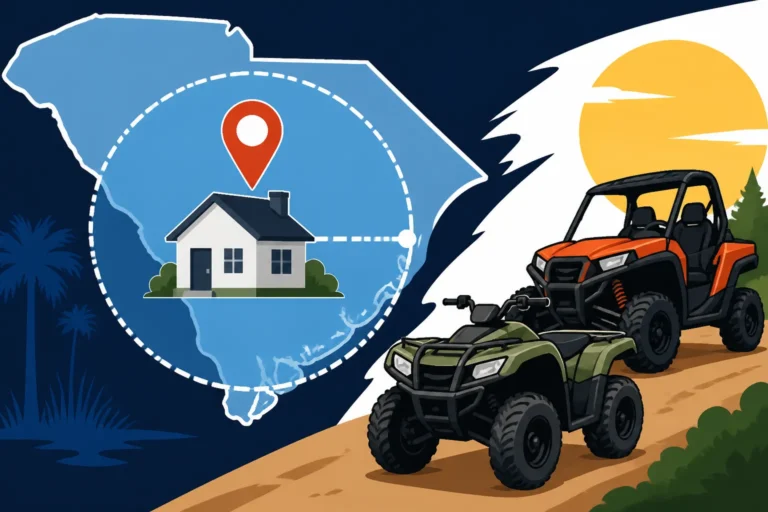
Additionally, while the new law aims to expand access, some specific local ordinances or private property rules may still apply. There's also a significant detail regarding proximity to your registered address: the [South Carolina's 10-Mile Radius Rule] often comes into play for golf carts, and similar radius restrictions or specific municipal permissions might apply to UTVs depending on local interpretation or future amendments. Always check local city and county regulations in addition to state law, as some areas may have specific nuances or even prohibitions that override general state allowance. For instance, just because you can legally ride in one county doesn't mean you can in an adjacent one without checking their specific ordinances.
Ensuring Compliance and Avoiding Common Mistakes
Getting your UTV street-legal in South Carolina is a fantastic step, but it's vital to stay on top of the details. Even with the best intentions, it's easy to overlook a crucial piece of paperwork or misunderstand a nuanced rule. A little diligence upfront can save you a lot of headache (and potential fines) down the road.
Overlooking Key Paperwork
The journey to street legality starts and ends with paperwork. One of the most common pitfalls is simply not having all your ducks in a row when you visit the DMV. Make sure you have your proof of ownership, such as the MCO or a properly assigned title. If you bought a used machine in a private sale, and for some reason, the previous owner didn't have a title (which was previously common since ATVs were optional to title), you might face hurdles. While there are sometimes ways to prove ownership without a title, like [South Carolina Proof of Ownership Without a Title], it's a more complex process and can delay your registration.
It's also easy to make small errors on forms, like forgetting a signature or miswriting a VIN. Double-check everything before you leave the house. Also, always keep your registration, proof of insurance, and your driver's license on you when operating your street-legal UTV. A quick stop by a deputy can turn into a serious citation if you don't have the required documentation readily available.
Misinterpreting Road Restrictions
Another common mistake involves misreading the "where you can ride" rules. Just because your UTV has a license plate doesn't mean every road is fair game. Remember, main highways and interstates are typically prohibited. Pay close attention to posted speed limits; if a road is 60 mph, even if it's secondary, your street-legal UTV likely isn't allowed there. The key phrase often revolves around roads with a posted speed limit of 55 mph or less.
It’s also crucial to understand the nuances of any local ordinances. What might be allowed in a rural county could be strictly forbidden within city limits, even on roads that meet the general state criteria. Always assume you need to verify local rules. Don't rely on hearsay; check official county or municipal websites, or call their administrative offices. Some towns have very specific rules about UTVs within their boundaries, regardless of state law.
Keeping Up with Ongoing Changes
Legislation, especially when it's relatively new, can evolve. Lawmakers might tweak rules, add amendments, or clarify existing statutes based on real-world experience. What might be true today about [South Carolina Street UTV Requirements Explained] could see minor adjustments in the future. The best way to avoid being caught off guard is to stay informed.
Regularly check the SCDMV website for updates, or even consider following local UTV riding groups or forums. These communities are often excellent sources of information on rule changes, upcoming events, and shared experiences. Building a relationship with your local DMV office can also be helpful; the clerks are often the first to hear about new policies or clarifications. Staying proactive ensures you can continue to enjoy the freedom of your street-legal UTV without any unexpected surprises.
Disclaimer
This article is for general informational purposes only and does not constitute professional advice. Laws, prices and regulations vary by location and change over time. Consult a qualified professional for guidance on your specific situation.