Secondary Roads at Fifty-Five or Less
It's a common sight now, seeing UTVs buzzing down a country road in South Carolina, but the rules around where and how fast you can legally drive them can feel like a tangled fishing line. For many of us, the idea of taking our side-by-side from the trail directly to the local general store or even just to a friend's house down a rural road has always been a dream. This guide is here to untangle all that, specifically diving into what "secondary roads at fifty-five or less" truly means for your street-legal UTV, covering the recent legal changes, equipment necessities, and crucial operating rules you need to know to stay safe and legal.
Understanding South Carolina's Street-Legal UTV Laws
For years, the lines were blurry, and often, the answer was a simple "no" when it came to riding your UTV on public roads in South Carolina. This led to a lot of frustration for owners who saw the utility of their machines extending beyond just the dirt. Thankfully, South Carolina has evolved its laws, opening up new possibilities for UTV enthusiasts. However, this doesn't mean every UTV can hit every road at any speed. There are specific requirements and restrictions that govern this newfound freedom, particularly concerning what constitutes a "street-legal" UTV and where it can actually be driven.
The pivotal change came with [South Carolina Act 164 and Street UTVs], which introduced a framework for side-by-sides to be titled and registered for road use. This was a game-changer, allowing owners to finally bridge the gap between their off-road adventures and the practicality of street navigation. But this act wasn't a blanket permission slip; it came with a detailed list of mandates designed to ensure safety and integrate these vehicles into the existing traffic ecosystem. Understanding these foundational laws is the first step toward enjoying your UTV on secondary roads.
The Definition of a "Street-Legal" UTV in South Carolina
Before your UTV can even think about hitting a paved secondary road, it must undergo a transformation, meeting a specific set of equipment standards to qualify as "street-legal" in South Carolina. This isn't just about adding a license plate; it's about making sure your machine is as visible, controllable, and safe as other vehicles on the road. The law is quite clear on these necessities, and skipping any of them can lead to a roadside stop and a citation faster than you can say "Palmetto State."
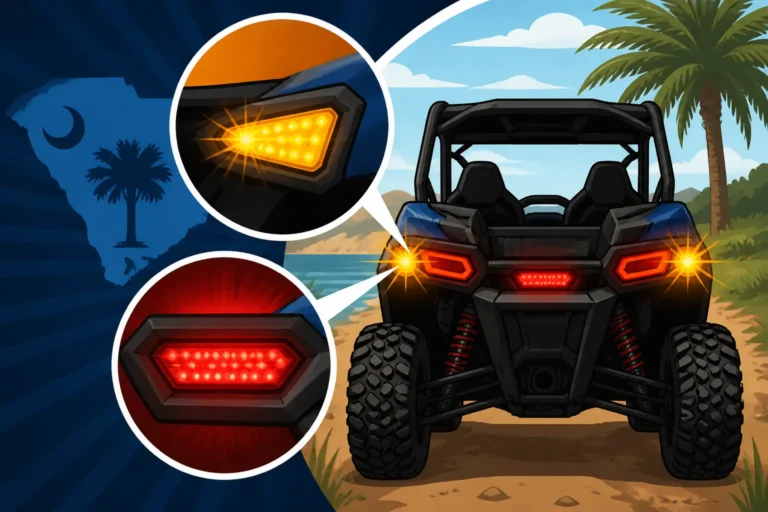
At the core, your UTV needs to be equipped with safety features that are standard on most passenger vehicles. This includes proper headlights, taillights, brake lights, and crucially, turn signals – front and rear. A rearview mirror (or two, for better visibility) is also a must, as is a horn for communicating with other drivers. Seat belts are non-negotiable for all occupants, and the vehicle must have a steering wheel, not handlebars, for directional control. Dimensions also play a role; your UTV needs to adhere to certain width and weight limits to be road-compliant. For instance, many states have limits around 80 inches wide and a certain weight threshold, so it's vital to check the exact specifics outlined in [South Carolina Street UTV Requirements Explained]. If you're looking to upgrade or convert your UTV, aftermarket companies like SuperATV offer a range of products specifically designed to help meet these street-legal requirements, from lighting kits to turn signal systems. It’s also important to distinguish a street-legal UTV from other similar vehicles; [A Low-Speed Vehicle Is Not a South Carolina UTV], nor is a golf cart, each having its own distinct set of rules and limitations when it comes to road use in South Carolina.
Registration and Titling for Street UTVs
Once your UTV is properly outfitted, the next crucial step is making it official with the state. This means going through the process of titling and registering your machine, just like you would a car or truck. Many UTV owners are used to the simplicity of owning an off-road machine with minimal paperwork, so this step often feels like a significant hurdle. However, it's a necessary part of proving your UTV meets the legal criteria for road travel.
The process for getting your street-legal UTV titled and registered in South Carolina is specific and requires a trip to the DMV. You'll need to gather all your paperwork, including proof of ownership (like a Manufacturer's Certificate of Origin or a previous title), a completed application form, and any receipts for the parts you added to make it street-legal, as well as proof of meeting all safety requirements. The [South Carolina Street UTV Registration Steps] will guide you through this, ensuring you have all your ducks in a row. There will be fees involved, both for the initial title and for the registration itself, which typically requires biennial renewal. You can learn more about this in [South Carolina's Biennial Street UTV Fee]. A crucial component often overlooked by new street-legal UTV owners is insurance. Just like any other vehicle operating on public roads, your UTV will need to meet minimum liability insurance requirements before it can be registered. This is not optional; [South Carolina Street UTV Insurance Rules] clearly mandate proof of coverage before a plate will be issued, as highlighted in [Insurance Proof Before a Plate Issues]. This protects not only you but also other drivers on the road in case of an accident.
Navigating Secondary Roads: Speed Limits and Restrictions
Now that your UTV is officially street-legal, titled, and registered, the real fun begins: understanding precisely where you can actually take it. The primary focus of South Carolina's street-legal UTV law is on secondary roads with specific speed limitations. This is a critical distinction that many riders misunderstand, often leading to costly mistakes or dangerous situations. The phrase "secondary roads at fifty-five or less" isn't just a suggestion; it's the bedrock of permitted UTV road use.
Secondary roads are generally less traveled routes, often found in rural or suburban areas, connecting smaller communities or serving as feeders to larger highways. They are distinct from the bustling interstates and multi-lane primary highways that crisscross the state. The reason for this distinction is primarily safety; UTVs, even when street-legal, are not designed for high-speed travel and don't offer the same level of protection as a passenger car or truck. The law is designed to allow their utility while minimizing risks on roads where speeds are lower and traffic volumes are typically lighter. It's about finding that balance between recreational use and public safety.
Where You CAN Ride: Identifying Approved Secondary Roads
The good news for street-legal UTV owners in South Carolina is that a significant network of roads is open to you. The key differentiator is the posted speed limit: if it's 55 mph or less, your street-legal UTV is generally welcome. This opens up countless miles of picturesque country roads, rural highways, and many local town and county routes. Imagine cruising through charming small towns, exploring scenic backroads, or simply getting from your home to a nearby trail system without having to load your machine onto a trailer.
These roads often present a more relaxed driving environment compared to major arteries. You'll typically find two-lane roads, sometimes without painted centerlines, winding through farmlands, forests, or coastal communities. Always pay close attention to the posted speed limits. While the maximum is 55 mph for your UTV, many of these secondary roads will have lower limits, such as 35 mph or 45 mph, especially as you approach residential areas or town centers. Always adhere to these lower posted limits. You might also encounter the "radius rule" in some contexts, but for street-legal UTVs, the primary governing factor for where you can ride is the speed limit of the road itself. [South Carolina Street UTV Road Speed Limits] clearly outlines that your machine is allowed on public roads and highways with a posted speed limit of 55 mph or less. Before heading out, it's always a good idea to consult a local map or even check with your local municipality, as some towns may have specific ordinances regarding UTV access within their limits, even on secondary roads. Companies like SuperATV also offer accessories such as mirrors and windshields which can greatly enhance your visibility and comfort on these varied road types.
Where You CANNOT Ride: Prohibited Roadways
While the freedom to ride on secondary roads is a welcome development, it's equally important to understand the strict limitations on where street-legal UTVs are not allowed. Crossing these boundaries can lead to severe penalties, not to mention putting yourself and others in serious danger. The law is unequivocal: interstates and any roads with a posted speed limit exceeding 55 mph are strictly off-limits to UTVs.
This means you cannot take your street-legal UTV on major highways like I-26, I-95, or even many of the multi-lane U.S. routes that often have speed limits of 60 mph or higher. [Why South Carolina Interstates Stay Closed to ATVs] boils down to a combination of speed differentials, vehicle design, and safety. UTVs simply aren't built to safely operate at those higher speeds or handle the intense traffic conditions found on such roadways. The risk of a serious accident increases dramatically when a UTV is mixed with vehicles traveling at freeway speeds. Beyond the obvious interstates, be vigilant about speed limit changes on even secondary roads. A rural road might start at 45 mph, but as it merges into a state highway, the limit could jump to 60 mph, making that stretch immediately prohibited. Always be aware of your surroundings and the posted signage. Ignoring these prohibitions isn't just a minor infraction; it can result in significant fines, points on your driving record, and potentially even the impoundment of your vehicle, making that convenient shortcut anything but.
Important Considerations for Street-Legal UTV Operators
Getting your UTV street-legal and knowing which roads you can traverse is a great start, but it's only part of the equation. Operating a street-legal UTV on public roads comes with the same responsibilities and legal obligations as driving any other motor vehicle. This means you need to be just as prepared, licensed, and compliant with all traffic laws. It's not just about the machine; it's about the driver and passengers, too.
Remember, when you're on a public road, you're sharing it with cars, trucks, motorcycles, and bicycles. Your UTV, while exciting, might be less visible or behave differently than other vehicles. This demands a heightened sense of awareness and adherence to all rules of the road. From signaling turns to yielding right-of-way, every action you take behind the wheel of your street-legal UTV is subject to the same scrutiny as any other driver.
Operator and Passenger Requirements
Just like driving any other vehicle on South Carolina's roads, there are specific requirements for who can operate a street-legal UTV and who can be a passenger. These rules are designed to ensure that everyone on board is of appropriate age and has the necessary qualifications to safely navigate public thoroughfares. It’s not simply about being old enough to reach the pedals; it's about having the legal standing and maturity for road use.
First and foremost, the operator of a street-legal UTV must be at least 17 years old. This is a strict age gate, meaning if you're 16 or younger, even with a learner's permit, you cannot legally drive a plated UTV on a public road. [South Carolina Street UTV Age of 17] makes this abundantly clear. Furthermore, the operator must possess a valid driver's license. A beginner's permit, while allowing you to drive a car with supervision, is not sufficient for operating a street-legal UTV independently on public roads, as explicitly stated in [No Beginner's Permit Allowed]. This ensures that anyone behind the wheel has demonstrated a basic level of driving competency and knowledge of traffic laws.
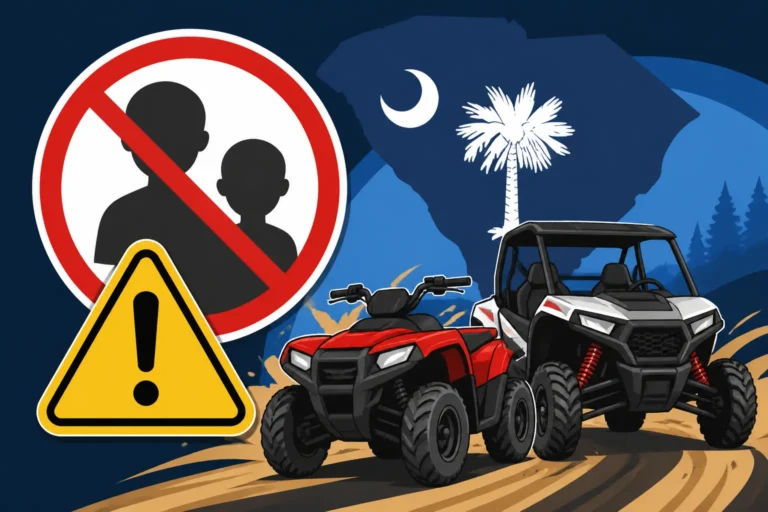
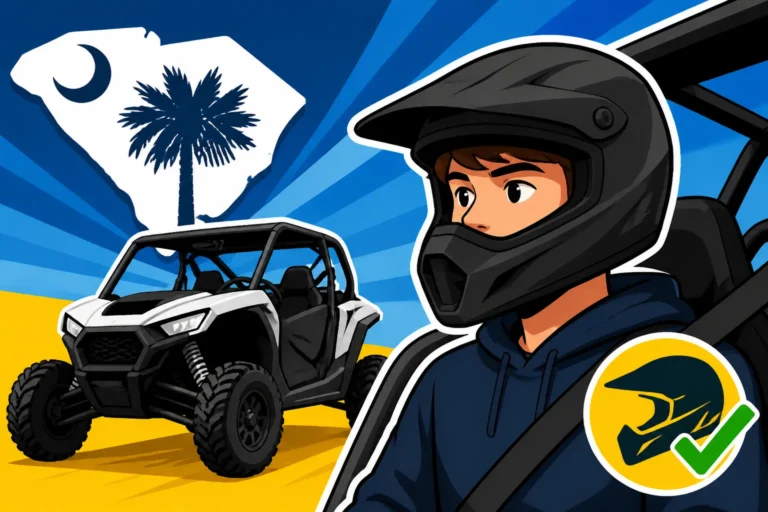
When it comes to passengers, there are also age restrictions. Children eight years old or younger are generally prohibited from being passengers in a street-legal UTV on public roads. [No Passenger Eight or Younger] is a rule aimed at protecting very young children who might not be safely secured or protected in a UTV during a road incident. For riders under 21, helmet rules often apply. While specific to UTVs, the general rule is that if you're under 21, you might be required to wear a helmet, or at least a face shield, for your own safety. [South Carolina Street UTV Helmet Rules Under 21] and [Face Shields Required for UTV Riders Under 21] provide greater detail on these requirements. Always double-check current regulations to ensure all occupants are compliant and safe.
Safety and Enforcement on Public Roads
Operating a street-legal UTV on secondary roads means prioritizing safety and being prepared for potential encounters with law enforcement. While the freedom to ride is wonderful, it comes with the responsibility of adhering to all traffic laws and ensuring your vehicle remains in proper working order. A street-legal UTV is still a unique vehicle on the road, and you want to ensure you're doing everything to be seen and understood by other drivers.
When you're out on the road, defensive driving is paramount. Your UTV might have a higher center of gravity, different braking characteristics, and less protection than a standard car. Always use your turn signals well in advance, maintain a safe following distance, and be extra cautious at intersections. Because UTVs can sometimes be less visible, consider adding reflective tape or extra lighting, especially if you plan on driving during dawn, dusk, or nighttime hours. Keeping your UTV properly maintained is also key. Regularly check your tires, brakes, lights, and steering components. Quality parts, whether from the manufacturer or trusted aftermarket providers like SuperATV, contribute significantly to your machine's reliability and safety on the road.
As for enforcement, South Carolina law enforcement officers treat street-legal UTVs like any other vehicle on the road. This means they can pull you over for speeding, reckless driving, or any other traffic infraction. They will also verify that your UTV meets all the street-legal equipment requirements and that you have a valid driver's license, registration, and proof of insurance. [What a South Carolina Deputy Can Ask to See] is essentially everything they'd ask a car driver for. Non-compliance can lead to fines, citations, and even the immediate removal of your UTV from the road. Staying informed and compliant ensures your street-legal UTV remains a source of enjoyment, not stress.
Here's a quick overview of key rules for street-legal UTVs on South Carolina's secondary roads:
| Requirement / Restriction | Details |
|---|---|
| Road Type | Secondary roads only |
| Speed Limit | Posted speed limit of 55 mph or less |
| Prohibited Roads | Interstates, primary highways, roads with speed limits > 55 mph |
| Operator Age | Minimum 17 years old |
| Operator License | Valid driver's license (no beginner's permit) |
| Passenger Age | No passengers 8 years old or younger |
| Equipment | Headlights, taillights, brake lights, turn signals, mirrors, horn, seat belts, steering wheel, DOT tires |
| Registration | Required, biennial renewal, proof of insurance needed |
| Insurance | Mandatory liability insurance |
Disclaimer
This article is for general informational purposes only and does not constitute professional advice. Laws, prices and regulations vary by location and change over time. Consult a qualified professional for guidance on your specific situation.