Yielding on a Narrow Carolina Trail
A narrow trail can turn a relaxed Carolina ride into an awkward standoff: two machines meet on a slope, dust hangs in the air, and neither rider is sure who should back up. This guide explains how to yield safely on South Carolina trails, make room for different types of trail users, and avoid turning a tight pass into a collision or a damaged trail.
Read the trail before you ride
Check the route and its limits
A trail that looks wide enough on a map may narrow between trees, dip into a creek crossing, or become soft after rain. Before unloading, check the route’s current rules, vehicle restrictions, closures, and conditions. A trail designed for motorcycles or narrow ATVs may not have room for a full-size side-by-side to pass another vehicle safely.
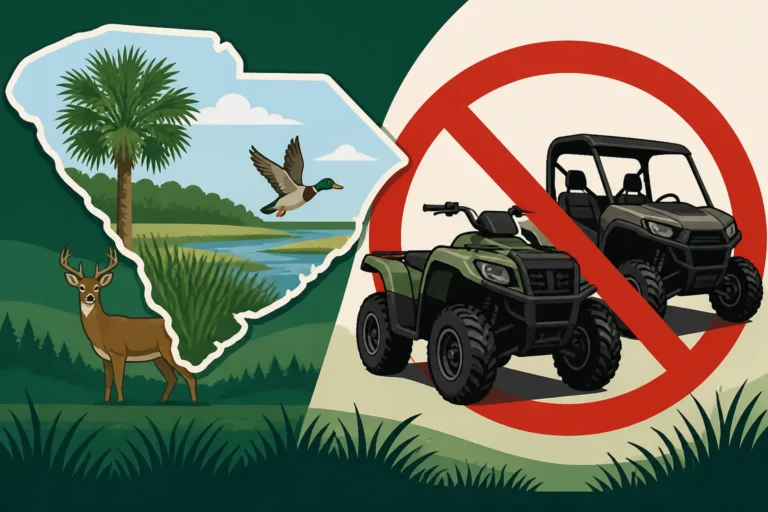
Trail maps are useful for planning, but they do not replace signs at the trailhead or instructions from the land manager. If a route is marked for a particular vehicle width or type, follow that restriction rather than assuming you can squeeze through. South Carolina Trails That Ban Full-Size Vehicles explains why a machine that fits on one route may be turned away at another.
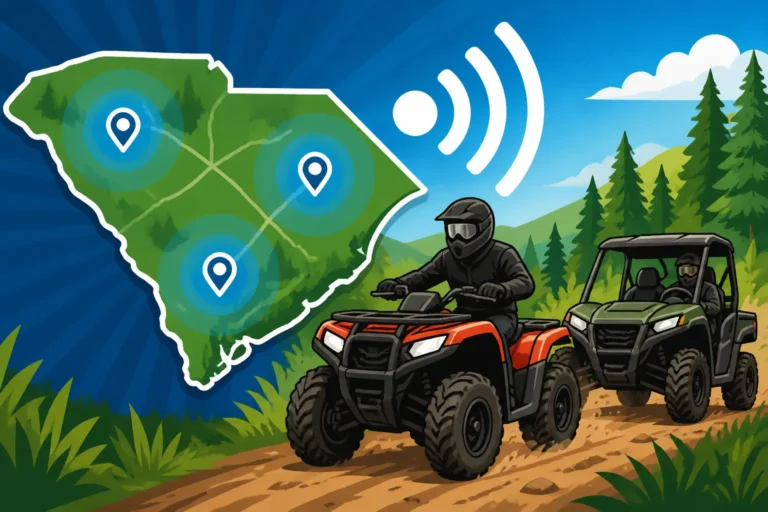
A mapping app such as onX Offroad can help you preview a route and identify nearby junctions or alternate paths before you ride. Treat it as a planning aid, not permission to use a trail: signs, gates, closures, and land-manager guidance take priority. If you’re riding somewhere unfamiliar, review the route with your group before starting, while everyone is parked and able to focus.
Set expectations with your group
A little preparation prevents a lot of trail-side confusion. Before rolling out, agree on simple signals for “stop,” “vehicle ahead,” and “come through.” Riders should know who is leading and who is sweeping at the back, and the group should leave enough space that a sudden stop does not cause a chain reaction.
It also helps to agree that nobody will pass the lead rider or split off to find a different route without telling the group. On a narrow trail, a rider who disappears around a bend can meet oncoming traffic without anyone else knowing where they are. If you need to stop, move to a place where other riders can see you and where your machine does not block the trail.
Ask each rider to check that mirrors, flags, cargo, and accessories are secure and not sticking out farther than expected. A UTV with a wide attachment or a load extending past the rack can make a close pass more difficult. For route planning, South Carolina Trail Difficulty Ratings can help you consider whether a trail is a sensible match for your group’s machines and experience.
What to do when vehicles meet
Slow down and communicate early
When you see another machine approaching, reduce speed well before the pass. On a blind curve or steep section, stop somewhere visible and stable rather than continuing until you are close enough to surprise the other rider. Avoid braking abruptly on a loose or slippery slope if you can slow down smoothly.
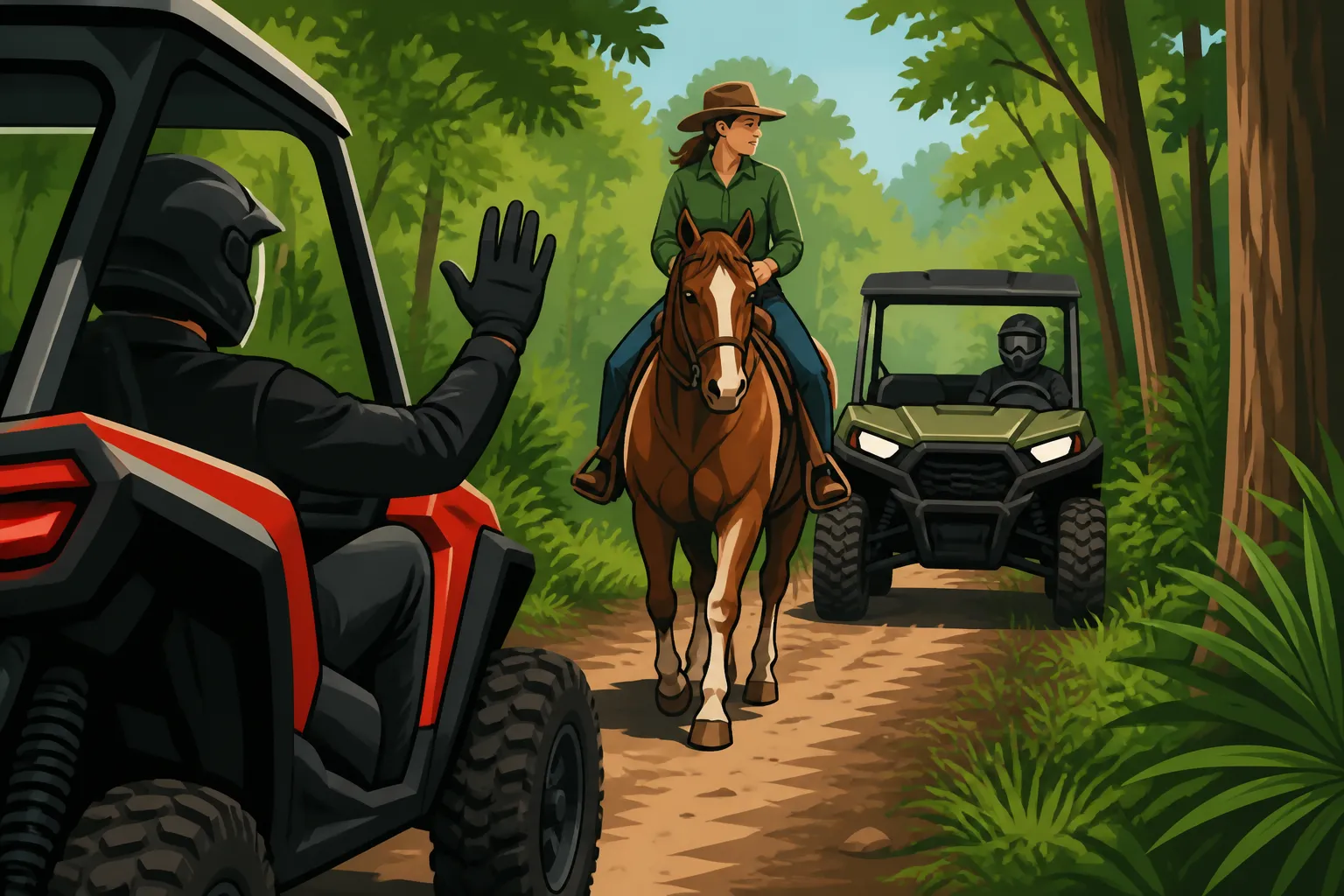
Use a clear signal: a hand wave, a nod, or a brief verbal exchange if you are close enough to speak safely. Do not assume the other rider has seen you, especially if the trail is dusty, wooded, or noisy. If you are in a group, make sure the riders behind you know there is oncoming traffic and are not still accelerating toward the meeting point.
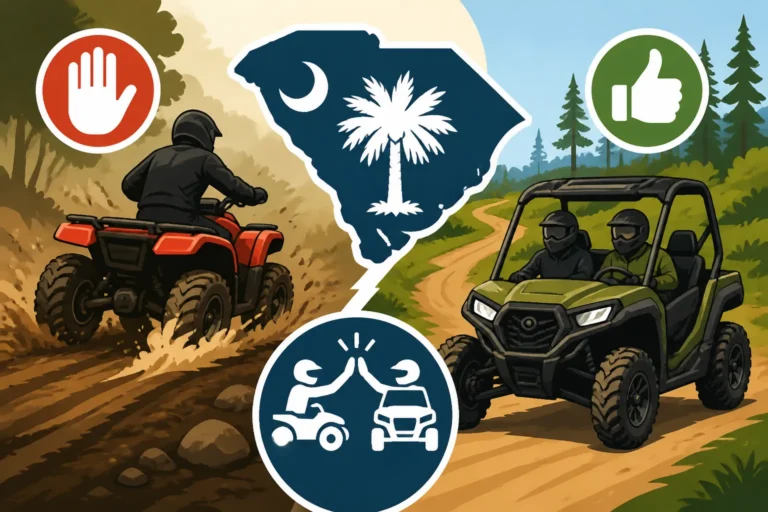
Once both parties have stopped, decide together who can move to a safe passing place. On many recreational trails, the rider traveling uphill is commonly given room to continue while the downhill rider waits or backs to a wider spot. That convention can prevent a rider from having to restart on a loose incline. However, it is a practical courtesy, not a substitute for posted rules or good judgment. If the uphill rider is already stopped in a safe turnout, or the downhill rider has a much easier place to pull aside, communicate and choose the safer option.
Find a passing place rather than forcing one
Do not try to squeeze two machines past each other where the trail edge drops away, the ground is soft, or a tree or rock could catch a tire or fender. One rider should wait while the other carefully moves to a wider, stable area. Keep wheels on the established trail where possible; cutting a new path around the obstacle can widen the trail, damage vegetation, or send a vehicle into hidden ruts.
If someone must reverse, move slowly and in short stages. The driver should look behind before backing and use a spotter when visibility is limited. A spotter should stand where the driver can see them and stay clear of the machine’s path, tires, and any edge or drop-off. Never rely on a passenger leaning out to guide a driver while the vehicle is moving.
Passing is not complete once the front bumpers clear. Leave enough room for the whole vehicle, including mirrors, tires, racks, and any trailer, before either party starts moving again. When the trail is too narrow to pass safely, take the time to back up to a proper turnout rather than making a risky squeeze. If you’re riding with side-by-sides, check the route’s vehicle limits ahead of time; South Carolina Trails That Allow Side-by-Sides can help you plan around trails intended for larger machines.
| Trail situation | Safer response | Avoid |
|---|---|---|
| Oncoming machine on a blind bend | Stop at a visible, stable spot and signal | Continuing around the bend at speed |
| Two vehicles meet on a slope | Communicate and use the safer turnout; uphill riders are often given priority | Treating a courtesy as an unbreakable rule |
| Narrow trail with no passing room | Back slowly to a wider section, using a spotter if needed | Squeezing past an edge, tree, or steep bank |
| Dusty trail with a group behind you | Slow early and alert the group | Stopping suddenly without warning |
| Soft or muddy shoulder | Stay on the established route and find firmer ground | Driving around the other vehicle into vegetation |
Yielding to other trail users
Give hikers, cyclists, and horses room
A motorized trail may still have other permitted users, and they may not hear you until you are close. Slow to a crawl when approaching people on foot or bicycles. If the trail is narrow, stop and let them choose a safe place to pass. Keep the engine noise low when practical, and avoid revving or spinning tires beside them.
Horses and other animals can react unpredictably to engine noise or sudden movement. Stop at a distance, make your presence known calmly, and ask the person handling the animal what they prefer. Do not rush past, honk, or assume the animal will remain calm. Give them enough room to move through the trail without being forced toward a steep bank or brush.
Even when you believe you have the right to continue, courtesy is often the safest choice. People may be startled, a child may be walking close to an adult, or a dog may be on a long lead that is hard to see. South Carolina Trail Etiquette Locals Expect offers useful context for sharing trails respectfully, while South Carolina Group Ride Planning can help a larger party decide how to regroup without blocking the route.
Handle water crossings and muddy bottlenecks patiently
Creek approaches and muddy sections often create the tightest passing situations. A vehicle may need room to line up, choose a stable route, and cross without damaging the bank. If someone is already crossing, wait until they are clear before entering the approach. Do not crowd the vehicle from behind or pass through the same narrow space at the same time.
Stay within the established crossing where allowed, and do not create a bypass around a muddy patch or blocked crossing. A new track through the edge of a creek or wetland can cause erosion and widen the damaged area. If the route looks unsafe, turn around or use a permitted alternate route rather than forcing a pass. South Carolina Trails With Water Crossings is a helpful topic to review before choosing a route with creek or stream sections.
After heavy rain, a trail that was easy to pass on may have deep ruts, slick clay, or a soft shoulder. Conditions can vary sharply between the Upstate, the Midlands, and the Lowcountry, so do not assume a familiar route will feel the same after a storm. Check conditions before towing to the trailhead; South Carolina Trail Conditions Before You Haul and South Carolina Trail Closures After Rain are useful starting points.
Keep the encounter safe and low stress
Stay visible and protect your space
Visibility matters most on wooded trails, dusty roads, and shaded sections where a rider may blend into the background. Keep lights and safety equipment in working order, and use any flag or visibility gear required by the trail or land manager. At blind junctions, approach slowly enough to stop if someone is coming from the other direction.
On a narrow trail, avoid stopping just beyond a crest or immediately around a bend. If you need to wait for your group, choose a straight, visible place with room for another vehicle to get by. A parked machine can be as much of a hazard as a moving one when the next rider cannot see it in time.
Map tools such as onX Offroad can help you anticipate junctions and identify options for a regrouping point, especially when riding a route for the first time. Still, keep your attention on the trail itself. A screen cannot show every newly fallen limb, soft shoulder, temporary closure, or rider coming around a blind curve.
Make room without damaging the trail
Yielding should not mean driving into sensitive ground. A shoulder may look firm but hide a ditch, root, or soft patch. If you cannot pull fully off the trail safely, stop in a visible spot and coordinate with the other rider rather than creating a new track through the vegetation.
When waiting, keep the machine pointed in a direction that allows you to move forward or reverse without a sharp, unstable maneuver. Set the brake when parked, and make sure passengers remain seated or stand in a safe place away from moving vehicles. If your group is large, let the oncoming rider pass one machine at a time instead of crowding the trail with several vehicles nose-to-nose.
Good yielding is less about winning an argument over who has priority and more about preventing a collision, avoiding trail damage, and letting everyone continue safely. Slow down early, communicate clearly, choose stable ground, and be willing to back up when that is the safer move. Those habits make a narrow Carolina trail much easier to share, whether you are riding a quad, a side-by-side, or a mixed group of machines.
Disclaimer
This article is for general informational purposes only and does not constitute professional advice. Laws, prices and regulations vary by location and change over time. Consult a qualified professional for guidance on your specific situation.