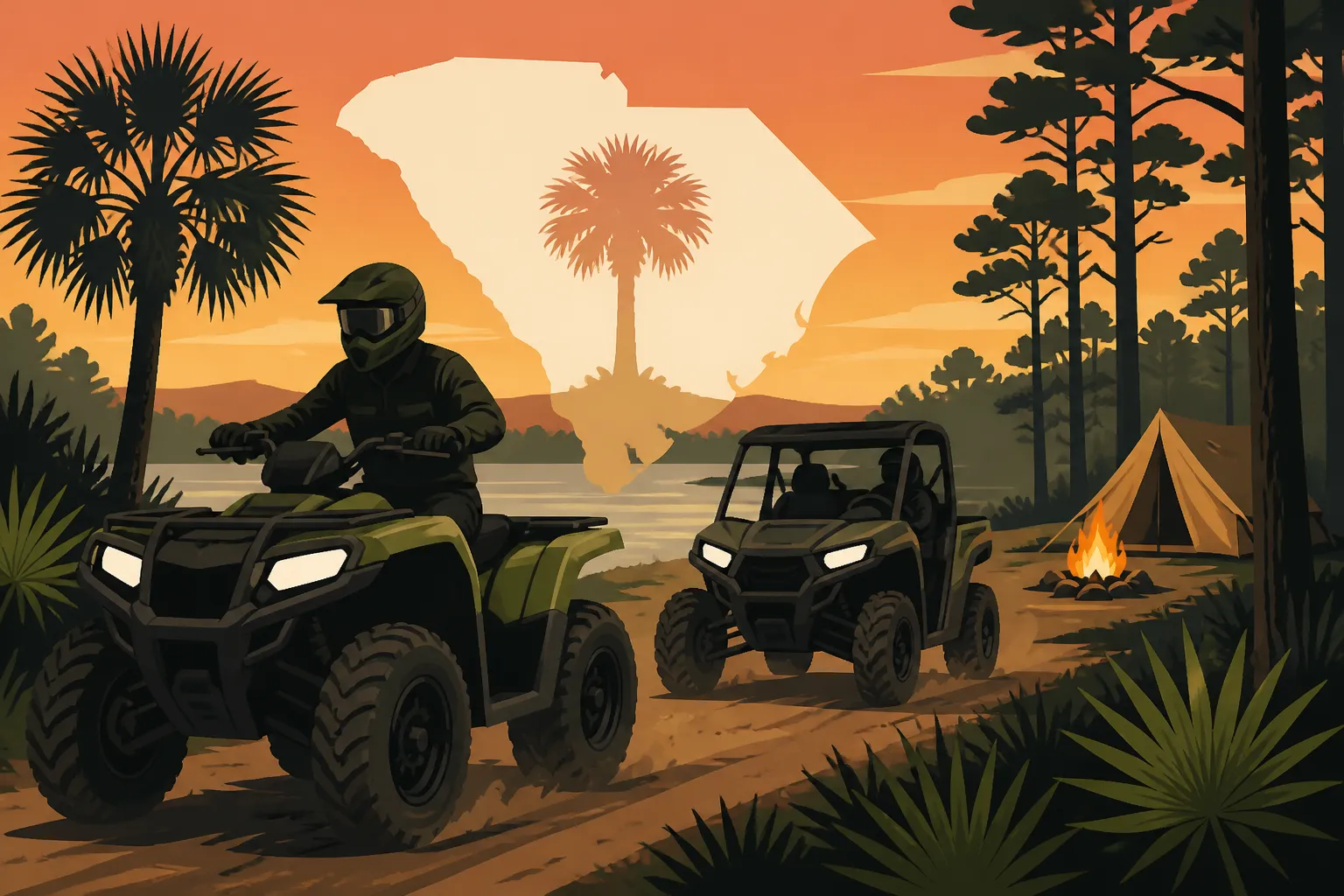
Riding Quietly Past Carolina Camps
A loud ATV or UTV can turn a peaceful campsite into an unwanted wake-up call, especially when a trail runs close to tents, cabins, or a campground road. Riding quietly past Carolina camps is mostly about slowing down, choosing considerate routes, and managing your machine—not simply hoping nobody minds. This guide explains how to reduce noise and avoid common trail-etiquette problems.
Why quiet riding matters near campsites
Camps are places where people expect a break
A camp may be full of people who have spent the day hiking, paddling, or riding and are trying to rest. Others may have children asleep in a tent, a dog that startles at engine noise, or a quiet morning planned before heading out on the trail. When a machine accelerates hard beside a campsite, even for a few seconds, that sound can carry across an otherwise peaceful area.
Noise also changes how other trail users experience a shared space. A camper who feels surprised or crowded may be less comfortable around riders, even if the rider is using an authorized route. That is why South Carolina Trail Etiquette Locals Expect is more than a matter of good manners: considerate riding can help keep shared riding areas welcoming.
Sound travels differently through woods and open camps
A trail through thick pine may seem sheltered, but engine noise can travel surprisingly far through quiet woods. It may also bounce across open ground, water, or a campground loop. At a busy private riding park, background noise can mask the sound of a passing machine. At a quiet campsite, the same engine can feel much louder.
The terrain matters, but so does the time of day. A machine passing at midday may be less disruptive than one passing early in the morning or after campers have settled in for the night. Quiet hours and campground rules vary, so do not assume that a route is appropriate simply because it is open to riding. Check the rules for the specific area and use extra care near established camps.
How to pass a Carolina camp with less noise
Slow down before you reach the campsite
The easiest way to make a quieter pass is to reduce speed well before you reach tents, cabins, or a campground entrance. If you wait until you are right beside a camp to slow down, a sharp throttle change or downshift can create a fresh burst of noise. Ease off early and keep your movements smooth.
Avoid accelerating hard, revving for fun, or spinning tires near camps. On loose South Carolina sand or clay, a sudden throttle burst may also throw dust or debris toward people and gear. If the trail is narrow and campers are walking nearby, slow enough to give them room and be prepared to stop. If someone is backing a trailer or moving around a campsite, wait rather than squeezing past.
A useful habit is to treat the approach to a camp as a transition zone. Before you arrive, remind your group to close the gap, keep a steady pace, and avoid unnecessary conversation shouted over engines. That makes the pass calmer and helps prevent one rider’s sudden acceleration from setting off a chain reaction through the group.
Keep your machine in good working order
A machine that sounds unusually loud may need attention. A damaged or loose exhaust component, a poorly secured panel, or a mechanical problem can make an otherwise ordinary ride more disruptive. Before a trip, listen for new rattles and changes in exhaust sound, and address obvious maintenance issues rather than assuming they will go unnoticed.
Do not modify or remove noise-control equipment to make a machine louder. Besides being inconsiderate near camps, equipment and sound rules can differ between public riding areas and private parks. Review the site’s requirements before you haul. For public forest riding, South Carolina Sound Limits on Forest Land is a useful topic to check alongside the rules for the specific trail system.
| Situation near camp | More considerate choice | Avoid |
|---|---|---|
| Approaching tents or cabins | Ease off the throttle early | Accelerating hard beside the camp |
| Campers are walking near the route | Slow down and give them space | Passing closely at speed |
| A group is spreading out | Regroup before the camp | Letting each rider race to catch up |
| A machine is rattling or unusually loud | Check it before the ride | Ignoring a new mechanical sound |
| You are unsure whether the route crosses a camp area | Confirm access and route boundaries | Cutting through a campsite or closed area |
Plan routes that respect camps and other trail users
Confirm where riding is allowed before you unload
A line that looks like a trail on a map is not automatically open to motorized riding. Public-land routes, private property, campground roads, and connecting paths can have different access rules. Follow posted signs and use only routes authorized for your machine. If you cannot tell whether a route is open, stop and confirm rather than riding through a camp to find out.
Digital mapping can help with route planning, and onX Offroad can be useful for reviewing mapped routes and nearby land boundaries before a ride. Treat any mapping app as a planning aid, not as a substitute for signs, official notices, or landowner permission. A mapped line does not by itself establish that a trail is open today or that it allows your particular vehicle.
Before choosing a destination, check the latest trail information and access conditions. For a broader starting point, see South Carolina’s Four National Forest Trails and South Carolina Trails With Camping. If rain has changed the route or a closure is in effect, follow the posted restriction rather than trying to find a way around it. South Carolina Trail Conditions Before You Haul can help you build a better pre-trip routine.
Share narrow routes patiently
A camp-adjacent path may also be a narrow trail where riders, hikers, hunters, or maintenance vehicles meet. Slow down when visibility is limited, stay to the established route, and leave room for others to pass. If you meet someone on foot, stop or crawl at a walking pace until there is plenty of space. Dust and engine noise can both be unpleasant at close range, particularly for people who have no easy way to step aside.
Be especially attentive during hunting seasons or in areas where other forest users may be present. A group of ATVs arriving together can feel intimidating to a lone hiker or camper. Keep the group compact enough to avoid prolonged noise, but never ride so close together that you lose control or visibility. Guidance on Sharing a Sumter Forest Trail With Hunters can help riders think through these shared-use situations.
If you need to wait for another rider, pull over only where it is safe and permitted. Do not block a campsite entrance, trail junction, or access road while regrouping. For larger outings, South Carolina Group Ride Planning can help you organize a route and meeting points so the group is less likely to stop or bunch up beside occupied camps.
A practical quiet-riding routine
Before the ride
A little preparation can prevent uncomfortable moments once you are on the trail. Confirm that the riding area is open, check whether your machine is allowed, and review campground or park rules. If you are visiting a private property or park, follow its posted policies, including any restrictions on riding near overnight areas. South Carolina Private Park Passes and Rules is a useful place to start when your trip involves a private park.
Use a map to identify campsites, trail crossings, and places where the route may pass close to other visitors. onX Offroad may help you visualize a planned route, but confirm important details with official area information and signs when you arrive. Make sure every rider in your group understands where to slow down and how to handle a meeting with campers or pedestrians.
It also helps to set expectations before anyone starts the engine. Agree that nobody will race through camp areas, rev for attention, or ride around a closure. If a rider in the group is unfamiliar with the area, pair them with someone who knows the route and can point out sensitive spots before the group reaches them.
During and after the ride
When a camp comes into view, ease off early, keep a steady pace, and look for people moving near the route. Pass with room, avoid sudden throttle changes, and do not use a campsite as a shortcut or turnaround. If the route is crowded or the pass does not feel safe, pause at a suitable place and let people clear the way.
After the ride, take a moment to consider whether your route or timing created unnecessary disturbance. If campers were gathered close to a trail, you may be able to plan a different authorized route next time. If you notice a new sign, barrier, or closure, respect it and share the information with your group. Small adjustments—leaving earlier, choosing a different loop, or spacing out a group’s stops—can make the experience better for everyone.
Quiet riding is not about expecting every trail to be silent. It is about recognizing that camps are places where people are resting, and adjusting your speed, machine, route, and group behavior accordingly. A little care near camp can make a ride more pleasant for riders and non-riders alike.
Disclaimer
This article is for general informational purposes only and does not constitute professional advice. Laws, prices and regulations vary by location and change over time. Consult a qualified professional for guidance on your specific situation.