The Jeep Badge of Honor Trail at Gulches
The Jeep Badge of Honor trail at Gulches ORV Park can sound like a straightforward destination, but the name alone does not tell you whether a particular ATV or UTV can use the route, how difficult it will feel, or what you need to do to earn the badge. This guide explains how to plan the visit, check access, prepare your machine, and ride responsibly.
What the Jeep Badge of Honor Trail Means
A badge is a destination marker, not a promise of easy riding
Jeep’s Badge of Honor program recognizes designated off-road routes. For a visitor, the badge can make a trail easier to identify and add a fun goal to a day out. But it should not be treated as a rating that guarantees a route is suitable for every driver, passenger, or vehicle.
At Gulches, the badge connection points you toward a trail experience within a private off-road park. It does not replace the park’s own trail information, access rules, or staff guidance. Route names and program instructions can also be presented differently across maps and apps, so check the current listing before setting out.
It helps to think of the badge as one layer of trip planning. You still need to understand the trail’s terrain, match it to your machine, and confirm that your vehicle is allowed on that specific route. For a wider look at the destination, see [The Jeep Badge of Honor Trail at Gulches] and [Gulches' Jeep Trail in South Carolina].
Gulches is an off-road park, not a public forest trail
Gulches ORV Park is a privately managed riding area in the Waterloo area of South Carolina. That matters because private parks set their own access rules, operating procedures, and expectations. A route that appears on a public map may still be subject to park-specific restrictions once you arrive.
The park is associated with challenging off-road terrain and full-size rigs. That does not automatically mean every route is intended for Jeeps only, but it is a good reason to check carefully before bringing an ATV or UTV. Look for vehicle-class information, width or equipment limits, and any instructions about which trails are open to your machine.
If you are comparing destinations, consider the type of experience you want as well as the location. The overview [Gulches ORV Park Is Built for Full-Size Rigs] can help set expectations, while [Gulches' 80 Acres in South Carolina] gives additional context about the park. Neither should replace the park’s own current trail guidance.
Choose the Right Machine and Route
A Jeep route may not suit every ATV or UTV
A route’s name does not tell you whether it is open to an ATV or side-by-side. Jeeps, ATVs, and UTVs have different dimensions, turning characteristics, ground clearance, and protection for occupants. A narrow passage that is manageable in one vehicle may be awkward or unsafe in another, even if both are capable off-road machines.
Before you go, ask the park whether the Badge of Honor route is open to your specific vehicle type. If you ride a side-by-side, clarify whether the route accepts your machine’s width and configuration. If you ride an ATV, ask whether the route is approved for ATVs rather than assuming that an off-road route is open to all off-highway vehicles.
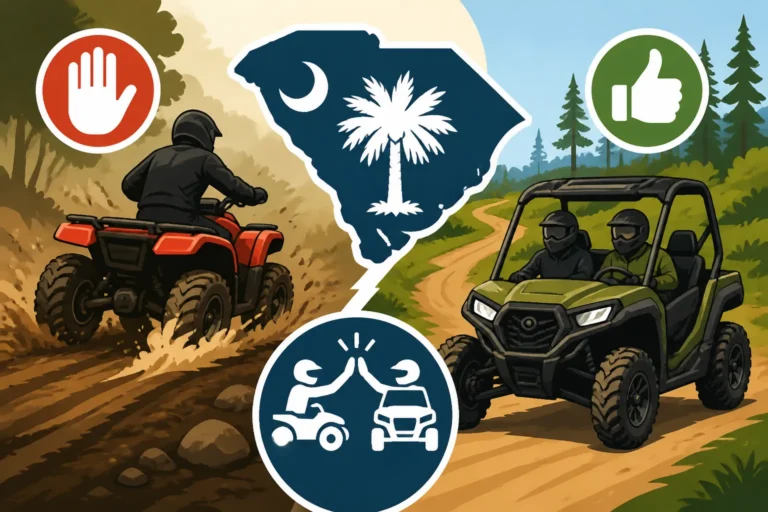
Use the distinction between vehicle categories as a planning tool, not a guess. [South Carolina Trails That Allow Side-by-Sides] and [South Carolina Trails That Ban Full-Size Vehicles] are useful reminders that access can vary substantially between riding areas and trails. Confirm the rules for Gulches directly before loading up.
| Planning question | Why it matters | What to confirm |
|---|---|---|
| Is my vehicle class allowed? | A route may be limited by vehicle type | Ask specifically about ATV, UTV, or Jeep access |
| Does my machine fit? | Width and turning space can affect safe passage | Check any size or equipment restrictions |
| Is the route within my ability? | Trail difficulty can change with conditions | Ask about obstacles, steep sections, and alternatives |
| Can I turn around safely? | Some difficult sections leave limited room | Learn where bypasses or exit points are available |
| What are the park’s current rules? | Private parks set their own policies | Review admission, riding, and safety requirements |
Match trail difficulty to your group, not your confidence
A route that looks manageable in a video or on a map can feel very different when you are approaching a steep, rocky, muddy, or tightly confined section. Riders may also have different comfort levels within the same group. A confident driver can still be responsible for passengers who feel uneasy or for a machine that is not suited to the obstacle.
Ask the park staff what the trail is like under the conditions you expect to encounter. Be specific: ask whether there are bypasses, how difficult the most demanding sections are, and whether the route is appropriate for your experience level. A general answer such as “it’s a fun trail” is not as useful as a clear description of the terrain and the vehicle types that commonly ride it.
It is also worth agreeing on a group plan before the first obstacle. Decide who will lead, who will follow, and how you will communicate if someone wants to stop or turn back. A sensible plan makes it easier to enjoy the challenge without letting peer pressure push someone into a section they are not prepared to ride.
Plan Navigation and Prepare for Conditions
Use maps as backup, not as permission
Mapping tools can help you understand the area and keep track of your position, especially when a group is spread out or a trail junction is easy to miss. An app such as onX Offroad can be useful for reviewing route information and preparing maps before you arrive. Downloading the information you need ahead of time is particularly helpful if your phone signal is unreliable.
Still, a digital map is not the same as permission to ride a route. It may not show a recent closure, a park-only restriction, a temporary reroute, or a staff instruction. Treat the park’s map and current directions as the authority for where your vehicle may travel. If an app’s route line differs from posted signs or staff guidance, stop and get clarification rather than following the screen.
A practical approach is to use more than one navigation reference. Save the park information, review the Badge of Honor listing, and use onX Offroad or another mapping tool as a supporting aid. Keep your phone secured and charged, and tell your group what you will do if devices lose signal or a rider becomes separated.
Weather can change the ride you thought you planned
Trail conditions affect traction, visibility, and how difficult an obstacle feels. Rain can soften soil, expose slick surfaces, and leave water or mud in places that looked harmless on a dry day. Dry conditions can bring dust that makes it harder to see the vehicle ahead, particularly when several machines are moving together.
Ask about recent weather and the condition of the route before you unload. A trail that was manageable during a previous visit may be more demanding after heavy rain or maintenance work. The park may also close or redirect routes to protect the terrain or manage safety, so check [South Carolina Trail Conditions Before You Haul] rather than assuming a trail is open because it was available last time.
Plan for a change of pace. Give the rider ahead enough space to avoid dust and allow room to stop safely. If the surface is slick, avoid rushing into an obstacle simply because the group behind you is waiting. Turning around or choosing a different route is a reasonable decision when conditions are not right for your vehicle or group.
Pack for a full day outside
Bring the essentials you are likely to need if the ride takes longer than expected: water, suitable clothing, basic first-aid supplies, and a way to contact your group. Secure loose gear so it cannot shift during rough sections. Passengers should know where to sit, how to use the machine’s safety equipment, and what to do if the vehicle stops unexpectedly.
Inspect the machine before the trip. Check the tires, brakes, steering, controls, and any safety equipment required for your vehicle and the park. If you are bringing a side-by-side, make sure everyone understands how to use the restraints and how to stay inside the protected seating area. For an ATV, check that the rider’s gear fits properly and that nothing loose can catch on the machine.
A pre-ride check is less exciting than the trail, but it can prevent a small issue from becoming a long recovery. If something does not feel right while you are testing the machine, deal with it before entering a difficult section. The same goes for any unfamiliar modification: confirm that it is secure and does not interfere with steering, braking, or visibility.
Make the Visit Go Smoothly
Confirm admission and park rules before you leave
Private riding areas may have their own admission procedures, vehicle requirements, age rules, safety expectations, and operating policies. Check the park’s official information before you travel, especially if you are visiting for the first time. Do not rely only on an old social media post or a map listing that may not reflect current procedures.
Ask whether you need to complete any paperwork, make arrangements in advance, or bring particular documents. Confirm the park’s expectations for riders and passengers, including any rules about protective equipment. If your group includes children, new riders, or people unfamiliar with off-road parks, ask which routes and activities are appropriate for them.
Admission details can change, so check the provider’s own information for current requirements and costs. The guide [South Carolina Private Park Passes and Rules] is a useful starting point for understanding the kinds of questions worth asking, but it is not a substitute for Gulches’ own instructions. Arriving prepared makes check-in easier and leaves more time for the reason you came.
Use a clear group routine on the trail
Before riding, agree on a simple communication plan. Decide where the group will regroup, how the lead rider will signal a stop, and what everyone should do if a machine has a problem. If your group has riders with different experience levels, keep the pace comfortable for the least experienced person rather than splitting up without a plan.
Give other riders space. Avoid crowding someone who is working through an obstacle, and do not park where you block a route or reduce visibility around a turn. When a route is narrow, wait for a safe place before passing. These habits reduce the pressure that can lead a rider to take an obstacle too quickly or continue when they should pause.
Respect the park’s posted signs and staff directions. Stay on approved routes, keep noise and speed under control, and leave the trail as you found it. [South Carolina Trail Etiquette Locals Expect] offers broader guidance that applies to shared riding areas, including the simple courtesy of making room for other groups and following local rules.
Earn the Badge and Know When to Turn Back
Check the badge instructions before the ride
The Badge of Honor program has its own steps for recognizing a route or earning a badge. Review the relevant listing and instructions before you arrive, rather than waiting until you have finished the ride. That gives you time to understand what the program asks you to do and whether phone service, location settings, or another requirement may matter.
Do not assume that simply entering the park automatically records your ride or qualifies you for a badge. The route may have a defined starting point, completion process, or other program-specific instructions. Those details can be updated, so check the program’s current information and follow the directions provided there.
If you use onX Offroad to navigate, keep its role separate from the badge process. It can help with orientation, but it should not be treated as proof that the Badge of Honor requirements have been met. Follow the program’s instructions for the badge itself and the park’s instructions for riding access.
Turn back when the route no longer feels right
A badge is not worth damaging a machine or putting someone at risk. If you reach an obstacle that exceeds your ability, your vehicle’s capability, or the group’s comfort level, pause and reassess. Look for a park-approved bypass or ask staff for advice. Do not improvise a shortcut across unmarked ground or pressure another rider into continuing.
Turn back if weather changes, visibility drops, a machine develops a problem, or a passenger is no longer comfortable. It can be frustrating to stop when you have planned the trip, driven to the park, and come close to the route’s most memorable section. But choosing a safer option is part of good off-road judgment, not a failed ride.
Afterward, take a moment to check your machine and group before heading home. Look for damage, loose gear, or signs that the vehicle needs attention. If the route was a good fit, note what worked and what you would change next time. If it was not the right match, use that information to choose a more suitable trail on your next visit. The best Badge of Honor day is one where the whole group gets home safely, whether or not every obstacle went to plan.
Disclaimer
This article is for general informational purposes only and does not constitute professional advice. Laws, prices and regulations vary by location and change over time. Consult a qualified professional for guidance on your specific situation.