Trailering to an Upstate Trailhead
A ride in the Sumter National Forest can get off to a frustrating start when the trailhead parking lot is full, your trailer cannot turn around, or the route you planned leads to a closed gate. A little planning before you leave home helps you choose a suitable Upstate trail, haul your ATV or UTV safely, and arrive ready to ride.
Plan the trailhead before you load
Choose a riding area that fits your machine and trailer
Start with the riding area, not just the destination name. Enoree OHV Trail near Whitmire and Parsons Mountain OHV Trail near Abbeville are two Upstate options, but their routes, access points, and trail rules aren’t interchangeable. A trail that suits a narrow ATV may not be open to a wider side-by-side, and the nearest parking area may not have room for a long truck-and-trailer combination.
Check the current riding-area information before setting out. Confirm that the trail is open, that your machine is allowed, and that the designated access point is the one you intend to use. If you’re comparing public-forest routes, South Carolina’s Four National Forest Trails can help you understand the broader set of options. For a closer look at individual destinations, start with Enoree OHV Trail in South Carolina or Parsons Mountain OHV Trail in South Carolina.
It’s also worth checking the South Carolina Trails That Allow Side-by-Sides before hauling a UTV. Trail width, vehicle type, and access rules can determine whether a route works for your machine. Don’t rely on an old social media post or a map pin alone: a location may show where a trail begins without confirming current access, permitted vehicles, or parking arrangements.
Check access, weather, and parking
The most useful pre-trip question is not just “Is the trail open?” Ask whether you can get your whole rig in and out. Look for information about trailer parking, turning space, road surface, gates, and any restrictions that could affect a truck pulling a trailer. If the information is unclear, contact the managing office before leaving rather than discovering the problem after driving deep into a forest road.
Weather matters, too. Heavy rain can make unpaved access roads slick, muddy, or difficult to navigate with a loaded trailer. A forecast that looks manageable in town may not reflect conditions on a forest road. Review South Carolina Trail Closures After Rain and check trail conditions close to departure. If a route is closed or the access road seems unsuitable, changing destinations is usually better than trying to squeeze a trailer past a barrier or turning around on a narrow road.
Use a map app such as onX Offroad to review the general route and save useful map information before you lose cell service. Treat any digital map as a planning aid, not a guarantee that a road is open or that a trailhead is trailer-friendly. Pair it with current information from the land manager and, where available, South Carolina ATV Trail Map Downloads.
Prepare the truck, trailer, and paperwork
Match the trailer to the machine
A trailer should have enough usable deck space and an appropriate load rating for your ATV or UTV, accessories, and any gear you’re carrying. Think about the complete load, not only the machine’s advertised weight. A winch, spare tire, fuel container, tool box, and riding gear all add weight. If you’re hauling more than one machine, account for how the combined load is positioned and distributed.
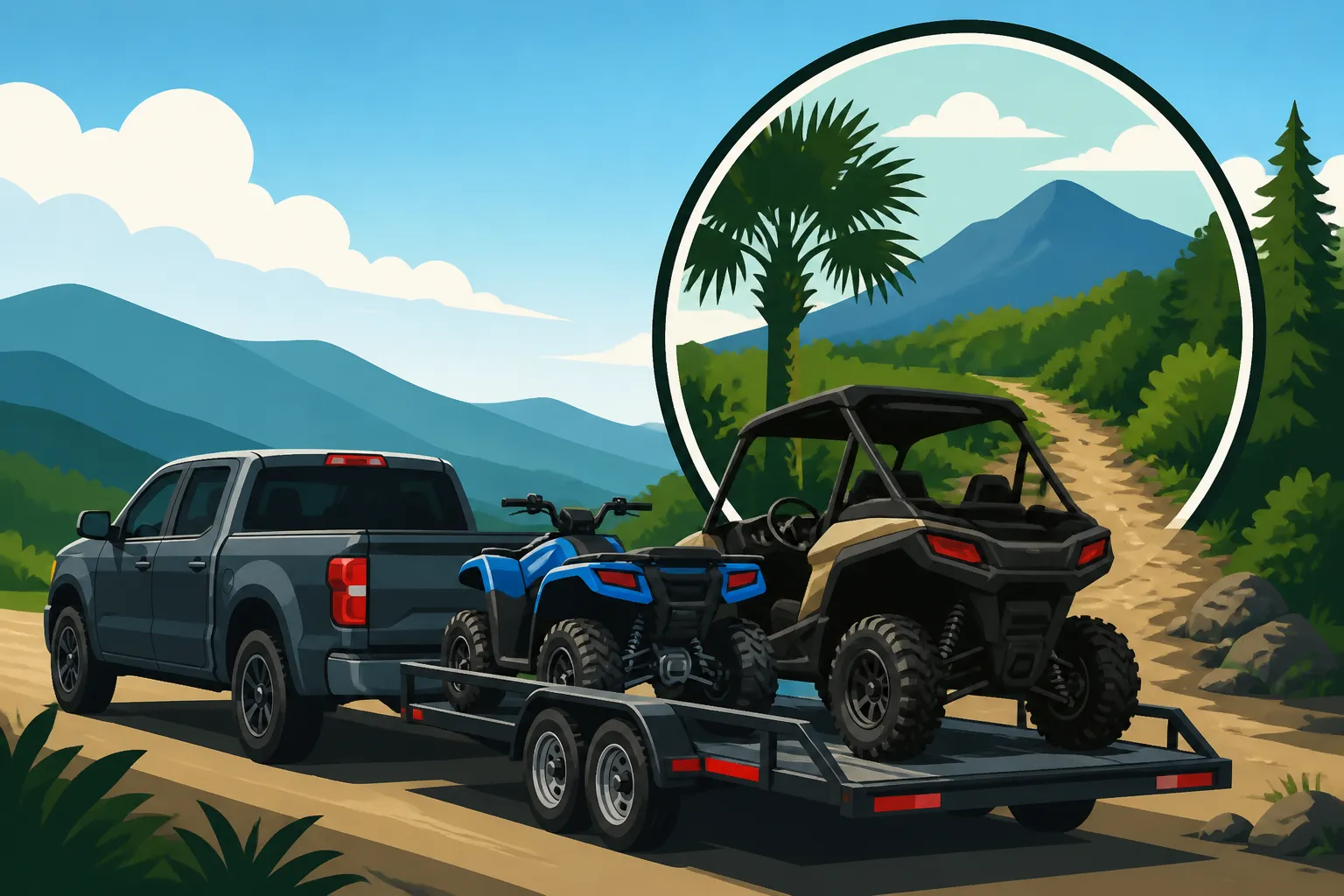
Before a trip, inspect the trailer tires for visible damage and check their pressure according to the trailer or tire manufacturer’s guidance. Test the lights, inspect the coupler and hitch connection, and make sure the safety chains and breakaway equipment are present and functioning where required. Look over the ramps, hinges, deck, and tie-down points for looseness, cracks, or other wear. A small problem found at home is much easier to deal with than one discovered beside a busy road.
Your truck and trailer should be a sensible match for the combined load. Check the ratings on the hitch, truck, and trailer rather than relying on how the rig feels on a short neighborhood drive. If you have questions about trailer registration, equipment, or towing requirements, check the applicable South Carolina rules before travelling. Requirements can depend on the trailer and how it is being used.
Pack for the route, not just the ride
Make a short departure checklist and keep it with your riding gear. Include the items you need to ride, the items that make the towing setup safe, and the documents or passes needed for your destination. Riders heading to public forest trails can review South Carolina National Forest OHV Passes in advance so they know what applies to their outing. Confirm the current pass and display instructions rather than assuming that a pass from an earlier trip is still valid for the same rider or vehicle.
Useful items to have on hand include:
- A spare trailer tire and the tools needed to change it
- A jack that can safely lift the trailer
- Tie-down straps in good condition, plus an extra strap
- Wheel chocks for loading and unloading
- A flashlight or headlamp
- Basic hand tools and a tire-pressure gauge
- Drinking water, first-aid supplies, and weather-appropriate clothing
- A paper map or offline map access
- A phone charger and a way to contact someone if plans change
In forested areas, cell coverage can be unreliable. Save the route and any relevant map layers before leaving service, and consider bringing a paper backup. Cell Dead Zones in a Carolina Forest explains why a phone that works during the drive can become less dependable at the trailhead. Carrying a Paper Map in a Carolina Forest is a useful reminder that a simple backup can prevent a navigation headache when your screen has no signal or power.
Load and secure your ATV or UTV safely
Position the machine with control
Park the truck and trailer on stable, level ground before loading whenever possible. Set the parking brake, secure the trailer, and use wheel chocks if appropriate. Make sure the ramps are firmly attached and aligned. Keep bystanders, children, and pets out of the loading area, and avoid rushing because someone is waiting behind you.
Use a spotter if visibility is limited, especially when loading a long or wide UTV. Agree on simple hand signals before moving. If the machine is powered up the ramps, use a slow, steady pace and avoid sudden throttle changes. If the ramp angle, ground surface, or machine position feels unsafe, stop and reset rather than trying to muscle through it.
Once on the deck, place the machine so the load is balanced and within the trailer’s limits. The goal is a stable combination that does not overload the truck, trailer, or hitch. If you’re carrying multiple machines, plan their positions before driving up the ramps. A load that looks tidy can still be poorly balanced, so follow the trailer manufacturer’s guidance and pay attention to the actual weight distribution.
Tie down, recheck, and inspect along the way
Use suitable tie-down points on the machine and trailer. Straps should be in good condition, secured against slipping, and arranged so the machine cannot roll, shift, or bounce free during travel. Avoid attaching straps to parts that could bend or break. If the manufacturer provides tie-down guidance, use it. Secure loose gear separately so it cannot slide into the machine or onto the road.
After tightening everything, walk around the rig. Check that ramps are stored and secured, straps are not rubbing on sharp edges, the trailer plug is connected, and the lights work. Check the hitch and safety chains again. After travelling a short distance, pull over somewhere safe and recheck the machine and straps. A strap can settle or loosen as the load shifts over bumps, so an early check is worthwhile.
Keep the machine’s keys, fuel, and loose equipment managed carefully. If carrying fuel, follow the container instructions and applicable transport rules; don’t leave a fuel container loose where it can tip or strike the machine. Before the trip, take a few clear photos of the loaded machine and tie-down setup. That gives you a quick reference if you need to check how things were arranged after a stop.
Arrive, unload, and leave the trailhead ready for the return
Make room for other riders and choose a safe unloading spot
When you reach the access area, take a moment to look before pulling into a parking space. A trailhead can be busier than expected, and a truck with a trailer needs more room to turn and back up than a passenger vehicle. Follow posted signs and use marked parking areas. Don’t block gates, roadways, access lanes, or space other riders need to unload.
If parking is crowded, don’t assume you can leave the trailer along a forest road or in an unmarked pullout. Find out where parking is allowed and whether there is room for your rig. The advice in South Carolina Trailheads With Trailer Parking is especially useful when you’re comparing destinations or planning a group ride. For a larger group, agree on a meeting and parking plan before everyone arrives; several trailers can fill a small staging area quickly.
Unload only when the truck and trailer are stable and the ramps are secured. Keep other people clear of the ramp path, and have a spotter help if the area is tight. Before starting the ride, check that your machine is ready and that you have the required pass or other paperwork for the area. Keep any trash and loose gear contained so it won’t blow away or get left behind.
Plan for navigation, trail etiquette, and the trip home
Save your route before riding, and tell someone your general plan if you’re heading out of cell range. onX Offroad can be handy for reviewing mapped routes and keeping offline navigation available, but it should be one part of your plan rather than your only source of trail information. Follow posted signs and use the trail information provided by the land manager. If the route looks different from what you expected, stop and reassess instead of pushing on in the wrong direction.
Be considerate around the staging area and on the trail. Keep noise and speed controlled near parked vehicles and other riders, yield appropriately on narrow sections, and avoid blocking trail entrances while regrouping. South Carolina Trail Etiquette Locals Expect offers useful reminders for sharing busy riding areas. If you’re riding with friends, choose a regrouping point that won’t interfere with traffic or access.
Before loading for home, give the machine a quick look for loose parts, damage, or debris caught around the wheels or underbody. Remove mud and gear that could shift during transport, then secure the machine using the same careful routine you used at home. Recheck the trailer lights, hitch, and straps before pulling away. If the access road or trail conditions have changed during the day, adjust your departure route rather than assuming the return will be identical to the drive in.
A little preparation can turn trailering from the most stressful part of the outing into a routine. Confirm access and parking, match the trailer to the load, secure the machine carefully, and keep a navigation backup. That way, whether your destination is near Whitmire, Abbeville, or another Upstate riding area, you can spend less time solving avoidable problems and more time enjoying the ride.
Disclaimer
This article is for general informational purposes only and does not constitute professional advice. Laws, prices and regulations vary by location and change over time. Consult a qualified professional for guidance on your specific situation.