Meeting a Logging Crew on a Timber Road
Coming upon a logging crew on a narrow timber road can turn a relaxed South Carolina ride into a stressful squeeze between trucks, dust, and heavy equipment. The safest response is to slow down, stop well clear, and follow the crew’s directions rather than trying to slip past. This guide explains how to prepare, where to wait, and how to leave the road safely.
Before You Ride a South Carolina Timber Road
Confirm that you are allowed to be there
A timber road may look like an open trail, but it can cross private land, active work areas, or property where recreational riding is not allowed. A route shown on a map does not automatically mean you have permission to ride it. Before unloading, check who manages the land and whether motorized access is currently permitted. If you are relying on a landowner’s permission, confirm that it covers the specific road and riding date.
This matters in areas with extensive timberland, including parts of the Lowcountry and the Sumter National Forest region. A road may be open to an authorized crew but closed to recreation, or it may be temporarily restricted because of logging, weather, fire risk, or road damage. Read posted signs and respect gates, barriers, and temporary closures. For more on access, see South Carolina Timber Land Access and Getting Written Permission From a Timber Landowner.
A mapping app such as onX Offroad can help you plan a route and orient yourself when roads branch or become hard to distinguish. Treat the map as a planning aid, not proof of public access. Before you ride, verify permission with the land manager and look for current notices at the entrance. Save the land manager’s contact details, and let someone at home know where you expect to ride.
Plan for changing conditions
Timber roads can change quickly. A route that was passable during a dry weekend may be rutted, muddy, or partly blocked after rain or a workday. Logging trucks may leave loose debris or deep tire tracks, while dust can make it difficult to see traffic coming from the other direction. If a route is unfamiliar, plan a turnaround point before the road narrows or disappears into a work area.
Tell your group that the plan is to stop and wait if you meet equipment. Agree on a simple regrouping spot away from the roadway, such as a wide, firm pull-off that does not block a gate or access lane. Keep your phone charged, but do not count on reliable service in wooded areas. onX Offroad can help you keep track of your position, but a downloaded map or paper backup is useful if reception drops.
Also check your machine before you leave. Make sure the brakes work properly, the headlights function, and mirrors or other visibility aids are secure if your machine has them. Carry water and basic emergency supplies, especially if your route is remote. Planning for a delay is sensible: a logging crew may need the road for longer than a quick pause.
What to Do When You Meet a Logging Crew
Slow down, stop, and make yourself visible
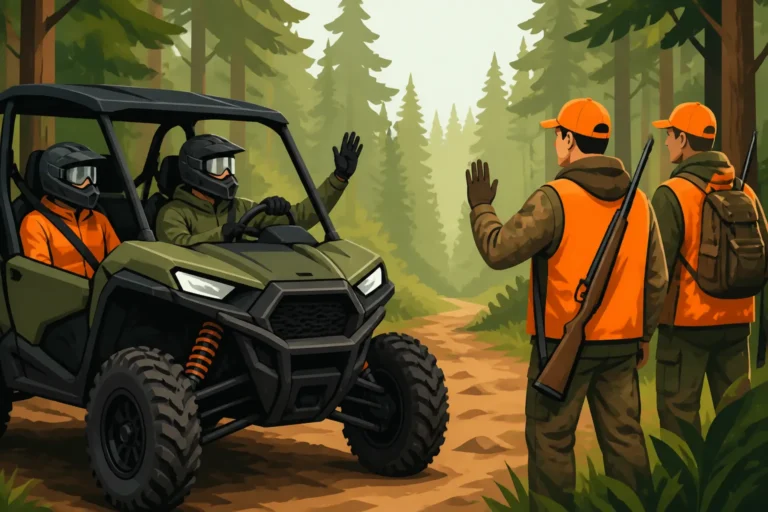
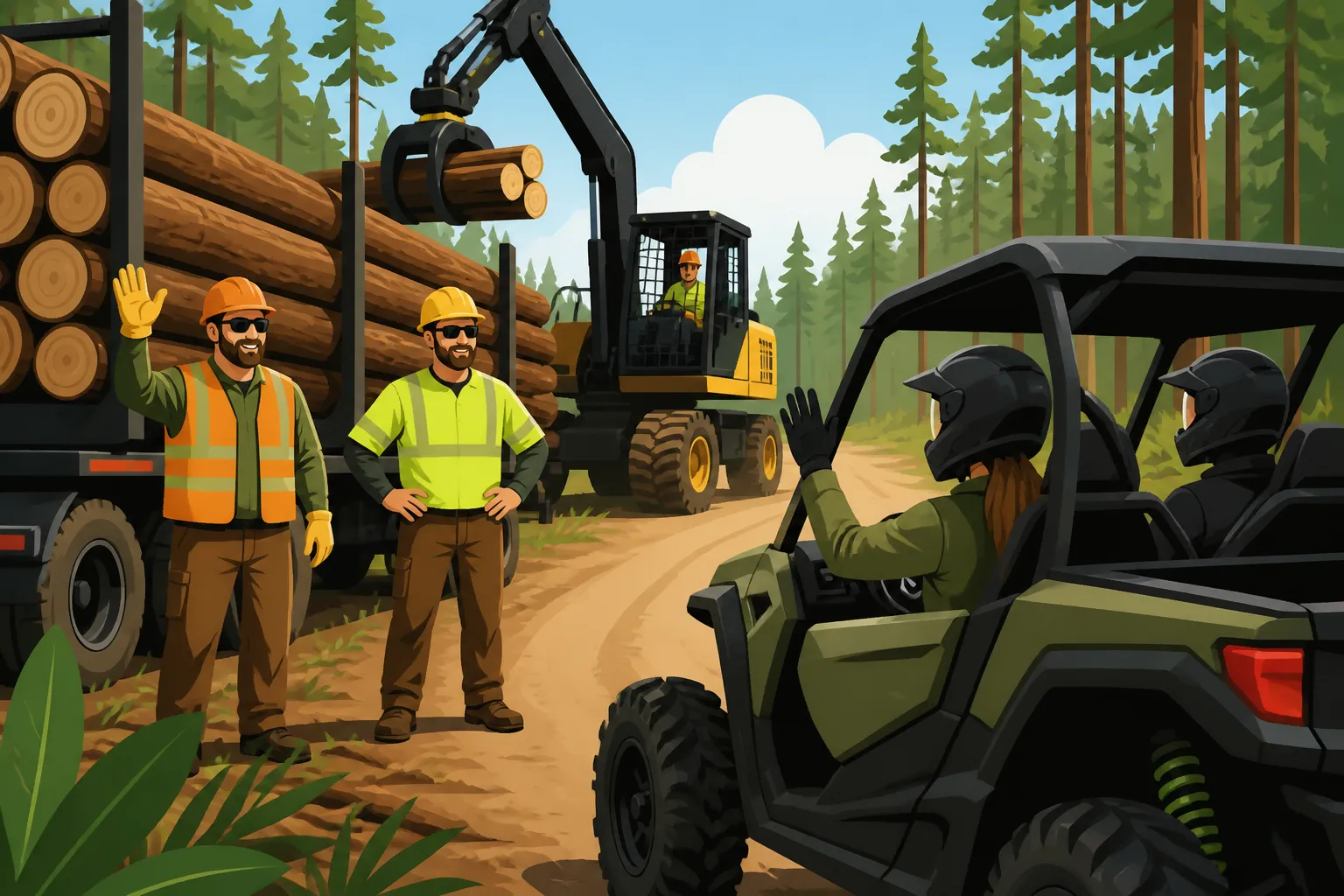
When you hear an engine, see dust rising, or spot a truck or piece of equipment, ease off the throttle and reduce speed well before you reach it. Do not assume the operator has seen you. A loader, skidder, or loaded truck can have large blind spots, and the noise of machinery may make a small ATV difficult to hear.
Stop on firm ground where the machine is easy to see, but stay out of the travelled path. Avoid stopping at the crest of a hill, around a blind bend, or in a place where a truck needs room to swing. If there is no safe pull-off, back away slowly to a wider section rather than forcing a pass. Switch on your lights if visibility is limited, and keep the group together without crowding the road.
| Situation | Safer response | Avoid |
|---|---|---|
| A truck approaches on a narrow road | Stop well clear and wait for the driver’s direction | Trying to squeeze past |
| Equipment is working near the road | Stay outside the work area and make yourself visible | Riding behind or beside moving machinery |
| Dust blocks your view | Stop until visibility improves | Following closely into the dust |
| The crew signals you to wait | Remain stopped in a safe location | Assuming the delay is over because the equipment pauses |
| A road is blocked or signed closed | Turn around and use an authorized route | Going around a barrier or through the work site |
If you are riding in a group, make sure the last rider knows you have stopped. A lead rider should not move on until the entire group is accounted for and the road ahead is confirmed clear. These habits also help on ordinary narrow trails; Yielding on a Narrow Carolina Trail covers the same basic courtesy in a trail setting.
Follow the crew’s directions without entering the work zone
If a worker approaches, speak calmly and ask whether you should wait, turn around, or take another permitted route. Do not assume that a hand signal means “go ahead” unless it is clear and directed at you. If you are unsure, stay stopped and ask again from a safe distance. The crew has a better view of truck movements and equipment operations than you do.
Never ride beneath a raised load, behind a reversing truck, or between a vehicle and the edge of the road. Keep clear of cables, chains, logs, and equipment that may swing or shift. Avoid walking into the work area to take photos or ask questions while machinery is moving. If the operator cannot see you, a quick approach on foot can create a new hazard.
Be patient if the crew needs time to finish a maneuver. A loaded log truck may need a wide turning arc, and a machine working at the roadside may have to reposition before traffic can pass safely. If the delay is significant, ask for guidance about turning around, but do not make your own route through brush, a gate, or a neighboring property. For more on sharing these roads, see Sharing a Dirt Road With Loaded Log Trucks.
Passing Safely and Handling Dust
Pass only when the route is clearly open
Do not pass a truck or piece of equipment simply because it appears to be moving slowly. Wait until the operator has stopped, signaled you through, or the road is clearly open and you can pass without entering an active work area. If a truck is moving, keep well back. Its tires can throw gravel, its load can shift, and its driver may not see a rider close behind.
When you are given permission to proceed, move slowly and predictably. Keep enough distance to avoid the truck’s wheels and any load overhanging the road. Do not stop beside equipment to talk, and do not dart around a vehicle as soon as it leaves a small opening. If the crew is guiding traffic, follow its directions exactly and wait for the signal intended for your group.
If a safe pass is not possible, turn around only where there is room and permission to do so. A narrow shoulder may be soft or unstable, and backing a group of machines into an active road can be awkward. Designate one rider to guide the turn while everyone else stays clear. The general advice in South Carolina Trail Etiquette Locals Expect applies here: be predictable, give others room, and do not treat a working road as a recreational obstacle.
Give dust time to settle
On dry days, a truck can create a thick cloud of dust that hides potholes, branches, other vehicles, and the road edge. Do not follow closely just because you know the route. Stop at a safe distance and wait until you can see clearly. If you are riding with others, leave enough space that one rider’s dust does not blind the next.
Dust can also make you less visible to people working nearby. Turn on your lights, keep your machine in a predictable position, and avoid moving toward the edge where workers may be clearing brush or handling logs. A bandanna or dust mask may make a dusty ride more comfortable, but it does not make it safe to ride without visibility. If you cannot see the road or the crew, stop.
A route-planning tool such as onX Offroad may help you identify a route back toward a known junction, but avoid checking a screen while moving. Pull over safely first, and do not treat an alternate track shown on a map as an approved detour. Riding Through Dust on a Dirt Road offers additional practical advice for dusty conditions.
When to Turn Around or Report a Problem
Leave if the road is closed or the crew says access is unsafe
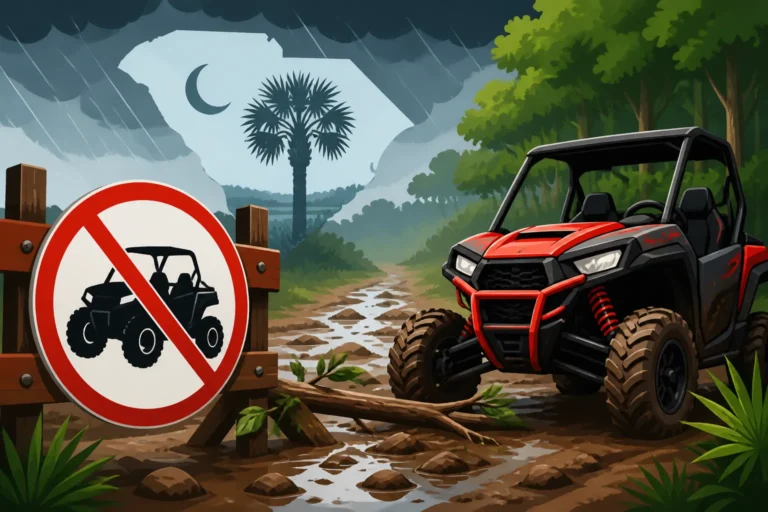
A closed road is not an invitation to find another way around. If there is a sign, barrier, gate, or worker directing riders away, turn back. Do not ride around a gate through the woods, cross a fresh logging area, or use a road that appears to lead through private property without permission. Those choices can put you near moving equipment, damage the land, or create problems with the landowner.
If you are unsure whether the road is open, ask the land manager before entering rather than asking a worker to decide whether you may ride there. A worker may be focused on operations and may not be responsible for granting recreational access. For related guidance on barriers and restricted routes, see Locked Gates on a Private Timber Road.
Use a backup route only if you have already confirmed it is permitted and passable. onX Offroad can be helpful for keeping a planned route visible, but cross-check any alternative with the relevant land manager. If no safe, authorized route is available, turn around and end the ride in that area. Losing part of a day is frustrating; entering a closed work zone can create a far more serious problem.
Keep the encounter calm and report immediate hazards
Most encounters are straightforward: stop, wait, and follow directions. If there is a disagreement about access, avoid arguing beside moving equipment. Leave the work area calmly and contact the property manager or landowner later. Keep notes about the location and the road entrance if you need to clarify access afterward, but do not photograph workers or equipment from an unsafe position.
If you see an immediate hazard, such as a blocked public route or a serious road obstruction, report it to the appropriate land manager or agency. Be specific about the location and what you observed. Do not approach machinery to investigate or attempt to move logs, cones, or barriers yourself.
A little courtesy goes a long way. A logging crew is working in a place where trucks and equipment need space, while riders are responsible for keeping themselves out of the work zone. If you stop early, make yourself visible, and wait for clear direction, you can avoid turning a routine meeting into a dangerous one. For broader access questions, South Carolina Trail Closures After Rain is also worth reviewing before heading out.
Disclaimer
This article is for general informational purposes only and does not constitute professional advice. Laws, prices and regulations vary by location and change over time. Consult a qualified professional for guidance on your specific situation.