No Jeeps or Full-Size Rigs
South Carolina riders can spend hours towing toward a trailhead only to find a gate too narrow for their machine—or discover that a route is for motorcycles and ATVs, not Jeeps. This guide explains what “no Jeeps or full-size rigs” usually means, how to check whether your ATV or UTV fits the rules, and what to verify before you haul.
What “No Jeeps or Full-Size Rigs” Means on a South Carolina Trail
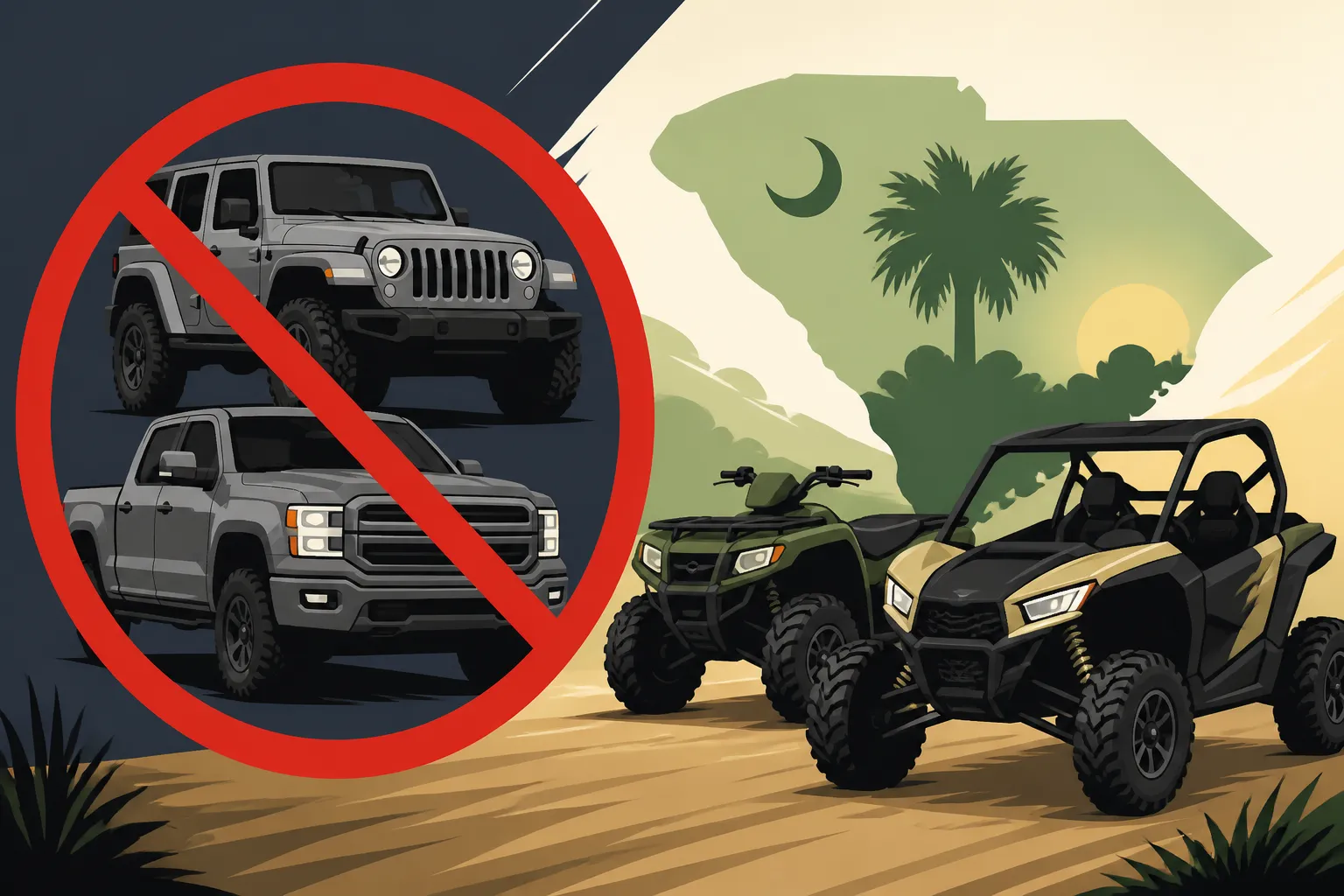
A sign banning Jeeps or full-size rigs is usually separating narrow off-highway vehicle trails from routes intended for larger vehicles. It does not automatically mean every ATV or side-by-side is allowed. Trail access can depend on vehicle type, width, season, current closures, and the rules for that specific property.
The distinction matters in South Carolina, where riding opportunities include public-forest routes, purpose-built trails, and private riding parks. A vehicle that fits physically may still be prohibited by the trail’s designation. Likewise, a trail open to ATVs may have a width restriction that rules out some UTVs.
Why a trail excludes Jeeps and larger vehicles
Narrow trails are built and maintained for smaller machines. A Jeep or full-size four-wheel-drive vehicle may be too wide to pass between trail markers, fit through a gate, or turn safely without damaging the edges. Larger tires and heavier vehicles can also rut soft ground, widen a route, and make erosion worse—especially after rain.
That is why “no Jeeps” should not be read as a casual suggestion. It may reflect the trail’s design, land manager rules, or a combination of the two. Even if a Jeep appears to fit at the entrance, taking it down a route marked for smaller machines could damage the trail or create a safety problem when another rider approaches.
The restriction also does not define every permitted vehicle. A route that excludes Jeeps might allow ATVs but prohibit side-by-sides. Another might allow certain UTVs while turning away full-size rigs. Check the specific vehicle categories and width limits posted for the trail rather than relying on the sign’s shorthand.
Why “small vehicle” does not always mean “your UTV is allowed”
An ATV may fit a narrow route that a side-by-side cannot. A compact UTV may fit where a wide model does not. But width is only one factor: a posted rule may distinguish between motorcycles, ATVs, and UTVs even when their dimensions are similar.
Accessories can change the fit. Aftermarket wheels, offset rims, wider tires, fender flares, mirrors, and other additions can make a machine wider than its original specifications. Measure the vehicle at its widest point as it will be ridden, including the accessories that extend beyond the body.
South Carolina riders will also encounter routes with specific width limits. Read [South Carolina's 50-Inch Trail Width Limit] alongside the individual trail’s rules. A machine that meets one width standard is not necessarily allowed on every trail with a narrow gate, and a gate’s physical width is not a substitute for posted regulations.
Trail type, machine type, and land manager rules
The phrase “trail” can describe very different places. A marked OHV trail in a national forest, a forest road, a private ORV park, and a route across private land may all have different access rules. A route open to trucks is not necessarily an OHV trail, and a narrow trail that excludes Jeeps may still be limited to one specific kind of smaller vehicle.
South Carolina’s public riding options include places associated with the Sumter National Forest and Francis Marion National Forest. Rules are not interchangeable across those areas, or even across routes within the same forest. [South Carolina's Four National Forest Trails] is a useful starting point for understanding the broader trail landscape, but the managing agency’s posted information should guide your decision about a particular route.
Private parks set their own vehicle, equipment, and conduct requirements. Do not assume that a public trail’s width rule applies at a private park—or that a park that welcomes Jeeps will allow them on every marked route. Look for the park’s rules for the specific area you plan to ride.
How to Check Whether Your ATV or UTV Is Allowed
The most reliable approach is to verify the trail from more than one angle: identify the exact route, check the managing organization’s rules and alerts, then compare those rules with your machine. This takes a few minutes at home and can prevent a long, frustrating drive to a gate that your vehicle cannot pass.
Identify the trail and its managing organization
Start with the trail’s official name and location. “The trail near the forest” is not specific enough: nearby roads, trail systems, and access points may have different designations. Record the trailhead or staging area, the route name, and the land manager or park operator.
Then look for rules that answer these questions:
- Are ATVs allowed?
- Are side-by-sides allowed?
- Is the route limited by vehicle width?
- Are motorcycles or dirt bikes the only permitted machines?
- Are there seasonal restrictions, temporary closures, or designated riding seasons?
- Does the trail require a pass, permit, or other access requirement?
A mapping app can help you locate a route, but it should not be treated as permission to ride it. onX Offroad can be useful for viewing mapped routes and planning where to go, especially when you are comparing trailheads or trying to understand how a route connects to nearby roads. Still, confirm access and restrictions with the official land manager or park before loading the trailer.
For more route-planning background, see [South Carolina ATV Trail Map Downloads]. A map helps you plan; it does not override a closure notice or a sign at the trail entrance.
Compare the rules with your machine’s actual dimensions
Check the manufacturer’s stated width, then measure the machine in its current setup. Measure from the outside edge of the widest part, not just the body panels. Include tires, wheels, fender extensions, and any other parts that stick out. If the trail publishes a maximum width, compare your measurement with that requirement rather than estimating by eye.
A machine listed as narrow in a sales description may not remain narrow after modifications. For example, a rider might add wider tires for mud and later plan a trip to a forest trail. The machine may still look compact, but the extra width could make it ineligible for a route with a strict limit. A measuring tape is more useful than a guess at the staging area.
Keep a note of your machine’s measurement and model details on your phone. If the posted rules are unclear, those details make it easier to ask the park or land manager a precise question: “Is this model, measuring this wide at the tires, permitted on this trail?” That is more helpful than asking whether “UTVs” are allowed in general.
Use maps as a planning aid, not a final ruling
onX Offroad can help you see where mapped trails run and plan a route around a staging area. That is particularly useful when you are unfamiliar with a forest road network or trying to avoid accidentally routing your group onto a road that is not open to your machine. Save the trail area before leaving home if you expect weak cell service.
But map layers can’t replace current access notices. Conditions and access may change, and the map may not show every gate restriction, machine-width rule, or temporary closure. Before you depart, check the managing agency or park’s latest information. Then read the signs at the entrance when you arrive.
If a route on onX Offroad looks promising but the official information does not clearly identify permitted machine types, contact the land manager or park rather than assuming the map settles the question. This is especially important for a wide side-by-side, a modified ATV, or a mixed group with several machine types.
| What to check | Why it matters | Best next step |
|---|---|---|
| Permitted vehicle classes | A trail may allow ATVs but not UTVs, or may be limited to motorcycles | Find the rules for the exact route |
| Maximum width | A UTV may be physically too wide even if its type is allowed | Measure the machine at its widest point |
| Gate and trail signs | Posted restrictions may identify limits not obvious on a map | Read signs before unloading |
| Current closures | Weather, maintenance, or land conditions can temporarily affect access | Check the land manager’s latest notices |
| Pass or permit rules | Access requirements vary by location | Confirm what is required before traveling |
| Route shown in a map app | A mapped line does not guarantee legal access | Use it for planning, then verify officially |
What to Do Before You Haul to a Trailhead
A simple pre-trip routine can catch most problems before they become a wasted day. It is especially worthwhile if you are traveling from another part of the state, meeting a group, or bringing a machine you have not ridden at that location before.
Confirm access and current conditions
Check the official trail or park information shortly before your trip. Look for vehicle restrictions, seasonal access details, weather-related closures, maintenance notices, and any pass requirements. If the information is unclear, call or message the managing organization and ask about your exact vehicle type and width.
Do not rely on an old social media post or a friend’s memory as the final word. A rider may have visited under different conditions, taken a different route, or ridden a machine that was narrower than yours. [South Carolina Trail Conditions Before You Haul] offers a useful reminder of why checking conditions is part of the trip, not an optional extra.
If your plan depends on a specific route, have a backup option. A trail might be temporarily closed or unsuitable after heavy rain, while another nearby riding area may be open. Keep the backup within the rules for your machine; do not make the switch on the assumption that any open-looking road is legal for OHV use.
Prepare your group for different machine rules
Mixed groups often create confusion. One rider arrives with a narrow ATV, another brings a wide UTV, and a third expects to bring a Jeep. The fact that everyone is traveling together does not mean everyone can use the same trail. Check each machine separately and make sure the group knows which routes are available to all of them.
If the trail system has separate routes for different vehicle classes, agree on a meeting point and a plan before riding. Avoid splitting up without a clear way to communicate, especially in forest areas where cell coverage may be unreliable. A paper map or an offline map in onX Offroad can help the group understand the general layout, but follow posted signs and official route markings on the ground.
Make sure every rider understands what to do if a gate or restriction rules out one vehicle. Turn around rather than trying to squeeze through, bypass a barrier, or continue on a route that is not approved for that machine. A short change of plans is better than risking trail damage, a citation, or an injured rider.
Pack for narrow trails and changing conditions
A narrow trail leaves less room to maneuver around obstacles or other riders. Before unloading, check that the machine is in good working order and that the group has appropriate protective gear, water, and basic tools. In South Carolina’s heat and humidity, bring enough water for the ride and avoid treating a short-looking route as an easy one.
Think about trail etiquette, too. Slow down when visibility is limited, leave space for other riders, and do not widen the route by driving around mud or an obstacle. If the trail is too wet or damaged to ride responsibly, turn back. [South Carolina Trail Etiquette Locals Expect] covers the small choices that help keep shared riding areas usable.
A narrow trail is not the place to test an unfamiliar machine’s turning limits or try a new modification for the first time. If your setup is close to the posted width limit, confirm eligibility before the trip and consider whether the route is practical for your machine even if it technically fits.
Common Mistakes That Lead to Turnarounds
Most trailhead disappointments come from assuming that one piece of information answers every question. A width sign, a map line, or a photo of another rider’s machine may be useful, but none tells the whole story on its own.
Assuming “no Jeeps” means all UTVs are welcome
This is one of the most common misunderstandings. A trail may exclude full-size vehicles but still have a width cap that rules out a larger side-by-side. It may also limit access to ATVs or motorcycles. Read the exact rules, not just the short version on a sign or a trail listing.
Use [South Carolina Trails That Ban Full-Size Vehicles] to explore this distinction, then verify each specific route before you ride. Similarly, a trail described as welcoming side-by-sides does not necessarily accept every UTV model or width. Compare your machine to the actual requirements in [South Carolina Trails That Allow Side-by-Sides].
Treating a forest road and an OHV trail as the same thing
A road through a forest and a designated OHV trail can have different purposes and access rules. A route may look wide enough for a Jeep without being open to Jeeps, or it may be a road where OHVs are not allowed. Conversely, a narrow trail may be specifically designated for certain off-road vehicles.
Keep your route planning tied to the official designation. If you are choosing between an ATV route and a motorcycle-only trail, for example, check the rules for both rather than assuming they are interchangeable. [South Carolina Trails That Allow Dirt Bikes] can help explain why vehicle eligibility may differ from one trail system to another.
Assuming a mapped trail is open because it appears on an app
A route can remain visible on a map even when access has changed, a seasonal restriction applies, or the route is not meant for your vehicle. Use onX Offroad to orient yourself and organize your trip, then check the official source for current status and machine rules.
At the trailhead, follow posted signs even if they differ from what you expected. Do not ride around a locked gate or use an unmarked bypass because a map shows a line beyond it. When in doubt, stop and confirm with the land manager or park staff.
Measuring only the vehicle body
The width printed in a brochure may not reflect the vehicle after modifications. Wider tires, wheel spacers, or accessories can change the measurement. A vehicle that is close to a posted maximum deserves a careful measurement before the trip, not a quick estimate beside a gate.
If you are unsure whether your measurement method matches the land manager’s rule, ask how width is defined. The answer can prevent a frustrating argument at the entrance and help you decide whether to take a different machine.
“No Jeeps or full-size rigs” is a useful warning, but it is only the start of the check. Confirm the exact trail, permitted vehicle class, width limit, current status, and access requirements before you leave home. Your best ride is the one that fits the rules as well as the trail.
Disclaimer
This article is for general informational purposes only and does not constitute professional advice. Laws, prices and regulations vary by location and change over time. Consult a qualified professional for guidance on your specific situation.