Why a 50-Inch Gate Turns Machines Away
A 50-inch gate can stop a ride before it starts, especially when a wider side-by-side has already been hauled to a South Carolina trailhead. The limit is about more than squeezing through an opening: it signals which vehicles the route is designed and approved to accommodate. This guide explains how to interpret the restriction, check your machine, and avoid a frustrating trip.
What a 50-inch gate means on an ATV trail
The number is a vehicle-width limit
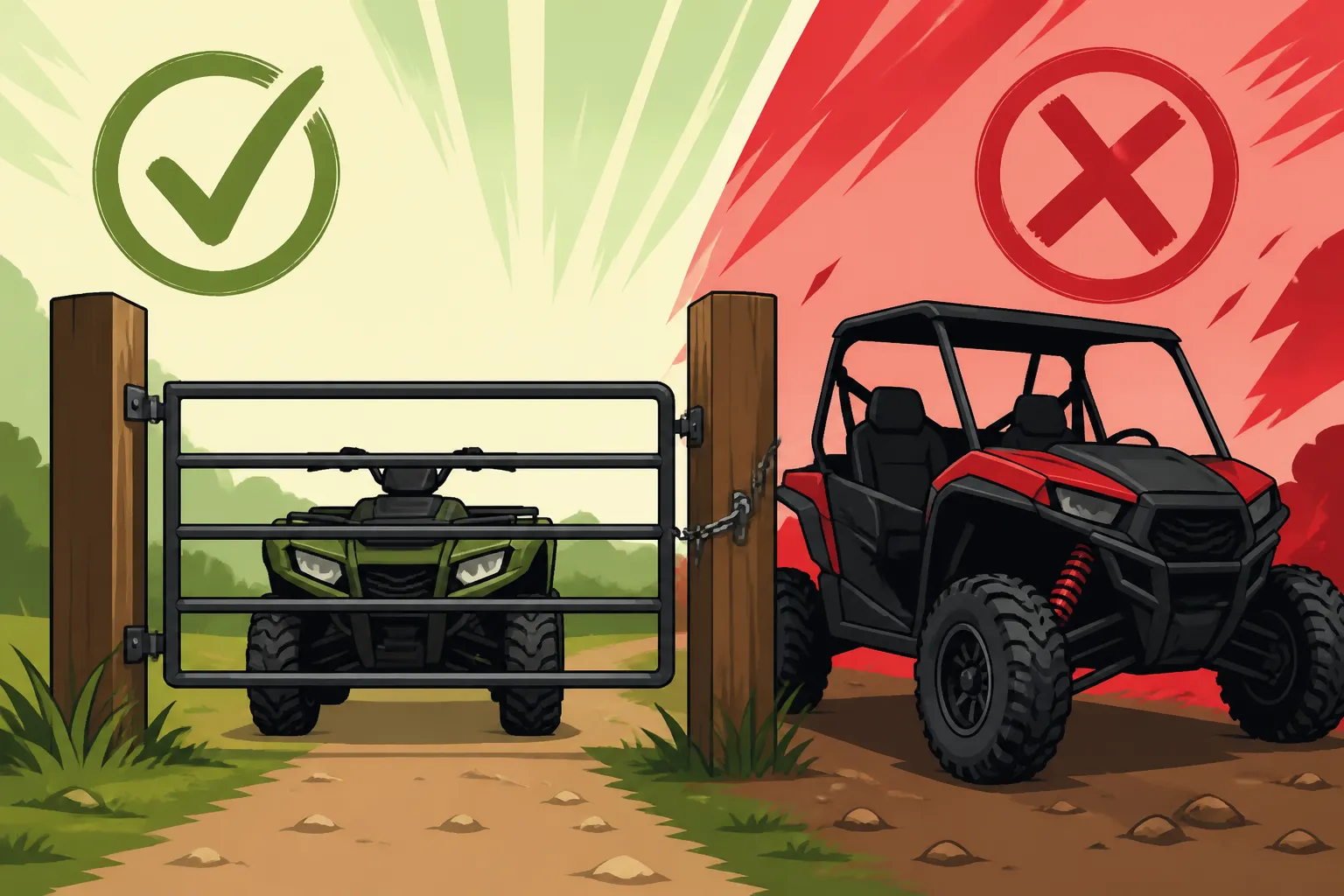
A 50-inch trail gate is a physical barrier with an opening roughly 50 inches wide. On a route marked for vehicles 50 inches wide or narrower, that opening also communicates the trail’s size restriction. It is not an invitation to force a wider machine through, remove parts temporarily, or assume that a vehicle that fits will be allowed.
The limit can catch side-by-side owners by surprise. Many full-size UTVs are wider than 50 inches, while narrower models may be designed to fit within that limit. ATVs are often narrower, but the machine’s actual width still matters. The name on the hood or the fact that it is an ATV does not automatically determine whether it qualifies.
A gate also protects the trail experience. Narrow routes can have tight turns, trees close to the trail, and limited room to pass or turn around. A wider vehicle may scrape vegetation, damage trail edges, or become stuck where a smaller machine can continue. The barrier helps keep vehicles suited to the route on it.
A gate is both a physical barrier and a warning
The opening itself is a practical test, but it is not the only rule to consider. A posted sign may identify which vehicle types are permitted, and the managing agency’s rules may set limits that apply even when a machine appears able to fit. A vehicle that squeezes through a gate is not necessarily authorized to ride the trail.
That distinction matters if your machine is close to the limit. Accessories such as oversized tires, aftermarket fenders, or other additions may affect the machine’s total width. Mirrors and removable accessories can complicate measurement, too. Don’t assume a manufacturer’s advertised width settles every question about the machine as it is currently equipped.
If a posted rule and the physical gate seem to conflict, treat the posted restriction as the rule to follow. Look for additional signs at the trail entrance, staging area, or junction. The page [South Carolina's 50-Inch Trail Width Limit] is a useful companion when you want to understand how this restriction fits into the state’s OHV trail landscape.
How to check whether your machine will fit
Measure the machine as you plan to ride it
Start with the manufacturer’s specifications, but do not stop there if your ATV or UTV has been modified. Measure the widest point of the machine in its riding configuration. That may be the tires, fenders, bodywork, or another fixed part, depending on the vehicle. If you are unsure where the widest point is, measure across the machine rather than relying on a model name or a guess.
Use a tape measure on level ground and have someone help hold it straight across the widest point. Record the measurement and compare it with the posted limit. If the machine is near 50 inches, leave yourself a margin rather than treating a borderline measurement as a guaranteed pass. A real gate may not be perfectly square, and a machine may need room to move through without striking the sides.
Do not count on removing mirrors, deflating tires, or changing your approach angle to make a too-wide vehicle fit. That can create a safety issue and does not override a trail rule. If there is doubt, contact the trail’s managing office before leaving home and ask about the exact route and vehicle configuration.
Check each trail, not just the general area
A trail system can include routes with different rules. A nearby road, staging area, or other loop may allow a wider vehicle, while a specific trail is limited to 50 inches or restricted to motorcycles. Knowing that a riding area is “open to OHVs” is not enough to confirm that every vehicle can use every route.
Before a trip, check the official information for the trail and look for posted restrictions on width, vehicle type, and seasonal access. A map app can help you plan where trails and staging areas are located, but it should not replace current agency directions or signs on site. For example, onX Offroad can help you review a route while planning, but check the managing agency’s rules before relying on a route for a particular machine.
The [South Carolina Trails That Ban Full-Size Vehicles] page can help you identify why some routes are not suitable for larger rigs. If you are comparing more than one riding area, [South Carolina Trails That Allow Side-by-Sides] is another useful starting point—but confirm whether the specific trail permits your vehicle’s width and type.
| What to check | Why it matters | Practical next step |
|---|---|---|
| Posted width limit | Establishes the maximum vehicle width for that route | Read signs at the entrance and trail junctions |
| Actual machine width | Modifications may change the original specification | Measure the widest point in riding configuration |
| Vehicle type | Some routes have rules beyond width | Check whether the trail allows ATVs, UTVs, or motorcycles |
| Trail status | Closures or access changes can affect the trip | Check official trail information before hauling |
| Alternate route | A different loop may be suitable for your machine | Plan a backup route before arriving |
Planning a South Carolina ride around width restrictions
Match the machine to the trail before loading the trailer
A little checking at home can save a long, aggravating drive. Write down your machine’s width, identify the exact trail you intend to ride, and verify the route’s posted limit. If you are taking several machines, check each one individually. A group of ATVs may fit a narrow system while one wider side-by-side cannot use the same trails.
This is especially important when planning around public forest routes. South Carolina has several designated OHV trail areas, but they are not interchangeable in layout or vehicle access. The page [South Carolina's Four National Forest Trails] gives broader context for public-forest riding, while [South Carolina ATV Trails: Where to Ride] can help you think through options beyond a single trailhead.
Use onX Offroad or another mapping tool to organize your route and identify the area you are considering. Then confirm details through the responsible land manager, especially if the map and a posted restriction do not appear to match. Offline maps can be helpful where cell service is weak, but downloaded mapping information should be treated as a navigation aid, not permission to ride a restricted trail.
Have a backup plan for a too-wide machine
If you arrive and find that your UTV is wider than the posted limit, do not try to force it through the gate or ride around the barrier. A gate can be damaged, and going around it may mean entering a closed or unauthorized section. The safest response is to stop and find a legal alternative.
A backup plan might mean using a different trail system that permits your vehicle, choosing a route with a suitable width limit, or saving the trip for a smaller machine. Check vehicle restrictions before you set out, and consider whether the trail offers separate routes for different vehicle classes. [South Carolina Trails That Allow Side-by-Sides] and [South Carolina Trails That Ban Full-Size Vehicles] can help frame that search, but the specific trail’s official restrictions should make the final call.
For a group trip, sort out the mismatch before everyone leaves. It is frustrating to have one rider parked at the staging area while the others ride, particularly after sharing fuel, travel, and lodging plans. Agree on an alternate route in advance, and make sure every driver knows which vehicles can access it. The [South Carolina Trail Conditions Before You Haul] guide can also help you build a more complete pre-trip check.
Common mistakes riders make at a 50-inch gate
Assuming the machine category decides everything
“ATV” and “UTV” are broad labels, not measurements. Some side-by-sides are built narrower than others, and some trail rules distinguish between vehicle types even when the machines have similar widths. A vehicle may fit through a gate but still be excluded by a rule that limits the trail to a different class.
Likewise, owning a narrow ATV does not guarantee access to every route. A trail may be closed, designated for motorcycles, or subject to other restrictions. Confirm the exact route rather than relying on what worked at another trailhead or what a friend remembers from a previous visit.
A useful habit is to keep a small note with your machine’s measured width and model information. If you have made changes that could affect width, update the measurement. That way, when you compare trail rules or call an office, you can give a clear answer instead of estimating from memory.
Treating the gate as something to get around
A closed or restrictive gate is not a challenge to solve with a different angle. Driving around it can damage the trail, put you in an area you are not authorized to use, or create a dangerous situation for your group. Even if a vehicle could physically pass, the gate may mark a route boundary or a restriction that applies to all riders.
If you reach a gate and cannot determine what the sign means, stop in a safe place and read it fully. Look for additional notices nearby, including signs that explain seasonal closures or vehicle classes. If the restriction is unclear, choose another route and ask the managing agency for clarification before returning.
The most reliable approach is simple: measure your machine, check the exact trail rule, and respect the gate and posted signs. Use onX Offroad as one planning aid if it suits your routine, then confirm access with official information. That small check can prevent a wasted haul and help keep South Carolina’s narrow trails in good shape for the riders they are intended to serve.
Disclaimer
This article is for general informational purposes only and does not constitute professional advice. Laws, prices and regulations vary by location and change over time. Consult a qualified professional for guidance on your specific situation.