Headlights a Half Hour After Sunset
It can be incredibly frustrating to try and enjoy a beautiful South Carolina evening ride on your ATV or UTV, only to constantly worry if your machine's lights are on at the right time. The rules often feel vague and leave you guessing, creating stress when all you want is to unwind. This guide aims to clear up the confusion surrounding South Carolina's specific lighting requirements, especially that crucial "half hour after sunset" window, so you can ride with confidence and stay safe and legal.
South Carolina's Core Lighting Requirements for ATVs and UTVs
When you're out enjoying the vast network of trails, timber roads, or even private land in the Palmetto State, understanding the basic rules for your machine's lighting is paramount. It’s not just about seeing where you're going; it’s about being seen by others, whether they're fellow riders, hunters, or even landowners. South Carolina law, specifically found within [South Carolina Code Section 50-26-50], lays out these fundamental requirements to ensure everyone's safety, particularly as daylight fades.
The core of the matter for ATVs is that they must be equipped with a headlight that can illuminate persons and vehicles at a distance of at least 100 feet. This isn't just a suggestion; it's a legal obligation. This headlight needs to be on when conditions call for it, which primarily means during periods of low visibility. For many riders, the stock lights that come on their quad or side-by-side are perfectly adequate for these basic requirements. However, relying solely on factory-installed lights might leave you wanting more, especially if you venture onto darker, more challenging trails.
For UTVs that are designated as street-legal, the requirements become even more stringent, aligning more with traditional road-going vehicles. They need proper headlights, taillights, brake lights, and turn signals, much like a car. This makes sense because they are permitted to operate on public roads under specific conditions. Whether you're riding an ATV or a street-legal UTV, the overarching goal of these rules is to prevent accidents and ensure that all vehicles are adequately visible to avoid unexpected encounters, especially in the fading light or adverse weather. It's a small but significant detail that keeps everyone safer.
The "Half Hour After Sunset" Rule: What It Means for Riders
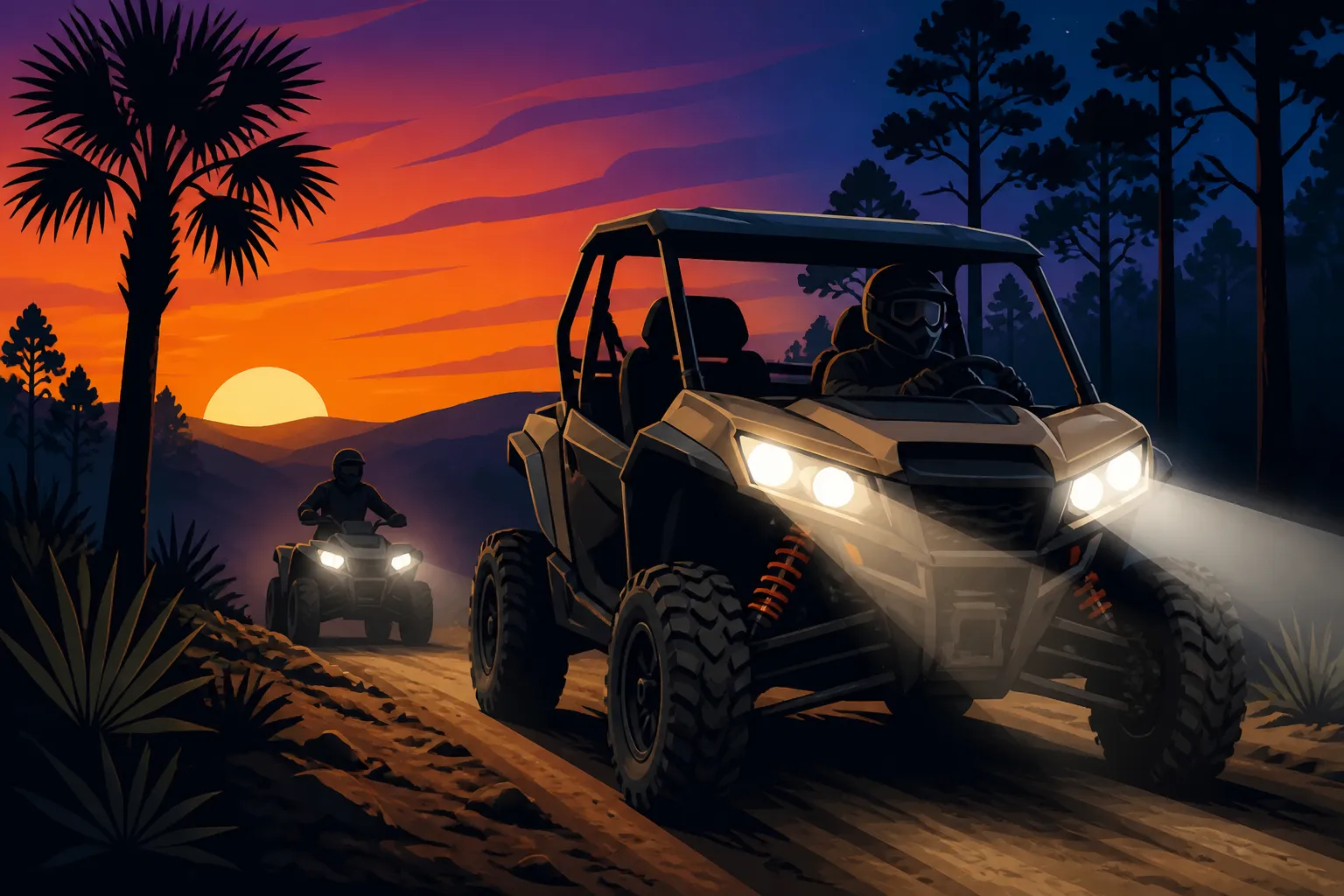
This is where a lot of riders get tripped up. The phrase "half hour after sunset" isn't just a casual guideline; it's a specific legal trigger for when your machine's lights must be on in South Carolina. It's part of the broader [South Carolina Rules for Riding After Dark], and understanding its practical application can save you from potential citations and, more importantly, keep you out of harm's way.
Sunset isn't a fixed time, of course. It changes every single day, varying with the seasons and your exact geographical location within South Carolina. What might be sunset in Charleston is slightly different from what it is in Greenville. This means you can't just set your watch once and forget it. You need to be mindful of the actual sunset time for your specific riding spot. Many riders now rely on smartphone weather apps or quick online searches to get the precise sunset time for their area. From that point, you calculate the additional 30 minutes. So, if sunset is at 7:00 PM, your headlights need to be shining brightly by 7:30 PM.
This rule extends beyond just a clear, dark night. It also applies during any period when there's insufficient light or adverse weather conditions that reduce visibility. Think of those foggy mornings that hang heavy over the low country, or a sudden, torrential downpour that often characterizes South Carolina summers. Even if it's technically still daylight hours, if visibility drops significantly, you're expected to have your lights on. The law prioritizes visibility in all challenging conditions, not just after sundown. It’s better to err on the side of caution and flip your lights on a little early rather than risk being unseen or cited.
Equipping Your Machine for Safer Night Riding
While standard factory lighting might meet the bare minimum legal requirements for ATVs, true night riding in South Carolina often demands more. The dark trails of the Sumter National Forest or private timber lands can be incredibly challenging without ample illumination. This is where strategic upgrades to your lighting system become not just a luxury, but a genuine safety and performance enhancement. You want to see the trail ahead, spot wildlife, and avoid obstacles long before you're on top of them.
Many riders start by upgrading their existing halogen headlights to more powerful LED bulbs. These offer a brighter, whiter light that significantly improves visibility. Beyond simple bulb swaps, dedicated light bars and auxiliary spotlights are incredibly popular. Brands like SuperATV offer a wide range of options, from small, powerful pod lights that can be mounted almost anywhere to long, sweeping light bars that turn night into day. These additions drastically increase your field of vision, helping you navigate tricky terrain, spot downed limbs, or even watch for sudden drops. For those who frequently ride in areas with thick underbrush or tight turns, adding ditch lights or rock lights can illuminate the immediate sides of your machine, which stock headlights often miss.
When considering these upgrades, remember the power draw. Adding multiple high-powered lights can strain your machine's electrical system, especially on older models. Ensure your stator and battery can handle the increased load. You might also want to look into beefier wiring harnesses and switches to manage the new lights effectively. Lastly, think about durability. Lights designed for off-road use, like those often found from specialized aftermarket providers, are built to withstand the bumps, vibrations, and occasional water crossings that are typical of South Carolina riding. Proper maintenance, like keeping lenses clean and connections free of corrosion, will also ensure your upgraded lighting performs when you need it most. [South Carolina Equipment Requirements for ATVs] also cover other essential components for trail riding.
Legal and Safety Implications of Improper Lighting
Ignoring South Carolina's lighting laws, particularly the "half hour after sunset" rule, carries both legal and significant safety repercussions. It's not just about a simple ticket; it's about the potential for serious accidents and the liability that comes with them. The authorities in South Carolina take these rules seriously because they are fundamental to preventing collisions and ensuring that everyone who uses the trails, whether on an ATV, UTV, or even on foot, can do so safely.
Legally, riding without the proper lights when required can result in a citation. While I can't state specific figures, [South Carolina Fines of $50 to $200] gives you an idea of the range for various violations. Beyond the immediate fine, repeated offenses or involvement in an incident due to improper lighting could lead to more severe penalties, including potential impoundment of your machine or even charges related to reckless endangerment if an accident occurs. It's simply not worth the risk for the sake of avoiding a flick of a switch.
From a safety perspective, the dangers are far greater than any fine. Riding in low light or darkness without adequate illumination drastically reduces your ability to see the trail ahead, making it easy to miss obstacles, drop-offs, or sudden turns. This increases your risk of a rollover or collision. Furthermore, other trail users, whether they are on foot, another machine, or a vehicle on a shared dirt road, rely on your lights to see you coming. Being invisible in the dark is an invitation for an accident, which could result in serious injury or worse, for yourself or others. Proper lighting is a simple, yet incredibly effective, preventative measure against these risks. Always check your lights before heading out, especially if there's any chance your ride will extend into the twilight hours or encounter adverse weather. Remember, a [South Carolina Street UTV Registration Arrives] with stricter rules, emphasizing the importance of visible lighting for all road-legal machines.
Adapting to South Carolina's Diverse Riding Conditions
South Carolina offers such a diverse range of riding environments, from the dense pinewoods of the Francis Marion National Forest to the open fields of private farmlands, and even the occasional designated beach access point. Each of these environments presents its own unique challenges when it comes to visibility and lighting, making a flexible approach to your machine's setup and your riding habits essential.
Consider the varying levels of natural light penetration. Deep within the woods, especially under a thick canopy, it can get dark much earlier than in an open field. That "half hour after sunset" rule might feel much more immediate when you're surrounded by towering trees that block out the last rays of sunlight. Conversely, riding along a more open path or cleared right-of-way might provide a bit more ambient light, but you still can't rely on it. It’s always best to prepare for the darkest conditions you might encounter. This is also why many riders carrying powerful aftermarket lights, perhaps from a brand like SuperATV, will use them even in dimmer daylight conditions to maximize their presence on the trail.
Dust, fog, and rain are also significant factors. South Carolina is known for its clay-rich soil, which can kick up incredible dust clouds in dry conditions. Your headlights might cut through some of it, but visibility can still be severely impaired. In such cases, lower-mounted lights or amber-colored fog lights can sometimes be more effective than high beams at reducing glare and enhancing definition. Similarly, a sudden evening shower can create significant spray and reflections, further diminishing your sight. Being proactive and having a robust, well-maintained lighting system that includes both forward-facing and rear-facing auxiliary lights can make all the difference. Always be aware of your surroundings, and don't hesitate to slow down significantly if visibility becomes an issue, regardless of how powerful your lights are.
| Visibility Condition | Recommended Action for Lighting | Legal Requirement Status |
|---|---|---|
| Full Daylight | Standard headlights off | Not required |
| Overcast/Heavy Rain | Headlights on (low beam) | Required if visibility low |
| Foggy Conditions | Headlights on (low beam), optional fog lights | Required if visibility low |
| Sunset to Half-Hour After | Headlights off, prepare to turn on | Not required yet, but close |
| Half-Hour After Sunset to Sunrise | Headlights on (low beam, high beam when safe) | Mandatory |
| Dusty Trails | Headlights on (low beam), consider amber lights | Recommended for safety |
Street-Legal UTVs and the "Headlights After Sunset" Rule
The recent changes allowing [South Carolina Street-Legal UTV Registration Arrives] have added another layer to the lighting conversation. For these machines, the "half hour after sunset" rule takes on a more direct and critical importance because they will be sharing public roads with cars, trucks, and other standard vehicles. This means their lighting systems must not only be fully functional but also adhere to specific standards to ensure safe operation alongside traditional traffic.
Street-legal UTVs are required to have all the standard equipment you'd expect on a road vehicle, which includes DOT-approved headlights that provide both low and high beam options, taillights, brake lights, and turn signals. When that "half hour after sunset" mark hits, or whenever visibility is poor, every one of these lights needs to be operational and in use. This isn't just about avoiding a ticket; it's about making sure other drivers can clearly see your UTV, anticipate your movements, and share the road safely. Neglecting these requirements puts everyone at risk, especially on higher-speed secondary roads where UTVs are now permitted to travel.
Beyond the basic requirements, it's a good idea for street-legal UTV owners to ensure their lights are properly aimed to avoid blinding oncoming traffic while still providing ample illumination. Regular checks of all bulbs, fuses, and wiring are essential, as the vibrations and stresses of off-road use can sometimes affect even road-legal components. Many street-legal UTVs come from the factory with basic road-legal lighting, but some owners might still opt for aftermarket upgrades for brighter, more reliable lights, often from a specialized vendor to enhance their visibility and safety on both the trail and the road. While South Carolina is excited to welcome UTVs to its secondary roads, it's crucial that operators understand and strictly follow all the rules, especially those pertaining to visibility after dark. [South Carolina Paperwork for a Street UTV] outlines all the specifics you'll need to know.
Disclaimer
This article is for general informational purposes only and does not constitute professional advice. Laws, prices and regulations vary by location and change over time. Consult a qualified professional for guidance on your specific situation.