South Carolina Rider Course Structure
A child who needs an ATV safety certificate may face two different tasks: online study and an in-person riding session. Knowing how those pieces fit together helps families choose the right course, prepare for the practical session, and avoid assuming that a booking alone satisfies South Carolina’s rules.
What the South Carolina rider course is for
South Carolina’s youth ATV rules make safety training relevant to riders age 15 and younger. The course is meant to teach safe operation and demonstrate basic riding skills; it is not simply a form to complete before a child can ride. The certificate and the rules about supervision are separate requirements, so completing a course does not automatically remove every restriction on a young rider.
The required training pathway is associated with the ATV Safety Institute. A general online safety video, a dealership handout, or a class from an unrelated organization may be useful, but should not be assumed to satisfy the state’s requirement. Before paying or registering, confirm that the specific course is recognized for the required certificate. The distinction is covered in Only an ATV Safety Institute Course Counts.
The course applies to ATV riding, not every kind of off-road vehicle or every roadway situation. A safety course does not make an ATV street legal, authorize a child to drive a street-registered UTV, or replace a license or equipment rule that applies to a different vehicle. Families comparing youth requirements can also review South Carolina ATV Age Requirements and South Carolina Street UTV Age of 17.
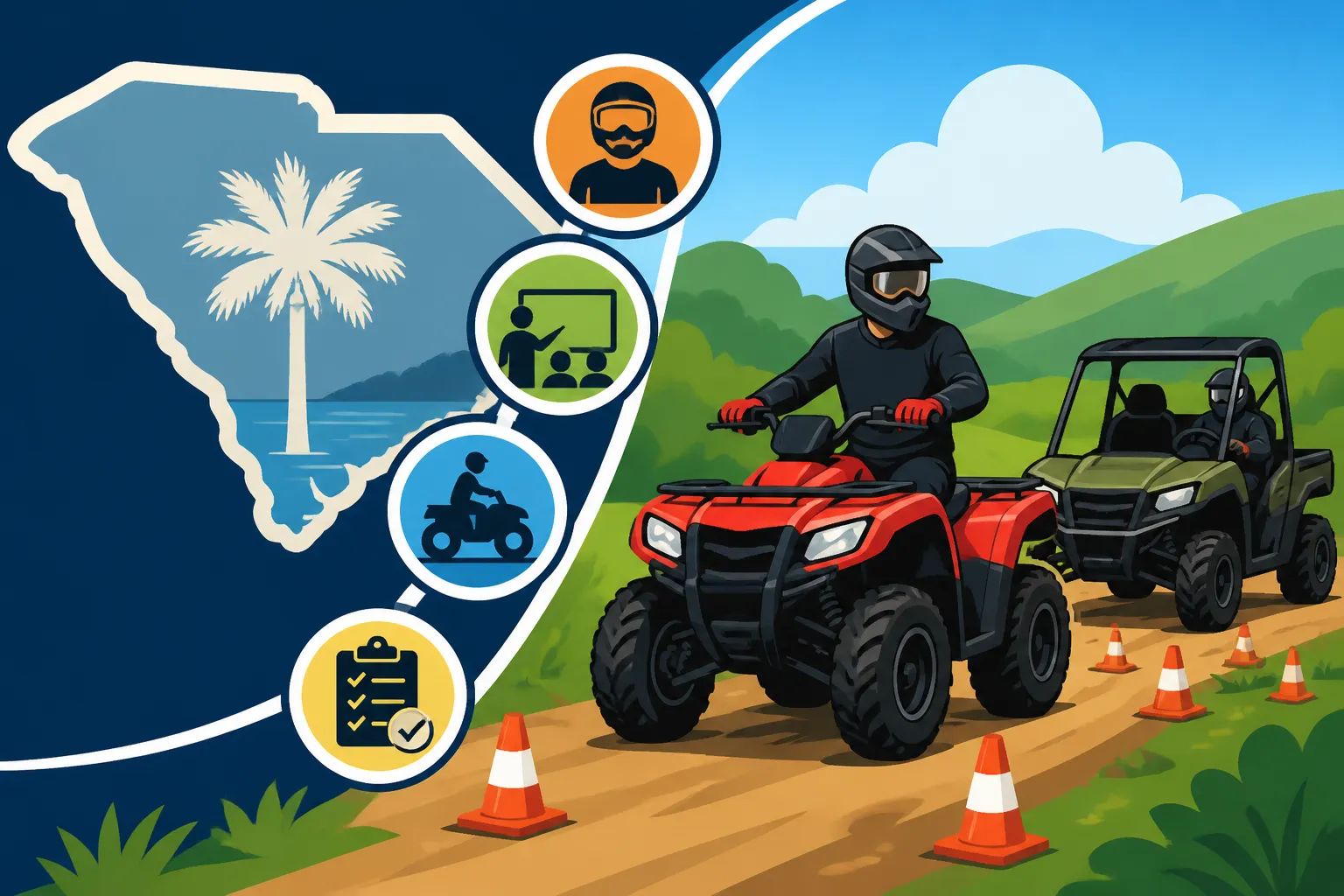
A useful way to think about the course is as a sequence:
- Check that the rider and machine are eligible for the course.
- Complete the required online learning before the practical session.
- Attend the hands-on training with the required equipment.
- Complete the instructor-led exercises and assessment.
- Keep the certificate details and continue following applicable age and supervision rules.
The exact booking process, available dates, equipment instructions, and certificate delivery can vary by provider. Confirm them before arranging travel or bringing a machine. If the certificate is needed for a particular ride or event, allow time to complete both parts and resolve any record or scheduling issues.
| Course element | What the rider generally does | What to confirm before booking |
|---|---|---|
| Eligibility | Meets the provider’s age and participation requirements | Whether the child’s age and experience fit the session |
| Online learning | Completes the assigned prerequisite material | How to access it and whether it must be finished before class |
| Practical session | Practices basic operating and safety skills under instruction | Location, duration, machine arrangements, and required gear |
| Completion record | Receives proof after meeting course requirements | How the certificate is issued and how to retrieve it later |
A course can provide a solid foundation, but it is not a substitute for adult judgment. Children still need an appropriately sized machine, proper protective equipment, suitable riding conditions, and supervision where the law requires it. For a fuller overview of the legal training requirement, see South Carolina Safety Certificate Requirements.
The online prerequisite comes first
The online portion prepares the rider for the in-person session. It introduces safety concepts and basic operating knowledge so that practical time can focus on applying what the rider has learned. The online work is a prerequisite, not a replacement for hands-on instruction when the course requires an in-person component.
The online prerequisite is commonly described as taking about two hours, but families should follow the provider’s current instructions rather than treating that as a guaranteed completion time. A rider may need more time to review material, answer questions, or repeat sections. A slow connection, forgotten login, or unfinished module can also affect whether the child is cleared to attend the practical session.
The online material may cover topics such as:
- How to choose and wear protective gear.
- Why an ATV must be appropriate for the rider’s size and ability.
- Basic controls and safe starting procedures.
- Braking, turning, and maintaining control.
- How terrain, speed, and obstacles affect stability.
- Why riders should avoid carrying passengers on a single-rider machine.
- What to do before, during, and after a ride.
Families should not try to rush through the material just to unlock the practical class. The rider should understand the concepts well enough to use them during exercises. If the child is struggling to follow the material, pause and help explain it in age-appropriate terms. The point is preparation, not simply clicking through screens.
Prepare before opening the course
Before beginning, gather the information the provider requires and make sure the child can use the device and internet connection. Check whether the course account must be created in the child’s name, whether a parent or guardian needs to register, and how the online work is connected to the in-person booking. Do not assume that a completed online module automatically reserves a practical-session place.
Keep a record of the completion confirmation. Save any email or certificate information and note the account login details in a safe place. If a provider asks for proof at check-in, being able to retrieve it can prevent a wasted trip.
If the online course is completed well before the practical date, confirm that the completion remains valid for that session. If the rider changes providers, ask whether the online work transfers or whether the new provider requires a different module. These are practical booking questions, not details to guess at.
For more on the prerequisite itself, see South Carolina Online Course Prerequisite. The provider can explain its current sign-up procedure and what to do if a child loses access to the course or cannot locate the completion record.
What happens during hands-on training
The practical session is where the rider works with an instructor and practices on an ATV. It is generally structured around basic skills, safe habits, and the rider’s ability to control the machine. It is not intended to teach aggressive riding, racing, or difficult trail techniques. A child who has ridden before should still approach the session as training and follow the instructor’s directions.
The session may start with check-in and a discussion of safety expectations. Instructors can review protective equipment, controls, starting and stopping, and how the exercises will work. Riders then practice skills in a controlled area. The sequence and exact exercises depend on the provider and site, but commonly focus on fundamental tasks such as starting, stopping, turning, controlling speed, and responding to simple riding challenges.
A practical session is not just an informal group ride. The instructor needs to observe each rider’s behavior and skill. A child may be asked to repeat an exercise or slow down until a skill is performed safely. That is a normal part of instruction, not a sign that the course is designed for experienced riders only.
The hands-on portion may take several hours, but its length and schedule depend on the provider. Ask whether the stated time includes check-in, breaks, equipment fitting, and the final evaluation. Also confirm whether the child must bring an ATV or whether one is provided. A family should not assume that every course site has machines available, or that a personal machine is acceptable without prior approval.
Expect coaching, not just a pass-or-fail ride
The instructor may give direct feedback on posture, speed, braking, or control. Children should be prepared to listen, stop when asked, and try again. A rider who is nervous or inexperienced may benefit from hearing in advance that the goal is to practice safely, not to compete with other participants.
Parents and guardians should ask how they can observe. Some providers may have a designated area for adults, while others may limit access near the riding exercises for safety. Respect the instructor’s setup and do not coach from the sidelines if doing so conflicts with instructions. Multiple voices can confuse a young rider.
The practical session should also help families identify skills that need more practice. Passing or receiving a certificate does not mean a child is ready for every trail, terrain, or machine. A rider who struggles with turning or braking in a controlled setting should continue practicing in a safe, permitted area before moving to more demanding conditions.
Course length, locations, and session formats can change. Check South Carolina Hands-On Course Length and South Carolina Course Providers for details to confirm directly before making plans.
Choosing a course and getting ready
The best course is one that satisfies the certificate requirement and gives the rider a safe, well-supervised learning environment. Compare providers on practical points rather than choosing only by the nearest date. A convenient location is helpful, but families also need clarity about instructors, machines, gear, scheduling, and completion records.
Before registering, ask the provider:
- Is this course accepted for the South Carolina ATV safety certificate?
- Does the rider complete an online prerequisite before the hands-on session?
- How long should the family plan to be at the practical session?
- Does the rider bring an ATV, or is a machine provided?
- What size or type of ATV is acceptable?
- What protective equipment must the rider bring?
- What happens if the weather is unsuitable or the child becomes ill?
- How is successful completion recorded, and how can the certificate be retrieved?
- Can a parent or guardian watch, and where may they stand?
- Are there prerequisites or experience expectations for the session?
Do not buy or borrow a machine solely on the assumption that it will be accepted at a course. Ask the provider about machine requirements first. A child should train on a properly functioning ATV that is appropriate for their age, size, and ability. A machine that is too large or powerful can make basic training harder and increase risk.
Pack for the practical session
Follow the provider’s gear list, since equipment requirements can differ by course. If the provider requires a helmet, check that it fits securely and is intended for ATV use. Eye protection, gloves, long sleeves, long pants, and sturdy footwear are sensible safety basics, but the provider’s instructions take priority for the session.
Avoid arriving in clothing that can snag on controls or equipment. Tie back long hair and remove loose items that could interfere with riding. Bring water and any requested paperwork, but keep phones, cameras, and other distractions put away during instruction unless the provider allows them.
Arrive with enough time for check-in. A late arrival can mean missing the safety briefing or being unable to join the group. If the rider is anxious, explain the outline of the day beforehand: listen to the instructor, practice at a controlled pace, and ask questions when unsure.
For specific protective equipment rules for young riders, South Carolina ATV Helmet Law and South Carolina Eye Protection for Young Riders offer useful context. Course gear guidance and legal requirements are not always identical, so use both the provider’s instructions and the current state rules.
After the course: certificate, supervision, and real-world riding
After successfully completing the course, make sure the certificate or completion record is accessible. Keep a digital copy and, if practical, a paper copy with the family’s important riding documents. Confirm the child’s name and other identifying information are correct. If there is an error or the record cannot be found, contact the course provider promptly rather than waiting until the certificate is needed.
A parent should understand the difference between course completion and permission to ride. The certificate does not cancel age restrictions, supervision rules, passenger limits, helmet requirements, or land-access rules. A child may still need an adult to accompany them, depending on age and where the riding takes place. The requirements are explained in South Carolina Rules for a Supervising Adult.
The child also needs continued practice after the course. Start on familiar, permitted ground with low-risk conditions. Choose a flat and open area when possible, inspect the ATV before riding, and keep the first practice sessions short. Work on one skill at a time rather than adding speed, passengers, steep slopes, or unfamiliar terrain. Supervision should be close enough for an adult to intervene, not merely a distant check-in.
A course certificate does not authorize riding on land where ATVs are prohibited. Public land, private property, parks, and trails can each have their own access requirements. Confirm that the route allows the type of machine and rider in question. For example, a family should not assume that a hunting license or a safety certificate opens a wildlife management area to ATV riding.
Keep the certificate information usable
Families often complete training and then misplace the record. Save the completion email, note the provider, and retain the account details needed to retrieve the certificate. If the rider’s name changes or the family changes contact information, ask the provider whether records need updating.
If an officer, land manager, or event organizer asks about training, the family should be able to explain what course the rider completed and show the record if requested. The exact proof that may be required in a particular setting can vary, so check ahead when attending an organized ride or using a site with its own rules. More information on finding a record is available in [South Carolina Safety Certificate Lookup].
Adults should not assume they need the same course merely because a child does. South Carolina does not impose the youth course requirement on every adult rider, although training is still useful for beginners and anyone moving to a different machine or riding environment. See South Carolina Has No Adult Course Requirement for that distinction.
Frequently Asked Questions
Does the online portion alone satisfy the course requirement?
No. The online component is a prerequisite for the practical training when the provider’s course requires both parts. Confirm that the rider completes every required component and receives the proper completion record.
How long does the hands-on session take?
The duration depends on the course provider and site. Ask how long to plan for, including check-in, instruction, breaks, and any assessment. Do not rely on a time listed for a different location or session.
Does a parent need to bring an ATV?
Not necessarily. Some providers may supply a machine, while others may require the rider to bring one. Confirm machine availability, accepted ATV size, and condition requirements before registering.
Does the certificate allow a child to ride without an adult?
No. Course completion and supervision rules are separate. Check the rider’s age and the location’s rules before riding.
Is an ATV safety course the same as a UTV driving license?
No. The ATV course is safety training for ATV riders. It does not replace any separate licensing, equipment, insurance, or registration requirements that may apply to a street-legal UTV.
Disclaimer
This article is for general informational purposes only and does not constitute professional advice. Laws, prices and regulations vary by location and change over time. Consult a qualified professional for guidance on your specific situation.