South Carolina Volunteer Passes for Trail Work
South Carolina Volunteer Passes for Trail Work
Trail maintenance can earn more than a clear route and a safer ride: some authorized programs offer volunteers a forest pass. The tricky part is knowing which work qualifies, who approves it, and what the pass covers. Here’s how to check the terms before you volunteer, keep the right records, and avoid assuming a volunteer pass works at every riding area.
How a volunteer pass for trail work works
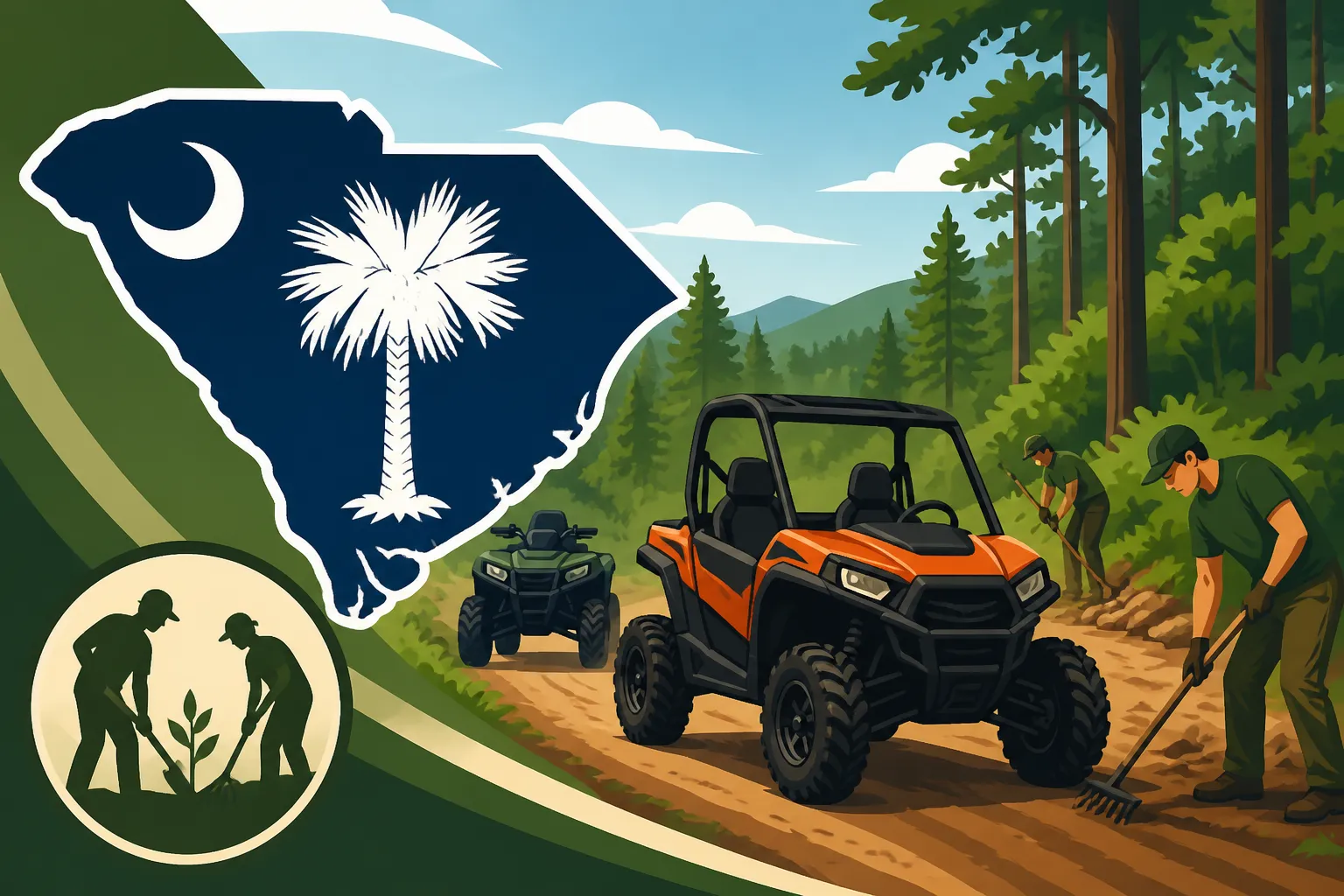
A volunteer pass is a possible benefit for taking part in approved trail work, not a pass that comes automatically with any maintenance effort. The work usually needs to be coordinated or recognized by the organization responsible for the trail. Picking up litter on your own, clearing brush without permission, or helping a private landowner may be appreciated, but none of those activities necessarily qualify for a public-land pass.
In South Carolina, the relevant pass programs are associated with designated national forest OHV trails. The basic idea is that approved volunteer service supports trail access and maintenance, and a qualifying volunteer may receive a forest pass. The specific eligibility rules and how a pass is issued can depend on the program and the managing organization. Confirm those details with the volunteer coordinator before counting on a pass.
A volunteer benefit is separate from ordinary pass purchases and is not a general exemption from every riding fee. For example, a forest pass does not automatically provide access to a private riding park, and a private park’s volunteer arrangement would be governed by that park’s own terms. Keep the scope clear: ask which riding area the pass applies to, who may use it, and when it is valid.
| Option | What it may cover | What to confirm |
|---|---|---|
| Approved trail-work volunteer pass | Riding access covered by the participating forest pass program | Eligible work, approval process, pass term, and how it is issued |
| Regular day pass | Access under the forest’s day-pass rules | Applicable trail system, date, and display or verification rules |
| Regular season pass | Access under the forest’s season-pass rules | Validity period and whether it is tied to one person |
| Private riding park pass | Access to that specific private park under its rules | Volunteer arrangements, eligible tasks, and park-specific restrictions |
If you’re unfamiliar with the standard options, South Carolina National Forest OHV Passes covers the role of forest passes, while South Carolina’s Day and Season Forest Passes explains the basic distinction between the two common purchase types. Those details matter because volunteer recognition may use a different process, but it does not necessarily change the underlying riding rules.
A pass is permission to use covered trails under the applicable conditions. It does not grant permission to create or repair trails independently, enter closed areas, ignore seasonal restrictions, or take a vehicle onto land outside the pass program. The best starting point is always the group or office authorizing the work.
Check eligibility before you commit to trail work
The most important question is not simply, “Do volunteers get a pass?” It is, “Does this specific volunteer opportunity qualify, and what must I do to receive the pass?” Ask before the workday, especially if you are traveling, planning a group ride, or volunteering because you expect to reduce your riding costs.
Eligibility can depend on details such as the work location, the organizer, the kind of task, and whether the work was scheduled or approved in advance. A volunteer day run by an authorized trail group may be treated differently from an informal cleanup arranged among friends. Even work that clearly benefits a trail may not count if the managing organization did not approve it or cannot verify who took part.
Before signing up, ask the coordinator these questions:
- Is this event recognized by the organization that manages the trail or pass program? A club or volunteer group may be a good point of contact, but ask who confirms eligibility.
- Which tasks count? Trail brushing, drainage work, sign installation, litter removal, and other activities may be handled differently. Do not assume every task qualifies.
- Is there a minimum participation requirement? If so, ask how the program measures it. Do not rely on an estimate from another volunteer if the coordinator can confirm the current rule.
- How is participation recorded? Find out whether you need to sign in and out, have a supervisor verify your hours, or complete another form.
- What pass is offered? Confirm whether it is a day pass, season pass, or another benefit, and whether it covers the trail system you intend to ride.
- How and when is the pass issued? It may be provided after the event, after the service is verified, or through a separate application process.
- Who can use it? Ask whether it is personal to the volunteer, and whether every rider in a group needs a separate pass.
- Can an existing pass be credited or replaced? Don’t assume that volunteer work will trigger a refund or transfer of a pass you already purchased.
These questions help avoid a common misunderstanding: hearing that “volunteers get a pass” and treating the statement as universal. It might apply only to approved events, only after certain service requirements, or only to people whose participation is recorded and accepted.
If a coordinator cannot answer a particular question, ask who can. It is better to confirm with the pass administrator or managing office than to rely on a casual comment at the trailhead. Keep the organizer’s written instructions, event details, and any confirmation of your service until the pass is issued and you understand its conditions.
Know what the pass does and does not cover
A volunteer pass should be understood as a specific access benefit, not a broad riding permit. Its coverage depends on the program that issues it. Check its validity period, the areas it covers, and any rider or vehicle conditions. A pass tied to one volunteer should not be treated as transferable unless the issuer explicitly says it is.
The ordinary forest pass system can help set expectations. South Carolina Passes Cover All Four Trails discusses how the forest pass relates to the designated trail network. Still, a volunteer award may come with its own limits or instructions, so confirm that the volunteer pass has the same coverage as a standard pass before planning a trip.
Pay special attention to whether the pass is:
- Valid for a particular date, season, or other stated period
- Limited to the volunteer who earned it
- Associated with one rider or another unit of access
- Accepted at all covered trail locations
- Required to be displayed, carried, or verified in a particular way
- Subject to the same closures, operating conditions, and machine restrictions as a purchased pass
Some pass terms are easy to overlook when the pass is free. But a no-cost pass still has rules. For instance, if ordinary season passes are issued to individuals, a volunteer should not assume one pass covers a whole family or riding group. Review South Carolina Season Passes Are Per Person and South Carolina Passes Are Non-Transferable for the general personal-use principles, then ask whether the volunteer-issued pass follows those same conditions.
A pass also does not make a vehicle eligible for a trail it cannot physically or legally use. Trail width limits, vehicle type restrictions, closures, and safety requirements continue to matter. Check the trail’s current rules before unloading. If a route is closed for maintenance or weather, a pass does not override the closure.
Nor should a forest volunteer pass be confused with a private park benefit. Private riding areas set their own entry terms, vehicle requirements, age limits, and services. A pass from public-land trail work should not be presented as payment at a private gate unless that park has explicitly agreed to accept it.
The same caution applies to public land outside the pass program. A volunteer pass is not a hunting permit, a fishing license, a general access permit, or authorization to ride on every forest road. Stay within the approved riding areas and follow posted notices. If you want a broader overview of the land distinction, South Carolina Public Land Compared to Private is a useful place to start.
A practical process for earning and using the pass
A little preparation can make the volunteer benefit straightforward. The goal is to verify the rules first, complete approved work safely, and receive clear confirmation of what you earned.
Before the workday
Start with the event organizer or trail coordinator. Ask whether the event is authorized and whether it is connected to the pass program. Get the work location, meeting instructions, task list, equipment guidance, and any participation requirements in writing if possible.
Do not show up to perform unrequested trail work. A well-meant effort can damage drainage, disturb vegetation, create an unsafe route, or conflict with planned maintenance. Trail work is best done under direction from people who know the site and the land manager’s standards.
If the event has a registration or sign-in process, complete it carefully. Use the same name and contact details you expect to use when receiving the pass. If a pass application requires a rider’s information, ask whether the volunteer coordinator submits it or whether you must take a separate step.
Bring only the gear the organizer requests. For personal basics such as work gloves, eye protection, and weather-appropriate clothing, make sure the items fit the task and meet the coordinator’s safety instructions. If you need to source replacement personal gear, Amazon may be one option, but do not buy specialized equipment until the organizer confirms what is appropriate. Tools, protective equipment, and work methods should follow the event’s safety plan.
During the workday
Sign in as directed and make sure the coordinator knows you are present. If the program tracks time or completed tasks, follow its process rather than assuming someone else will record it. Ask before leaving if the event requires a sign-out or supervisor verification.
Stay with the assigned task. Do not bring an ATV or UTV into a work area unless the organizer has specifically approved it. Trail-maintenance activity can involve tools, vehicles, uneven ground, and other volunteers. Riding through a work zone can create hazards or interfere with the crew.
If the planned work changes, check with the lead before moving to another location. A change in task or worksite might affect both safety and eligibility. Be especially careful around drainage structures, water crossings, signs, and areas that appear closed; leave decisions about alterations to the authorized crew.
After the workday
Ask the coordinator how participation is confirmed and when you should expect an update. Keep any sign-in confirmation, email, or other record until the pass is issued. If you do not receive the pass or confirmation within the stated process, contact the organizer politely with the event date and your participation details.
Read the pass instructions as soon as you receive them. Check the holder’s name, validity period, areas covered, and any display or verification steps. If something is unclear or appears incorrect, ask the issuer before using it. Do not assume that a digital message, volunteer badge, or event registration is itself a riding pass.
When preparing for a ride, follow the regular pass rules and check trail conditions. How to Buy a South Carolina Forest Pass is useful for understanding the normal purchase process if the volunteer program does not cover your planned trip, while South Carolina Pass Display Rules can help clarify the general expectations for having a pass available at the trailhead. Use the instructions attached to your specific pass if they differ.
Common misunderstandings and how to avoid them
Volunteer pass questions often come down to assumptions. Clearing them up ahead of time prevents an awkward conversation at a trailhead and helps the trail organization keep its records accurate.
“Any trail cleanup earns a pass”
Not necessarily. A cleanup can be valuable and still fall outside a particular pass program. The work may need advance approval, a designated location, or confirmation by an authorized coordinator. Ask before doing the work, and do not treat a personal cleanup as a qualifying event unless the program confirms it.
“One volunteer pass covers the whole group”
Do not count on it. A pass may be associated with the volunteer who performed the work. Ask whether other riders need their own passes, and keep the pass holder’s identity and any transfer rules in mind. South Carolina Passes Are Non-Transferable explains why lending or sharing a pass can create problems under standard pass conditions.
“The pass works at any place with ATV trails”
A forest pass does not automatically apply at a private riding park, a different public property, or an unlisted route. Verify the exact area covered. If you are planning a mixed trip that includes more than one riding location, check each place’s access rules separately.
“The pass cancels other riding rules”
It does not. A pass does not override closures, machine restrictions, safety rules, landowner permissions, or laws that apply to riders. It provides only the access described by its issuer. Continue to check official trail notices and follow posted directions.
“If the pass is free, there is no paperwork”
There may still be a sign-in sheet, service verification, application, or pass-display requirement. Keep records and follow the process. A free benefit can require careful administration just like a paid pass.
“A club’s statement is the final word”
A local club may coordinate excellent volunteer work, but the person who organizes an event may not be the final authority on pass eligibility. Ask who issues or approves the benefit. If the pass is managed separately, get confirmation from that office or program contact before relying on it.
“A volunteer pass means trails are open”
Trail availability changes. Weather, maintenance, safety concerns, and other management needs can close a route. Check conditions shortly before travel, especially after heavy rain or when a trail is being worked on. A pass does not guarantee that every trail will be open on the day you arrive.
A sensible rule is to treat the pass as earned only once the responsible program has verified your service and issued clear instructions. Until then, budget for the ordinary pass you may need, and avoid building a trip around an unconfirmed benefit.
Frequently Asked Questions
Do trail-work volunteers in South Carolina get a free forest pass?
Some authorized trail-work programs offer pass recognition to qualifying volunteers. Eligibility and the award process depend on the program. Confirm current requirements with the event organizer or pass administrator before volunteering.
Does volunteer work have to be arranged in advance?
Often, the work must be approved or coordinated so the program can verify that it qualifies. Ask the organizer before doing maintenance on your own; unapproved work may not count and can create safety or land-management problems.
Can I share my volunteer pass with a friend?
Do not assume so. Passes may be issued to an individual and subject to non-transferability rules. Check the instructions on your pass and ask the issuer if another rider’s use is not clearly allowed.
Does a forest volunteer pass work at a private riding park?
Not unless that park explicitly accepts it. Public forest passes and private park admissions are separate systems. Confirm entry terms with each riding area you plan to visit.
Disclaimer
This article is for general informational purposes only and does not constitute professional advice. Laws, prices and regulations vary by location and change over time. Consult a qualified professional for guidance on your specific situation.