Why a South Carolina Forest Pass Sits in the Truck
A forest pass can feel like an odd thing to leave in a truck when the ride happens on an ATV or UTV. The reason is practical: the pass is part of the fee-compliance setup for a forest visit, and the tow vehicle is where a ranger can readily check it. Here’s how to think about the pass, what it does—and what it doesn’t do—and how to avoid arriving at the trailhead without the right proof.
Why the Pass Belongs With the Tow Vehicle
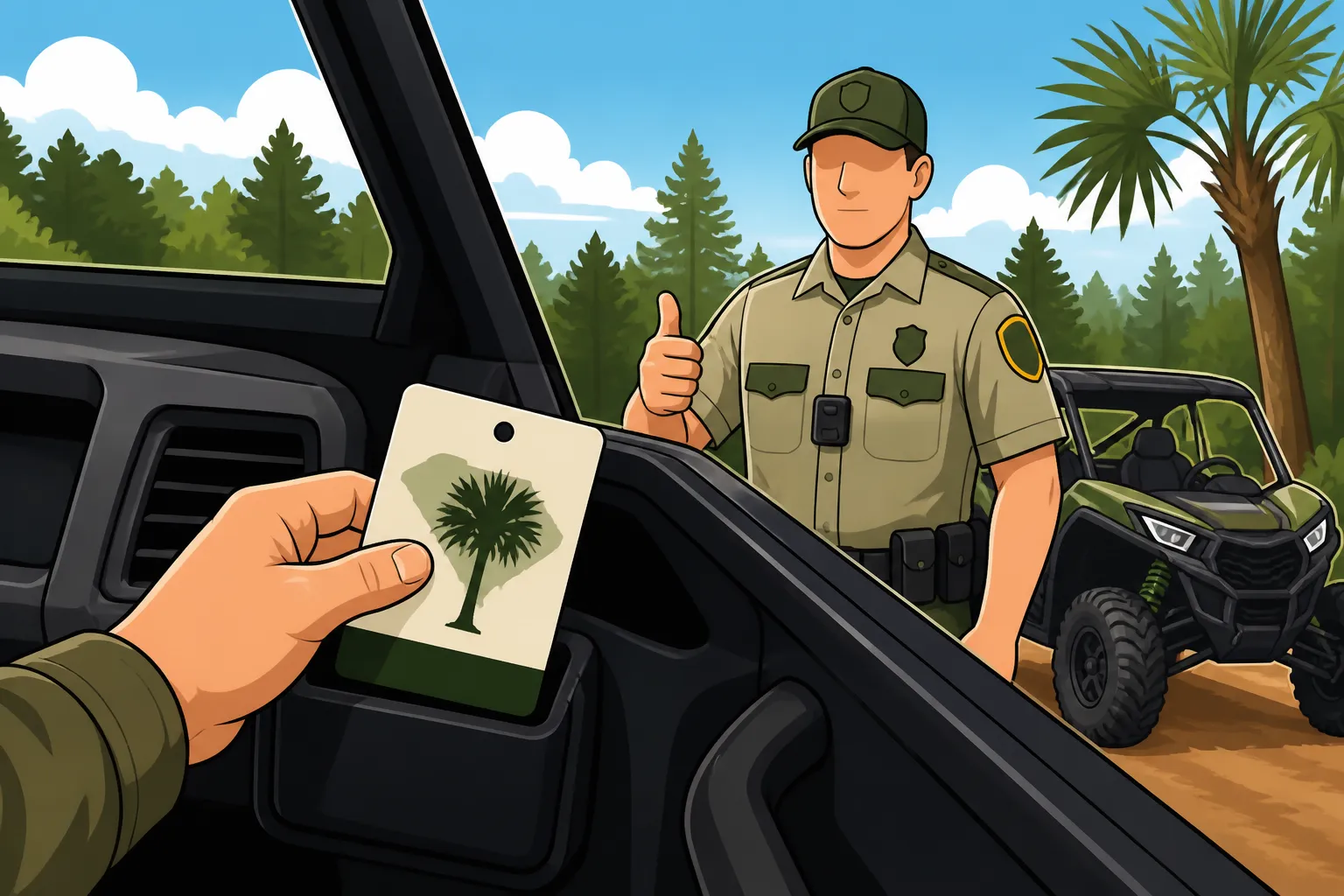
If you haul your machine to a South Carolina National Forest OHV trail, the truck or trailer is usually the first thing a ranger or fee-compliance officer can identify at the trailhead. Keeping the pass in the tow vehicle makes it available for a check without relying on a rider to find it in a pocket, gear bag or ATV storage compartment.
That matters because a forest pass is part of the fee system for using designated trails. It is not a general license plate, a title, or permission to ride anywhere on public land. The pass helps show that the applicable trail-use fee has been paid; it does not replace trail rules, closures, vehicle restrictions or land-access requirements. For an overview of what the pass covers, see South Carolina National Forest OHV Passes.
There are two different ideas to keep straight:
- The pass is associated with the person or vehicle according to the pass type and its rules.
- The proof of the pass may be displayed or kept in the tow vehicle so it can be checked at the trailhead.
Those ideas can sound contradictory, but they are not. An annual pass may be tied to an individual rider and still need to be printed and displayed in the tow vehicle. The vehicle is where the proof is visible; it does not necessarily become the owner of the pass.
A truck is also a sensible place to keep the paperwork because it stays at the trailhead while you ride. If a pass is required to be displayed, a ranger can check the vehicle without asking you to bring a loose document onto the trail. If the pass must remain with a particular rider, keeping the printed copy in the tow vehicle still gives you a dependable place to store it when the rider is not using it.
Follow the current instructions for the specific pass you buy. Display requirements can differ between day and season passes, and instructions can change. Before leaving home, read the pass details and any confirmation or display directions rather than assuming that a phone screenshot, a paper printout or a dashboard display will automatically satisfy every requirement.
What the Forest Pass Covers—and What It Does Not
The pass is for authorized use of designated OHV trail systems, subject to the applicable rules. It does not create a right to ride on every road, trail, wildlife area or piece of forest land. A trail can be closed even if you have a valid pass, and a pass for a forest trail does not grant access to private property or a nearby wildlife management area.
South Carolina’s forest trail pass system covers multiple designated OHV trails, but the pass does not eliminate the need to check the specific trail’s restrictions. Machine width, trail type, seasonal closures and operating rules can all matter. A trail designed for motorcycles or narrower machines may not accept a full-size side-by-side. A pass does not make an otherwise ineligible vehicle suitable for that trail.
The pass also does not replace other paperwork you may need. Depending on the circumstances, you might need proof of ownership, a driver’s license, a valid forest pass, and any other required documents. A forest pass is not an ATV title or an off-road registration. South Carolina does not register off-road ATVs in the same way it registers street vehicles, but riders should still be prepared to establish that they are entitled to use their machine. See [South Carolina Proof of Ownership on the Trail] for more on that separate issue.
A few practical distinctions help:
| Item | What it generally addresses | What it does not do |
|---|---|---|
| Forest OHV pass | Fee compliance for authorized use of covered forest trails | Open closed trails or grant access to other land |
| ATV or UTV title | Ownership record, where a title applies or is obtained | Pay a forest trail fee |
| Street registration or plate | Legal operation on qualifying roads under the relevant rules | Automatically authorize forest-trail use |
| Trail map and current closure information | Where riding is allowed and what is open | Substitute for a required pass |
| Landowner permission | Access to the specific private land covered by permission | Replace forest rules or a required forest pass |
That separation is important when your ride combines different kinds of land. You might trailer to a national forest trail, stop at a private riding park on another day, and hunt on private land during a separate trip. Each place can have its own access and fee rules. A forest pass should be treated as permission to satisfy one part of one system—not as a universal riding permit.
If your plan involves a wildlife management area, do not assume that a hunting license or forest pass gives you permission to ride there. South Carolina wildlife management areas generally prohibit ATV use except where a specific rule allows it. Review South Carolina WMA Riding Is Prohibited before planning a route that crosses or enters one.
Day Passes and Season Passes Work Differently
South Carolina’s forest pass options include day and season passes. The names are straightforward, but the way a pass is associated with a rider or vehicle is easy to misread. Before buying, check the current official instructions for the pass type you want and make sure it fits your trip.
A day pass is commonly connected to the tow vehicle’s plate information. That can make sense for a single visit: the vehicle transporting the machine is identified for the day, and the pass can be checked against that vehicle. If you change trucks after buying the pass, use the official rules to determine whether the pass still applies. Do not assume it can be moved to another vehicle just because the machines or riders are the same.
A season pass is associated with an individual rider rather than being a transferable pass that any person in the truck can use. That distinction matters for families and groups. One person’s season pass should not be treated as a pass for everyone riding that day. Review South Carolina Season Passes Are Per Person and South Carolina Passes Are Non-Transferable before buying for multiple riders.
The most useful way to compare them is to focus on the trip pattern and the pass conditions, not just the labels:
| Question | Day pass | Season pass |
|---|---|---|
| What is it designed for? | A visit or limited riding period | Repeated use during the covered season |
| What information may connect it to the trip? | Tow-vehicle plate information | The named individual rider |
| Can a group assume one pass covers everyone? | Do not assume so; check the current terms | No—treat each rider’s pass as individual |
| Should it be kept in the truck? | Keep the required proof with the identified tow vehicle | Keep a printed copy or other required proof available in the tow vehicle |
| Can it be transferred to another person or vehicle? | Check the pass conditions before changing vehicles | Do not assume it can be transferred |
This table is a planning aid, not a substitute for the instructions attached to the pass. In particular, don’t treat “day pass” as meaning “one pass for every machine” or “one pass for every person.” The current official rules determine what the pass covers, how it is identified, and what must be displayed.
If you are buying for a group, sort out the details before you reach the forest. Write down the names of the riders who need season passes, the plate information needed for any day pass, and the display instructions for each pass type. That short check is much easier at home than in a crowded staging area with helmets on and machines unloaded.
For more on the differences between options, see South Carolina’s Day and Season Forest Passes and South Carolina Day Passes Tied to a Plate.
How to Store and Display the Pass
The practical answer to “why does the pass sit in the truck?” is that the truck is the pass’s home base. It carries the machine to the trailhead, remains there during the ride, and gives you a fixed place to keep the document or display the required proof. It also reduces the chance that the pass gets lost during a bumpy ride or soaked in a jacket pocket.
That does not mean you should put the pass anywhere in the cab and forget it. Follow the current display directions. If the instructions call for a printed pass to be visible in the tow vehicle, place it where it can be read without removing it or exposing the original to weather. If the pass must be carried by a named rider, make sure that person knows where it is and has access to it when needed.
A simple setup works well:
- Buy the correct pass for the trip. Confirm whether you need a day pass or a season pass and check who or what it is associated with.
- Save the confirmation. Keep the purchase record and pass instructions somewhere you can access even if cell service is poor.
- Print the pass if the instructions require or recommend a printed copy. Do this before you head to a forest with limited connectivity.
- Protect the paper. Use a clear document sleeve or a weather-resistant holder if the pass will be displayed in a window or left in a vehicle.
- Put it in the correct tow vehicle. For a day pass tied to a plate, confirm that the vehicle you bring matches the information on the pass.
- Tell the riders where it is. Everyone in the group should know which pass belongs to which rider and where the proof is stored.
- Check it before unloading. Make sure the pass is present, legible and displayed as required before you start riding.
A plain clear sleeve can protect a printed pass from damp air, dust and accidental spills. If you need one, Amazon is one place riders commonly look for basic document sleeves, but the holder is secondary: it must not obscure information that needs to be visible. A plastic sleeve is not a replacement for an official pass or for following the official display instructions.
Avoid leaving important documents loose on a seat or dash where they can slide under gear. A small folder in the glove box or a dedicated holder can be more reliable. If the pass needs to be visible through a window, do not cover it with a dark sunshade or place it behind a reflective windshield accessory. Make sure the printed information remains readable from outside.
A phone can be a useful backup for the purchase confirmation, but do not assume a digital image is an acceptable substitute for a required physical display. Download or save the confirmation before the trip, because a weak signal at the trailhead can make it difficult to retrieve an email or online account. For the official purchase channel and current instructions, see Forest Passes Sold Only on Recreation.gov and Nowhere Else.
Buying the Pass Before You Haul
Buying the pass ahead of time is usually the least stressful option. It gives you time to confirm the correct pass type, enter the information carefully, print the proof if needed, and correct an error before you are standing at a trailhead. The forest pass system is not something to improvise after you have already unloaded the machine.
Use the official purchase route identified in the current forest instructions. Be cautious with third-party posts or old screenshots that describe a previous process. A pass may have a specific purchase channel, and an unofficial receipt or a pass bought for a different person or vehicle may not meet the requirement.
Before completing a purchase, verify:
- Which forest trail or system you plan to use. A pass for a covered forest trail is not a general pass for all riding areas.
- Whether you need a day or season pass. Think about your actual use and compare the current conditions.
- Who the pass is for. For season passes, check the named rider’s details.
- Which vehicle information is required. For day passes, enter the tow vehicle information accurately if the process asks for it.
- How the pass must be displayed. Save the directions rather than relying on memory.
- Whether the pass can be changed. If you may switch vehicles or riders, check the rules before buying.
- What proof you should keep. Keep the pass and purchase record accessible, but do not confuse the receipt with the pass if the rules distinguish them.
If you are coordinating a family ride, it can help to assign one adult to manage the paperwork. That person can keep a list of the riders, pass types and vehicle information, then check that each rider understands the rules. This prevents one common mistake: a group arrives with proof for the person who purchased the passes but not for the other riders who need their own authorization.
Keep in mind that pass availability and purchase instructions can change. Confirm current details with the official source before paying, especially if you are traveling from out of state or planning a visit months ahead. The goal is not just to have an email saying you paid. It is to arrive with the correct pass, connected to the correct rider or vehicle, and displayed in the way the rules require.
What to Check Before Leaving Home
The pass is only one part of trail preparation. A complete pre-trip check helps prevent the frustrating situation where you have paid for access but cannot legally or practically use the trail you came to ride.
First, confirm that the trail is open. Forest trails may close for maintenance, weather, safety or other management reasons. A valid pass does not override a closure. Check current conditions shortly before departure, and do so again if there has been heavy rain or a major weather event. South Carolina Trail Conditions Before You Haul is a useful next step when your drive is long enough that a surprise closure would ruin the day.
Second, check whether your machine is allowed on the trail you have selected. This is especially important for side-by-sides. A pass does not waive width limits or change the type of machines a trail accepts. If a trail has a narrow gate, a full-size UTV may not fit even if it is otherwise mechanically capable of riding the route. Compare your machine’s actual width with the current trail requirements, including any width added by tires, spacers or accessories.
Third, plan for the conditions at the trailhead. Bring the printed pass if required, a driver’s license, proof of ownership where appropriate, and a backup copy of purchase information. Keep the pass protected, but make sure the display remains readable. If the tow vehicle will be locked, decide in advance how an authorized officer can inspect the pass without leaving the paperwork inaccessible.
Fourth, make sure the whole group understands where the pass applies. If a ride includes a public forest trail and a private connector road, the forest pass does not grant private-land access. If the route crosses a road, that road has its own operating rules. If you plan to ride somewhere beyond the designated trail system, confirm permission and legality separately.
Finally, have a plan for low cell service. Save the trail map, closure information, pass confirmation and emergency contacts before you leave coverage. A screenshot can be a useful reference, but do not rely on it as a substitute for the required pass display. Carry a paper map if your route or phone coverage makes that sensible. A printed pass, an offline map and a charged phone solve different problems; having one does not make the others unnecessary.
Common Pass Mistakes and How to Avoid Them
Most pass problems are preventable. They often come from assuming that a pass works like a vehicle registration sticker or that one purchase automatically covers everyone in the group.
Treating the truck as the pass owner
The pass may sit in the truck because that is where it needs to be displayed or checked. That does not necessarily mean the pass belongs to the truck. A season pass can be assigned to an individual rider, while a day pass may be connected to the tow vehicle’s plate. Keep those distinctions clear, particularly if you change vehicles or lend a machine to someone else.
Assuming one season pass covers the whole group
A season pass should not be treated as a family pass unless the current terms specifically say that it covers multiple people. Where the pass is per person, each rider who needs one must have the appropriate pass. Review South Carolina Season Passes Are Per Person before purchasing for a family, club or group outing.
Buying the right pass but entering the wrong details
A typo in a name or plate number can create a mismatch that is hard to explain at a fee check. Check the information before submitting, and compare the confirmation with the vehicle you plan to tow. If you discover a mistake, use the official process to find out how to correct it rather than altering the pass yourself.
Keeping only the email on a phone
Email may be difficult to retrieve in a forest with poor reception. Save the confirmation offline and print the pass if the instructions call for a physical copy or display. A phone backup is helpful, but it is not a reason to ignore the required display method.
Leaving the pass where it cannot be read
A paper pass buried under jackets, shaded by a dashboard cover or turned face down may not be useful when someone checks the tow vehicle. Put it where the instructions say and make sure it is visible and legible.
Assuming the pass guarantees the trail will be open
Trail status can change. Check for closures before you haul, and do not ride around a gate or use a closed route because you already paid. Keep a second riding option in mind for trips where a closure would otherwise leave you with no plan.
Confusing a forest pass with permission to ride elsewhere
A forest pass does not authorize riding on private land, public roads that are not open to your machine, or wildlife management areas where ATV use is prohibited. Confirm access for every part of your route. If you are visiting a private park, check that park’s separate pass and operating rules.
A Simple Trailhead Routine
A consistent routine makes the pass easy to manage. Before you leave, confirm the trail is open, check that your machine is eligible, verify the pass type, and make sure the tow vehicle and rider details match the purchase. Save the official instructions and print the pass if required.
At the trailhead, leave the pass in the position required for inspection. Tell your riding group who has the season pass and where any supporting paperwork is stored. Do not move the pass to another vehicle or hand it to another rider unless the rules expressly allow that. Before departing, check that the document has not blown away, become unreadable or been covered by other items.
The pass sits in the truck because the truck is the practical point of contact between your machine, your ride and the trailhead’s fee-compliance check. Think of it as accessible proof for the forest visit—not permission to ride every place you can reach. Match the pass to the correct rider or vehicle, display it as directed, and check conditions before hauling. Those small steps make the paperwork less likely to interrupt the part of the trip you came for.
Disclaimer
This article is for general informational purposes only and does not constitute professional advice. Laws, prices and regulations vary by location and change over time. Consult a qualified professional for guidance on your specific situation.