South Carolina Fines of $50 to $200
Riding an ATV or UTV in South Carolina can be an absolute blast, a true taste of freedom across diverse terrain, but nothing brings that joy to a screeching halt faster than flashing blue lights and the cold reality of a hefty fine. Many riders, especially those new to the Palmetto State or just getting into the sport, grapple with confusion over what's allowed and what's not, particularly when it comes to operating these machines on public roads. This guide aims to clear up that confusion, detailing the common violations that can lead to fines ranging from $50 to $200, and empowering you with the knowledge to stay on the right side of the law.
Understanding South Carolina's Core ATV Road Rules and Penalties
South Carolina has a specific set of rules governing ATVs, UTVs, and golf carts, especially concerning their use on public roads. These aren't just minor suggestions; they carry real penalties that can quickly add up, turning a fun day into an expensive headache. Understanding the foundation of these laws is the first step in avoiding those dreaded tickets.
Why Fines Exist: The Spirit of Chandler's Law
The backbone of South Carolina's ATV regulations is often referred to as [Chandler's Law and South Carolina ATV Rules], codified primarily in [South Carolina Code Title 50 Chapter 26]. This law, enacted to enhance safety, particularly for young riders, imposes strict rules on ATV operation. While it covers various aspects from age restrictions to safety equipment, a core tenet is the prohibition of ATVs on public roads. The fines are a direct reflection of the state's commitment to public safety. Imagine a child on a small ATV pulling out onto a busy highway; the dangers are immediate and severe. The law aims to prevent such scenarios by keeping these machines off surfaces where they are not designed to safely interact with cars, trucks, and other road-legal vehicles. It's not about stifling fun, but ensuring that riders and the public alike are protected from preventable accidents.
The Basic Fine Range: What to Expect
When it comes to fines for ATV violations in South Carolina, you're generally looking at a range of South Carolina Fines of $50 to $200. This might seem like a manageable amount on its own, but it's crucial to remember that this is often just the base fine. Factors influencing whether you pay closer to $50 or $200 can include the severity of the violation, whether it's a first offense or a repeat issue, and if there are any accompanying violations. For instance, riding an ATV on a public road might be a base fine, but if you're also underage without proper supervision, or if your machine lacks required safety equipment, additional citations could compound the financial hit. Beyond the stated fine, there are almost always mandatory [South Carolina Court Costs for a Citation] and administrative fees tacked on, which can easily double or triple the initial amount. It's not uncommon for a "minor" $100 ticket to turn into a $300-$400 bill once all the extras are applied. So, while the range sounds broad, it's wise to budget for the higher end and associated costs if you find yourself facing a citation.
Common ATV Violations That Lead to Fines
For standard, off-road ATVs, South Carolina's rules are quite restrictive regarding public road use. Most fines stem from riders attempting to use their machines in ways or places the law simply doesn't permit, especially when it comes to roads or rider qualifications.
Riding an ATV on Public Roads
This is arguably the most common and easily spotted violation: operating an ATV on a public road. South Carolina law is quite clear: off-road vehicles, including ATVs, are generally prohibited from traveling on federal, state, or county highways, streets, and rights-of-way. This prohibition applies whether the road is paved or unpaved, busy or seemingly deserted. Riders often get caught for what seems like innocent actions – a quick hop across a highway to access a different trail, a short ride down a dirt road to a friend's house, or even just driving a few hundred feet on the shoulder. Police officers in South Carolina are vigilant about this, as it's a major safety concern. A deputy isn't going to distinguish between a "quick hop" and a prolonged journey; if your ATV is on a public road, you're in violation. There are very limited, specific exceptions, such as crossing a highway at a ninety-degree angle to get to another section of private property, or for agricultural purposes, but these are narrow and strictly defined. Assuming an unpaved road is fair game, or that a quiet backroad is exempt, is a common and costly mistake.
Age and Supervision Violations
[South Carolina ATV Age Requirements] are among the most critical aspects of Chandler's Law, and violations here carry significant fines. The law establishes clear minimum ages and supervision requirements for ATV riders. For example, children under 6 are absolutely prohibited from operating an ATV, regardless of supervision. Riders aged 6 to 15 must operate an ATV designed for their age group and engine size, and they must always be supervised by an adult at least 18 years old on private land. This [South Carolina Adult Accompaniment at 16 and Under] rule is stringently enforced.
If a child who is, for instance, a [South Carolina Rules for a 6-Year-Old Rider] or a [South Carolina Rules for a 10-Year-Old Rider] is caught riding unsupervised, or on a machine too large for them, the supervising adult (or often, the parent/guardian) can face fines. Even a [South Carolina Rules for a 15-Year-Old Rider] needs to adhere to specific rules, including carrying an ATV Safety Institute safety certificate if they are riding off private land. These rules are in place because ATVs can be incredibly dangerous in the hands of inexperienced or unsupervised young riders, and the fines serve as a deterrent to ensure adults take these responsibilities seriously.
Helmet and Safety Equipment Infractions
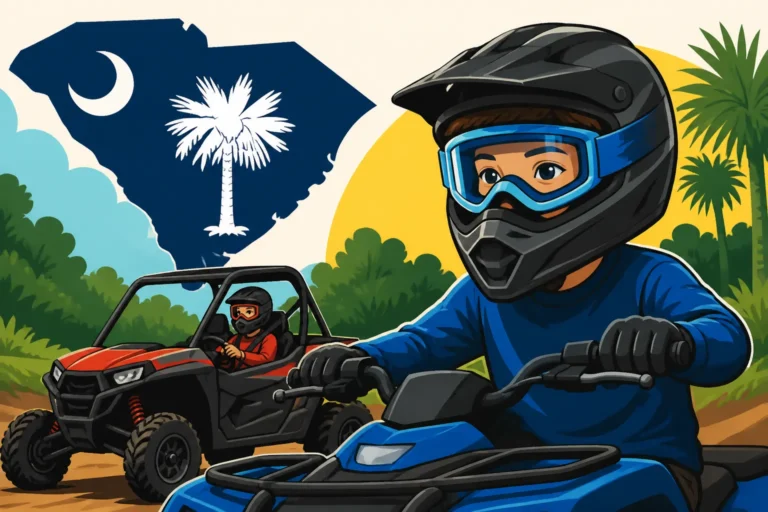
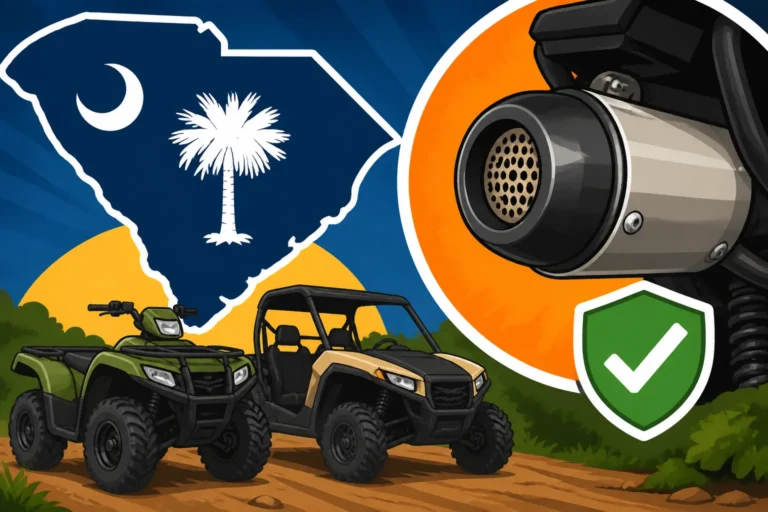
South Carolina places a strong emphasis on rider safety, particularly for younger ATV operators. This translates directly into requirements for helmets and other protective gear, with fines for non-compliance. [South Carolina Helmet Rules for Young Riders] dictate that anyone 15 years old or younger operating or riding as a passenger on an ATV must wear a securely fastened helmet meeting federal safety standards. This isn't optional; it's a critical safety measure, and officers will issue citations if it's ignored. Similarly, [South Carolina Eye Protection for Young Riders] is also required for those under 16, typically meaning goggles or a face shield on a helmet. Beyond personal protective equipment, the law also touches on machine-specific safety features. For instance, ATVs must be equipped with a proper [South Carolina Spark Arrester Requirements] to prevent wildfires, especially when riding on public lands or near wooded areas. Functional [South Carolina Brake Requirements] are also non-negotiable for safe operation. While not always carrying the same direct fine as a helmet violation, operating a machine without proper safety equipment can lead to fines if it's deemed a contributing factor to an incident or if an officer conducts an equipment check. Ensuring your machine is up to par and all riders, especially the young ones, are properly geared up, is essential to avoid fines and, more importantly, stay safe.
Street-Legal UTV Fines: A Different Set of Rules
The landscape for UTVs in South Carolina shifted significantly with new legislation. While standard ATVs remain largely restricted from public roads, certain UTVs can now be made street-legal, but this comes with its own detailed set of rules and potential fines.
The New Era of Street-Legal UTVs Post-2026
For a long time, UTVs (Side-by-Sides) faced similar road restrictions as ATVs, leading to much frustration among owners who saw them as versatile utility machines. However, a significant change arrived with [South Carolina Act 164 and Street UTVs], which, effective around November 2026, allows qualified UTVs to be registered and operated on certain public roads. This was a game-changer, but it didn't open all roads to all UTVs. It created a specific class of "street-legal UTVs" that must meet stringent equipment and registration criteria. [South Carolina Street-Legal UTV Registration Arrives] is a landmark development, recognizing the evolution of these machines. The intent of the law is to allow UTVs that can be made safe enough to share the road, but it's absolutely critical to understand that this is not a blanket permission for any UTV to hit the pavement. Only those that jump through all the hoops and meet specific requirements can do so, and failing to understand these nuances will quickly lead to fines.
Specific UTV Violations and Their Penalties
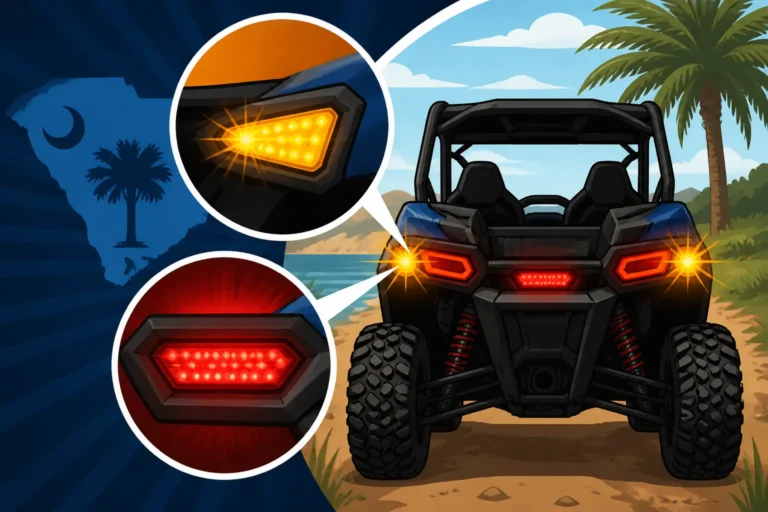
Becoming a street-legal UTV owner means adhering to a whole new layer of rules, and violations here can quickly rack up fines. One major area is equipment. A UTV intended for road use must have turn signals, brake lights, mirrors, a horn, a windshield, and a VIN. Many stock UTVs lack some of these, requiring aftermarket additions. Companies like SuperATV offer kits and components specifically designed to bring UTVs up to street-legal standards, from turn signal kits to DOT-approved windshields. However, simply installing parts isn't enough; they must be correctly installed and fully functional. Operating a "street-legal" UTV that's missing turn signals, for example, is a quick way to get a ticket.
Then there are operational rules. [South Carolina Street UTV Road Speed Limits] are crucial; these machines are generally restricted to roads with posted speed limits of 55 mph or less, and often have their own speed limitations. Driving a street-legal UTV on an interstate or a highway above 55 mph will result in a fine. Additionally, drivers must possess a valid driver's license – a beginner's permit is not sufficient [South Carolina Street UTV License Requirements]. If you're under 21, you'll also need to wear a helmet with a face shield [South Carolina Street UTV Helmet Rules Under 21]. Each of these requirements, if not met, can result in separate fines, turning a single stop into multiple citations.
Registration and Insurance Mandates for Street-Legal UTVs
Unlike off-road ATVs, which generally don't require registration or insurance for private land use in South Carolina, street-legal UTVs are treated much more like cars in this regard. This means that if you've gone through the effort to make your UTV street-legal, you absolutely must have it properly registered with the DMV and carry the legally mandated liability insurance. [South Carolina Insurance Proof at Registration] is a non-negotiable requirement to get your plate. Operating an unregistered street-legal UTV is akin to driving an unregistered car, and it carries significant fines and potential impoundment. The same goes for not having valid insurance.
There's an associated [South Carolina's Biennial Street UTV Fee] that you'll need to pay to keep your registration current, which is an additional cost to factor in beyond the initial [South Carolina Street UTV Registration Cost]. Forgetting to renew, or thinking you can slide by without the proper paperwork, will lead to fines. Law enforcement can easily check your registration and insurance status on the spot, so there's little room for error. Ensuring your UTV is fully compliant with registration, titling, and insurance before ever hitting a public road is paramount to avoid these costly fines.
Golf Cart Fines: The "Radius Rule" and Beyond
Golf carts occupy their own unique legal space in South Carolina, often leading to confusion. While they can be operated on certain public roads, their use is strictly defined, and veering outside those definitions will certainly result in a fine.
Understanding the Golf Cart Permit and Radius
The most iconic rule for golf carts in South Carolina is the "radius rule." To legally operate a golf cart on permitted public roads, you first need a valid [South Carolina Golf Cart Permit Rules]. This permit costs a small fee – you're essentially [Buying a Golf Cart Permit for $5] – and you'll get a decal that needs to be renewed every five years. But the permit doesn't grant carte blanche. The cart must be operated within [South Carolina's 10-Mile Radius Rule] of your home or the place where the cart is temporarily parked. This means you can't just load your cart up on a trailer, take it to another town 50 miles away, and expect to ride it on their public roads under your permit. The intent is clearly for local, neighborhood use. Violating this radius rule, or operating a cart without a valid permit displayed, will almost certainly lead to a fine. It's a common mistake for tourists or new residents who don't fully grasp the hyper-local nature of these permits.
Speed, Daylight, and Road Restrictions for Golf Carts
Beyond the radius, golf carts face other specific restrictions. They can generally only be operated on secondary roads or streets where the posted speed limit is 35 mph or less. Crucially, even on these roads, the golf cart itself often has a maximum speed it can reach. Driving a golf cart on a road with a 45 mph speed limit, or trying to take it on a primary highway, is a violation of [South Carolina Golf Cart Road Rules] and will result in a ticket. Another significant restriction is operating hours. Golf carts are generally limited to [South Carolina Golf Cart Daylight Rules], meaning they cannot be driven on public roads between sunset and sunrise. While some may have headlights, the law often still restricts nighttime operation unless specific, additional requirements are met, which goes beyond the standard permit. Furthermore, passenger rules also apply, especially concerning how many people can be in the cart and whether minors are properly restrained. Ignorance of these specific operational limits is no excuse and can quickly lead to a fine from local law enforcement.
Enforcement and What to Do If You Get a Ticket
Getting a ticket for an ATV, UTV, or golf cart violation can be stressful. Knowing how law enforcement approaches these situations and what your options are if you're cited can help you navigate the process.
How Law Enforcement Identifies Violations
South Carolina law enforcement officers are well-versed in the state's ATV, UTV, and golf cart regulations. They often identify violations through routine patrols, citizen complaints, or during accident investigations. When a deputy pulls over an ATV or UTV, they're typically looking for several key things:
- Proof of Ownership/Permission: Officers will likely ask to see [What a South Carolina Deputy Can Ask to See], such as a bill of sale or written permission if you're on private land not your own. While ATVs don't have mandatory titles in SC, having proof of ownership is still vital.
- Road Usage: The most obvious violation is simply being on a prohibited public road.
- Rider Age and Safety Gear: Officers pay close attention to the age of riders and whether they're wearing required helmets and eye protection, particularly for minors.
- Equipment Compliance: For street-legal UTVs and golf carts, they'll check for proper lighting, signals, and other mandated safety equipment.
- Permit and Registration: For golf carts and street-legal UTVs, they'll verify the presence of a valid permit or registration and corresponding decals.
- Trespass: Riding on private land without explicit permission is a major offense, covered by [South Carolina Trespass Law for Riders], and can lead to severe fines and even impoundment of your machine.
Common scenarios where riders get caught include: riding through neighborhoods, cutting across roads, riding on fire breaks or utility easements that are not public trails, or being observed by residents who report illegal activity. Officers are also particularly aware of "hot spots" where violations are common.
Disputing a Citation and Court Procedures
If you receive an ATV, UTV, or golf cart citation in South Carolina, you generally have a few options: pay the fine, or contest it in court. If you believe the ticket was issued in error, or if you have a valid defense, you have the right to [How to Dispute an ATV Citation in Court]. This usually involves notifying the court of your intention to plead "not guilty" by a specific deadline. You will then be scheduled for a court date.
During your court appearance, you'll have the opportunity to present your side of the story, provide evidence (such as photos, documents, or witness testimony), and cross-examine the issuing officer. It's wise to gather any and all documentation that supports your case, whether it's a valid permit, proof of ownership, or evidence of private land access. Remember that court costs will be added if you're found guilty, making the total penalty even higher. Fines can also escalate for repeat offenders or if more serious violations, like [South Carolina DUI Law and Off-Road Machines], are involved. Consulting with an attorney experienced in traffic or ATV law can be beneficial, especially if the fines are substantial or if there are multiple charges.
Preventing Fines: Best Practices for Riders
The best way to deal with fines is to avoid them altogether. By being proactive and informed, you can enjoy your ride without the looming threat of a ticket.
- Know the Laws: This is paramount. Don't assume. Research [South Carolina ATV Age Requirements], [South Carolina Golf Cart Permit Rules], and [South Carolina Street UTV Requirements Explained] specific to where you plan to ride. Local ordinances can sometimes add additional restrictions, so check with county or municipal offices.
- Strictly Adhere to Age and Supervision Rules: If you have young riders, ensure they are on age-appropriate machines, wear helmets and eye protection, and are always supervised as required by law.
- Stay Off Public Roads (Unless Street-Legal): For ATVs, simply avoid public roads unless you have a very specific, legally defined exception. For street-legal UTVs, make absolutely sure your machine meets all equipment requirements, is properly registered, and insured, and you understand where you can and cannot ride (e.g., [South Carolina Street UTV Road Speed Limits]).
- Obtain Proper Permits/Registrations: If you're riding a golf cart or a street-legal UTV, ensure your permit or registration is current and clearly displayed. Renew your [South Carolina Golf Cart Decals Every Five Years] on time.
- Respect Private Property: Always get explicit, written permission from landowners before riding on their property. Trespassing is a serious offense.
- Maintain Your Machine: Ensure all safety equipment, from brakes to spark arresters, is in good working order.
By following these best practices, you can enjoy the fantastic riding opportunities South Carolina offers without incurring unnecessary fines. Remember, companies like SuperATV can help you equip your UTV to meet many of the requirements for street-legal operation, but ultimately, compliance is the rider's responsibility.
South Carolina Off-Road Vehicle Road Use Comparison
Understanding the distinct rules for ATVs, street-legal UTVs, and golf carts on South Carolina roads is crucial for avoiding fines. Here's a quick comparison of key aspects:
| Feature | Off-Road ATVs | Street-Legal UTVs (Post-2026) | Golf Carts |
|---|---|---|---|
| Public Road Use | Generally Prohibited | Permitted on certain roads (55 mph speed limit or less) | Permitted on secondary roads (35 mph speed limit or less) within 10-mile radius of home |
| Registration Required | No (optional titling) | Yes | Yes (Permit) |
| Title Required | Optional | Yes | No (but MCO often required for permit application) |
| Insurance Required | No (for off-road use) | Yes (liability insurance mandatory) | No (but highly recommended) |
| Driver's License | Not for off-road use (adult supervision for minors) | Yes (valid driver's license, no beginner's permit) | Yes (valid driver's license) |
| Helmet Required | Yes (15 and under) | Yes (under 21 with face shield) | No (but recommended for all ages) |
| Daylight Operation | No specific road rule (general prohibition) | Yes (can operate day/night with proper lighting) | Generally Daylight Only |
| Common Violations | Riding on any public road, age/supervision issues, lack of safety gear for minors | Missing required equipment, exceeding speed limits, no registration/insurance | Exceeding 10-mile radius, riding on high-speed roads, nighttime operation, no permit |
| Fine Range | $50 – $200 + court costs | $50 – $200 + court costs | $50 – $200 + court costs |
Disclaimer
This article is for general informational purposes only and does not constitute professional advice. Laws, prices and regulations vary by location and change over time. Consult a qualified professional for guidance on your specific situation.