No Passenger for an Unlicensed Young Rider
If a young ATV rider does not have a driver’s license, the passenger rule is easy to misread: it is not permission to ride alone or a substitute for other age and safety requirements. Here’s what South Carolina’s rule says, how it fits with supervision and training rules, and what to check before a ride.
What South Carolina’s passenger rule means
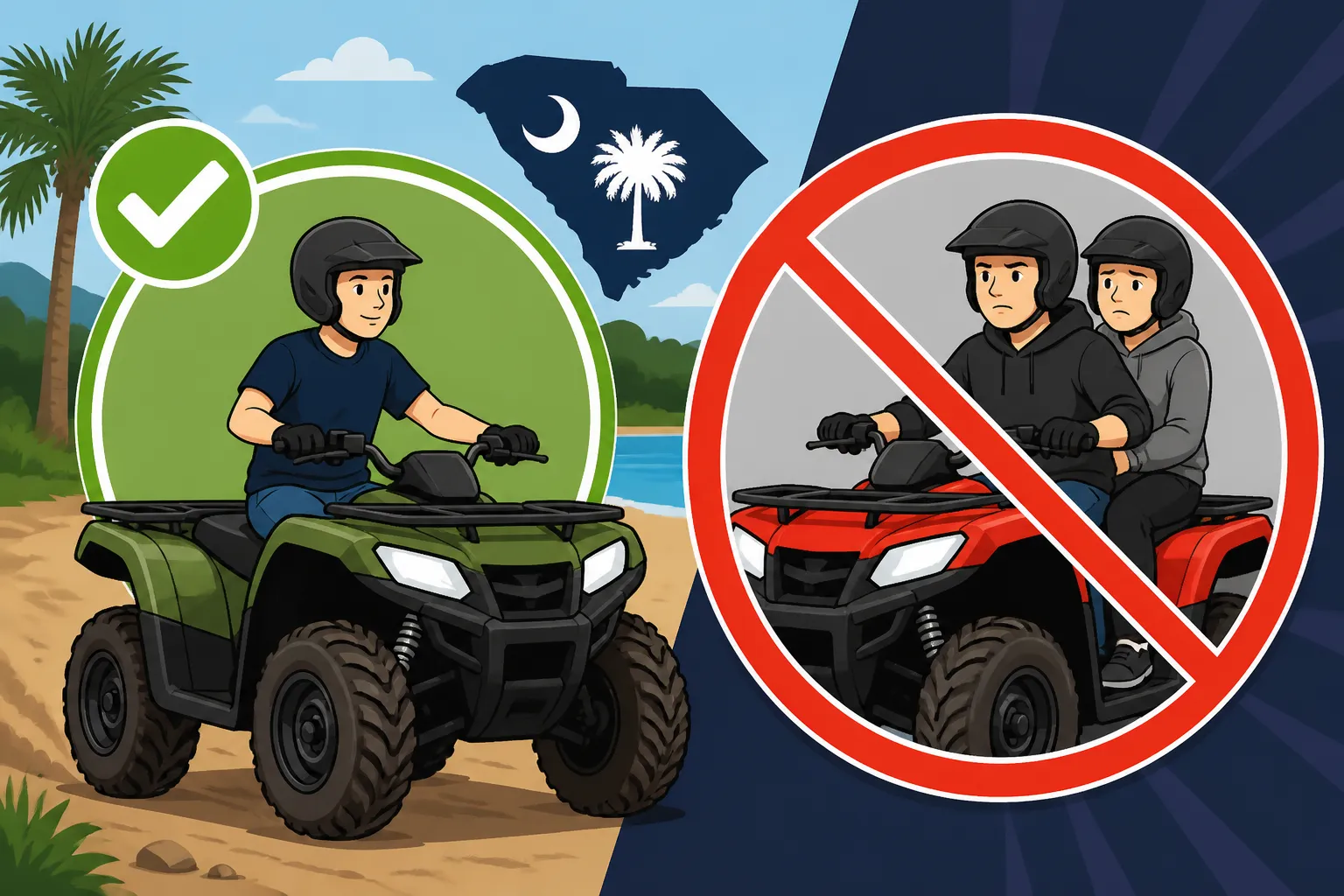
According to the South Carolina Legislative Services Agency, an ATV operator under 16 who does not have a driver’s license may not carry passengers. The South Carolina Department of Public Health describes the rule as prohibiting riders from carrying a passenger on an ATV without a valid driver’s license.
In practical terms, a young rider who is not licensed must ride without a passenger. Having a parent nearby, completing a safety course, or riding on private property does not, by itself, turn that rider into a licensed operator or create permission to carry someone. The passenger restriction is separate from requirements about age, supervision, training, helmets, and where the ATV is operated.
This rule is about carrying a passenger on an ATV. It is not a general rule that every ATV rider must have a driver’s license to operate the machine. A rider may still be allowed to operate an ATV if they meet the requirements that apply to their age and riding location, but they cannot carry a passenger if they fall under the no-license restriction.
| Situation | What to keep in mind |
|---|---|
| Operator is under 16 and has no driver’s license | The South Carolina Legislative Services Agency says the operator cannot carry a passenger. |
| Young rider has completed a safety course | A course may satisfy a training requirement, but it does not replace a driver’s license for carrying a passenger. |
| Young rider is with an adult | Supervision may be required for young riders in certain settings, but it does not cancel the passenger restriction. |
| Machine is a UTV rather than an ATV | Do not assume ATV passenger rules and road-use rules are interchangeable; the applicable requirements depend on the vehicle and where it is used. |
The distinction matters when a family is planning a ride. A child may be permitted to operate an ATV under some circumstances and still be prohibited from taking a sibling or friend along. If the planned ride involves a passenger, confirm the operator’s license status and the specific rules that apply before the machine starts moving.
For related age and operation rules, see South Carolina ATV Age Requirements and South Carolina Rules for a Child Passenger.
The passenger rule is only one part of a young rider’s requirements
South Carolina’s rules for young ATV riders layer several separate obligations together. Meeting one does not automatically meet the others. A safety certificate, adult accompaniment, helmet, and passenger restriction each address a different part of riding safely and lawfully.
According to the South Carolina Department of Motor Vehicles, parents or guardians cannot allow a child under 6 to drive an ATV, and cannot allow a rider 16 or younger to drive unless accompanied by an adult. The South Carolina Department of Public Health also says that children 16 and under must be accompanied by an adult when riding an ATV on public land. These are supervision rules; they do not give an unlicensed young operator permission to carry a passenger.
Training is another separate requirement. According to the South Carolina Legislative Services Agency, operators age 15 and younger must possess a safety certificate from an approved hands-on course. The South Carolina Department of Public Health likewise says children under 16 must complete a hands-on ATV rider safety training course approved by the ATV Safety Institute before operating. Check the course and certificate requirements for the child’s age and riding situation rather than assuming that informal instruction is enough.
Helmet and eye protection rules also apply independently. According to the South Carolina Legislative Services Agency, operators age 15 and younger must wear a safety helmet meeting FMVSS #218 and eye protection. The South Carolina Department of Public Health says children under 16 must wear a safety helmet and eye protection while operating an ATV.
| Requirement | Why it matters |
|---|---|
| Minimum operating age | Sets the youngest age at which a child may operate an ATV under the state rule. |
| Adult supervision | Applies to young operators in the circumstances specified by law, including riding on public land. |
| Approved hands-on safety course | Applies to young operators covered by the training rule. |
| Helmet and eye protection | Protect the operator and are required for the age groups identified in state rules. |
| No passenger for an unlicensed young operator | Prevents a young operator without a driver’s license from carrying another rider. |
For an age-specific breakdown, South Carolina Rules for a 15-Year-Old Rider can help identify which duties apply at that age. See South Carolina Safety Certificate Requirements for more on training, and South Carolina ATV Helmet Law for protective gear rules.
Where the ride takes place can change what else applies
A passenger restriction does not tell you, on its own, whether a young person may ride in a particular place. Public land, private property, and a designated trail can each bring additional rules. Before a ride, identify the land type and check the rules that govern that location.
The South Carolina Legislative Services Agency says ATV operators age 16 and younger must be accompanied by an adult on public lands. The South Carolina Department of Public Health also says children 16 and under must have an adult accompanying them when riding on public land. That requirement is about the young operator’s supervision; it does not create an exception to the no-passenger rule for an unlicensed operator.
On private property, different provisions may be relevant. According to the South Carolina Legislative Services Agency, minors between 6 and 16 may operate ATVs on private property under the direct visual supervision of a parent or legal guardian. The agency also identifies exemptions for specified farming, ranching, wildlife management, hunting, and trapping activities. Do not treat an exemption for a particular activity as a blanket exemption from every safety or passenger rule; check whether the activity and circumstances actually qualify. See South Carolina Private Property Exemptions and South Carolina Hunting and Trapping Exemptions for those distinctions.
A public trail can have its own operating conditions as well as state requirements. For example, the Forest Service says the Enoree OHV Trail has a beginner loop for children with dirt bikes smaller than 110 cc or ATVs smaller than 90 cc. That trail feature does not, by itself, change South Carolina’s passenger rule, training requirements, or any applicable supervision requirement. The Forest Service also says operators must have a permit in their possession while riding on its trails, and that riders should check the Call Before You Haul hotline for current trail status.
Before taking a young rider to a Forest Service trail, check the current access rules and make sure the vehicle is allowed. The Forest Service prohibits side-by-sides over 50 inches, Jeeps, and other 4×4 vehicles on the Enoree OHV Trail. The Forest Service also says children under 16 are required to wear helmets there. Those trail-specific conditions sit alongside state law rather than replacing it.
The general lesson is to check the place, the machine, and the rider separately. A child’s permission to operate an ATV in one setting does not necessarily carry over to a different trail or type of land. For rules concerning wildlife management areas, see South Carolina WMA Regulations for Vehicles.
Avoid confusing ATV rules with UTV road rules
ATVs and UTVs are different vehicle categories, and their passenger rules should not be blended. The ATV restriction discussed here concerns an unlicensed young ATV operator carrying a passenger. A UTV may be subject to separate requirements, especially when it is operated on a public road.
The South Carolina Department of Public Safety says passengers in a UTV operated on a public road must be at least 8 years old, and the driver must be at least 17 with a valid Class D driver’s license. The South Carolina Department of Motor Vehicles says drivers and passengers under 21 operating a UTV on public roads must wear a helmet with a chin strap and a face shield or goggles. These are UTV road-use rules; they do not alter the ATV passenger rule.
The South Carolina Department of Public Safety says operating a UTV on public roads is illegal and subject to citation until November 18, 2026, when the new state law allowing UTVs on certain public roads takes effect. After that date, road use remains limited by requirements involving the vehicle, registration, insurance, road type, and operating area. Do not interpret the change as permission to use any ATV or UTV on any road.
If the vehicle’s type is unclear, check its documentation and the applicable rules before planning a passenger ride. For additional context, see South Carolina Street UTV Rules From November 2026 and South Carolina ATV Rules for a Child Passenger.
A practical check before letting a young rider carry anyone
Use this checklist before a ride, especially when another child wants to join:
- Confirm the vehicle category. Make sure the machine is an ATV and not a UTV, since separate rules may apply to each.
- Check the operator’s license status. If the operator is under 16 and does not have a driver’s license, do not allow them to carry a passenger, as specified by the South Carolina Legislative Services Agency.
- Check age and supervision requirements. According to the South Carolina Department of Motor Vehicles, a child under 6 cannot be allowed to drive an ATV, and a rider 16 or younger must be with an adult. Confirm the requirements for the location, too.
- Verify training and protective gear. The South Carolina Legislative Services Agency requires a safety certificate from an approved hands-on course for operators age 15 and younger and requires those operators to wear a helmet meeting FMVSS #218 and eye protection.
- Check landowner and trail rules. Confirm that riding is allowed and that the trail permits the machine. A trail’s beginner area or a landowner’s permission does not automatically waive state requirements.
- Keep the passenger off the ATV if the rule applies. Do not use adult presence, a safety course, or a different riding location as a substitute for the required driver’s license.
If you are buying protective equipment, check that the helmet and eye protection meet the requirements for the rider rather than relying on a product description alone. A listing on Amazon or another marketplace is not a substitute for confirming the standard and fit.
When in doubt, pause the ride and verify the rule with the relevant land manager or state agency. The South Carolina Legislative Services Agency says violations of the ATV chapter carry fines between fifty and two hundred dollars upon conviction. That is another reason not to treat passenger eligibility as a casual judgment call.
Sources
- South Carolina Department of Motor Vehicles — Terrain Vehicles | SCDMV (checked November 3, 2026)
- Forest Service — Francis Marion and Sumter National Forests | Enoree OHV Trail | Forest Service (checked November 3, 2026)
- South Carolina Department of Motor Vehicles — Terrain Vehicles | SCDMV (checked November 3, 2026)
- South Carolina Department of Public Health — ATV Safety | South Carolina Department of Public Health (checked November 3, 2026)
- South Carolina Legislative Services Agency — Code of Laws – Title 50 – Chapter 26- – FISH, GAME AND WATERCRAFT (checked November 3, 2026)
- South Carolina Department of Public Safety — UTV Law | SCDPS (checked November 3, 2026)
- Francis Marion Sumter National Forest — Enoree%20OHV%20Trail%20rules_0.pdf (checked November 3, 2026)
- Forest Service — Francis Marion and Sumter National Forests | Wambaw Cycle Trail (North Loop) | Forest Service (checked November 3, 2026)
- Forest Service — Francis Marion and Sumter National Forests | Wambaw Cycle Trail (South Loop) | Forest Service (checked November 3, 2026)
Disclaimer
This article is for general informational purposes only and does not constitute professional advice. Laws, prices and regulations vary by location and change over time. Consult a qualified professional for guidance on your specific situation.