Learning on a Real Quad With an Instructor
A child may be eager to ride, but learning on a real quad takes more than a quick explanation in the driveway. South Carolina has hands-on ATV safety course requirements for young riders, and it matters that the course is approved. Here’s what the training involves, how to prepare, and how to think about the next step: supervised practice on a suitable trail.
What a hands-on ATV course teaches
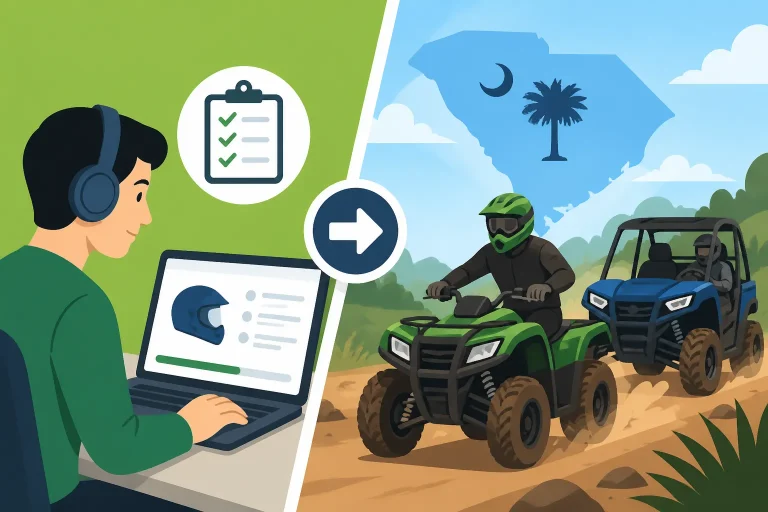
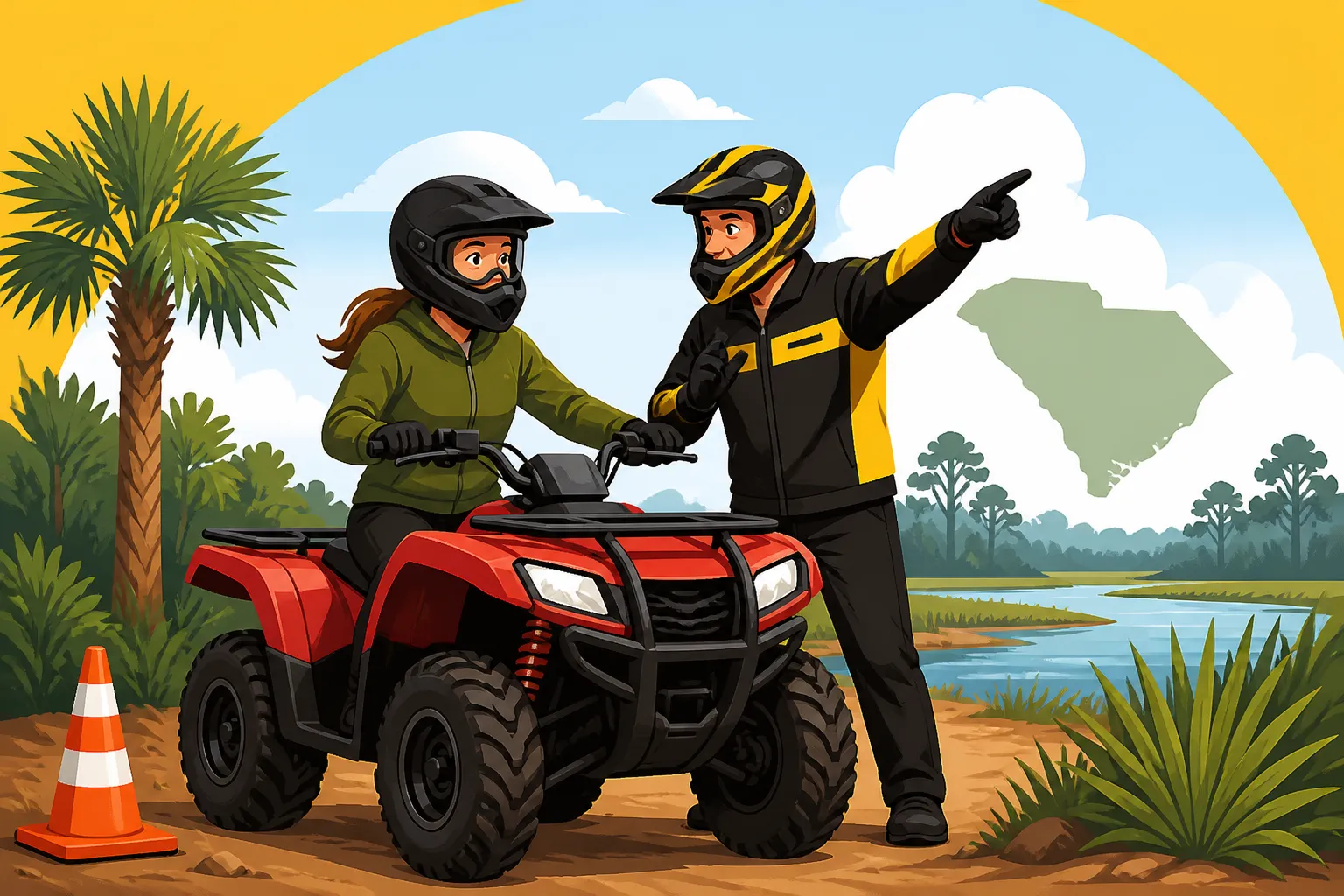
A hands-on course gives a young rider a chance to practice operating an actual ATV under instruction. It is different from watching a video or reading about controls: the learner has to respond to the machine, terrain and directions while building basic habits.
The course requirement is tied to age. According to the South Carolina Legislative Services Agency, operators age 15 and younger must possess a safety certificate from an approved hands-on course. The South Carolina Department of Motor Vehicles also says children 15 or younger must successfully complete a hands-on ATV safety course approved by the All-Terrain Vehicle Safety Institute. The South Carolina Department of Public Health describes the course requirement as applying to children under 16. Because the wording differs slightly among these sources, confirm the requirement for the rider’s age with the official source before scheduling.
The key point is that the course must be hands-on and approved. A general riding lesson, a manufacturer’s video or informal coaching may help a child learn, but it should not be treated as a replacement for the required course and certificate. For more on the rules, see South Carolina Safety Certificate Requirements and South Carolina Safety Courses for Riders 15 and Under.
Training is also about deciding whether a child is ready to ride at all. South Carolina’s minimum age to operate an ATV is 6 years old, according to the South Carolina Department of Public Health. The South Carolina Legislative Services Agency says parents or legal guardians may not allow a child under 6 to operate one. Meeting the minimum age does not automatically mean a child is ready for a particular machine or trail.
A course can help a learner understand core skills such as:
- Identifying the controls and checking the machine before riding.
- Using a safe starting and stopping routine.
- Steering and managing speed in a controlled setting.
- Recognizing that surface conditions affect traction and handling.
- Following instructor directions and yielding when needed.
- Understanding basic protective equipment and trail conduct.
Those skills matter because an ATV is not simply a smaller car. It is designed primarily for off-road travel and is no more than 50 inches wide, according to the South Carolina Department of Motor Vehicles. Its balance, steering and response to uneven ground differ from a passenger vehicle. Learning these differences with an instructor is more useful than asking a child to figure them out while following a group on a busy trail.
A course certificate is a legal requirement for young riders, not a guarantee that every rider is ready for every machine or situation. Parents still need to consider the manufacturer’s age guidance, the child’s ability to understand instructions, and whether the ATV is an appropriate size. South Carolina law also prohibits removing the manufacturer’s age restriction warning label, according to the South Carolina Legislative Services Agency. Read South Carolina Age Restriction Warning Labels before treating a machine as suitable for a young rider.
How to prepare for instruction and supervised practice
A little preparation can make the course more useful. The goal is not to teach the child everything beforehand; it is to help them arrive ready to listen, ask questions and follow instructions.
Confirm the course is approved
Before enrolling, ask the provider whether the course is hands-on and approved by the ATV Safety Institute. Ask what the student needs to bring, what equipment is provided, and how the safety certificate is issued. The facts available about South Carolina’s requirement do not establish a single course location or enrollment process, so confirm those details directly with the provider.
If a course description is unclear, ask whether it is intended to meet South Carolina’s safety certificate requirement for young operators. Don’t rely on a course title alone. Keep any completion information or certificate where it can be found later, and ask the provider how to replace it if it is misplaced. South Carolina Safety Certificate Lookup may help with the next administrative question.
Check equipment before the class
Ask the instructor what protective equipment the student must bring. South Carolina’s young-rider rules include helmet and eye-protection requirements: the South Carolina Legislative Services Agency says operators age 15 and younger must wear a safety helmet meeting FMVSS #218 and eye protection. The South Carolina Department of Public Health also says children under 16 must wear a safety helmet and eye protection while operating an ATV.
Make sure the helmet fits securely and that the eye protection works with it. If you are shopping for gear, Amazon may help you compare options, but check the manufacturer’s specifications and fit rather than choosing by appearance. Confirm the equipment meets the required standard and ask the course provider whether it has additional gear rules.
Dress for a fall or a change in weather, and avoid clothing that could snag on controls or moving parts. The exact clothing and equipment list can vary by provider, so use the instructor’s directions rather than assuming every class follows the same setup.
Explain the purpose of the class
Children can feel pressure to keep up with other riders or to appear confident. Before the class, make clear that stopping to ask a question is a good decision. A learner should tell the instructor if a control is confusing, a helmet feels uncomfortable or the ATV seems difficult to manage.
Parents can also help by discussing simple signals for pausing or stopping and by reinforcing that the instructor’s directions come first. Avoid giving conflicting instructions from the sidelines. A calm adult presence is useful; a second coach calling out commands can make a new rider less sure of what to do.
After the course, ask the instructor what the child handled well and what needs more practice. The answer can guide the next step: repeat a basic skill in a controlled setting, wait before moving to more challenging terrain, or choose a smaller and more manageable machine. A certificate confirms course completion; it does not remove the need for adult judgment.
Keep the machine in safe working order
Before any practice ride, check that the ATV is in suitable condition. South Carolina requires ATVs to have an effective muffler system, a USDA Forest Service-approved spark arrester and a working brake system, according to the South Carolina Legislative Services Agency. Ask the instructor or a qualified mechanic if you are unsure whether the machine meets those requirements. South Carolina Equipment Requirements for ATVs covers the related equipment rules.
Choosing a place to practice after the course
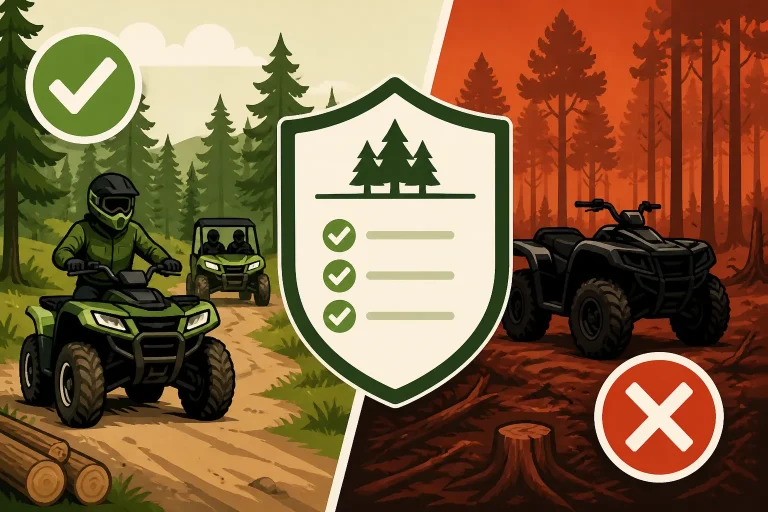
After training, pick a legal riding area that suits the learner’s current ability. Public trails are not a substitute for a training course, and a trail’s beginner option does not necessarily mean it is an appropriate place for a child to learn without supervision.
Enoree OHV Trail offers 23 miles of trail with easy to moderate difficulty and interconnecting loops, according to the Forest Service. The Forest Service also identifies a beginner loop for children riding dirt bikes smaller than 110 cc’s or ATVs smaller than 90 cc’s. That smaller-machine loop may be a practical place to consider, but check the current trail status and rules before traveling. See Enoree OHV Trail in South Carolina and Best South Carolina ATV Trails for Beginners for related planning information.
The Forest Service says the Enoree trail has one-way sections marked with orange blazes and two-way sections marked with white blazes. Teach a child to follow the markings and remain on designated trails. A beginner rider should not be expected to memorize the whole trail system at once, so keep the route conservative and stop if the rider is tired, uncertain or struggling to maintain control.
Trail access has its own requirements. According to the Forest Service, daily and annual passes for the Enoree OHV Trail must be purchased through Recreation.gov, and operators must have a permit in their possession while riding. Passes must be downloaded to a phone or printed ahead of time and available during the ride. The Forest Service says fee tubes are no longer available on-site for cash payment, a change noted as of November 2026. Check the official trail information before setting out in case purchasing or access instructions have changed.
The Forest Service advises riders to check the Call Before You Haul hotline for current trail status. The Forest Service lists the number as (803) 561-4025. Weather and maintenance can affect access, so checking before loading the machine can prevent a wasted trip. The Enoree Ranger District office is at 20 Work Center Road, Whitmire, SC 29178, and its listed phone number is (803) 276-4810. The Forest Service gives office hours as Monday through Friday, 8:30 a.m. to 4:30 p.m.
Not every South Carolina OHV trail is open to every machine. The Forest Service says side-by-sides over 50 inches, Jeeps and other 4×4 vehicles are prohibited on the Enoree OHV Trail. That limit is easy to overlook if a family owns both an ATV and a UTV. Confirm the vehicle type and trail rules before going; South Carolina Trails That Allow Side-by-Sides can help with that distinction.
Keep children under close supervision. According to the South Carolina Department of Public Health, children age 16 and under must be accompanied by an adult when riding an ATV on public land. The Forest Service also requires children under 16 to wear helmets on the Enoree trail. Riders should stay on marked routes and avoid treating a trailhead, road crossing or unmarked track as an extension of the riding area.
Keep ATV training separate from road-going UTV rules
An ATV safety course does not qualify a machine for public-road use, and it is not the same as learning to drive a street-legal UTV. The two vehicles and rule sets are different. An ATV is designed mainly for off-road travel; a street-legal UTV must meet separate vehicle specifications and road-use conditions.
According to the South Carolina Department of Motor Vehicles, a UTV must be four-wheel drive, have an engine displacement of at least 450cc, reach a top speed greater than 55 mph, measure 80 inches or less in width and have a gross weight rating of 4,000 pounds or less to qualify as street legal. It must also have factory-approved Type 2 seat belts for every seat. These are specifications for street-legal UTV qualification, not beginner recommendations for choosing an ATV.
The road-use rules have their own age, license and equipment requirements. According to the South Carolina Department of Motor Vehicles, registered UTVs may be operated on certain public roads starting November 18, 2026, with restrictions. Drivers must be at least 17 years old and hold a valid driver’s license. UTVs may be used only on roads with a speed limit of 55 mph or less and within a 10-mile radius of the address listed on the registration. Drivers and passengers under 21 must wear a helmet with a chin strap and a face shield or goggles.
Those road rules do not turn a young ATV rider’s course certificate into road-driving authorization. Before using a UTV on public roads, check its eligibility and the current requirements for registration, insurance, equipment and operation. South Carolina Street UTV Requirements Explained and South Carolina Street UTV Rules From November 2026 cover those separate topics.
For families, the useful sequence is straightforward: meet the child’s legal course requirement, confirm the ATV is suitable, use properly fitting protective gear, and choose a legal practice area that matches the rider’s ability. Keep the instructor’s feedback in mind after the course. A young rider’s confidence should grow with demonstrated control, not pressure to move quickly to a harder trail.
Sources
- South Carolina Department of Motor Vehicles — Terrain Vehicles | SCDMV (checked November 3, 2026)
- Forest Service — Francis Marion and Sumter National Forests | Enoree OHV Trail | Forest Service (checked November 3, 2026)
- Forest Service — Francis Marion and Sumter National Forests | Parsons Mountain OHV Trail | Forest Service (checked November 3, 2026)
- South Carolina Department of Motor Vehicles — Terrain Vehicles | SCDMV (checked November 3, 2026)
- South Carolina Department of Public Health — ATV Safety | South Carolina Department of Public Health (checked November 3, 2026)
- South Carolina Legislative Services Agency — Code of Laws – Title 50 – Chapter 26- – FISH, GAME AND WATERCRAFT (checked November 3, 2026)
- South Carolina Department of Public Safety — UTV Law | SCDPS (checked November 3, 2026)
- Forest Service — Francis Marion and Sumter National Forests | Off-Highway Vehicles (OHV) | Forest Service (checked November 3, 2026)
- Forest Service — Francis Marion and Sumter National Forests | Check the Call Before You Haul hotline before riding our OHV trails | Forest Service (checked November 3, 2026)
- Francis Marion Sumter National Forest — Enoree%20OHV%20Trail%20rules_0.pdf (checked November 3, 2026)
- USDA Forest Service — Francis Marion and Sumter National Forests | Cedar Springs OHV Trail | Forest Service (checked November 3, 2026)
- Forest Service — Francis Marion and Sumter National Forests | Wambaw Cycle Trail (North Loop) | Forest Service (checked November 3, 2026)
- Forest Service — Francis Marion and Sumter National Forests | Wambaw Cycle Trail (South Loop) | Forest Service (checked November 3, 2026)
Disclaimer
This article is for general informational purposes only and does not constitute professional advice. Laws, prices and regulations vary by location and change over time. Consult a qualified professional for guidance on your specific situation.