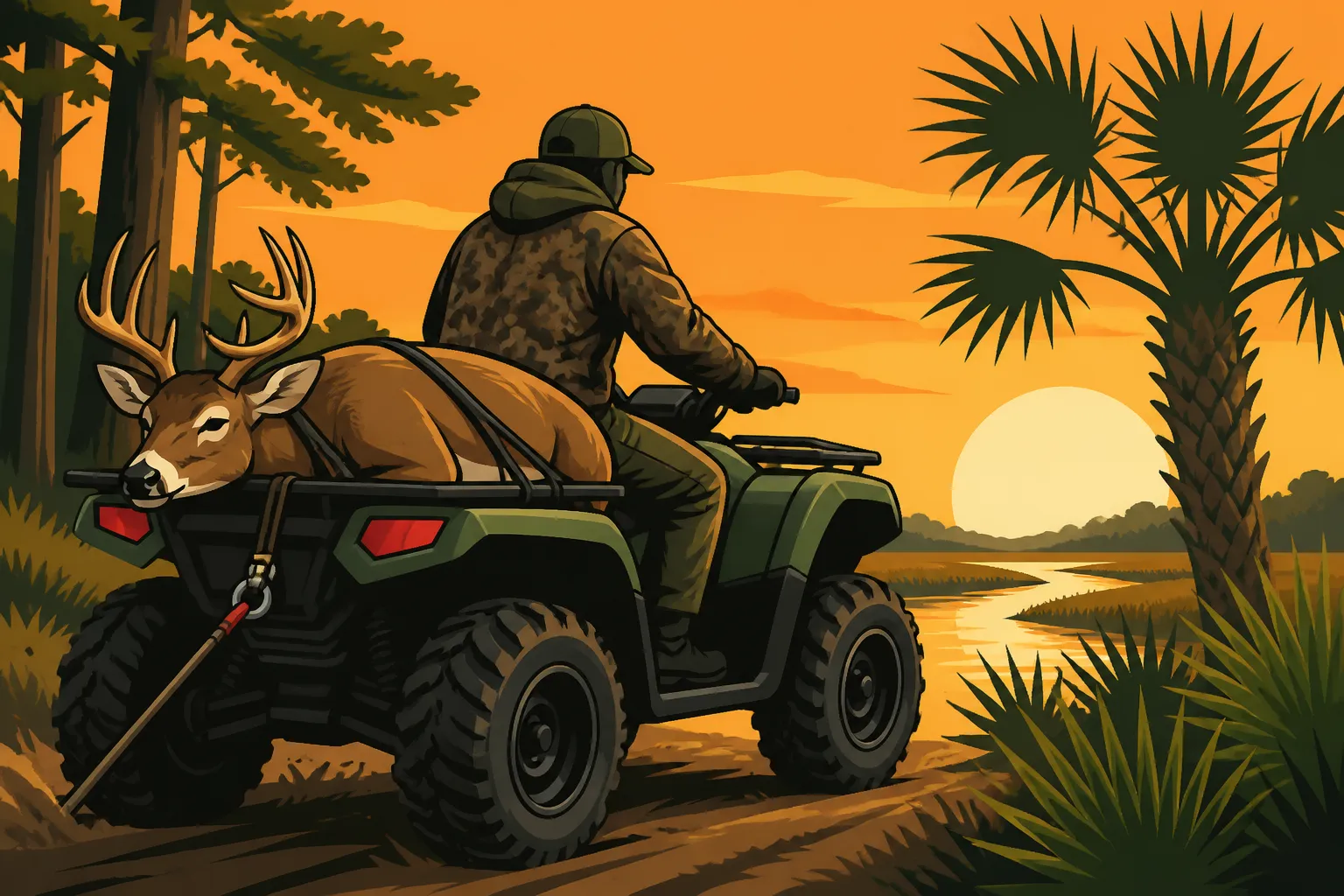
Hauling a Deer Out by Quad in South Carolina
Recovering a deer with a quad can save a long carry, but permission, land rules and safe loading matter as much as the machine. In South Carolina, a hunting-related exception does not automatically open every road or public property to ATVs. Here’s how to plan a retrieval, check where you can ride, and bring the deer out without creating a safety or compliance problem.
Start with permission and the land’s rules
Before riding toward a downed deer, establish that you may operate the quad on the route you plan to use. A hunting license, permission to hunt, or permission to retrieve a deer does not necessarily grant permission to drive an ATV or UTV across every part of the property.
On private land, ask the landowner or lease manager about the specific route, gates, posted areas, and any limits on machine use. Permission to hunt may not include permission to cross a neighboring parcel, use a timber road, or ride on a restricted road. Written permission can prevent confusion, especially when multiple owners or clubs manage nearby ground. The details in South Carolina Landowner Permission Forms can help you keep access permission clear.
Timberland deserves particular care. A road that looks open may be private, gated, subject to a company’s access policy, or in use by logging crews. Confirm whether the road is open to ATVs and whether there are active operations before entering. See South Carolina Timber Land Access for more on checking access rather than assuming a visible road is available.
Public hunting land is a separate issue. South Carolina’s Wildlife Management Areas have property-specific rules, and ATV or UTV use is generally restricted unless the relevant property rules or an authorized access arrangement allow it. Don’t assume that being licensed to hunt, or having a deer to retrieve, gives you permission to ride there. Check the current rules for the exact WMA before the hunt, not only after you make a recovery. South Carolina WMA Riding Is Prohibited and A Hunting License Opens No Trails to Quads explain why hunting access and motorized access are not the same thing.
South Carolina law includes hunting and trapping exemptions in its off-road vehicle rules, but an exemption is not a blanket pass to ride anywhere. It does not grant access to land you do not have permission to use, override property-specific restrictions, or make a prohibited route lawful. For the distinction, see South Carolina Hunting and Trapping Exemptions. When the legal scope is unclear, confirm it with the land manager or the agency responsible for the property.
| Situation | What to confirm before riding |
|---|---|
| Private property you hunt | Permission for the quad, the route, and any gates or restricted areas |
| Leased hunting property | The lease’s vehicle rules and the manager’s approval |
| Timberland or a logging road | Current access policy, closures, and active work |
| Wildlife Management Area | The current rules for that specific property and any authorization required |
| Public road or road crossing | Whether the machine and rider may use that road, and what rules apply |
| Neighboring parcel | Separate permission; permission on one property does not carry over |
If the deer is on one parcel and your machine is parked on another, stop and get permission before crossing. Do not treat a fence, field edge, creek, or old two-track as an implied boundary or permission to proceed. A short phone call can prevent a trespass complaint and avoid turning a simple recovery into a bigger problem.
Plan the route before you ride
The best retrieval route is usually the shortest permitted route that avoids steep banks, soft ground, water, and unnecessary turns. Look at the terrain before setting off, and consider whether the machine can get back out with a loaded rack. A route that is easy to ride in on an empty quad may be unsafe or impassable when the deer is aboard.
Check for hazards that can be hard to see from the machine: hidden ditches, wire, stumps, loose rock, slick clay, fallen limbs, and washouts. In wooded areas, confirm that a narrow track is actually open to vehicles rather than a footpath or closed trail. If the route crosses a creek, do not assume you can ride through the water. South Carolina has specific rules for watercourse crossings; review South Carolina Rules for Crossing a Creek and use only a lawful, suitable crossing.
On a farm or hunting lease, ask whether the landowner has designated access lanes or areas where machines should stay. Restricting travel to an agreed route can reduce damage to crops, soil, fences, and habitat. It can also reduce the chance of disturbing other hunters or disrupting active work.
Before leaving the staging point:
- Tell someone where you are going and when you expect to return.
- Make sure the quad is in good working order, with functional brakes, tires, steering, and lights.
- Carry a charged phone or another communication device, while recognizing that signal may be limited.
- Bring water, a first-aid kit, and basic recovery equipment suited to the route.
- Wear appropriate protective gear and keep any required safety equipment accessible.
- Check that the load can be secured without covering the rider’s controls or blocking safe movement.
A recovery plan should include a way to get back out if the machine becomes stuck or the load shifts. Avoid setting out alone into unfamiliar or difficult terrain if you do not have a reliable way to call for help. If you are riding in a group, agree on who will operate the loaded machine and how the others will assist without standing in a dangerous position.
Do not use a public road as a shortcut simply because it connects two parts of a property. ATV and UTV road-use rules are different from rules for riding on private ground. Check the route and the machine’s legal status before using any public road; South Carolina Rules for Riding a Farm Road covers the importance of distinguishing a private farm route from a road with public access.
Load and secure the deer safely
A deer can be awkward, heavy, and difficult to balance. Load it only if the quad’s rack, cargo system, and rated capacity can handle the weight. The manufacturer’s capacity includes the rider, any passenger, gear, and cargo—not just the deer. A large animal can exceed what a small machine can safely carry, even if it can be physically lifted onto the rack.
Whenever possible, use a purpose-built cargo setup or a game cart for terrain where pulling is permitted. If you compare straps, cargo nets, or weather-resistant bags on Amazon or elsewhere, check their stated working limits, attachment points, and compatibility with your rack. A product that looks strong is not necessarily suitable for securing a shifting load on uneven ground.
Secure the deer so it cannot slide, swing, or interfere with the rider. Use multiple attachment points and check the load before moving, after the first short stretch, and whenever the terrain changes. Keep the weight as low and centered as practical. A high or uneven load can make a quad unstable, especially on a side slope or during a turn.
Do not overload the rear rack or place weight where it blocks the exhaust, lights, controls, or the rider’s ability to move. Never carry a deer in a way that prevents the rider from steering, braking, or dismounting safely. If the animal cannot be secured without compromising control, make another trip, use a cart, or bring in a second machine only if the property rules allow it.
Ride slowly and smoothly. Avoid sharp turns, sudden braking, steep side hills, and aggressive throttle inputs. Keep extra distance from other riders and give yourself more time to stop. If the route is too steep, muddy, narrow, or unstable with the load, turn around and choose a safer method rather than trying to force the machine through.
Never try to recover the deer while the quad is moving or while it is perched on unstable ground. Park on firm, level ground, set the brake, and turn the machine off before adjusting straps or shifting cargo. Keep hands and feet away from pinch points, and ask for help lifting if the animal is too heavy to handle safely. A back strain or rollover risk is not worth saving a few minutes.
If the route is difficult, a hand-carried section or a game cart may be safer than riding all the way to the deer. The fact that a machine can reach a spot does not mean it can safely carry a load back out. Keep the route within the property’s rules and avoid widening trails, cutting vegetation, or driving around obstacles in a way that causes unnecessary damage.
Keep the hunt and the recovery compliant
Treat the recovery as part of the hunt, not as an exception to every other hunting rule. Follow current South Carolina requirements for harvest identification, reporting, possession, and transport. Rules and processes can change, so check the current instructions from the state agency responsible for wildlife regulations before hunting. Do not rely on a past season’s procedure or on what another hunter remembers.
Keep the animal under your control and avoid leaving it unattended while you make repeated trips. If you need to return for help or equipment, use a permitted route and follow the applicable harvest requirements. If a tag, permit, or other documentation is required for the circumstances, make sure it is handled as directed before transporting the deer.
Also consider what an officer or land manager may reasonably ask about your presence. Carry identification and any hunting documents required for the hunt, and be ready to explain where you are authorized to ride. For general trail documentation, [South Carolina Proof of Ownership on the Trail] explains why keeping relevant machine records can be useful, though proof of ownership is not a substitute for land access permission.
If another vehicle or person is involved in a collision, stop and address safety first. Report an incident when required and do not leave an injured person without help. South Carolina Accident Reporting for an ATV Crash can help you understand the separate question of reporting an ATV accident.
A practical rule is to pause whenever the route, permission, or machine’s ability to carry the load is uncertain. Call the landowner or property manager, use a different recovery method, or leave the machine behind and carry the deer out if that is safer and allowed. A careful recovery protects the hunter, the machine, the land, and continued access for future hunts.
Disclaimer
This article is for general informational purposes only and does not constitute professional advice. Laws, prices and regulations vary by location and change over time. Consult a qualified professional for guidance on your specific situation.