What to Bring to a South Carolina DMV Counter
You know the feeling: you set aside precious time, rearrange your schedule, and finally make it to the South Carolina DMV, only to find out you're missing one crucial piece of paper. It's a frustrating dance many of us have done, especially when dealing with the unique requirements for ATVs and UTVs. This guide is here to help you skip that headache, detailing exactly what you need to bring to the counter so you can get in, get it done, and get back to riding.
Why Getting Prepared Before Your DMV Visit Matters
Let's be real, no one enjoys a trip to the DMV. They're often busy, and while the clerks do their best, their time is just as valuable as yours. Showing up unprepared isn't just a minor inconvenience; it can derail your entire day and delay your ability to legally ride your machine.
Avoiding Multiple Trips and Wasted Time
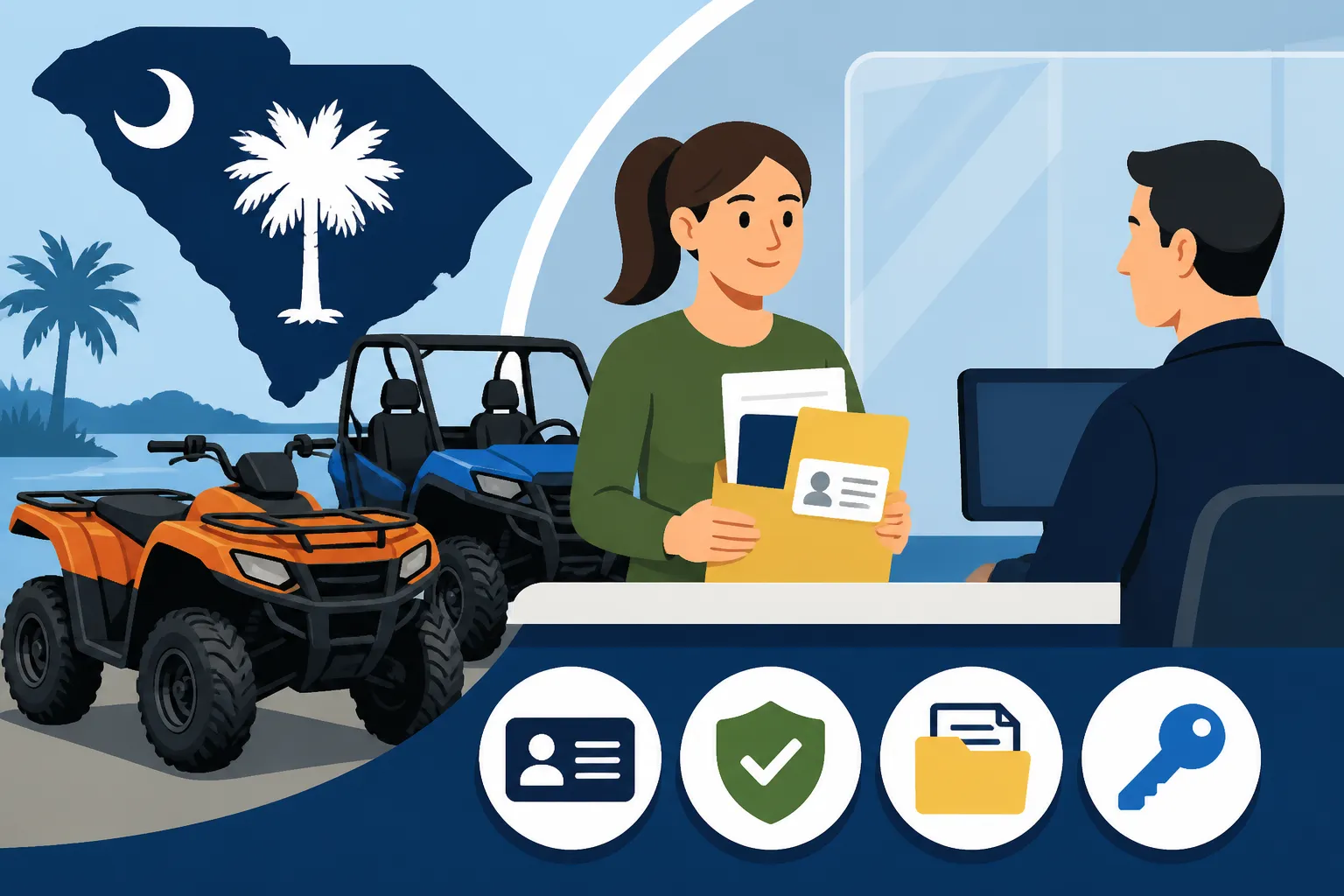
Imagine this: You've got your new-to-you side-by-side loaded up, ready for its title. You drove an hour to the nearest DMV office, waited in line, and finally got to the counter. "I'm sorry," the clerk says, "we need the original bill of sale and a legible copy of the seller's ID." Suddenly, your afternoon plans are shot. You have to go home, track down documents, maybe even contact the seller again, and then find another window in your schedule to make the trip all over again. It's a colossal waste of time and energy, and frankly, it's just plain annoying. That's why having all your ducks in a row before you even leave the driveway is so incredibly important.
The Specifics of South Carolina's DMV Process
South Carolina has its own set of rules when it comes to ATVs and UTVs, and they're not always what you might expect, especially if you're used to titling cars or trucks. For example, while titling off-road ATVs is often optional, it's highly recommended, and for street-legal UTVs, registration and titling are absolutely mandatory. The nuances between these machine types mean the paperwork can differ significantly. You can't just assume that what worked for your last vehicle will work for your new quad or side-by-side. The DMV clerks are following specific guidelines, and if your documents don't align, they simply cannot process your request. Understanding these distinctions, like the fact that [South Carolina Does Not Register Off-Road ATVs] but has a whole new process for street-legal UTVs, is your first step to a smooth transaction.
Essential Documents for Titling Your ATV or UTV
Titling your ATV or UTV is often the first big hurdle you'll face, whether it's a brand-new machine or one you just bought used. The key here is proving ownership. Without proper proof, the DMV can't issue a title in your name.
Proof of Ownership: New Machines
If you've just rolled a shiny new ATV or UTV off the dealer's lot, congratulations! The process for titling it is usually a bit simpler, but you still need a very specific document: the Manufacturer's Certificate of Origin, or MCO. Think of the MCO as the birth certificate for your machine. It confirms that the vehicle is new and has never been titled before.
The dealer should provide you with this document. When you get it, double-check that your name and the machine's Vehicle Identification Number (VIN) are correctly listed. Any discrepancies can cause delays. The DMV will take this original MCO, as [South Carolina Requires an MCO for a New Machine], and use it to issue your first title. Make sure you don't lose it or let it get damaged between the dealership and the DMV!
Proof of Ownership: Used Machines Private Sale
Buying a used ATV or UTV from a private seller in South Carolina can be a fantastic way to get into the sport, but it comes with its own set of paperwork considerations. The most common scenario involves an already titled machine. In this case, the previous owner should hand you their existing title, which they will have "assigned" to you on the back. This means they've filled out your name, the sale price, and signed it over. You'll then bring this assigned title to the DMV.
However, an equally crucial document, even with an assigned title, is a robust bill of sale. A good bill of sale isn't just a scrap of paper with a price. It should clearly identify both the buyer and seller, include the machine's VIN, the date of sale, the purchase price, and explicitly state that the machine is being sold "as is." It's also wise to include a clause confirming that the seller has the legal right to sell the machine and that it's free of liens. A tool like LawDepot can help you generate a professional and legally sound bill of sale that covers all these bases, protecting both parties. This document, alongside the assigned title, provides clear evidence of the transfer of ownership. [South Carolina Titles After a Private Sale] delves deeper into this process.
Proof of Ownership: Used Machines No Title or Special Circumstances
What happens when you buy a used machine, and the seller doesn't have a title? This is where things get a bit more complicated, but not impossible. South Carolina does allow for titling machines without a previous title under certain conditions, though it often requires more legwork.
If the machine was never titled in South Carolina (remember, ATV titling was optional for a long time), you might need a sworn affidavit of ownership, a comprehensive bill of sale (again, LawDepot can be invaluable here for a detailed document), and potentially an affidavit from the seller explaining why a title doesn't exist. For machines acquired through an estate, you'll need certified copies of probate documents, such as a will or letters of administration, to prove your legal right to the machine. [South Carolina Titles for an Inherited Machine] provides more information on this. If you bought it at an auction, you'll need the auction house's bill of sale and any other documentation they provided. [South Carolina Title for an Auction Buy] can be helpful here. In some rare cases, particularly with very old machines or if the VIN is missing, you might even need to apply for a bonded title, which is a process that proves ownership through a surety bond. Getting clarity from the DMV on [South Carolina Machines With No Paperwork] before you go is always a smart move in these situations.
Personal Identification and Payment
Beyond proving who owns the machine, you need to prove who you are and that you live where you say you do. And, of course, you need to be ready to pay the applicable fees.
Verifying Your Identity and Residency
When you walk up to that DMV counter, the clerk needs to confirm that you are, indeed, the person applying for the title or registration. Your South Carolina driver's license or state-issued ID card is typically the primary document for this. Make sure it's current and valid. If you're a new resident to South Carolina, you might need additional proof of residency beyond your out-of-state license if you haven't yet obtained a SC license. This could include a utility bill, a lease agreement, or a property tax receipt showing your current South Carolina address. The goal is to establish both your identity and your current, official mailing address within the state.
Fees and Payment Methods
There are several fees associated with titling and registering your ATV or UTV in South Carolina. For an ATV title, the fee is generally quite modest, often just a flat rate. For street-legal UTVs, you'll have a biennial registration fee in addition to the title fee. Remember, [What a South Carolina ATV Title Costs] is usually a small amount compared to the peace of mind it provides. If you're in a hurry and want to walk out with your title the same day, many DMV offices offer an expedite fee for an additional charge. [South Carolina Expedite Fee of $20] is an option if you need that title in hand quickly.
When it comes to payment, most South Carolina DMV offices accept cash, checks, and major credit or debit cards. However, it's always a good idea to confirm their accepted payment methods before you go, especially for larger transactions, as some locations might have specific policies or limits. Having a couple of options ready is always a good backup plan. For a deeper dive into how long things take and what methods are usually accepted, check out [South Carolina Title Processing Time] and [South Carolina Title Payment Methods].
Additional Requirements for Specific Situations
Not every ATV or UTV transaction is the same. Depending on what you're trying to do, or who the machine is for, you might need a few extra items in your paperwork pile.
Street-Legal UTV Registration
The arrival of street-legal UTV registration in South Carolina is a game-changer for many riders. If you're planning to register your UTV to legally hit certain public roads, your list of required documents grows. Beyond your proof of ownership (MCO or assigned title and bill of sale), you will absolutely need proof of liability insurance. This isn't optional; it's a core requirement for any vehicle operating on public roads. Your insurance card or a declaration page from your insurer will suffice. Furthermore, you'll need to confirm that your UTV meets specific equipment requirements for street legality, though a formal inspection might not always be required at the counter. Having your valid South Carolina driver's license is also essential. For all the specifics on this exciting new chapter, refer to [South Carolina Street-Legal UTV Registration Arrives] and [South Carolina Insurance Proof at Registration].
Titling for Minors or Multiple Owners
If you're titling a youth quad for your child, or if you plan to put two names on a title, there are specific requirements to consider. For youth quads, while the title will likely be in the parent's or guardian's name, you might still need to bring proof of the minor's identity (like a birth certificate) if the title or registration forms require information about the intended rider. This helps confirm age requirements for operation, especially with [Chandler's Law and South Carolina ATV Rules].
When putting two owners on a title, both individuals will typically need to be present at the DMV with their identification. If only one can make it, they'll often need a notarized power of attorney from the absent owner. The way names are listed (e.g., "And" vs. "Or") can also affect future transfers, so be sure to discuss your preferences with the clerk. For more on this, see [Titling a Youth Quad in South Carolina] and [South Carolina Title With Two Owners].
Lien Holders and Financing
If you've financed your ATV or UTV purchase, either through a dealership or a credit union, there will be a lien holder involved. The lien holder is the entity that lent you the money, and they have a legal claim on the machine until the loan is paid off. When you title your machine with a lien, the DMV will note the lien holder's name and address directly on the title document. In many cases, the title will actually be sent directly to the lien holder, and they will hold onto it until your loan is satisfied.
If you are paying off a loan or the lien needs to be released, you will typically need a lien release form from the financing institution. This document officially states that you have paid off your loan and the lien holder no longer has a claim to the machine. You would then take this form to the DMV to get a "clean" title issued in your name only. Understanding [How a Lien Gets Noted on Your Title] is crucial when financing your purchase.
To make it easy to remember, here's a quick checklist of what to bring depending on your situation:
| Document Category | New Machine (Dealer Purchase) | Used Machine (Private Sale) | Street-Legal UTV Registration | Multiple Owners / Minor |
|---|---|---|---|---|
| Proof of Ownership | Original MCO | Assigned Title + Bill of Sale | MCO or Assigned Title + Bill of Sale | MCO or Assigned Title + Bill of Sale |
| Identification | Valid SC Driver's License/ID | Valid SC Driver's License/ID | Valid SC Driver's License/ID | Valid SC Driver's License/ID for ALL owners |
| Proof of Residency | Current SC Address | Current SC Address | Current SC Address | Current SC Address for ALL owners |
| Payment | Cash, Check, Card | Cash, Check, Card | Cash, Check, Card | Cash, Check, Card |
| Additional (if applicable) | N/A | Affidavits (if no title) | Proof of Liability Insurance | Notarized Power of Attorney (if one owner absent), Birth Certificate for minor |
| Optional | N/A | N/A | N/A | Lien Release Form (if applicable) |
Remember, this guide is designed to make your DMV visit as smooth as possible. Always double-check with your specific DMV office if you have unique circumstances or highly unusual paperwork, or use a tool like LawDepot to generate forms. A little preparation goes a long way in avoiding frustration and getting you back on the trail or road faster.
Disclaimer
This article is for general informational purposes only and does not constitute professional advice. Laws, prices and regulations vary by location and change over time. Consult a qualified professional for guidance on your specific situation.