South Carolina Trails With Rock Sections
South Carolina riders looking for rock sections can waste a weekend hauling to a trail that is too mild, too narrow, or closed after rain. This guide explains where to look for rocky riding, how public forest trails differ from private off-road parks, and what to check before loading your ATV or UTV so the terrain fits your machine and experience.
Where to Find Rocky ATV and UTV Riding in South Carolina
Gulches ORV Park for deliberate rock crawling
For riders specifically seeking rock obstacles, Gulches ORV Park near Waterloo is one of the clearest places to start researching. It is a private off-road park known for technical terrain and full-size rigs, rather than a public forest trail system where rocky patches may simply be part of the route. The park’s mix of terrain can make it more appealing to riders who want to choose a challenge instead of hoping to stumble across one.
That distinction matters if you are bringing a side-by-side. A technical obstacle that looks manageable from the trail can feel very different when you approach it in a wider, heavier machine. Before going, check the park’s current machine rules, permitted routes, safety requirements, and trail information. A place that welcomes full-size rigs may still have obstacles or areas that are a poor fit for a particular vehicle or driver.
Gulches is also a place to be honest about your comfort level. A rock-crawling route can involve steep approaches, uneven ledges, tight turns, and limited room to reposition. If you are new to this kind of terrain, start with the easiest route that suits your vehicle and ask staff or experienced riders about conditions. You can explore related details in [Gulches ORV Park Is Built for Full-Size Rigs] and [Gulches' 80 Acres in South Carolina].
Public forest trails are a different kind of rocky ride
South Carolina’s national forest OHV trails offer a different experience from a dedicated rock-crawling park. Routes in the Sumter and Francis Marion National Forest areas are managed trail systems, and their character depends on the specific trail, recent maintenance, and weather. A rider may encounter stones, roots, ruts, or uneven ground, but that does not mean a route is designed as a technical rock-crawling course.
The distinction is useful when planning for a particular machine. A narrow trail may be a good match for a trail quad or dirt bike but unsuitable for a wide side-by-side. Some routes have width restrictions, and the available trail network is not interchangeable. Check the rules for the exact trail you plan to ride rather than assuming that one forest’s access rules apply to another. [South Carolina's Four National Forest Trails] is a helpful starting point for understanding the public options.
If your goal is a sustained challenge with boulders or constructed obstacles, a private park may be a better match. If you want a forest ride with natural variation, a public OHV trail could suit you—but confirm the permitted vehicle type and current conditions first. For side-by-side riders comparing routes, [South Carolina Trails That Allow Side-by-Sides] can help narrow the search.
| Riding option | Best fit | What to expect | Check before you go |
|---|---|---|---|
| Gulches ORV Park | Riders seeking technical off-road and rock-crawling terrain | A private park with varied challenges and routes | Current access, machine rules, trail status, and suitability for your skill level |
| National forest OHV trails | Riders looking for managed trail riding and natural terrain | Trail conditions that vary by route and weather; rocky patches are not necessarily dedicated rock obstacles | Vehicle eligibility, width limits, pass requirements, and closures |
| Other private riding parks | Riders who want a managed riding area and defined rules | Terrain and difficulty vary by park | Whether rock features are available and whether your machine is permitted |
Match the Terrain to Your Machine and Experience
Know what “rocky” can mean on the trail
“Rock section” can describe anything from scattered embedded stones to a steep, uneven obstacle that requires careful tire placement. A smooth trail with occasional rocks is not the same as a route designed for crawling. Before you choose a destination, look for a description of the specific route or obstacle—not just general language saying that a park has challenging terrain.
Think about what happens when your tires meet a rock ledge. The machine may lose traction, slide sideways, or lift a wheel. On a side-by-side, the vehicle’s width can limit your line choice; on a quad, the rider’s balance and ability to shift position matter. A route that is technically passable can still be a poor choice if you do not have room to turn around or a safe place to stop.
Ask practical questions before setting out: Are obstacles optional? Is there a bypass? Are route ratings available? Is recovery help offered, and how is it handled? These questions are especially important if your group includes riders with different experience levels. You can use [South Carolina Trail Difficulty Ratings] as a prompt for what to investigate, but confirm how the individual park or trail describes its own routes.
Consider width, clearance, tires, and recovery
A machine’s fit is about more than engine size. Ground clearance, tire condition, wheelbase, width, and available protection all affect how it handles uneven rock. A wide UTV may have plenty of power but still struggle with a narrow route or a tight line between obstacles. A small ATV may fit through the route but lack the clearance or tires needed for a rougher section.
Avoid making modifications solely because a trail video shows another machine doing something dramatic. Skid plates can protect vulnerable components, while suitable tires may improve traction, but gear cannot make every obstacle safe. A winch can help in a difficult spot, yet recovery itself can be hazardous if the anchor, cable path, or people nearby are not managed carefully. Carry equipment you know how to use, and do not treat recovery gear as permission to attempt a route beyond your ability.
Pay attention to trail-width limits. Some public routes are restricted to narrower machines, and a vehicle that is physically capable of riding a trail may not be legally allowed on it. Check [South Carolina's 50-Inch Trail Width Limit] before planning around a narrow route, and verify the exact rules for your destination. If you are comparing machine fit across public trails and private parks, confirm each location’s requirements independently.
Plan the Ride Before You Haul
Verify access, rules, and trail conditions
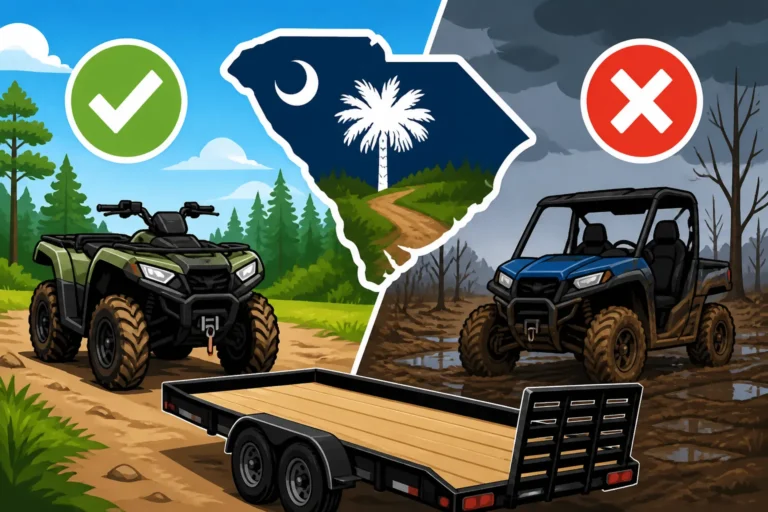
A map can help you find a destination, but it cannot replace checking the operator’s current information. Trail closures, maintenance, weather, seasonal restrictions, and machine rules can change what is rideable. This is particularly frustrating when you have already loaded the trailer and driven across the state, so make a quick confirmation part of your departure routine.
For public land, check which trail is open, what vehicles it accepts, and whether a pass or other requirement applies. For a private park, check opening details, reservations if applicable, permitted machines, age or helmet rules, and any restrictions on passengers or equipment. Do not assume that an open gate means every route is open or appropriate for your vehicle.
Use a navigation app such as onX Offroad to research access points and keep track of your route, but compare what you see with the land manager’s or park’s own information. An app can be useful for orientation, especially when cell service is weak, but it should not be treated as proof that a trail is open or that a route is legal for your machine. Download or save the information you need before leaving reliable service. For a final pre-trip check, see [South Carolina Trail Conditions Before You Haul] and [South Carolina Wet Weather Trail Closures].
Prepare for a slow, demanding day
Rock riding often takes longer than the mileage suggests. A group may move slowly through an obstacle, wait for a safe line, or pause to help a rider reposition. Set expectations before you start: agree on a pace, identify a regrouping point, and make sure everyone knows what to do if the group becomes separated.
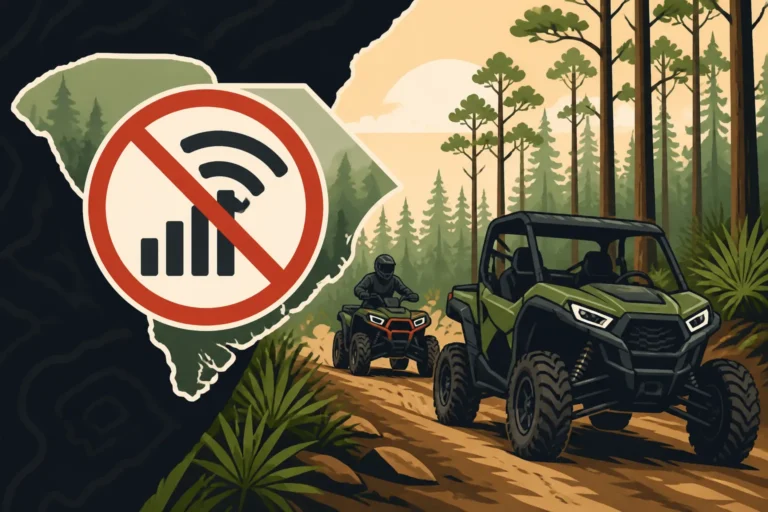
Before the ride, inspect tires, brakes, steering, suspension, and any protective equipment you rely on. Bring water, basic first-aid supplies, tools suited to your machine, and a way to communicate if the group is spread out. A charged phone is useful, but forested areas can have dead zones, so do not count on a continuous signal. Keep a paper or offline map available, and tell someone where you plan to ride and when you expect to return.
Wet conditions deserve extra caution. Rocks can become slick, mud can conceal edges, and water can make it harder to judge depth or traction. If a route looks beyond your comfort level, turn around. There is no shame in skipping an obstacle; damage, a rollover, or a long recovery can turn a fun day into a serious problem. Keep the route flexible, and choose a safer option if rain or changing conditions alter the trail.
Ride Rock Sections With Care
Use a deliberate approach instead of chasing speed
On uneven ground, a controlled pace gives you more time to read the surface and respond. Look for a stable line, avoid sudden steering or throttle inputs, and leave enough room between machines that one rider’s stop does not become another rider’s collision. If you are unsure about an obstacle, stop somewhere safe and look at it before committing.
Do not climb onto a rock just because the rider ahead did. Different machines may need different lines, and a route that worked for a shorter ATV could put a longer UTV at an awkward angle. If the obstacle has a bypass, use it when that is the sensible choice. If there is no safe line for your skill level or vehicle, turn back rather than relying on momentum.
Keep spectators and other riders clear of the machine’s path. A tire can slip, a vehicle can roll, and recovery equipment can become dangerous under tension. If a rider needs assistance, pause and make a plan before anyone steps close to the vehicle. Make sure the person operating the machine knows when people are nearby and where they should stand.
Respect the park, forest, and other riders
Stay on designated routes and follow the rules posted by the land manager or park. Riding around a closed section can damage the land, create a hazard, and jeopardize access for everyone. Do not assume a worn track is an authorized trail, and never bypass gates or signs because the route appears passable.
On public trails, expect other users and changing conditions. Give space, reduce speed near trailheads and staging areas, and yield where the trail is narrow or visibility is limited. At a private park, follow staff directions and route markings; a feature that is open to one class of vehicle may not be appropriate for another. If you want to visit a feature such as the park route discussed in [The Jeep Badge of Honor Trail at Gulches], check its current access and requirements directly with the park.
After the ride, inspect the machine for loose parts, damaged tires, bent components, and leaks. Wash off mud and debris when practical, especially if the machine has been through wet or gritty conditions. A short inspection at the staging area can catch a problem before it becomes a breakdown on the road home. When you plan around the terrain, confirm access, and ride within your limits, South Carolina’s rocky routes can be challenging without turning the day into a gamble.
Disclaimer
This article is for general informational purposes only and does not constitute professional advice. Laws, prices and regulations vary by location and change over time. Consult a qualified professional for guidance on your specific situation.