South Carolina Snake Season on the Trail
Warm South Carolina weather brings riders back to the trails, but it also brings snakes out to bask, hunt, and move through leaf litter. A close encounter can turn an easy ride into a frightening one, especially when you’re walking a trail or checking a machine. This guide explains when snake activity is most likely, how to reduce your risk, and what to do if you spot or are bitten by a snake.
When snakes are active on South Carolina trails
Spring through fall brings the most encounters
Snakes in South Carolina may be active whenever conditions are warm enough, but riders are more likely to encounter them during the warmer months. Spring can bring snakes onto sunny ground after cooler weather, while summer heat may shift activity toward mornings, evenings, and shaded areas. In fall, snakes may still be active as temperatures stay mild.
There is no single calendar date when snake season begins or ends. Weather, time of day, and the conditions in a particular area all matter. A warm afternoon in the Upstate may feel very different from a humid morning near the coast, and snakes respond to local conditions rather than a statewide schedule.
Plan with that in mind when riding places such as Enoree OHV Trail, Parsons Mountain, and the Wambaw Cycle Trail. They have different terrain and habitats, but wooded edges, brush, rocks, and damp low spots can all provide places for snakes to shelter. Check [South Carolina Riding in Spring] for broader seasonal planning, and review [South Carolina Trail Conditions Before You Haul] before loading up.
Where snakes may be along a route
A snake may be difficult to see in leaf litter, tall grass, pine straw, or the shadow beneath a log. Pay particular attention when stepping off your machine, walking around a blind bend, or reaching into vegetation to retrieve gear. Snakes may also use rocks, brush piles, creek edges, and other sheltered spots.
That does not mean every sunny patch or trail edge is dangerous. It does mean that a rider’s attention often shifts to the machine, the route, or a riding group just when it is useful to look at the ground nearby. Pause before stepping into tall grass, and avoid putting hands where you cannot see.
Conditions change after rain, too. Wet trails can mean more walking around muddy sections, fallen branches, or puddles, and those detours can take you into brush that you would otherwise pass by. Check [South Carolina Wet Weather Trail Closures] and [South Carolina Trail Closures After Rain] before your trip, and don’t assume a familiar route will be easy to navigate after a storm.
Common snakes riders may encounter
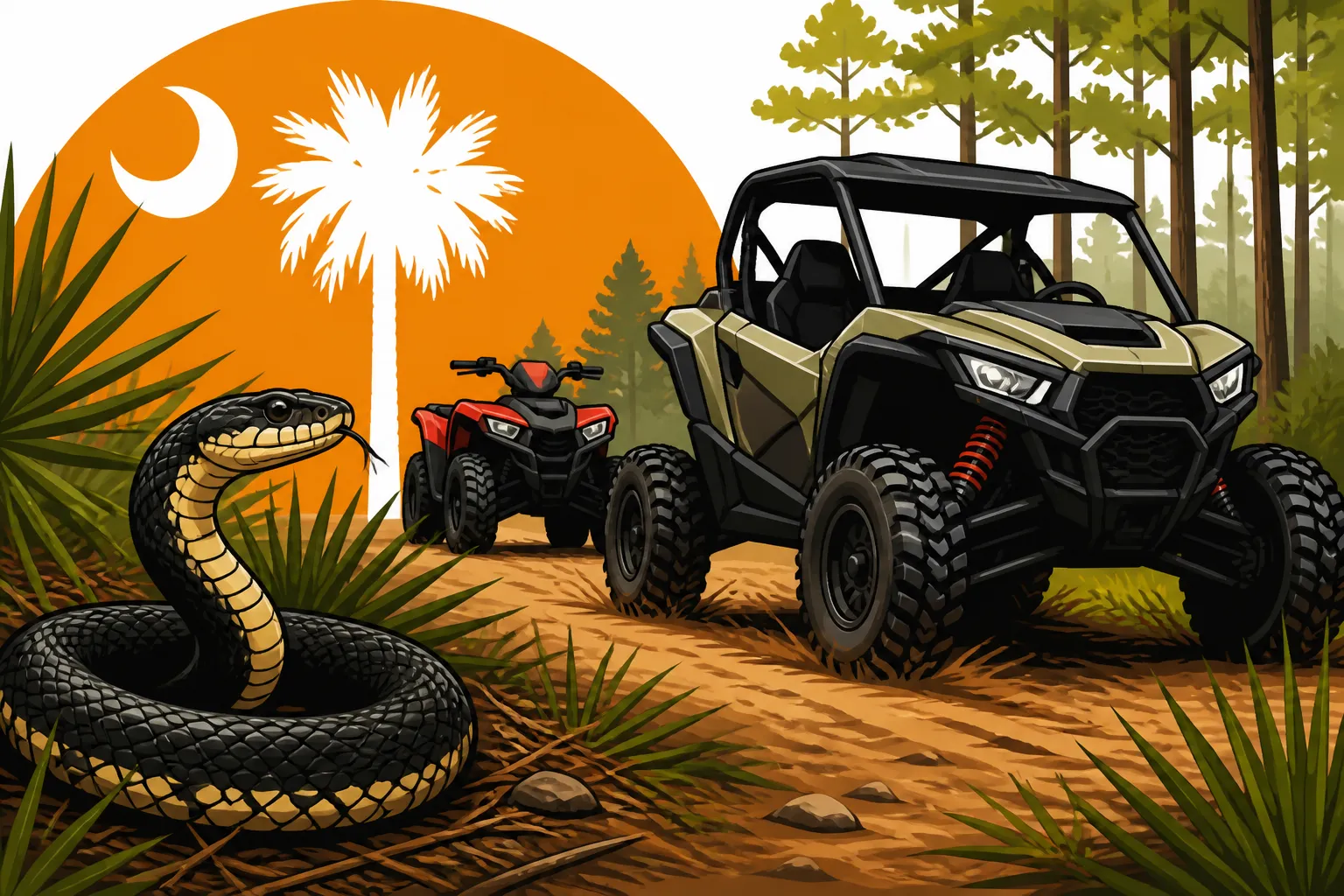
South Carolina has several venomous snakes, including copperheads, cottonmouths, rattlesnakes, and coral snakes. Copperheads are often associated with wooded areas and leaf litter; cottonmouths are more closely associated with wet habitats. Rattlesnakes may be found in a range of settings, depending on species and local habitat. These are broad tendencies, not a reliable way to identify a snake from a quick glance.
Color and pattern can be hard to judge in low light, at a distance, or when a snake is partly hidden. Don’t move closer to get a better look, and don’t rely on a phone photo to decide whether an animal is dangerous. Treat an unidentified snake as one to leave alone.
| Trail situation | Safer response |
|---|---|
| Snake is on or beside the trail | Stop at a safe distance and give it room to move away |
| Snake is near your parked machine | Wait or move away calmly; don’t try to scare or push it |
| You need to step off the trail | Look over the ground and place your feet where you can see |
| You cannot tell what kind of snake it is | Don’t approach; identify it only from a safe distance |
| Someone may have been bitten | Call 911 and get emergency medical care promptly |
How to reduce the chance of a close encounter
Look before you step, reach, or sit
A machine can make it tempting to hop off quickly to check a tire, help a riding partner, or take a break. Before stepping into vegetation, scan the ground and choose a clear place to stand. Look before reaching beneath a machine, lifting a log, or picking up equipment from the edge of the trail.
Choose rest stops with open sightlines rather than thick brush or piles of leaves. If your group stops near a creek or shaded area, take a moment to check where everyone will stand and where children or dogs may wander. Keep hands out of hollow logs, rock gaps, and dense plants.
This simple habit is more useful than trying to memorize every snake’s markings. You do not need to know exactly what species might be nearby to avoid reaching blindly or approaching an animal.
Wear practical gear and keep your group together
Sturdy footwear and long pants can help protect your legs from scratches, insects, and rough vegetation. They are not a guarantee against a snakebite, so don’t treat clothing as permission to approach or handle a snake. Gloves can be useful for ordinary trail work, but they do not make it safe to put your hands into a hidden space.
Keep children close when walking away from machines, and remind them not to touch or chase wildlife. Dogs should be leashed or kept under close control at stops; a curious dog can approach a snake before its owner has time to react. Agree on a simple group rule: if someone sees a snake, they tell the others calmly, and everyone gives it space.
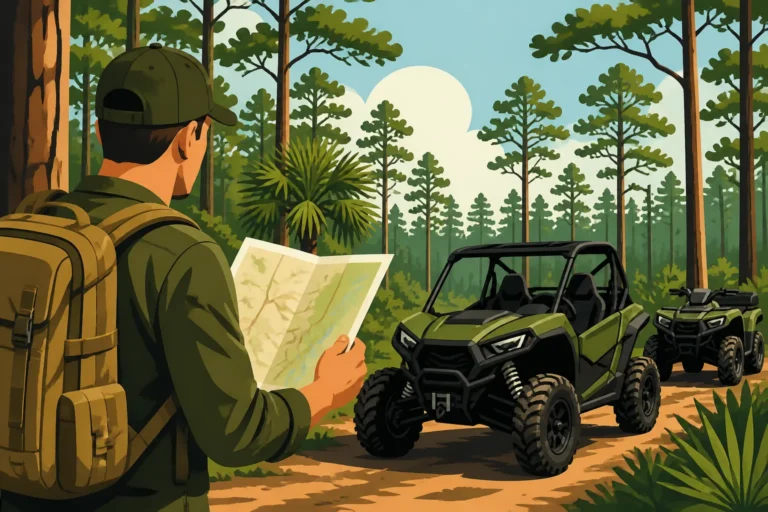
A detailed ride plan can help your group avoid confused detours into unfamiliar brush. Some riders use onX Offroad to review mapped routes before heading out, then share the intended route with the group. A map app is a navigation aid, not a substitute for checking signs, closures, or conditions on the ground. For a broader ride-planning checklist, see [South Carolina Trail Etiquette Locals Expect] and [South Carolina Trail Difficulty Ratings].
Make navigation part of your safety plan
When a route crosses a large forest or has multiple junctions, decide in advance where your group will stop and how you will regroup if riders get separated. Save or review your route before leaving cell coverage, and carry a backup way to navigate. An app such as onX Offroad can help riders keep track of mapped trails, but phones can lose signal, run low on battery, or fail in wet conditions.
This matters when a snake sighting causes an unexpected stop. Rather than rushing into brush to catch up with the group, riders should use the agreed meeting point or communication plan. At a trailhead, note the route you intend to ride and the time you expect to return.
If you are comparing routes, [South Carolina ATV Trails: Where to Ride] can help you think through riding-area options. For a longer outing, read [First Aid on a Long Carolina Loop] and pack for the possibility that a minor delay could become a longer wait.
What to do if you see a snake or get bitten
Give a snake space and let it move away
If you see a snake on the trail, stop far enough away that you are not crowding it. Warn the people behind you, keep pets back, and wait for the snake to move on if it has a clear path. If it does not move, choose another route only if you can do so without getting close or stepping into unseen vegetation.
Do not poke it with a stick, throw objects, attempt to move it, or try to kill it. Those actions can bring you closer and increase the chance of a bite. Snakes may not move as you expect, so keep watching from a distance until you have passed safely.
Avoid blocking the animal against a machine or trail edge. If the group is stopped on a narrow route, calmly move away from the snake and make room rather than trying to hurry it along. Once the encounter is over, continue only when everyone is accounted for and the route is clear.
Treat a suspected bite as an emergency
If someone may have been bitten, call 911 as soon as possible and arrange emergency medical care. Don’t wait to see whether symptoms worsen or spend time trying to identify the snake. If you can do so without delaying help or approaching the animal, note what it looked like from a safe distance.
Keep the person as calm and still as possible while help is arranged. Remove rings, watches, or tight items near the bite if swelling may develop, and follow the dispatcher’s instructions. If you are in a remote area, share your location clearly and send someone to guide responders if that can be done safely.
Do not cut the wound, try to suck out venom, apply ice, use an electric shock, or tie a tourniquet. These actions can cause additional harm and do not replace medical treatment. A snakebite is not a situation to manage with a home remedy or a ride back to the truck before calling for help.
Prepare for a remote trailhead before the ride
Before leaving home, tell someone where you are going and when you expect to return. Carry a charged phone, a backup power source, and a first-aid kit, while remembering that cell service may be unreliable in forested areas. Know the name of the riding area and the nearest access point so you can describe your location to emergency services.
A small amount of preparation can prevent a stressful search for directions during an emergency. Review your planned route, check posted closures, and make sure everyone knows who will call for help. If your group is riding somewhere unfamiliar, use an app such as onX Offroad to review the route before the trip, but keep an offline or paper backup when possible.
Leave space in the plan for delays. A group may need to stop for a mechanical issue, weather, or a wildlife encounter, and daylight can disappear while riders are sorting things out. [Packing for Carolina Humidity] offers additional preparation ideas for a warm-weather outing.
A calm, practical approach to snake season
Snake season does not mean you need to cancel every South Carolina ride. It means paying attention when you step off the machine, giving wildlife room, and avoiding risky attempts to identify or move a snake. Those habits work on familiar local routes and on trails you are riding for the first time.
Before you leave, check trail conditions and closures, make a route plan, and tell someone where you will be. On the trail, look before stepping into brush and keep children and pets close. If a bite is suspected, call 911 and seek emergency care promptly rather than trying to treat it yourself.
Disclaimer
This article is for general informational purposes only and does not constitute professional advice. Laws, prices and regulations vary by location and change over time. Consult a qualified professional for guidance on your specific situation.