South Carolina Poker Runs and Charity Rides
A South Carolina poker run can sound simple: ride a route, collect cards or checkpoints, and meet up afterward. The tricky parts are confirming where you’re allowed to ride, understanding what your machine needs to enter, and showing up prepared for changing trail conditions. This guide explains how to find, plan, and enjoy an ATV or UTV charity ride without avoidable surprises.
What to expect at a South Carolina poker run
How a poker run works
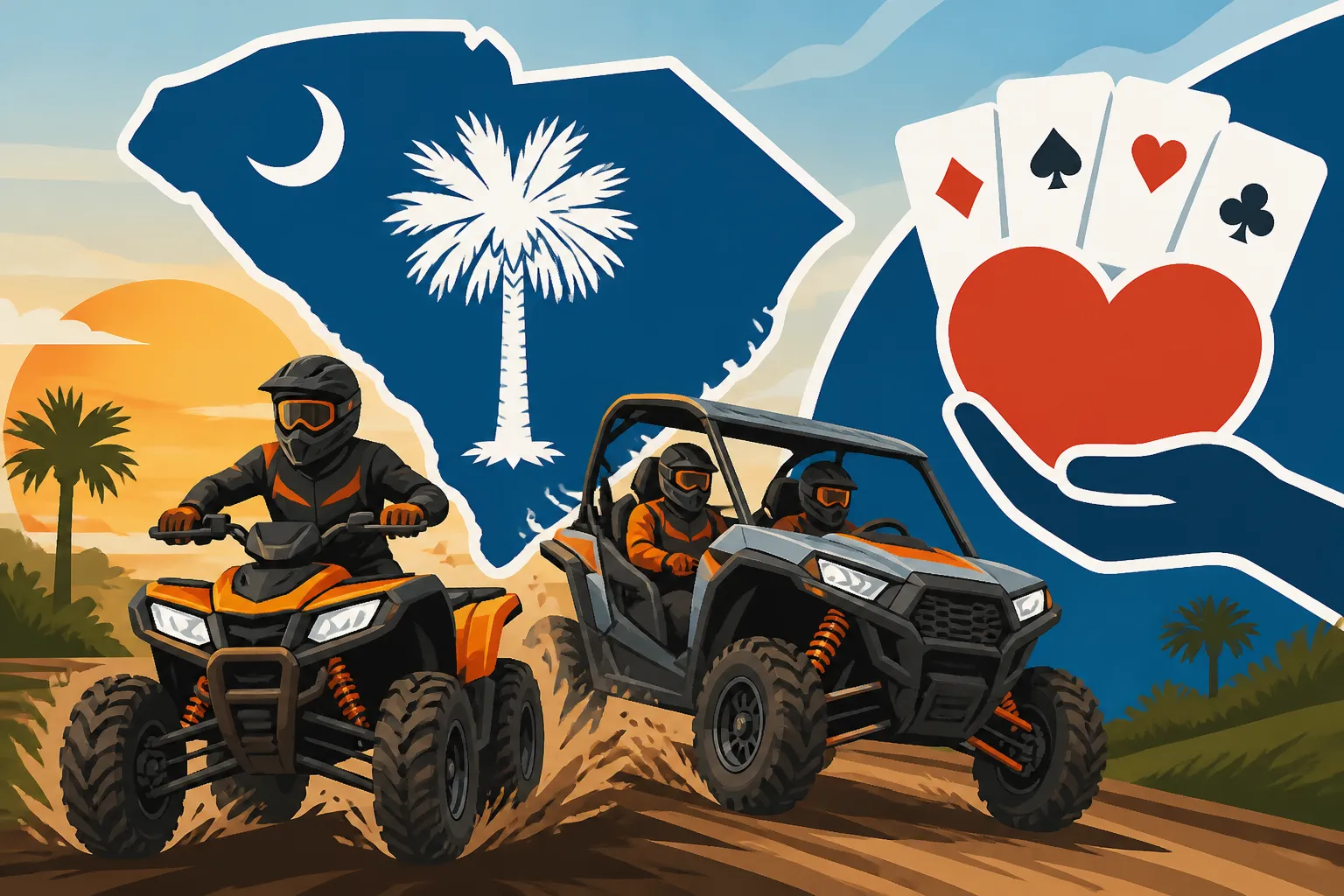
A poker run is usually a group ride built around checkpoints. Riders follow a designated route and collect a card, token, or other marker at each stop. At the end, the collected cards form a poker hand, and organizers award prizes according to the event’s rules. Some rides use a different checkpoint challenge, so read the event details rather than assuming every ride works the same way.
A charity ride may use the same format, or it may be a more straightforward group ride with a registration fee, donation request, raffle, or fundraising activity. The cause, route, and event structure vary. One organizer might plan a relaxed ride for mixed experience levels; another might make the route more demanding or include activities back at the staging area.
Before signing up, look for the basics: who may participate, what vehicles are permitted, where riders meet, what the fee supports, whether passengers are allowed, and what happens if weather affects the event. Ask whether the ride is guided or self-directed and whether the route is marked. If the information is vague, contact the organizer before you load your machine.
Where rides may take place
In South Carolina, an organized ride might use a private off-road park, a permitted route, or another property where the organizer has arranged access. Places such as Carolina Adventure World near Winnsboro and Gulches ORV Park near Waterloo are examples of private riding areas; their admission, vehicle, age, and riding rules are separate from the rules for public land. Do not assume that an event takes place at either location just because it is in the state.
Public-land access also requires care. National forest trail access, seasonal closures, passes, and vehicle restrictions can affect whether a route is appropriate for your machine. For example, a trail with a width limit may not admit a full-size side-by-side. Check the specific trail’s current rules and the organizer’s route information before traveling. [South Carolina's 50-Inch Trail Width Limit] explains why a machine that fits one riding area may be turned away at another.
A Wildlife Management Area is not automatically an ATV riding area, even if you have a hunting license or know the property. Confirm the land designation and access rules rather than following a route simply because it appears on a map. For more background, see [South Carolina WMA Riding Is Prohibited]. On private land, make sure the event organizer has permission for the route and that participants are expected to stay within the approved boundaries.
Common event formats
| Event format | What riders usually do | What to confirm before registering |
|---|---|---|
| Poker run | Visit checkpoints and collect cards or markers | Route length, checkpoint hours, scoring, and whether the route is guided |
| Charity ride | Ride or join related activities that support a cause | How donations are handled, what the fee includes, and whether a ride is part of the event |
| Park-based group ride | Ride designated trails at a private facility | Vehicle restrictions, admission, safety rules, and available amenities |
| Forest or public-land ride | Use trails open to the public under applicable land rules | Pass requirements, seasonal closures, trail limits, and event authorization |
How to find a ride and check the details
Look for useful event information
Start with local ATV and UTV clubs, riding-area event calendars, community organizations, and the charity’s own announcements. Nearby riders may also share event notices, but treat a social post as a starting point, not as a complete set of instructions. Look for a named organizer, a clear meeting location, and a way to ask questions before registering.
A reliable event description should identify the riding area or route, vehicle types allowed, registration process, and any restrictions that could affect your group. It should explain whether riders need to bring their own machine, whether children may participate, and whether a passenger is allowed on the particular vehicle. If you’re joining from out of town, ask about trailer parking and whether the meet-up point is suitable for a truck and trailer.
It also helps to understand the distinction between a ride’s charitable purpose and its access arrangements. A fundraising event does not, by itself, grant permission to ride on public or private land. The organizer should be able to explain where the route goes and what access has been arranged. If the event crosses more than one property or trail system, ask which rules apply at each part of the ride.
Verify the route and access rules
Once you know the riding area, check its rules directly. A private park may set its own limits for machine size, helmets, passengers, sound, speed, camping, and alcohol. A public trail system may have its own pass and seasonal requirements. Keep the event’s directions and the land manager’s rules together so you are not relying on one source to answer every question.
For a route that involves public land, ask whether an event permit or other authorization is required and who is responsible for securing it. Individual rider access and organized-event permission are not necessarily the same thing. If a route includes a forest trail, check for closures before you leave home; rain, maintenance, fire conditions, or other operational issues can change access. [South Carolina Trail Closures After Rain] covers a frustration many riders know well: plans can change after a wet stretch, even when the forecast looked manageable earlier.
Digital mapping can help you understand the general area and keep track of your own route. Some riders use onX Offroad to review trails and organize navigation, but a map app should not be treated as proof that a trail is open or that you have permission to use it. Confirm access with the event organizer and the relevant land manager. Save the meet-up location and route details before you head into an area where cell service may be limited.
Ask these questions before you commit
A quick message to the organizer can prevent a long drive to the wrong staging area or an awkward conversation at check-in. Ask whether your machine is permitted, whether there is a maximum width, what safety equipment is expected, and whether passengers or youth riders have special requirements. If the event is described as family-friendly, clarify the age rules rather than assuming every route and vehicle is suitable for every child.
Also ask how the event handles bad weather, late arrivals, mechanical breakdowns, and route changes. Find out whether there are fuel or food stops, whether a sweep rider or support vehicle is available, and what to do if you become separated from the group. These are practical questions, not signs that you’re overthinking it. A little clarity makes the day easier for newer riders and experienced ones alike.
If the event benefits a charity, you can ask how registration and donations are collected and whether the organizer provides details about the beneficiary. That helps you understand what your contribution supports without turning a fun ride into a paperwork exercise. Keep any registration confirmation and event instructions accessible on your phone or in a printed copy.
Prepare your ATV or UTV and your group
Check the machine before trailering
Do a basic inspection before the event rather than discovering a problem at the staging area. Check tires, brakes, steering, lights, fluid levels, and visible damage. Make sure cargo is secured and that any winch, tow strap, or recovery gear you plan to carry is in good condition. For a UTV, check seat belts and make sure everyone knows how the doors or restraints work.
Pay attention to equipment requirements for the specific event and location. A forest trail or private park may have rules that differ from the ones you follow on your own property. If you’re riding a public route, review the relevant requirements in [South Carolina Equipment Requirements for ATVs]. For an event that requires travel on public roads, do not assume an off-road machine can use the road simply because it is part of a group ride; confirm that route and vehicle use are lawful.
Give the machine a short test ride close to home before loading it. Listen for unusual noises, check that the brakes respond as expected, and confirm that you can operate the controls comfortably in your riding gear. If you have recently made repairs, this is a good chance to catch a loose connection or a handling issue before you are several miles from the trailer.
Pack for the route, not just the meetup
Bring water, basic first aid, snacks, weather-appropriate layers, and any medication your group needs. South Carolina heat and humidity can make a moderate ride feel much harder, especially when riders are wearing protective gear and moving slowly in a group. Start hydrated, take breaks when needed, and do not wait until someone feels unwell to speak up.
Pack a phone charger or power bank, but plan for stretches without reliable service. Download or save route information ahead of time, and consider carrying a paper map as backup. onX Offroad may be useful for reviewing your planned route and keeping navigation information available, but make sure your group knows the organizer’s official directions too. Agree on a meeting point in case riders get separated, and tell someone who is not riding where you expect to be.
Bring practical items for the machine and the weather: a tire repair kit, a basic tool roll, gloves, eye protection, and a way to carry trash back out. A tow strap can be helpful if you know how to use it safely and the organizer permits recovery equipment. Do not count on another rider to have the supplies you need, and avoid packing so much loose gear that it can shift or interfere with controls.
Set expectations for mixed-experience groups
A charity ride may bring together riders who know the trails well and people who are new to organized group riding. Before the start, agree on a pace that suits the least experienced rider and identify who will lead and who will stay at the back. The group should know whether to stop at turns, how to signal a problem, and what to do if someone needs a break.
Keep space between machines and avoid pressure to keep up. Dust, blind corners, mud, and narrow sections can make sudden stops risky. If a rider is uncomfortable with an obstacle, they should be able to pause or take an approved alternate route without being mocked or rushed. A charity ride is not a race unless the organizer explicitly says otherwise and has arranged an appropriate format.
Parents and guardians should check age, passenger, supervision, helmet, and safety-certificate requirements before bringing a young rider. Rules may depend on the rider’s age, the machine, and where the ride takes place. The event’s family-friendly label does not replace those checks. [South Carolina Safety Certificates at 15 and Under] is a helpful starting point for understanding one part of the state’s youth-riding rules.
Ride responsibly and support the cause
Follow the organizer’s route and land rules
Stay on the designated route, obey signs and staff directions, and do not cut across closed trails or private property. If the group pauses at a checkpoint, leave room for other riders and follow the event’s instructions for collecting cards or recording a stop. On a narrow trail, ride in a way that gives others room to pass safely when appropriate and avoid sudden turns that can surprise the person behind you.
Respect local conditions and other land users. Trails may be shared with hikers, hunters, equestrians, or maintenance crews, depending on the location and season. Slow down near people, campsites, and road crossings. Do not assume that a gate left open means a route is available to riders; it may be open for a landowner, forestry crew, or another authorized user.
Pack out litter, including small items such as drink caps and food wrappers. Keep noise in mind near homes and campgrounds, and avoid spinning tires or creating unnecessary damage. Riding carefully protects the event’s relationship with landowners and gives organizers a better chance of holding future rides.
Make the charitable part count
Before the event, decide how you want to participate: register as a rider, contribute to a fundraiser, volunteer at a checkpoint, or invite friends to donate. Follow the organizer’s instructions for payments and donations, and keep any confirmation details. If you volunteer, ask what time to arrive, who your contact person is, and whether you need to bring supplies.
At the event, remember that the route and community are part of the experience, but the cause is the reason people have gathered. Be patient during check-in, follow directions even if the line moves slowly, and thank the volunteers. If the event includes a raffle or prize drawing, read the rules and timing so you do not miss an announcement while you’re on the trail.
Afterward, share the organizer’s official recap or donation information if you want to help spread the word. Keep comments accurate and avoid posting private property details or route information that the organizer has not made public. A well-run event depends on good relationships among riders, volunteers, beneficiaries, landowners, and riding-area staff.
Make your next ride easier to plan
After you get home, note what worked and what you would change: whether your machine was comfortable for the route, what gear you used, and whether the meeting instructions were clear. If the event was a good fit, follow the organizer or charity for future announcements, but still check the next ride’s requirements from scratch. Routes and access arrangements can differ from one event to another.
If you enjoyed the experience but want more structured outings, local clubs and riding areas can be useful places to learn about group rides and volunteer opportunities. For trail-specific trip ideas, [South Carolina ATV Trails: Where to Ride] can help you explore options, while [South Carolina Group Ride Planning] offers more guidance for organizing a ride with friends. Keep using maps as navigation aids, not substitutes for current trail rules or landowner permission.
The best South Carolina poker runs and charity rides are the ones where the route is clear, the machines fit the rules, and riders look out for one another. Confirm the details early, prepare for the conditions, and leave the trail and staging area in good shape for the people who come after you.
Disclaimer
This article is for general informational purposes only and does not constitute professional advice. Laws, prices and regulations vary by location and change over time. Consult a qualified professional for guidance on your specific situation.