20 Miles of Full-Size Trail
A “20-mile trail” can sound like a full day of uninterrupted driving, but at an off-road park it usually describes a network of routes, not one continuous loop. If you’re bringing a full-size rig to Gulches ORV Park near Waterloo, South Carolina, this guide explains what to check, how to plan your route, and how to avoid hauling all the way there only to find your vehicle or plans don’t fit.
What the 20 miles of full-size trail means
A trail network, not necessarily one long route
The “20 Miles of Full-Size Trail” figure refers to trail mileage for larger off-road vehicles at Gulches ORV Park. It’s more useful to think of it as a network of trails and connections than as a single 20-mile loop. Your actual ride may cover less or more distance depending on which routes are open, which branches you take, and how much time you spend exploring.
That distinction matters when you’re planning fuel, ride time, and a return schedule. A group might spend hours on a comparatively short route if it includes slow technical sections, stops to help a vehicle through an obstacle, or repeated attempts at a challenging feature. Conversely, a familiar group on easier ground may cover more mileage in the same amount of time. Don’t plan your day around mileage alone.
The park’s full-size routes are aimed at vehicles larger than a narrow ATV trail is designed to accommodate. That can make Gulches relevant to Jeep drivers and some UTV or side-by-side riders, but “full-size” does not automatically mean every vehicle fits every trail. Width, wheelbase, ground clearance, tires, and the driver’s experience all affect whether a particular route is appropriate. For more context, see [Gulches ORV Park Is Built for Full-Size Rigs] and [South Carolina Trails That Allow Side-by-Sides].
Trail mileage does not tell you the difficulty
A route’s length doesn’t tell you whether it’s easy, technical, steep, muddy, rocky, or appropriate for a first-time driver. Even within one park, trail conditions and difficulty can vary substantially. A short, rocky climb may demand more skill and careful vehicle placement than a much longer route on smoother ground.
Before choosing a trail, consider the least experienced driver and least capable vehicle in your group. A confident driver in a well-equipped rig may be comfortable with an obstacle that feels intimidating to someone new to off-roading. Agree on a conservative route together, and give everyone permission to turn around if the terrain becomes uncomfortable. Choosing a less demanding trail is good planning, not a failure.
Gulches is also a private riding park, which means its access rules and route information are distinct from those for public forest trails. Don’t assume that a map or rule set for a nearby national forest applies at the park. The broader guide to [South Carolina Private Park Passes and Rules] can help you understand why private riding areas may set their own entry, vehicle, and safety requirements.
How to plan a full-size ride at Gulches
Confirm access and vehicle fit before you leave
Start with the park’s own current information. Confirm that the park is accepting riders on your planned date, ask which routes are open, and check whether your specific vehicle is permitted. If you’re bringing a side-by-side, give the park its make and model and ask about any restrictions relevant to width, passenger setup, or equipment. A general description such as “UTV” may not be enough to answer a fit question.
Ask what you need to bring for entry, what safety rules apply, and whether advance arrangements are needed. Private parks can have different procedures, and details may change with weather, maintenance, events, or seasonal operations. Check directly before loading rather than relying on an older social post, a saved map, or a friend’s memory from a previous visit. [South Carolina Riding Areas That Take Reservations] is useful background when you’re comparing how riding areas handle planning ahead.
This is especially important if your rig is modified. Oversized tires, a lift, a long wheelbase, or added accessories can affect clearance and maneuverability. Be candid about your setup when asking questions. It’s much easier to sort out a potential mismatch at home than after driving to the trailhead with a trailer.
Match your route to the group and the machine
Once access is confirmed, plan a route that suits the people and vehicles you’re bringing. A capable full-size rig can still be a poor match for a route if the driver is inexperienced, the vehicle is carrying extra passengers or gear, or the group has no recovery plan. Consider your lowest-clearance vehicle, not just the rig that can handle the most difficult obstacle.
For a mixed group, agree on basic decisions before you enter the trail network: who leads, who follows, where you’ll regroup, and what the group will do if someone needs to turn back. Keep space between vehicles so drivers have room to respond to obstacles and avoid crowding. If someone stops, make sure the rest of the group knows whether it’s a planned pause or a problem.
Maps can help you understand the general layout, but use them as planning aids rather than as permission to enter every route. The park’s posted signs and directions take priority. Apps such as onX Offroad can help with trip preparation and keeping track of your location, but do not assume an app’s trail line reflects current closures, private-property rules, or the park’s latest route guidance. Check the park’s information first, then use digital mapping as a supplement.
| Planning question | Why it matters | What to do |
|---|---|---|
| Is the park open for your planned visit? | Access can vary by date, conditions, or park operations. | Confirm directly before departing. |
| Is your vehicle allowed on the full-size routes? | Vehicle size and setup can affect access and fit. | Share your make, model, and modifications when asking. |
| Which trails are open and suitable? | Mileage alone doesn’t indicate difficulty or availability. | Ask about current conditions and route options. |
| Does your group have a recovery plan? | A stuck or disabled vehicle can affect everyone’s day. | Bring appropriate recovery equipment and agree on a response plan. |
| Are your maps current? | A saved route may not show closures or local restrictions. | Follow park signs and current park guidance. |
What to expect on full-size trails
Prepare for slow, technical sections
A full-size trail ride is not always a fast drive. You may need to crawl over uneven ground, pause to choose a line, or let a spotter guide you through a tight section. Maintaining a slow pace helps protect your vehicle and gives the driver more time to react. Resist the pressure to follow another rig through an obstacle just because that driver made it look easy.
Pay attention to your vehicle’s limits. Ground clearance, approach and departure angles, tire condition, and the placement of vulnerable components all affect how a rig handles rough terrain. If you are unsure whether an obstacle is appropriate, stop somewhere safe and assess it before committing. A careful walk-around can prevent body damage or an avoidable recovery.
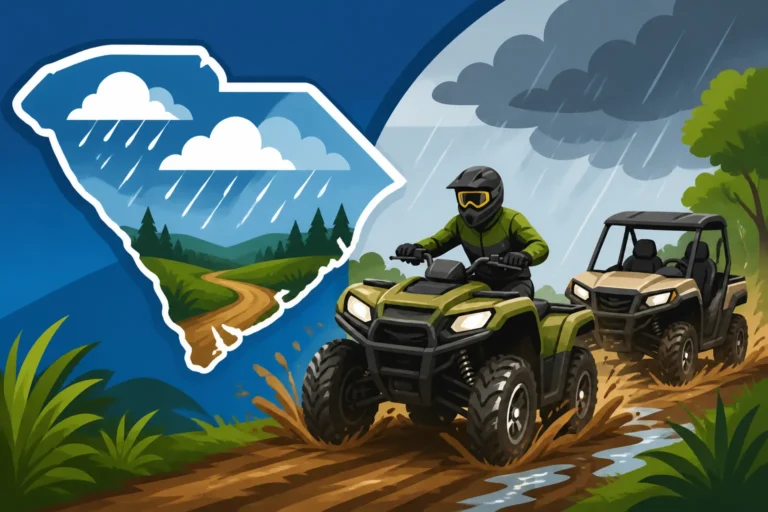
Conditions can change the character of a route. Rain can leave clay and dirt slick; dry weather can mean dust and reduced visibility behind other vehicles. Don’t count on a trail looking or driving exactly as it did in a video or on a previous visit. Check [South Carolina Trail Conditions Before You Haul] and ask the park about recent conditions, especially after heavy rain.
Bring equipment and set group expectations
Before departure, inspect the vehicle and pack for the ride you actually plan to do. Check tires, brakes, steering, fluids, lights, and any recovery gear you expect to use. Carry water, basic first-aid supplies, and a way to contact your group if you become separated. Keep essential items secured so they do not shift during rough sections.
A recovery plan should be realistic for your vehicle and your group. Know where your recovery points are, use equipment rated for the task, and don’t improvise with unsuitable straps or attachment points. If you haven’t used your recovery gear before, learn how it works before you are on a trail with a stuck rig and an audience. For harder routes, ask the park what recovery support is available and what limitations apply.
Good trail etiquette makes the day safer and more enjoyable for everyone. Give other riders room, avoid blocking a route while stopped, and follow instructions from park staff. Keep noise and speed under control near other groups and parking areas. [South Carolina Trail Etiquette Locals Expect] offers useful guidance that applies well beyond public trails.
Getting to the park and making the day go smoothly
Plan the tow and arrival as carefully as the ride
Gulches is near Waterloo in the Upstate, so include the drive, trailer parking, unloading, and check-in in your schedule—not just the time you expect to spend riding. Confirm the route to the park and make sure your tow vehicle and trailer can handle the roads you plan to use. If you’re unfamiliar with the area, avoid making last-minute navigation decisions while towing through narrow or unfamiliar roads.
Before leaving, check that the rig is secured, the trailer lights and tires are in good condition, and the load is balanced. Bring the vehicle documents and any items the park says are required. For additional towing preparation, see [Trailering to an Upstate Trailhead]. If you’re deciding between Gulches and a public forest destination, [South Carolina's Four National Forest Trails] is a useful starting point for understanding that these are different kinds of riding experiences with different access arrangements.
When you arrive, take a few minutes to orient yourself before unloading or heading out. Find the posted rules, check the route information, and make sure everyone knows where to meet if the group gets separated. A quick conversation at the staging area can prevent confusion once engines are running and vehicles are spread across the trail network.
Use maps as backup, not as the final authority
Offline navigation can be helpful in wooded areas where cell service is weak or inconsistent. You can use onX Offroad to prepare a route and check your position, but download or save what you need before leaving reliable service. Don’t rely on a live signal to find your way back to the staging area, and don’t treat a mapped line as proof that a route is open or permitted.
Carry a simple backup plan as well. Agree on a meeting point, keep track of who is in the group, and make sure each driver knows the general direction back to the staging area. If anyone is unfamiliar with off-road navigation, have them ride with someone who understands the route rather than asking them to follow an app on their own.
Most importantly, follow posted park signs and staff directions even when a digital map suggests another way through. Routes can be closed for maintenance or conditions, and a map may not reflect those changes. For a closer look at the park’s terrain and trail identity, see [Gulches' Jeep Trail in South Carolina] and [Gulches' 80 Acres in South Carolina].
Is 20 miles enough for your group?
For many groups, a 20-mile trail network offers plenty to explore, particularly when routes include technical terrain and frequent stops. But the number alone cannot guarantee a full day of riding, a particular difficulty level, or access to every trail. Your experience depends on which routes are open, how quickly your group moves, and what kind of machine you bring.
The best approach is to confirm access and vehicle fit, ask about current trail conditions, and build a flexible plan. If the park’s guidance, your group’s experience, and your machine’s capabilities all line up, the mileage can be a useful starting point for a rewarding day near Waterloo. If they don’t, choose a different route or riding area rather than forcing the plan.
Disclaimer
This article is for general informational purposes only and does not constitute professional advice. Laws, prices and regulations vary by location and change over time. Consult a qualified professional for guidance on your specific situation.