Do You Need to Register an ATV in South Carolina?
It's a common head-scratcher for many folks in South Carolina: "Do I actually need to register my ATV?" You see other states requiring plates and tags for off-road machines, and it can leave Palmetto State riders wondering if they're missing something or riding on borrowed time. This guide is here to clear up that confusion, explaining the distinct rules for ATVs, the newer street-legal UTVs, and even those friendly golf carts you see cruising around coastal towns.
The Core Question: Do Off-Road ATVs Need Registration in South Carolina?
Let's cut right to the chase because this is where a lot of riders get tangled up. The rules in South Carolina for traditional off-road ATVs are pretty straightforward, though often misunderstood due to what's required in other parts of the country.
No Mandatory Registration for Trail ATVs
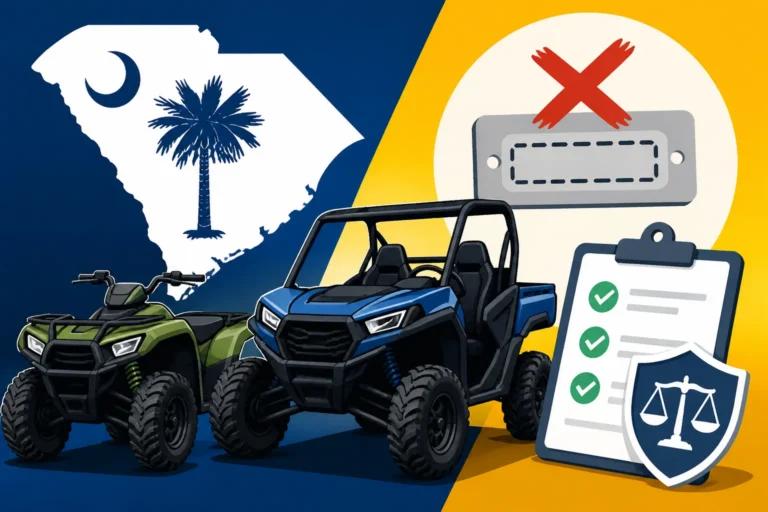
Here's the big answer: In South Carolina, you do not need to register your ATV for off-road use. That's right, unlike a car, truck, or even some motorcycles, your quad or dirt bike used exclusively on trails, private land, or designated off-highway vehicle (OHV) parks isn't subject to a mandatory registration requirement with the South Carolina Department of Motor Vehicles (SCDMV).
Many people come here from states like North Carolina or Georgia, where off-road vehicle registration or titling might be a standard part of ownership, and they naturally assume it's the same here. Others might confuse ATVs with street-legal vehicles that absolutely require registration. But for the purpose of riding a trail quad through the [Enoree OHV Trail in South Carolina] or tearing up some private acreage, the state simply doesn't require a registration plate or yearly sticker. This means less bureaucracy and fewer annual fees for your typical trail machine. You won't be visiting the DMV every year just to keep your off-road ATV current with the state, at least not for registration. [South Carolina Has No Off-Road ATV Registration] is a clear point of difference for our state.
Titling is a Separate, Optional Process
While registration isn't required, titling is a completely different ballgame. In South Carolina, getting a title for your off-road ATV is entirely optional. This is a crucial distinction that often adds to the confusion. Registration is about permission to operate a vehicle on public roads, usually requiring annual renewal and proof of insurance. Titling, on the other hand, is about establishing legal ownership of an asset.
Think of it like this: your house has a deed, but you don't "register" it with the DMV. Your ATV can have a title, even if it never sees a public road or gets registered. Many owners choose to title their ATVs anyway, and there are some very good reasons for doing so. A title serves as official proof that you are the legal owner, which can be invaluable in cases of theft or if you ever decide to sell the machine. It can also make things easier if you're trying to finance an ATV through a bank or credit union, as lenders often require a title to secure their loan. Even if you buy from a private seller, having a title provides a clear chain of ownership, which can protect you down the road. [South Carolina Titles Are Optional] for off-road machines, but it’s definitely something worth considering for peace of mind. To understand the process, you might look into [How to Title an ATV in South Carolina].
When Registration Does Apply: Street-Legal UTVs
Now, here's where things get a bit more nuanced and where the state has seen significant changes in recent years. While off-road ATVs remain registration-exempt, certain types of utility task vehicles (UTVs) — specifically those modified and certified for street use — absolutely require registration in South Carolina.
The New Era of Street-Legal UTVs
For years, UTV owners in South Carolina were in a gray area, often limited to private land or very specific, local ordinances for road use. That changed dramatically with [South Carolina Act 164 and Street UTVs]. This landmark legislation, which came into full effect, created a dedicated category for "street-legal utility vehicles." This means that if your side-by-side meets specific equipment and safety criteria, you can now get it titled and registered, allowing you to legally operate it on certain public roads within the state. This was a game-changer for many UTV enthusiasts, opening up secondary roads and making it much easier to commute between properties or access trails without trailering every single time. [South Carolina Street-Legal UTV Registration Arrives] has been a welcomed development for many.
Requirements for Street UTV Registration
To qualify for street-legal UTV registration, your machine isn't just a regular side-by-side fresh off the showroom floor. It needs to meet a specific set of requirements designed to ensure it's safe for road use. These typically include things like turn signals, brake lights, headlights, a horn, rearview mirrors, seatbelts, and a windshield. The UTV also needs to fall within certain size and weight limits, usually concerning width and gross vehicle weight.
Once your UTV is properly equipped and inspected (if required), you'll go through a process similar to registering a car. This involves presenting proof of ownership (like a Manufacturer's Certificate of Origin or an assigned title from a previous owner), an application for title and registration, and crucially, proof of liability insurance. Without insurance, your street-legal UTV will not get its license plate. Then, you'll pay the applicable fees, and your UTV will receive a South Carolina license plate and registration, just like any other road-going vehicle. [South Carolina Street UTV Registration Steps] will outline the specific forms and documentation you'll need to gather. Remember, [South Carolina Insurance Proof at Registration] is a non-negotiable step for these machines.
Golf Carts and Low-Speed Vehicles: Different Rules Entirely
To further clarify the picture, it's important to understand that golf carts and low-speed vehicles (LSVs) operate under their own distinct sets of rules in South Carolina, separate from both off-road ATVs and street-legal UTVs.
Golf Cart Permits for Limited Road Use
Golf carts are a common sight in many South Carolina communities, especially near beaches and lakes. However, they don't get "registered" in the same way cars or street-legal UTVs do. Instead, they require a permit from the SCDMV. This permit allows them to be operated on secondary roads (those with a speed limit of 35 mph or less) during daylight hours and within a specific radius, usually four miles, of your home or the place you're staying.
The golf cart permit is a decal you display on the cart, and it comes with a much lower fee compared to vehicle registration. It's truly designed for local, limited-distance travel, not for extensive road use. You'll need proof of insurance for your golf cart to get this permit, and you must be at least 16 years old and have a valid driver's license to operate one on public roads. [South Carolina Golf Cart Permits Compared] shows how this differs from other vehicles. The fees are also quite distinct; you can learn more at [South Carolina Golf Cart Permit Fees].
Low-Speed Vehicles (LSVs) Are Distinct
Then there are Low-Speed Vehicles (LSVs). These are a specific class of vehicle that often get mistaken for golf carts or UTVs, but they have their own classification and rules. An LSV is typically defined as a four-wheeled vehicle with a top speed of 20 to 25 mph. Unlike golf carts, LSVs are manufactured to meet specific federal safety standards, including features like headlights, taillights, turn signals, stop lamps, reflex reflectors, parking brakes, rearview mirrors, windshields, and seatbelts.
Because they meet these standards, LSVs are treated much more like conventional automobiles than golf carts or ATVs. They must be titled and registered with the SCDMV and carry standard vehicle license plates. They can be driven on roads with posted speed limits of 35 mph or less. So, while an LSV might look like a beefed-up golf cart, legally, it's in a different category altogether. It's crucial to understand that [A Low-Speed Vehicle Is Not a South Carolina UTV].
Why the Confusion? Common Misconceptions
It’s completely understandable why so many South Carolina riders get confused about ATV registration. There are several factors at play that contribute to the widespread misunderstanding, making it difficult to sort out fact from fiction.
Other States' Laws and Internet Advice
One of the biggest sources of confusion stems from the varied laws across state lines. Many states, particularly those with vast public lands managed by federal agencies, have mandatory registration or off-highway vehicle (OHV) permits for ATVs. These systems often fund trail maintenance and enforcement. If you're moving to South Carolina from a state like Colorado, Arizona, or even some neighboring states, where you had to register your quad, you might naturally assume the same applies here. Online forums and general articles often discuss ATV laws without specifying the state, leading riders to believe a universal rule exists. This isn't the case in South Carolina, which takes a more hands-off approach to off-road ATV oversight. Always make sure the information you're reading specifically pertains to South Carolina, as laws can differ significantly.
Distinguishing Between Off-Road and On-Road Machines
Another major point of confusion is the blurring line between "off-road" and "on-road" machines, especially with the rise of increasingly versatile UTVs. For many years, an ATV was clearly an off-road machine, never intended for public roads. However, modern UTVs, with their comfort, cargo capacity, and sometimes even enclosed cabs, look more and more like small cars. This visual similarity can make it hard for people to grasp why one version (an off-road ATV) doesn't need registration, while another (a street-legal UTV) absolutely does. The key differentiator is the intended use and the design features that qualify a vehicle for public road operation. South Carolina's laws are specifically crafted around these distinctions, which means a machine designed exclusively for trails won't have the same requirements as one that's certified for secondary roads.
The Role of Optional Titling in the Mix
The existence of optional titling for ATVs in South Carolina further complicates the issue. When someone says, "You can get a title for your ATV," it's easy to mistakenly infer that this means registration is also required. People often use "title" and "registration" interchangeably, but they are distinct legal concepts. Titling is about documenting ownership, while registration is about permission to operate on public ways. Because titling is available for off-road ATVs, many assume it's a prerequisite for any use, including off-road, and then confuse that with registration. To summarize the distinctions, here's a helpful table:
| Vehicle Type | Requires Registration/Permit? | Purpose | Primary Use | Key Features/Context |
|---|---|---|---|---|
| Off-Road ATV | No | Optional Titling (Proof of Ownership) | Trails, Private Land, OHV Parks | Not designed for public roads; no license plate. |
| Street-Legal UTV | Yes | Legal Road Operation, Proof of Ownership | Secondary Roads (under 55 mph), Private Land | Must meet specific safety equipment standards, has a license plate. South Carolina Street UTV Age of 17 |
| Golf Cart | Yes (Permit) | Limited Road Operation, Proof of Ownership | Local streets (35 mph or less), 4-mile radius | Permit decal, typically slower, no full registration plate. South Carolina Golf Cart Radius and Speed Rules |
| Low-Speed Vehicle (LSV) | Yes (Registration) | Legal Road Operation, Proof of Ownership | Roads (35 mph or less) | Manufactured to federal safety standards, full registration plate. [South Carolina Low-Speed Vehicle Plates] |
When dealing with ownership documents, especially for optional titling or creating a bill of sale for a private transaction, resources like LawDepot can be quite helpful in ensuring you have the correct legal forms. Whether you're selling an untitled ATV or just want robust proof of purchase, having proper documentation protects both buyer and seller. Even for situations like registering a street UTV, understanding the paperwork, which could include a bill of sale, is crucial. If you're buying a machine from a private party, a well-drafted bill of sale is essential even if a title isn't mandatory, and LawDepot provides templates that can help you create one quickly and easily.
Conclusion
So, to definitively answer the question: most off-road ATVs in South Carolina do not need to be registered with the SCDMV. You won't get a license plate or an annual sticker for your quad if you're just riding it on trails or private property. However, titling your off-road ATV is an optional process that many owners choose for added security and proof of ownership, which can be invaluable in case of theft or resale.
The game changes entirely for certain other vehicles. If you have a street-legal UTV that meets all the state's requirements, then yes, it absolutely needs to be titled and registered, just like a car, complete with a license plate and proof of insurance. Golf carts also have their own permit system for limited road use, and Low-Speed Vehicles (LSVs) are treated as fully registrable vehicles.
Understanding these distinctions is key to staying legal and avoiding potential headaches while enjoying South Carolina's beautiful landscapes on your machine. Always confirm the specific requirements for your type of vehicle and its intended use to ensure you're compliant with state law.
Disclaimer
This article is for general informational purposes only and does not constitute professional advice. Laws, prices and regulations vary by location and change over time. Consult a qualified professional for guidance on your specific situation.