The Safety Certificate a South Carolina Teen Needs
A South Carolina teen may be ready to ride an ATV but still need a safety certificate before operating it. The age cutoff can be confusing, especially for riders near their sixteenth birthday. Here’s who needs an approved hands-on course, what the certificate does and does not cover, and what families should check before heading to public land.
Which South Carolina teens need an ATV safety certificate
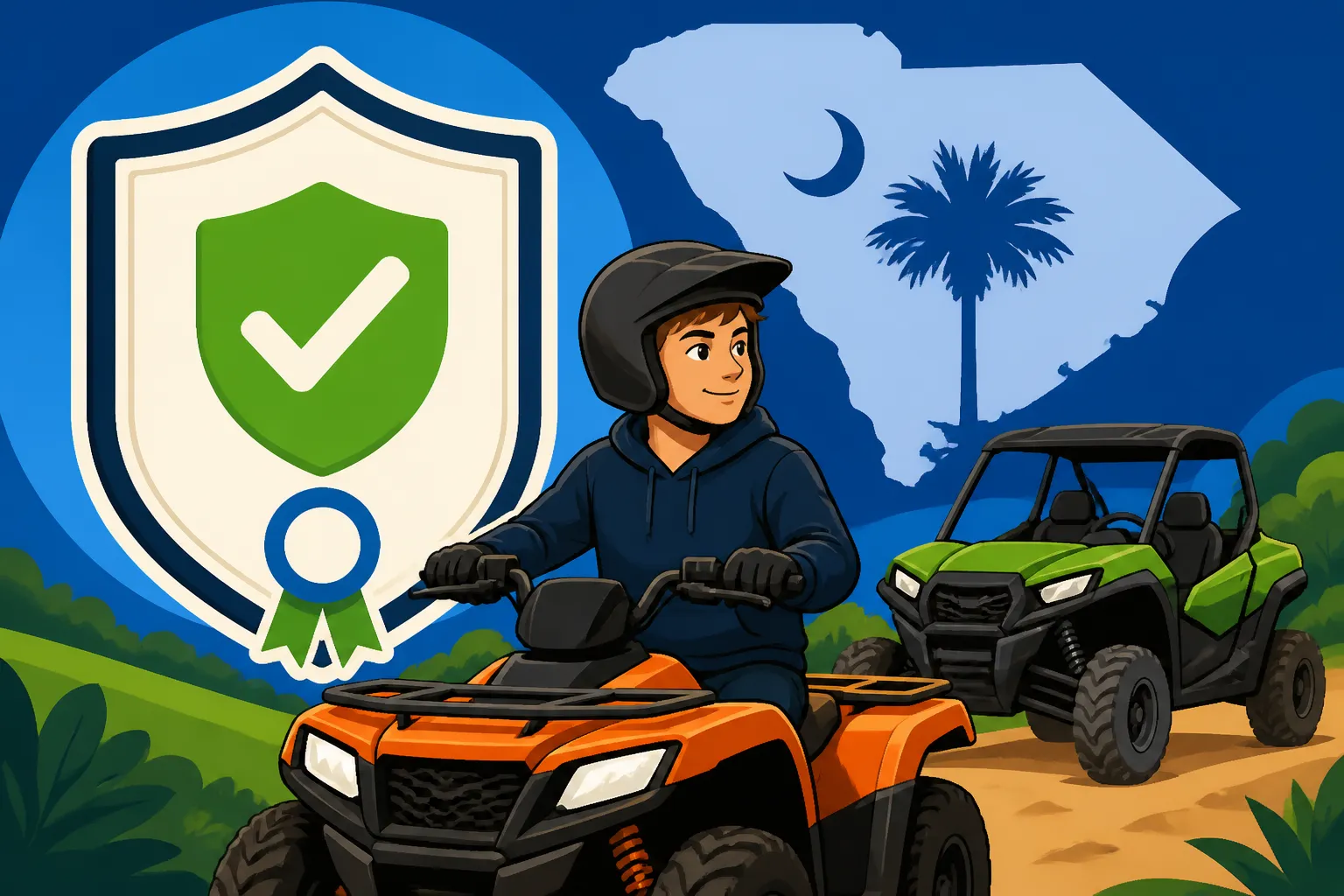
South Carolina’s ATV rules require operators age 15 and younger to possess a safety certificate from an approved hands-on course. According to the South Carolina Legislative Services Agency, the course must be approved by the All-Terrain Vehicle Safety Institute. That is the clearest age-specific rule for the certificate itself.
Some official summaries describe the cutoff as applying to children under 16. The South Carolina Department of Public Health says children under 16 must complete an approved hands-on ATV rider safety course before operating, while the South Carolina Department of Motor Vehicles says children 15 or younger must successfully complete one. Those descriptions point to the same practical cutoff: a teen who is 15 needs the course and certificate; a rider who has turned 16 is not in the “15 and younger” certificate group described in the statute.
If your teen is close to the cutoff, confirm the rule and what proof is accepted with the course provider or the relevant public-land manager before the ride. A certificate rule is different from rules about adult accompaniment, helmets, eye protection, passengers and where the ATV may be operated.
| Teen rider situation | Certificate rule | Other point to check |
|---|---|---|
| Age 15 or younger | Must possess a certificate from an approved hands-on course, according to the South Carolina Legislative Services Agency | Helmet, eye protection, supervision and manufacturer age label |
| Age 16 | Not included in the statutory certificate group of operators age 15 and younger | Public-land accompaniment rules still apply |
| Younger than 6 | Cannot be allowed to operate an ATV | Minimum age applies regardless of course completion |
| Age 16 or younger on public land | The South Carolina Legislative Services Agency says the rider must be accompanied by an adult | Check the land manager’s trail rules as well |
The age distinctions can feel fussy, but they matter. Completing a course does not let a child ride an ATV that the manufacturer’s warning label says is unsuitable for that age. The South Carolina Legislative Services Agency says removing that label is illegal, and operators may not ride in violation of it. A course certificate is not a waiver of the machine’s age guidance.
For a broader look at the legal age framework, see South Carolina ATV Age Requirements. For a closer explanation of the rules that apply to a 15-year-old, see South Carolina Rules for a 15-Year-Old Rider.
What the hands-on course and certificate mean
The required credential is tied to a hands-on course, not simply to reading safety material or watching a video. According to the South Carolina Legislative Services Agency, operators age 15 and younger must have a certificate from an approved hands-on course. The approval detail matters: before enrolling, ask the course provider whether its training meets the ATV Safety Institute approval requirement for South Carolina.
A hands-on course gives a young rider structured practice with safe operating techniques. It is meant to build skills and judgment before a teen rides independently, but it cannot make every machine, trail or riding situation appropriate. Families should still choose an ATV that fits the rider and follow the manufacturer’s age warning label.
The certificate is proof of course completion; it is not an ATV registration, a driver’s license or permission to ride on any particular property. South Carolina does allow ATVs to be registered with the S.C. Department of Motor Vehicles for the purpose of receiving a title, but that is a separate process. A title does not replace the training certificate, and a certificate does not grant road access.
Before the course, ask the provider practical questions:
- Is this a hands-on ATV rider safety course approved by the ATV Safety Institute?
- What information or equipment should the teen bring?
- How does the provider issue proof of successful completion?
- How can the family obtain replacement proof if the original certificate is misplaced?
- Does the course use an ATV that is suitable for the teen’s size and experience?
Those questions help avoid a common mix-up: a general safety class may be useful, but it may not satisfy the specific approved-course requirement. For details on course format and what training involves, read South Carolina Rider Course Structure and What Happens at an ATV RiderCourse Session. If you need help locating training, [South Carolina Course Providers] is also relevant. Families who already have a certificate but need to check its status can see South Carolina Safety Certificate Lookup.
Safety rules that still apply after the course
A teen who has completed the course must still follow South Carolina’s other ATV requirements. Under Chandler’s Law, children under 6 cannot be allowed to operate an ATV, and operators age 15 and younger must wear a safety helmet meeting FMVSS #218 and eye protection, according to the South Carolina Legislative Services Agency. The same agency says riders age 16 and younger must be accompanied by an adult on public lands.
That adult-accompaniment rule is separate from the course requirement. It also has a different age boundary: a rider may be outside the certificate group after turning 16 but still fall within the public-land accompaniment rule through age 16. Do not assume that having a certificate means a teen can ride alone on a public trail.
The South Carolina Department of Public Health also says children under 16 must wear a safety helmet and eye protection while operating an ATV. Helmet and eye-protection requirements are worth treating as part of the ride plan, not as paperwork to sort out at the trailhead. See South Carolina ATV Helmet Law and South Carolina Eye Protection for Young Riders for more on those protections.
The ATV itself must also be in suitable condition. According to the South Carolina Legislative Services Agency, an ATV must have an effective muffler, a USDA Forest Service-approved spark arrester and a working brake system. The South Carolina Department of Motor Vehicles describes ATVs as designed primarily for off-road travel and no more than 50 inches wide. Make sure the machine fits the intended trail and that required equipment is present before loading it.
Daylight and route rules matter too. The South Carolina Legislative Services Agency says headlights must be on when operating an ATV between one-half hour after sunset and one-half hour before sunrise. It also says crossing a watercourse is restricted to designated areas unless the trail bisects the watercourse. A teen’s course experience is useful, but the adult responsible for the ride should check the trail’s rules and conditions rather than relying on the rider to make every decision.
Chandler’s Law includes exemptions for some uses, including farming, ranching, wildlife management, and lawful hunting or trapping, according to the South Carolina Legislative Services Agency. An exemption for a specific activity should not be treated as general permission to ignore safety practices or land-access rules. If the ride involves one of those activities, confirm how the exemption applies to the planned use.
For information about adult accompaniment and passengers, see South Carolina Rules for a Supervising Adult and South Carolina Rules for a Young Passenger. These rules can affect the ride even when the teen has already completed the course.
Planning a public-land ride with a teen
Public-land riding adds requirements beyond the state’s general ATV rules. The Forest Service says federal rules require operators to use only areas, roads and trails designated as open to off-highway vehicles. Forest trails may also have restrictions on machine size, passes, operating seasons and current conditions. A valid safety certificate does not automatically grant trail access.
Enoree OHV Trail is one example of why it pays to check the specific trail before leaving home. The Forest Service describes it as a 23-mile trail with easy-to-moderate difficulty and interconnecting loops. It also lists a beginner loop for children using dirt bikes smaller than 110 cc or ATVs smaller than 90 cc. Those size limits describe that beginner loop; they are not a substitute for the ATV manufacturer’s age label or a general recommendation that every child use a machine of that size.
The Enoree trail has marked one-way and two-way sections, according to the Forest Service: orange blazes mark one-way sections, while white blazes mark two-way sections. The Forest Service also says operators must have a permit in their possession while riding, and the trail’s daily and annual passes must be purchased through Recreation.gov. Check the trail’s current status and pass instructions before setting out; trail access and fees can change with conditions and management requirements.
A practical pre-ride routine helps keep the certificate from becoming the only item the family remembers:
- Confirm the teen’s age and course requirement, and pack the certificate or accepted proof of completion.
- Check the ATV manufacturer’s age warning label and make sure the machine is appropriate for the rider.
- Inspect the helmet, eye protection, brakes, muffler and spark arrester.
- Confirm that the trail is open to the machine and that the planned route is suitable for the teen’s experience.
- Check current trail conditions and pass requirements with the land manager.
- Make sure the required adult accompaniment is in place for a public-land ride.
For Enoree and other South Carolina forest trails, the Forest Service recommends checking the Call Before You Haul hotline for current trail status. Closures can occur because of weather or maintenance, so an old trip plan may not reflect conditions on the day you intend to ride. Review South Carolina Safety Courses for Riders 15 and Under for related training information and South Carolina ATV Trails: Where to Ride when choosing a riding area.
The core takeaway is straightforward: a South Carolina ATV operator age 15 or younger needs a certificate from an approved hands-on course, but that certificate is only one part of a legal and sensible ride plan. Age labels, adult accompaniment, protective equipment and trail-specific rules still matter.
Sources
- South Carolina Department of Motor Vehicles — Terrain Vehicles | SCDMV (checked November 3, 2026)
- Forest Service — Francis Marion and Sumter National Forests | Enoree OHV Trail | Forest Service (checked November 3, 2026)
- South Carolina Department of Motor Vehicles — Terrain Vehicles | SCDMV (checked November 3, 2026)
- South Carolina Department of Public Health — ATV Safety | South Carolina Department of Public Health (checked November 3, 2026)
- South Carolina Legislative Services Agency — Code of Laws – Title 50 – Chapter 26- – FISH, GAME AND WATERCRAFT (checked November 3, 2026)
- Forest Service — Francis Marion and Sumter National Forests | Off-Highway Vehicles (OHV) | Forest Service (checked November 3, 2026)
- Francis Marion Sumter National Forest — Enoree%20OHV%20Trail%20rules_0.pdf (checked November 3, 2026)
- Forest Service — Francis Marion and Sumter National Forests | Wambaw Cycle Trail (North Loop) | Forest Service (checked November 3, 2026)
- Forest Service — Francis Marion and Sumter National Forests | Wambaw Cycle Trail (South Loop) | Forest Service (checked November 3, 2026)
Disclaimer
This article is for general informational purposes only and does not constitute professional advice. Laws, prices and regulations vary by location and change over time. Consult a qualified professional for guidance on your specific situation.